

Most startups start with a logo and a name and call it branding. That is backwards. Strong branding begins with clear positioning: The people you help, the problem you solve better than anyone else, and the importance of all this. Once you figure that out, your name, your logo, and your branding story come from a position of strength.
For the overarching strategy, read our complete guide on Startup Marketing.
Here’s a practical 2026 guide for early-stage founders.
How to Build a Startup Brand
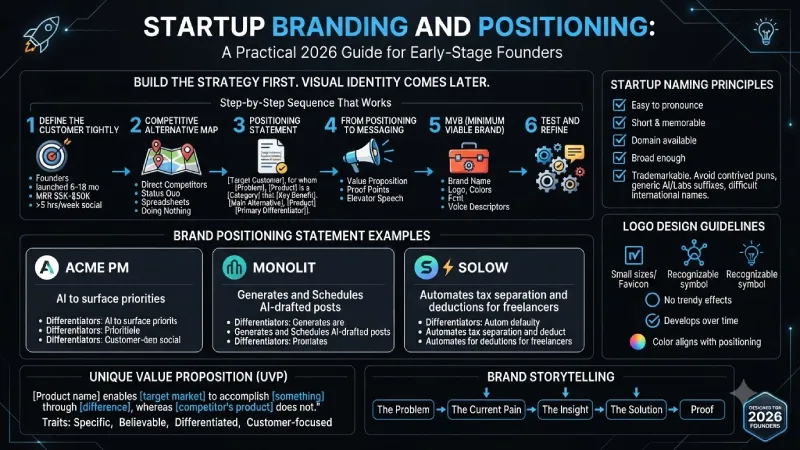
Build the strategy first. Visual identity comes later.
Step-by-step sequence that works:
- Define the customer tightly Not “small businesses.” More specific: “founders who have been launched 6-18 months and earning MRR between $5K-$50K and spend more than 5 hours/week on manual social.”
- Competitive alternative map Include not only the direct competition but also the status quo (spreadsheet solutions, doing nothing, freelancers).
- Positioning statement Write one. The following information should only be shared among us since it is intended to keep us on the same page.
- From positioning to messaging Value proposition, proof points, and elevator speech.
- MVB Brand name, basic logo, 1-2 colors, font, and 3-5 voice descriptors. Enough consistency to give meaning to each touch point.
- Test and refine Use the language with real prospects. If they don’t immediately understand who it’s for and why it matters, revise.
A brand is not a logo. It is the consistent set of perceptions people form when they encounter your product, content, and communications. Consistency compounds. Inconsistency dilutes.
Brand Positioning Statement Examples
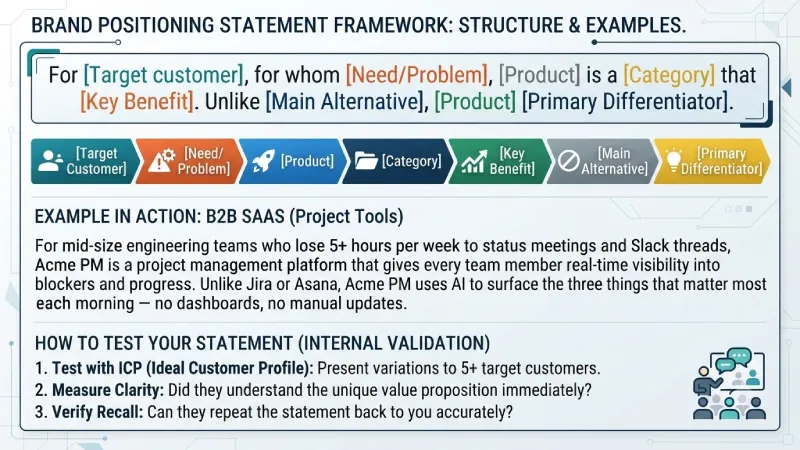
The positioning statement must be one which is clear, measurable, and valuable internally. Classic structure:
[Target customer], for whom [need/problem], [Product] is a [category] that [key benefit]. Unlike [main alternative], [Product] [primary differentiator].
Examples:
- B2B SaaS (project tools) For mid-size engineering teams who lose 5+ hours per week to status meetings and Slack threads, Acme PM is a project management platform that gives every team member real-time visibility into blockers and progress. Unlike Jira or Asana, Acme PM uses AI to surface the three things that matter most each morning — no dashboards, no manual updates.
- SaaS for founders For first-time founders generating under $50K MRR who spend more time writing social posts than building product, Monolit is a content system that generates, optimizes, and schedules AI-drafted posts they review and approve. Unlike scheduling tools that still require founders to write every post, Monolit removes the blank-page problem.
- Consumer / creator tool For independent creators who hate tracking taxes manually, Solow is a finance app that automatically separates income, estimates quarterly payments, and surfaces missed deductions. Unlike generic accounting software built for traditional businesses, Solow is designed around the messy reality of freelance income.
Write several versions. Test them with people who match your ICP. The best version is the one they can repeat back to you accurately.
Startup Naming and Logo Design
Naming principles that still matter in 2026:
- Easy to pronounce and spell on first encounter
- Short enough to remember
- Available as a domain (or an acceptable alternative: .co, .io, .app, .ai)
- Doesn’t box you into one narrow product forever
- Passes a basic trademark check in your key markets
Try not to use puns that seem contrived, suffixes like “AI” or “Labs,” unless there is a genuine meaning, and names that cannot be easily pronounced or spelled internationally if international expansion is on the agenda.
Put your name to the test by speaking it out loud to five people and asking them to spell what they heard. If most spell it incorrectly, continue searching.
Logo guidelines for startups:
- Should be carried out on small sizes (favicon, application icon, social avatar).
- Basic enough that it is recognizable without the wordmark
- Doesn’t use trendy effects that will be out of fashion in 2-3 years
- Based off a wordmark or a symbol that can develop over time
- Choose colors in accordance with your positioning (such as trust, energy, and calm) rather than fashion alone
It turns out that quite a few businesses have already gotten an outstanding logo even from the early stages of their development when there were no products or positioning yet. Perfection kills.
Unique Value Proposition for Startups
Unique value proposition (UVP) is defined as a strategy that makes you different due to something that concerns the customer.
Good UVP structure: “[Product name] enables [target market] to accomplish [something] through [difference], whereas [competitor’s product] does not
It should be:
- Specific (not “better” or “faster” without context)
- Believable (you can prove it)
- Differentiated (competitors cannot honestly say the same thing)
- Customer-focused (outcome, not feature list)
A poor UVP leaves it up to the prospect to determine why it matters. A good UVP makes the relevance immediately apparent. Begin with the UVP when developing your home page headlines, sales language, and message themes.
Brand Storytelling for Startups
Storytelling is not a polished origin myth. It is a clear narrative that helps people understand the problem, the tension of current solutions, and the better future your product enables.
Simple story structure that works:
- The problem — Specific, real, and costly for your customer
- The current pain — Why existing alternatives fall short
- The insight — The non-obvious truth that led you to build this
- The solution — How your approach is different and better
- Proof — Evidence that it works (metrics, customer stories, demos)
Keep the founder story brief and on point. People do not really care about how well you know the problem, but more about how you have learned from your journey.
Stick to the same story everywhere on the website, pitch, sales call, and content marketing. KeEvery piece of communication should reinforce the same positioning.
Bottom line
With the positioning step, it all starts. Define who you’re serving and why you are the preferred solution to their problems. And then build everything else on top of it. A well-defined brand that clearly addresses the needs of its audience is much better than a pretty but generic brand trying to target all possible customers at once.
The best startup brands become inevitable once you understand the customer and his problem. You never see anything artificial there, or even too much design work.
Need help defining positioning for your particular product, some example cases relevant to your business, or an easy template for creating brand guidelines? Let me know!
To take the next step, see our detailed guide on Startup Content Marketing.