

Introduction
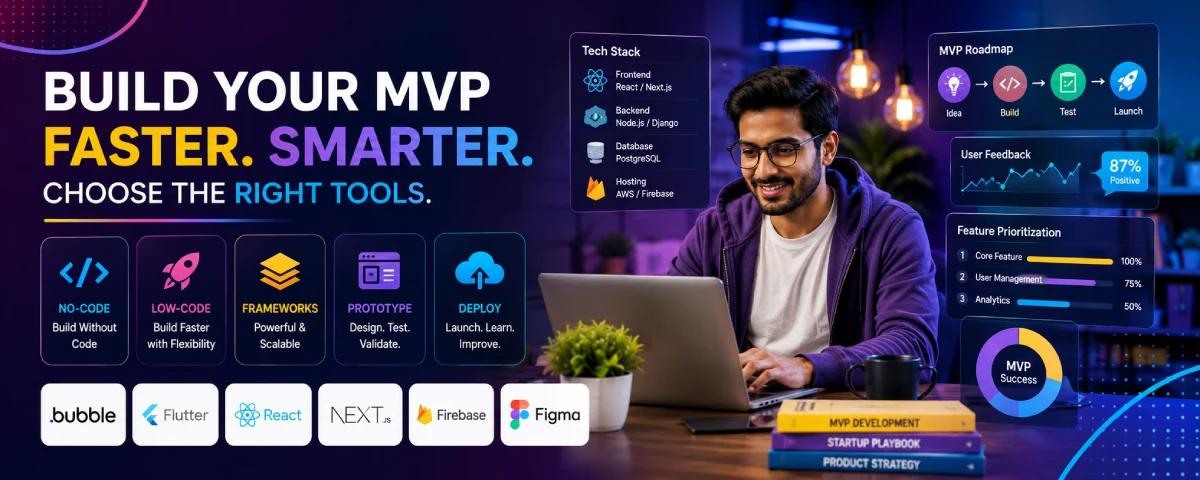
Creating a good MVP is not only dependent on having an awesome idea but also on picking the right MVP development tools. The choice of these tools can make a huge difference in the pace of development, its cost, as well as scalability and the ability to test out various ideas fast. It doesn’t matter whether you are a single founder, a team from a startup, or an entrepreneur without much technical knowledge – the proper choice of MVP development tools will help you get things done quicker.
Why Choosing the Right MVP Development Tools Matters
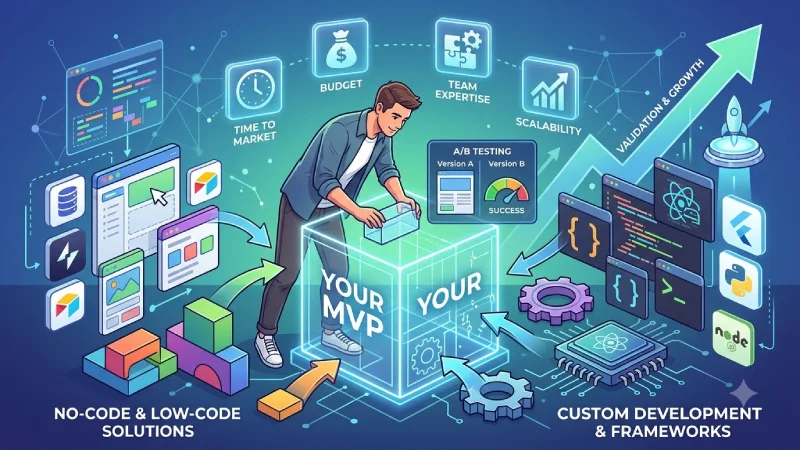
MVP aims at testing the business idea in the quickest and most efficient manner possible. With the help of today’s development technologies, companies can save coding time and expenses, as well as make quick changes based on customer feedback.
Benefits of choosing the right tools include:
- Quick product development
- Reduced costs in developing and maintaining the product.
- Simpler collaboration among designers and developers.
- Greater scalability when your company scales up.
- Faster testing and deployment of new features.
- Increased productivity.
Using tools that fit within your budget, skills, and products can save many months of development time.
No-Code MVP Development Tools
The founders can build their own websites, apps, and software as a service by using no-code tools, and therefore the founder will not be required to write any code himself. This is a good way to test ideas rapidly.
| Tool | Best For | Key Features |
| Bubble | SaaS and web applications | Drag-and-drop builder, workflows, database |
| Glide | Mobile apps | Build apps from spreadsheets without coding |
| Softr | Client portals and marketplaces | Easy integration with Airtable and databases |
| Webflow | Landing pages and websites | Responsive design with CMS support |
| Adalo | Mobile app MVPs | Visual app builder with built-in components |
Benefits of No-Code MVP Tools
- No programming knowledge required.
- Faster product launches.
- Lower development costs.
- Easy updates and feature additions.
- Perfect for validating startup ideas before hiring developers.
There have been many cases of successful startups that started by leveraging no-code technology but ultimately built their own apps.
Low-Code Platforms for Startup MVPs
Low-code technology is a blend of visual programming and customized coding and is thus suited for startups which require more flexibility than no-code technology.
Popular low-code platforms include:
| Platform | Best For | Advantages |
| OutSystems | Enterprise applications | High scalability and security |
| Microsoft Power Apps | Internal business tools | Excellent Microsoft ecosystem integration |
| Mendix | Business applications | Rapid deployment and collaboration |
| Appsmith | Internal dashboards | Open-source and developer-friendly |
| Retool | Admin panels and operations tools | Fast database integration |
Low-code platforms allow startup firms to build advanced applications with less development time and complexity.
Best Frameworks for Building MVPs Fast
In case custom development is needed, it becomes crucial to pick the appropriate framework when creating the MVP.
Some of the best frameworks include:
| Framework | Best For | Key Benefits |
| React | Web applications | Fast, reusable UI components |
| Next.js | SEO-friendly web apps | Server-side rendering and high performance |
| Flutter | Cross-platform mobile apps | Single codebase for Android and iOS |
| React Native | Mobile applications | Faster development with native performance |
| Laravel | Backend web applications | Secure, scalable PHP framework |
| Django | SaaS platforms | Rapid development with built-in security |
| Node.js | APIs and real-time applications | High performance and scalability |
A/B Testing for Minimum Viable Products
The A/B test strategy is one of the best ways to validate decisions about the product using actual customers. Here, the founders will create two similar products, namely Version A and Version B, and present them to the different sets of customers. Hence, through analyzing the behavior of users, founders will be able to understand which one is better.
Instead of relying on assumptions, A/B testing uses real data to improve the user experience and increase conversions. Google — A/B Testing Guide
What Can You Test in an MVP?
Startups can use A/B testing to evaluate different elements of their MVP, including:
- Landing page headlines
- Call-to-action (CTA) buttons
- Sign-up forms
- Pricing plans
- Feature placement
- Product descriptions
- App navigation
- Email subject lines
Individual testing of elements yields insight on what affects the behavior of the users.
Benefits of A/B Testing
Validates decisions with real customer data.
Improves user experience and engagement.
Increases conversion and signup rates.
Reduces the risk of adding ineffective features.
Helps prioritize product improvements based on measurable results.
So the exact position is:
A/B Testing explanation → Google source link → “What Can You Test in an MVP?”
That is the cleanest placement because the source directly supports the explanation of comparing two versions and measuring user behavior.
How to Choose the Right Framework
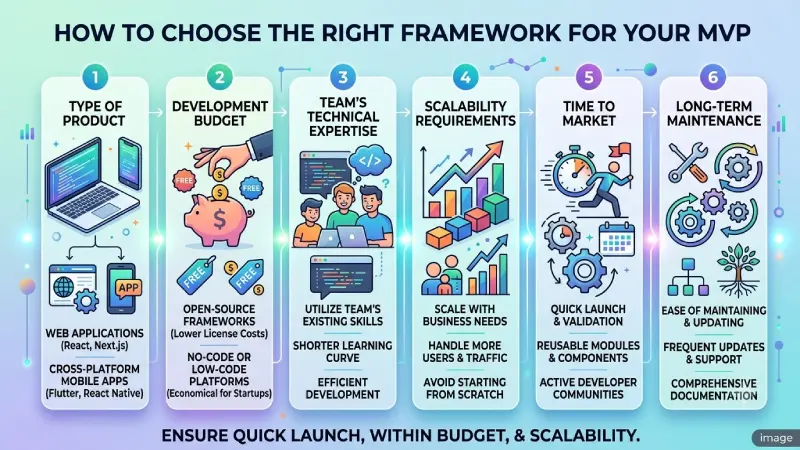
Selection of the appropriate framework is among the most critical decisions made in developing the MVP. The best framework will ensure that the launch is quick, within the budget, and scalable. Consider the following points before selecting a framework.
- Type of Product
Select whatever framework will be appropriate for your particular type of product. For instance, React and Next.js are the two most suitable frameworks for the creation of web applications whereas Flutter and React Native frameworks are suited for cross-platform mobile applications.
- Development Budget
The budget is an important factor in choosing a suitable framework. An open-source framework can help cut down costs related to licensing, and a no-code or low-code platform can prove more economical for start-ups.
- Team’s Technical Expertise
Pick something your team is comfortable working with. Utilizing what you know makes for a shorter learning curve and will make for more efficient development.
- Scalability Requirements
MVPs need to scale with your business needs. Pick a framework that will allow you to scale up on more users, functionalities, and traffic without having to start from scratch.
- Time to Market
In case quick launch is what you seek, go for the ones with reusable modules, proper documentation, and active developer communities. This will enable quicker development and validation of your product.
- Long-Term Maintenance
Think about the ease of maintaining and updating your program. Using frameworks that have frequent updates and have documentation makes things easier for you in the long run.
Framework Selection Checklist
| Factor | Why It Matters |
| Product Type | Ensures the framework fits your application needs |
| Budget | Keeps development costs under control |
| Team Expertise | Speeds up development and reduces errors |
| Scalability | Supports future business growth |
| Time to Market | Enables faster MVP launch |
| Maintenance | Simplifies updates and long-term support |
Choosing the correct combination of development tools and platforms, startups are able to create their MVP swiftly, check their ideas and create a sound technical foundation for future expansion. By building a correct stack of technology, startups minimize risks of development and, at the same time, make the process of scaling up their products easy.
Prototyping Tools for Early-Stage Products
Prior to the actual development, startups develop prototypes to visualize their ideas and test user experience. Prototyping technologies allow startup owners to test their workflow and designs without the need for production coding.
Some of the most popular prototyping tools include:
| Tool | Best For | Key Features |
| Figma | UI/UX design | Collaborative design, interactive prototypes |
| Adobe XD | Website and app design | Wireframes, animations, and design systems |
| Sketch | macOS UI design | Lightweight interface and reusable components |
| InVision | Interactive prototypes | Clickable mockups and team collaboration |
| Balsamiq | Wireframing | Low-fidelity layouts for early product planning |
Benefits of Using Prototyping Tools
- Visualize ideas before development.
- Test user experience with minimal cost.
- Gather feedback from investors and early users.
- Reduce design errors before coding.
- Improve collaboration between designers and developers.
One can be able to ensure that MVP will be according to the actual user requirements and not based on assumptions through use of a correct prototype.
How to Choose the Right Tech Stack for Your MVP
Stack choice is one of the key decisions that have to be taken in your startup. This will be determined by the type of your product, available budget, timeframe and development roadmap.
When evaluating technologies, consider the following factors:
Product Requirements
Select tools that will suit the purpose of your product. The type of MVP that you want to develop will determine the type of tools that you use.
Development Budget
No code/low code solutions suit start-up businesses that have less budget, and custom development frameworks give more flexibility.
Team Expertise
Choose technology that your development team is familiar with to reduce learning time and accelerate development.
Scalability
Although you may have a small MVP, still go for a scalable technology stack to cater for increased number of users and features.
Third-Party Integrations
Make sure your stack includes payment gateways, authentication services, analytics tools, cloud storage and any other services your product needs.
Picking the mix of tools helps founders launch fast and build a strong base, for future growth.
Recommended MVP Tech Stack by Startup Type
| Startup Type | Recommended Tech Stack |
| SaaS Platform | React, Node.js, PostgreSQL, AWS |
| Mobile App | Flutter or React Native with Firebase |
| Marketplace | Next.js, Laravel, MySQL |
| E-commerce Store | Shopify, WooCommerce, or Magento |
| No-Code Startup | Bubble, Glide, Webflow, Airtable |
Technology selection in line with the business model is key to minimizing development time and maximizing scalability.
Best Practices
- Begin with the most basic technology that will suit your requirements.
- Keep in mind that you should consider speed instead of complicating things unnecessarily.
- Use those technologies which will help you scale up in the future.
- Always test out your MVP before implementing other features into it.
FAQs
Which tools can be used for creating an MVP?
Depending on the nature of the product and its technical requirements, there may be several solutions to consider, including Bubble, Flutter, React, Next.js, Figma, and Firebase.
No-code or custom development?
Whether no-code or custom development is chosen relies on the rate of hypothesis validation and the complexity of the product features.
Which framework is best for creating an MVP?
React, Next.js, Flutter, Laravel, and Django frameworks can be used for creating an MVP.
Conclusion
Choosing right tools for MVP creation will ensure saving not only time and money but also increase the chances for success of the created product. No matter whether the process of development will take place in a way of no-code platform development, low-code or custom-made, the key goal will remain the same – fast creation, testing with the target audience, and iterative improvement of the product. Right choice of the technology stack will provide required flexibility and scalability for the product.