

The internet remains the most fluid environment to launch into something. There is no limit to where you can operate from, to who you can reach out as clients from various time zones, and the cost efficiency can be high depending on what kind of a model you will go for. 2026 is a perfect time to do this thanks to cheaper tools, efficient artificial intelligence, and the consumer behavior where anything can be purchased online.
For the overarching strategy, read our complete guide on Startups
These are not a few ways to get rich quick and easy. Online businesses require hard work to launch. Some generate income instantly. Others may need months to become stable. The ones that survive are those which solve a problem for a particular target audience and are cost-efficient.
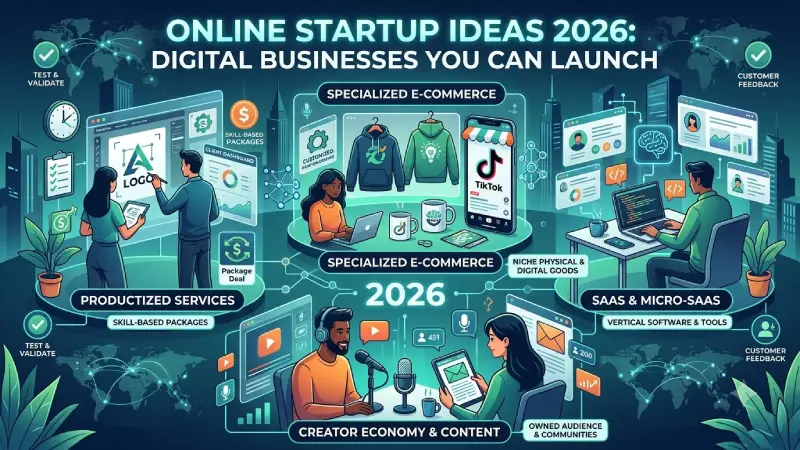
In this piece, I will cover all the types of online business ideas that work today for those interested in maintaining a distance from physical work: service-based online businesses, ecommerce angle, smaller SaaS, and creator/content-based online business ideas. The second part will include testing the idea.
Table of Contents
ToggleBest Online Business Ideas for Remote Founders
In case location independence is your primary objective, some business models will work better for you than others. Such models include the ones that do not tie you to a certain city, do not require any physical inventory which requires handling every day, and operate based on asynchronous communication.
Strong options in 2026:
Productized online services
You take a skill (writing, design, ads, basic development, operations help, AI setup) and sell it as a clear package instead of pure hourly work. “Monthly content system for coaches” or “Website conversion audit + fixes.” Clients know what they get. You can deliver from anywhere. Many people start solo and later hand off pieces.
Specialized virtual support or consulting
Virtual assistance has evolved. The more lucrative options cater to the specific needs of e-commerce, podcasting, real estate transactions, or even AI workflow management. Recurring monthly retainers are common once you prove yourself.
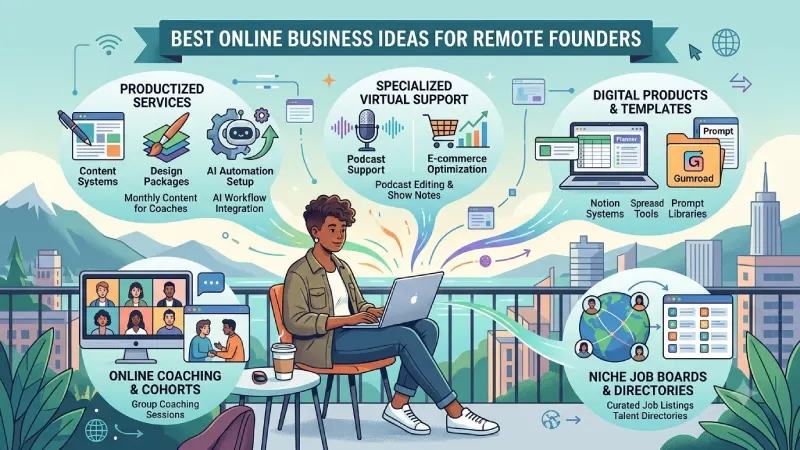
Digital products and templates
Notion systems, spreadsheets, planners, prompt libraries, easy tools, or swipe files. Make once, resell again and again. Platforms like Gumroad, Etsy, or even your own easy website do the distributing. This works best if you already know your market.
Online coaching or cohort-based learning
Provided you have practical experience in a particular skill set that is paid for learning, you can provide your services to teach through an online course, either through small group training or individual training sessions via the internet.
Niche job boards, directories, or simple marketplaces
Positions for remote work in the industry, a list of individuals who possess skills related to specific tasks, or a narrow marketplace that targets a community of people. They require a lot of time to make liquidity and yet they can be very reliable.
Why are they remote friendly? Because delivery and customer communication can be done using email, video conferencing, and project management tools. This means you are not limited by location-specific foot traffic or same-day deliveries.
| Model | Startup Cost | Speed to First Money | Scalability | Best For | Main Challenge |
|---|---|---|---|---|---|
| Productized services | Very low | Fast (weeks) | Medium | People with existing skills | Getting first clients |
| Specialized virtual support | Very low | Fast | Medium | Organized, reliable people | Niche positioning |
| Digital products | Low | Medium | High | People who know an audience | Creating + marketing |
| Online coaching / cohorts | Low | Medium | Medium-High | Experts with real results | Building trust & enrollment |
| Niche directories / boards | Low-Medium | Slow | High | Networked founders | Building supply & demand |
E-commerce Startup Opportunities in 2026
E-commerce is still huge, but the easy generic dropshipping days are mostly over. The opportunities that still work tend to be more focused.
Print-on-demand with a clear niche
Don’t sell random shirts to any person; sell shirts to a community of people who already purchase merchandise, have their own language, and have their own jokes. This way, the margin is improved since the item is created for them. The fulfillment process is done by the platform.
Niche physical products with strong branding
Consumable or problem solving products perform much better than straight fashion products. This includes consumable products or home organization products catering to specific lifestyles, pet products catering to specific breeds or issues, or hobby products. It’s possible to go private label or limited batch provided you stay lean on the inventory.
Digital-first e-commerce
The sale of pure digital products such as templates, courses, software, and membership does away with all risk of inventory and delivery. A number of businesses now combine physical products with digital upsells.
Social commerce and creator-led stores
Sales through TikTok Shop, Instagram, or existing fans. It still needs to be good, but the means through which it is being distributed will no longer be advertising alone but content-driven.
Subscription or repeat-purchase models
Products people need regularly (certain consumables, refill models, or membership boxes with a tight theme) create more predictable revenue than one-time purchases.
Realistic figures for 2026: Many new retailers continue to battle advertising expenses. Those who make it through tend to have either a solid organic feed, a clear niche with a high willingness to pay, or great unit economics where they can afford to do paid ads. It’s always best to begin testing out the waters with smaller budgets before ordering loads of inventory.
| E-commerce Model | Typical Margin | Inventory Risk | Ad Dependency | Best Starting Approach |
|---|---|---|---|---|
| Print-on-demand (niche) | 15–35% | Very low | Medium | Strong community + good designs |
| Niche physical products | 30–50%+ | Medium | High | Small test batch + organic content |
| Pure digital products | 70–95% | None | Low-Medium | Audience or strong SEO first |
| Social commerce | Varies | Low-Medium | Low (content) | Existing audience or viral content |
| Subscription boxes | 25–45% | Medium | Medium | Tight theme + retention focus |
SaaS Startup Ideas for Digital Entrepreneurs
It sounds like a grand plan, but micro-SaaS and vertical software are feasible options for individuals or small teams in 2026. The successful formula is often to solve one painful task for one distinct category of users.
Examples that keep coming up:
- Software for scheduling, billing or client management specifically made to cater to a certain profession (for example, therapists, tutors, cleaners, photographers or coaches).
- Note-taking, reporting or other content creation applications designed to work within a specific industry process.
- CRMs or pipeline applications designed specifically for freelancers and agencies.
- In-house applications that eliminate the need for spreadsheet chaos for a particular purpose.
- Analytics or tracking applications that answer one critical question better than generic applications.
Why “vertical” or “micro” fits better for the majority of people: the market is much smaller, yet there is more pain, willingness to pay is higher, and you can get your customer through a few particular communities instead of competing with big “horizontal” solutions.
Build cost has reduced because of no code, AI coding solutions, and low hosting cost. Many individuals get to have their first solution within weeks rather than months. The hardest part is identifying the right problem to solve and the initial paying customers.
These products are priced around $19-$99/month. The recurring income is the main point here. The downside is that it will take more time to get any income compared to services.
| Micro-SaaS Type | Typical Price | Build Difficulty | Time to First Revenue | Key Success Factor |
|---|---|---|---|---|
| Profession-specific tools | $19–49/mo | Low-Medium | 1–4 months | Deep understanding of workflow |
| AI workflow helpers | $29–99/mo | Medium | 2–6 months | Accuracy + easy setup |
| Lightweight CRM / pipeline | $15–39/mo | Low | 1–3 months | Simplicity over features |
| Spreadsheet replacement tools | $19–49/mo | Low-Medium | 1–3 months | Solving one clear pain |
| Simple analytics dashboards | $29–79/mo | Medium | 2–5 months | Actionable insights |
Content and Creator Economy Business Ideas
But what is true is that the creator economy does exist, but the rate at which it delivers results is often overestimated.
Models that function as actual businesses:
Newsletter + paid community or products
Build an email list around a specific topic. Offer a free version and a paid tier, or sell digital products and sponsorships to the list. Ownership of the audience matters more than platform followers.
UGC and brand content services
Create short-form video or content for brands without needing a huge personal following. Many companies pay for authentic-feeling content they can run as ads. This can be pure service work at the beginning.
Faceless or low-face content channels
YouTube, TikTok, or Instagram channel based on niche via stock footage, artificial intelligence, narration, or screen recordings. Earn money through advertising, affiliate marketing, digital goods, or sponsorships. But the key is to know what the audience wants.
Online courses and cohort programs
Turn expertise into structured learning. However, when it comes to cohorts (group-based live training with an ending date), their conversion rate tends to be higher during the start due to accountability and community.
Affiliate and review content done properly
Valuable information in a specialized field where people are willing to spend their money, accompanied by sincere recommendations. This takes time, but the profits can be substantial when it succeeds.
| Creator Model | Time to First Money | Income Ceiling | Consistency Needed | Best Monetization Path |
|---|---|---|---|---|
| Newsletter + products | Medium | High | High | Paid tier + digital products |
| UGC / brand content services | Fast | Medium-High | Medium | Direct brand deals |
| Faceless content channels | Slow | High | Very High | Ads + affiliates + products |
| Cohort courses | Medium | High | Medium | High-ticket live programs |
| Affiliate / review content | Slow | Medium-High | High | Deep niche + trust |
How to Validate an Online Business Idea Quickly
This is the part that saves the most time and money. A lot of online ideas look good on paper and die quietly because nobody actually wanted to pay.
A practical way to test in days or a couple of weeks:
- Get specific about the problem and the person
Write one clear sentence: “This type of person struggles with this specific job and currently solves it in this imperfect way.” If you cannot make it specific, the idea is still too vague. - Look for existing proof the pain is real
Search forums, Reddit, review sites, and Facebook groups for people complaining about the problem unprompted. See what they currently pay for or use as workarounds. If nobody is complaining or spending, be careful. - Talk to real potential customers
Have 10–20 short conversations. Ask about their current process, what frustrates them, what they have tried, and what they have spent money on. Do not pitch your solution early. Listen for intensity of pain and willingness to pay. - Test with a simple offer
Create a basic landing page or even a clear Google Doc / Notion page that explains the offer and the price. Drive a little traffic from communities, your network, or cheap ads. The goal is not perfection. The goal is to see if people will give an email, join a waitlist, or better — pay a deposit or pre-order. - Run a manual version first when possible
For service or tool ideas, deliver the result manually for a few customers (the “concierge” approach). This teaches you what people actually need and whether they will pay before you build anything automated or fancy.
Powerful signals: asking when they can purchase, being willing to pay, or introducing others. Weak signals: “cool concept” or “let me know when you launch.”
Frequently Asked Questions
What is the easiest online business to start in 2026?
Productized services or specialized virtual support. They need the least money, can generate income in weeks, and work fully remotely.
How much money do I need to start an online business?
Many solid options can start with under $200–500 (domain, basic tools, and time). Pure digital products or services can start even lower. E-commerce with inventory needs more.
Can I start an online business while working a full-time job?
Yes. Most of the service and digital product models work well part-time at the beginning. The key is choosing something that does not need constant real-time availability.
Is dropshipping still worth it in 2026?
Only in very specific niches with strong branding or content distribution. Drop shipping generics is far more difficult today compared to several years ago due to advertising fees and competition.
How long does it take to make real money online?
Services can produce the first dollars in 2–6 weeks. Digital products and content usually take 2–6 months. Micro-SaaS often takes 3–8 months to reach meaningful recurring revenue.
Do I need to show my face to succeed with content?
No. Faceless and low-face channels work in many niches, especially when combined with digital products or affiliate income. Consistency and audience understanding matter more than appearing on camera.
Conclusion
The key factors in running an online business will still have their importance in 2026; it is essential to offer an answer to some question, control your expenses, and ensure that you reach your potential clients repeatedly.
If you need fast cash flow, consider launching a service-based business or offering specialized remote assistance. For future growth and leverage, introduce digital products, a tool, and content creating an owned audience. eCommerce is possible but requires much more specificity than ever before.
The tools have never been cheaper or more powerful. The difficult part remains the same — choosing the right problem, interacting with real users, offering something of value, and then making it even better.
Pick one idea that feels realistic with the time and skills you have right now. Make the smallest possible offer. Put it in front of real people this week. That is still how almost every solid online business actually begins.
To take the next step, see our detailed guide on tech startup ideas