

Introduction
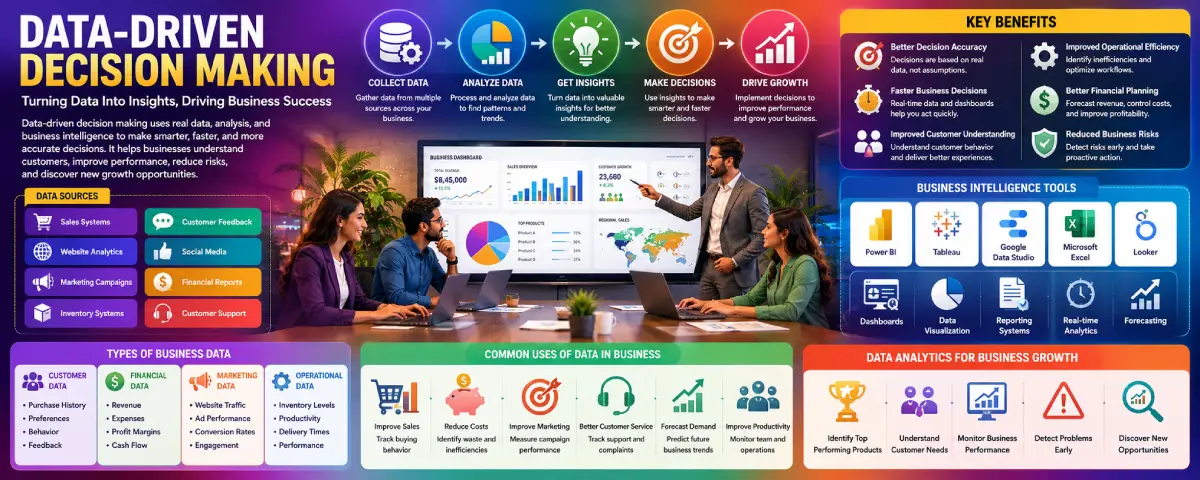
Businesses today collect large amounts of information from websites, customer interactions, sales systems, social media platforms, marketing campaigns, and daily operations. But mere data collection will not make any difference to a company’s progress. The real benefit can be reaped when that information is analyzed and applied in the making of sound business decisions.
This approach is called data-driven decision making.
Without making assumptions or speculations, businesses today use data to have a better idea about customer behavior and how they can operate efficiently and cut down costs and explore opportunities for expansion.
It is safe to say that data is one of the most valuable resources in the present corporate environment. From small businesses to startups, e-commerce players to service providers, hospitals to schools, from small businesses to large corporations, everybody is using analytical and reporting tools to improve their performance.
Data-driven decision making helps businesses:
- Understand customer behavior
- Improve marketing performance
- Increase operational efficiency
- Reduce business risks
- Improve financial planning
- Track employee productivity
- Forecast future trends
- Support faster decision-making
Data-driven decisions from our digital transformation guide.
Firms that have precise data are likely to be more able to make good decisions than firms that depend more on manual analysis or guessing.
The purpose of the article is to clarify data-driven decision making using clear language. The topics to be covered include business intelligence, analytics, dashboards, predictive analytics, data culture, pros and cons, and case studies of different businesses.
What is Data-Driven Decision Making?
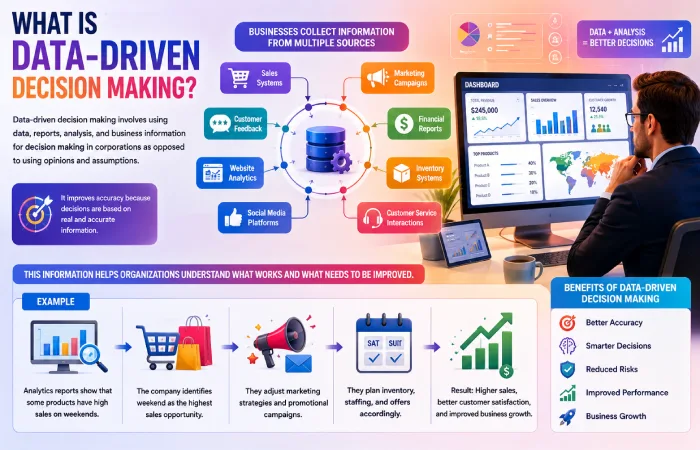
Data-driven decision making involves using data, reports, analysis, and business information for decision making in corporations as opposed to using opinions and assumptions.
According to the IBM Data and Analytics Guide, data-driven decision making helps organizations use data insights to improve business outcomes and strategic planning.
Businesses collect information from multiple sources such as:
- Sales systems
- Customer feedback
- Website analytics
- Social media platforms
- Marketing campaigns
- Financial reports
- Inventory systems
- Customer service interactions
This information helps organizations figure out what is working and what needs to be improved. Organizations can use this information to make things better. This enables them to know what is working for the business and what is not working for the business.
For example:
From the analytics reports, one may discover that some products have high sales volumes on weekends. Based on this information, the company can change its marketing strategies and planning.
Decisions made using data will be much more precise since they are based on precise data.
Why Businesses Are Moving Toward Data-Driven Strategies
Contemporary organizations function under very competitive situations, which make their market expectations and conditions change very quickly.
Without proper data analysis, businesses may struggle to:
- Understand customer needs
- Track performance
- Identify business problems
- Predict future demand
- Improve operations
Businesses now use data to make faster and smarter decisions.
Common Reasons Businesses Use Data
| Business Goal | How Data Helps |
| Improve sales | Tracks customer buying behavior |
| Reduce costs | Identifies waste and inefficiencies |
| Improve marketing | Measures campaign performance |
| Better customer service | Tracks complaints and support issues |
| Forecast demand | Predicts future business trends |
| Improve productivity | Monitors operational performance |
Types of Business Data Companies Use
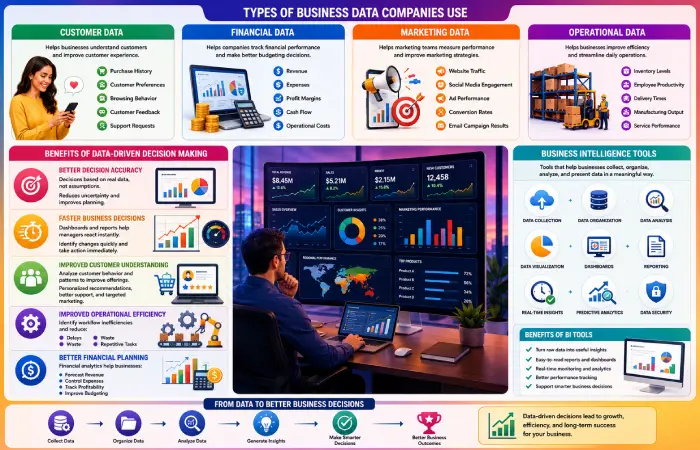
Businesses collect different types of information depending on their operations.
Customer Data
Customer data includes:
- Purchase history
- Customer preferences
- Browsing behavior
- Customer feedback
- Support requests
This information helps businesses improve customer experience.
Financial Data
Financial data helps companies track:
- Revenue
- Expenses
- Profit margins
- Cash flow
- Operational costs
Financial reports help business owners make budgeting decisions.
Marketing Data
Marketing teams track:
- Website traffic
- Social media engagement
- Ad performance
- Conversion rates
- Email campaign results
This helps businesses improve marketing strategies.
Operational Data
Operational data includes:
- Inventory levels
- Employee productivity
- Delivery times
- Manufacturing output
- Service performance
This data helps businesses improve efficiency.
Benefits of Data-Driven Decision Making
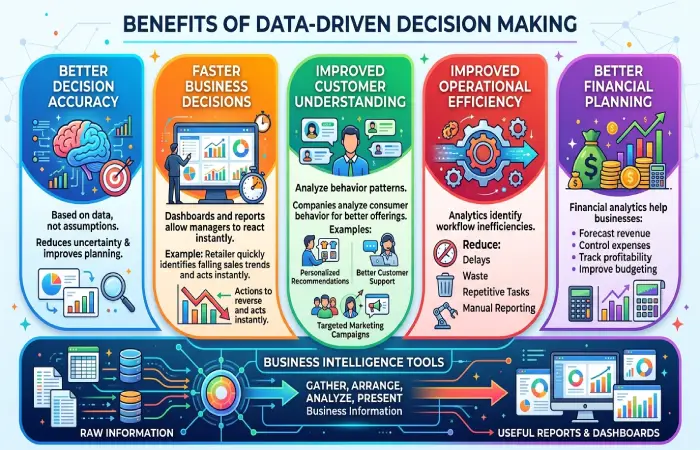
Better Decision Accuracy
All the decisions made should be data-based and not assumptions.
This reduces uncertainty and improves planning.
Faster Business Decisions
Dashboards and reports allow managers to react to these changes instantly.
For example:
The retailer can quickly identify falling sales trends and act on them instantly.
Improved Customer Understanding
Companies are able to analyze patterns in consumer behavior in order to improve their offerings.
Examples include:
- Personalized recommendations
- Better customer support
- Targeted marketing campaigns
Improved Operational Efficiency
Analytics systems help identify inefficiencies in workflows.
Businesses can reduce:
- Delays
- Waste
- Repetitive tasks
- Manual reporting
Better Financial Planning
Financial analytics help businesses:
- Forecast revenue
- Control expenses
- Track profitability
- Improve budgeting
Business Intelligence Tools
Business intelligence tools allow companies to gather, arrange, analyze, and present business information.
These tools convert raw information into useful reports and dashboards.
Common Features of Business Intelligence Tools
| Feature | Purpose |
| Dashboards | Visual business reports |
| Data visualization | Easy-to-read charts and graphs |
| Reporting systems | Business performance tracking |
| Real-time analytics | Instant updates |
| Forecasting | Predict future trends |
Popular Uses of BI Tools
Businesses use business intelligence systems for:
- Sales analysis
- Marketing reports
- Financial tracking
- Customer analytics
- Operational monitoring
Data Analytics for Business Growth
Data analysis enables organizations to identify areas where they need improvements.
Analytics can help companies understand:
- Which products perform best
- Which marketing campaigns generate sales
- Which customers are most valuable
- Where operational delays happen
Example of Data Analytics in Business
An ecommerce company may analyze:
- Product sales
- Website traffic
- Customer reviews
- Cart abandonment rates
This helps the business improve product pages and marketing campaigns.
KPIs and Data Dashboards
KPIs (Key Performance Indicators) help businesses measure their performance.
Dashboards organize KPI data into visual reports.
Common Business KPIs
| KPI | Purpose |
| Revenue growth | Tracks business growth |
| Customer retention | Measures customer loyalty |
| Conversion rate | Tracks marketing effectiveness |
| Operational cost | Monitors expenses |
| Employee productivity | Measures team performance |
Why Dashboards Matter
Dashboards help businesses:
- Monitor performance quickly
- Identify problems early
- Improve reporting accuracy
- Support decision-making
Performance evaluation by managers can be done through one source instead of referring to several spreadsheets.
Predictive Analytics in Business
Predictive analytics makes use of history and algorithms to predict future results.
Businesses use predictive analytics to estimate:
- Customer demand
- Inventory requirements
- Sales trends
- Market behavior
- Financial risks
Example of Predictive Analytics
A retail organization could make use of historical holiday sales figures to predict future inventory needs.
It prevents over-stocking and stock-out situations.
Building a Data-Driven Culture
Technology alone is not sufficient to make an organization data-driven.
The employees and managers have to play a role in making decisions based on data.
Characteristics of a Data-Driven Culture
Businesses with strong data cultures usually:
- Encourage data usage
- Train employees on analytics tools
- Share reports across departments
- Use measurable business goals
- Support continuous improvement
Why Company Culture Matters
Data systems lose their usefulness if employees ignore them or depend merely on their own opinions.
Superior outcomes are achieved by organizations where teams make effective use of data.
Challenges of Data-Driven Decision Making
Poor Data Quality
Incorrect or outdated information may lead to poor business decisions.
Businesses should regularly clean and update data.
Too Much Data
Some companies collect excessive information without proper organization.
This can create confusion.
Data Security Risks
Organizations need to protect customer and company information.
Cybersecurity practices are essential.
Lack of Employee Skills
Some employees may not understand analytics tools or reports.
Training helps improve adoption.
Comparison: Traditional Decision-Making vs Data-Driven Decision-Making
| Feature | Traditional Decisions | Data-Driven Decisions |
| Decision basis | Experience and assumptions | Real business data |
| Reporting | Manual reports | Automated dashboards |
| Accuracy | Lower | Higher |
| Speed | Slower | Faster |
| Forecasting | Limited | Advanced analytics |
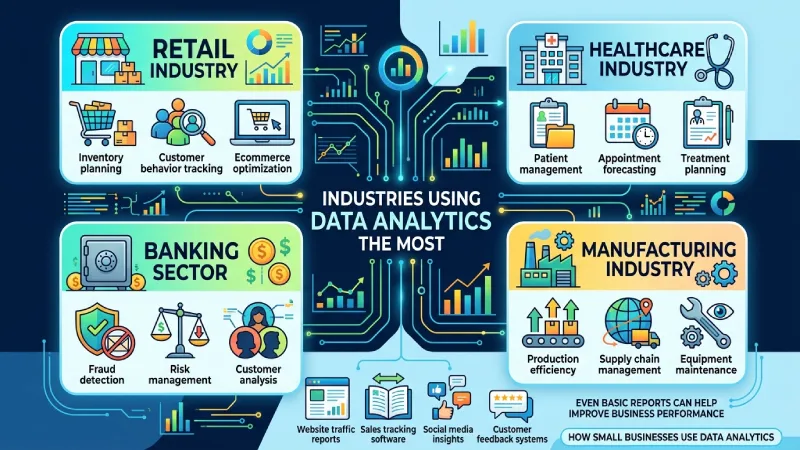
Industries Using Data Analytics the Most
Retail Industry
Retail businesses use analytics for:
- Inventory planning
- Customer behavior tracking
- Ecommerce optimization
Healthcare Industry
Healthcare organizations use analytics for:
- Patient management
- Appointment forecasting
- Treatment planning
Banking Sector
Banks use data analytics for:
- Fraud detection
- Risk management
- Customer analysis
Manufacturing Industry
Manufacturers use analytics to improve:
- Production efficiency
- Supply chain management
- Equipment maintenance
How Small Businesses Use Data Analytics
Small businesses also benefit from simple analytics tools.
Examples include:
- Website traffic reports
- Sales tracking software
- Social media insights
- Customer feedback systems
Even basic reports can help improve business performance.
Common Mistakes Businesses Make with Data
Ignoring Important Metrics
However, some businesses tend to gather more data than necessary while overlooking critical KPIs.
Using Inaccurate Data
Poor-quality data may create misleading reports.
Focusing Only on Numbers
Businesses also need to consider customer opinions and current market trends.
Lack of Clear Goals
Without business goals, data analysis becomes less useful.
Future of Data-Driven Business Strategies
Use of data analytics will continue to grow in the future for business purposes.
Future trends may include:
- AI-powered analytics
- Real-time business forecasting
- Automated reporting systems
- Smarter customer insights
- Advanced predictive analytics
Use AI and automation in business for analytics.
For those companies which successfully leverage the power of data, competitiveness and efficiency can be achieved.
Decision making based on data analysis has become one of the most crucial aspects in the digital transformation strategy. Firms no longer rely solely on manual analysis and reporting. Contemporary enterprises use such advanced technologies as analytics platforms, dashboards, automation systems, and intelligent reporting systems to enhance business performance and customer experience.
Frequently Asked Questions (FAQs)
What is data-driven decision making?
The process of data-based decision making entails the use of information from business data and analysis to guide decisions as opposed to just making assumptions.
Why is data important for business?
Data improves precision, efficiency, customer knowledge, and future planning within companies.
What are business intelligence tools?
These are tools which businesses use to gather and analyze their data and present it visually.
What are KPIs?
measures that are used to track the performance and goals of businesses.
What is predictive analytics?
This technique utilizes past data for forecasting future performance.
Conclusion
Making decisions based on data is one of the key aspects of modern business operations. The use of analytics, dashboards, business intelligence solutions, and performance reports is used by companies to support decision-making and promote development.
Companies that make use of data appropriately will be able to understand customer behavior better, increase efficiency, reduce risks, and react quickly to market changes.
However, to have effective data-based approach, businesses need not only apply appropriate software but also focus on data quality, personnel training, security issues, and planning.
In the case of further evolution of digital business environment, those who use proper data and analytics will enjoy better development and performance in the long term perspective.
Apply insights to digital customer experience