

Introduction
Starting a business begins with an idea, but finding the right opportunity is often more difficult than it seems. A good startup idea is not simply something that sounds innovative or follows a popular trend. It should address a meaningful problem, serve a clearly defined audience, and have the potential to become a sustainable business.
In 2026, entrepreneurs have access to more tools, platforms, and technologies than ever before. AI, automation, remote work, digital commerce, and changing consumer behavior are creating new possibilities across many markets. At the same time, increased competition means founders need to think carefully about differentiation, customer needs, and long-term value.
Whether you are an experienced entrepreneur exploring your next venture or someone considering business ownership for the first time, the process starts with understanding how opportunities are created and evaluated. This guide explains how to discover business opportunities, recognize market gaps, assess startup potential, build a strong business model, and turn a promising concept into a sustainable company.
What Makes a Good Startup Idea?
Not every business idea has the potential to become a successful startup. Before investing your time and money, consider whether the opportunity has the characteristics of a strong business.
A good startup idea should have:
- A clear customer problem
- A defined target audience
- Strong or growing demand
- A practical solution
- A clear competitive advantage
- A realistic revenue model
- Potential for sustainable growth
- A market that is large enough to support the business
The strongest ideas often come from solving problems that people already experience rather than creating demand for something they do not need.
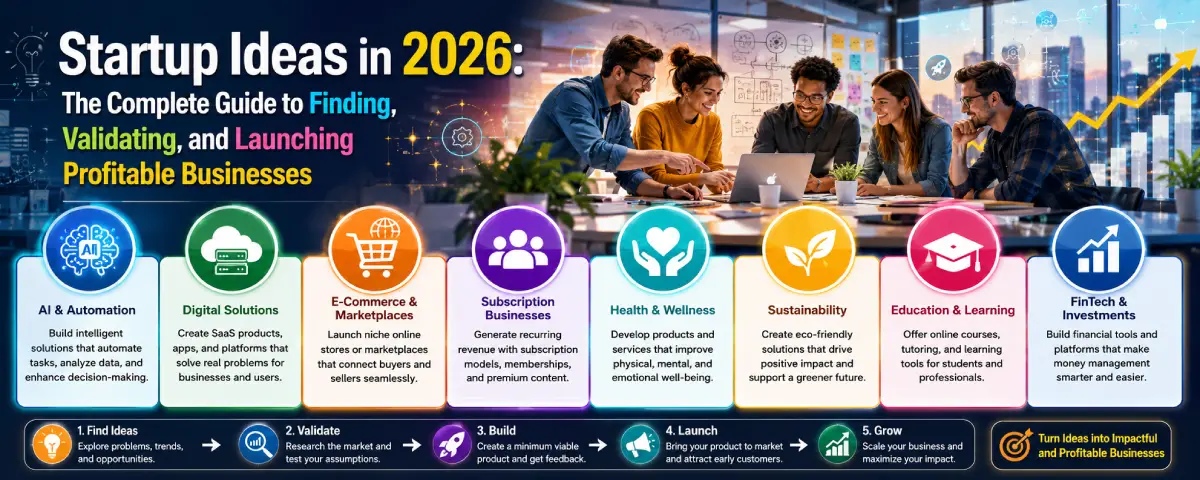
Best Startup Ideas 2026
The startup landscape is changing rapidly as technology and consumer behavior evolve. Instead of focusing on a single business model, entrepreneurs can explore opportunities across several broad categories.
AI-Powered Business Solutions
AI is creating opportunities to improve existing business processes and develop new products.
Potential areas include:
- Business automation
- AI-powered analytics
- Customer experience
- Workflow optimization
- Personalized services
The strongest opportunities often come from applying AI to a specific industry or problem rather than creating another general-purpose AI tool.
Digital Infrastructure Businesses
As businesses become increasingly digital, there is growing demand for infrastructure and support services.
Opportunities include:
- Cloud management
- Data solutions
- Cybersecurity
- Digital compliance
- Business automation
These businesses can serve other companies that need reliable technology but do not have large internal teams.
Specialized Marketplaces
Online marketplaces can connect buyers and sellers within specific niches.
Examples include marketplaces for:
- Professional services
- Specialized products
- Local businesses
- Industry-specific suppliers
- Second-hand goods
A focused marketplace can create value by solving trust, discovery, payment, or convenience problems.
Subscription-Based Businesses
Subscription models provide recurring revenue and can be applied to both physical and digital businesses.
Examples include:
- Software
- Membership communities
- Educational services
- Professional resources
- Curated products
The key is to provide ongoing value that encourages customers to remain subscribed.
Experience-Based Businesses
Consumers increasingly value convenience and memorable experiences.
Opportunities may include:
- Personalized travel
- Local experiences
- Wellness services
- Hobby communities
- Specialized events
These businesses can combine digital tools with real-world experiences.
How to Come Up with Startup Ideas
Great startup ideas can come from many sources. Instead of waiting for inspiration, entrepreneurs can use a systematic approach to discover opportunities.
Look at Problems in Your Daily Life
Pay attention to tasks that are:
- Slow
- Expensive
- Confusing
- Repetitive
- Difficult to access
A frustrating experience may reveal a potential business opportunity.
Study Customer Complaints
Online reviews can reveal what customers dislike about existing products and services.
Look for repeated complaints about:
- Poor customer service
- High prices
- Complicated processes
- Missing features
- Lack of convenience
If many customers have the same complaint, there may be an opportunity to build a better solution.
Observe Changes in Consumer Behavior
Changes in how people work, shop, communicate, and consume information can create new markets.
Pay attention to trends such as:
- Remote work
- Digital payments
- AI adoption
- Personalized services
- Online education
- Sustainable consumption
A lasting change in behavior can create opportunities for new businesses.
Improve an Existing Business Model
You do not always need to invent something completely new.
You can improve an existing business by offering:
- Better customer service
- Faster delivery
- Lower costs
- Greater convenience
- More personalization
- A better user experience
Many successful businesses win by executing an existing concept better.
How to Identify a Market Gap
A market gap exists when customer needs are not being adequately served.
To identify one, compare:
What customers want
vs.
What existing businesses provide
Look for situations where:
- Customers have limited choices
- Existing products are too expensive
- Services are difficult to access
- Current solutions are outdated
- Certain customer groups are ignored
The bigger the gap between customer expectations and available solutions, the greater the potential opportunity.
Startup Ideas Based on Market Opportunities
Instead of selecting a business first, entrepreneurs can begin by identifying a market opportunity.
Underserved Customer Groups
Some markets contain customers who are overlooked by larger businesses.
Examples may include:
- Small businesses
- Rural communities
- Specialized professionals
- Older consumers
- Niche hobby groups
Serving a smaller but clearly defined audience can be an effective way to establish a strong market position.
Outdated Industries
Traditional industries often rely on inefficient processes.
Opportunities may exist in:
- Digital transformation
- Automation
- Online booking
- Digital payments
- Data management
- Customer communication
Modernizing an outdated process can create significant value.
Growing Markets
Look for industries where customer demand is increasing.
Examples include markets influenced by:
- Technology adoption
- Demographic changes
- Environmental concerns
- Changing lifestyles
- New regulations
However, market growth alone is not enough. The business must still solve a specific customer problem.
Profitable Startup Ideas: What Makes a Business Financially Strong?
Profitability depends on more than revenue. A strong startup should have a business model that can generate sustainable margins while controlling costs.
Recurring Revenue
Businesses with recurring revenue can create more predictable cash flow.
Examples include:
- Subscriptions
- Memberships
- Retainers
- Maintenance contracts
Strong Customer Retention
A business becomes more sustainable when customers continue using its products or services.
High retention can reduce the need to constantly find new customers.
Healthy Profit Margins
A startup should understand how much money remains after delivering its product or service.
Consider:
- Production costs
- Marketing expenses
- Employee costs
- Technology costs
- Customer support
Scalable Operations
A scalable business can grow revenue without increasing costs at the same rate.
Digital products and software are often highly scalable, while some service businesses may require additional employees as they grow.
Small Business Startup Ideas
Not every entrepreneur wants to build a venture-backed technology company. Small businesses can also become profitable and sustainable companies.
Potential models include:
- Professional services
- Local businesses
- Specialized retail
- Consulting
- Education services
- Creative businesses
- Home-based businesses
The right choice depends on the founder’s skills, resources, location, and goals.
A small business can also evolve over time. A founder might begin as a solo service provider and eventually build an agency, hire employees, or develop software based on recurring customer needs.
Startup Ideas by Business Model
Understanding business models can help entrepreneurs identify opportunities that match their goals.
| Business Model | How It Works | Example |
| Subscription | Customers pay regularly | Software platform |
| Marketplace | Connects buyers and sellers | Niche marketplace |
| Transaction Fee | Earns from each transaction | Payment platform |
| Service | Charges for expertise or work | Consulting |
| Product | Sells physical or digital goods | Online store |
| Freemium | Free basic service with paid upgrades | Digital application |
| Advertising | Earns from advertisers | Content platform |
| Licensing | Charges for using intellectual property | Software licensing |
How to Evaluate a Startup Opportunity
Before choosing an idea, evaluate it from multiple perspectives.
Customer Demand
Ask whether customers genuinely need the solution.
Market Size
Determine whether enough potential customers exist.
Competition
Understand who already serves the market and how you can differentiate.
Startup Costs
Estimate how much money is required to launch and operate the business.
Revenue Potential
Determine how the company will generate income.
Scalability
Consider whether the business can grow beyond its initial market.
Founder Fit
Evaluate whether your skills and experience match the opportunity.
Startup Idea Evaluation Scorecard
You can score each potential idea from 1 to 5.
| Factor | Score |
| Customer Demand | /5 |
| Market Size | /5 |
| Competition | /5 |
| Profit Potential | /5 |
| Startup Cost | /5 |
| Scalability | /5 |
| Founder Skills | /5 |
| Long-Term Potential | /5 |
A scoring system does not guarantee success, but it can help you compare multiple ideas more objectively.
From Business Idea to Business Model
A startup idea becomes a real business when you can explain how it will create and capture value.
Define:
Customer
Who will buy your product?
Problem
What problem are you solving?
Solution
How will your product or service solve it?
Value
Why will customers choose your solution?
Revenue
How will you make money?
Costs
What will it cost to operate?
Distribution
How will customers discover and purchase your product?
Retention
Why will customers continue using your business?
Answering these questions creates the foundation for a practical business model.
How to Test a Startup Idea Before Launching
You do not need to build a complete company to test an idea.
Start by:
- Researching the market
- Talking to potential customers
- Studying competitors
- Creating a simple prototype
- Building a landing page
- Testing marketing messages
- Offering a basic version of the product
- Measuring customer interest
- Testing pricing
- Collecting feedback
The objective is to learn whether the idea has potential before committing significant resources.
When Should You Abandon or Change a Startup Idea?
Not every idea will work. Recognizing this early can save time and money.
Consider changing direction when:
- Customers show little interest
- People do not see enough value
- Acquisition costs are too high
- The market is too small
- Customers refuse to pay
- The business model cannot generate sustainable margins
Changing your approach does not necessarily mean failure. Customer feedback can help you discover a better problem to solve or a more valuable target market.
How to Build a Competitive Advantage
A startup needs a reason for customers to choose it over alternatives.
Your competitive advantage could come from:
- Proprietary technology
- Specialized expertise
- Better customer experience
- Lower operating costs
- Strong brand
- Unique distribution
- Exclusive partnerships
- Faster service
- Industry specialization
The best advantage is one that competitors cannot easily copy.
Building a Startup Growth Strategy
Once your startup begins generating consistent demand, focus on sustainable growth.
Improve the Product
Continue solving customer problems and improving usability.
Strengthen Customer Acquisition
Identify marketing channels that consistently bring qualified customers.
Increase Customer Retention
Give customers reasons to continue using your business.
Automate Repetitive Work
Use technology to reduce manual tasks and improve efficiency.
Build a Strong Team
Hire people who bring skills that complement your own.
Expand Carefully
Enter new markets or launch new products only after establishing a strong foundation.
Common Startup Idea Mistakes to Avoid
Entrepreneurs often make mistakes before their business even launches.
Avoid:
- Choosing an idea solely because it is trending
- Assuming everyone is a potential customer
- Ignoring existing competitors
- Building too many features
- Spending heavily before validation
- Focusing on technology instead of customer needs
- Ignoring unit economics
- Expecting immediate profitability
- Scaling before finding product-market fit
A disciplined approach can help reduce unnecessary risk.
Startup Idea Trends to Watch in 2026
Entrepreneurs can monitor several broad trends when looking for opportunities.
Artificial Intelligence
AI is becoming part of everyday business operations and consumer experiences.
Automation
Companies are looking for ways to reduce repetitive work and improve efficiency.
Personalization
Customers increasingly expect products and services tailored to their needs.
Remote and Distributed Work
Businesses continue to need tools that support collaboration and productivity.
Digital Commerce
Online purchasing continues to create opportunities for specialized products and services.
Sustainability
Businesses and consumers are increasingly interested in reducing environmental impact.
Aging Populations
Changing demographics create demand for healthcare, senior services, and accessibility solutions.
The goal should not be to follow every trend. Instead, identify where a trend creates a specific problem that your business can solve.
Frequently Asked Questions
What are startup ideas?
Startup ideas are potential business concepts designed to solve a customer problem or meet a market need. They can range from technology companies and online platforms to local services and specialized products.
How do I find a good startup idea?
Start by identifying problems that people experience regularly. Research customer complaints, observe industry changes, study existing businesses, and look for gaps between customer expectations and available solutions.
What makes a startup idea profitable?
A profitable startup typically has strong customer demand, a clear value proposition, healthy margins, manageable costs, and a business model that can generate sustainable revenue.
Do I need a completely original idea to start a business?
No. Many successful businesses improve existing products or services. A better customer experience, lower cost, specialized solution, or more convenient process can create a strong competitive advantage.
How can I know if my startup idea will succeed?
No method can guarantee success. However, market research, customer interviews, MVP testing, pricing experiments, and early sales can provide evidence about whether an idea has potential.
Should I focus on a trend when choosing a startup idea?
Trends can reveal opportunities, but they should not be the only reason to start a business. Look for long-term customer problems and sustainable demand behind the trend.
Conclusion
Finding the right startup ideas is not about discovering a perfect business concept that guarantees success. It is about identifying meaningful problems, understanding customers, recognizing market opportunities, and developing a solution that creates real value.
The most promising opportunities in 2026 can emerge from technology, changing consumer behavior, underserved markets, outdated industries, and new business models. However, the strongest idea is ultimately the one that matches a genuine customer need with a practical and sustainable way to deliver value.
Before investing heavily, research the market, evaluate the business model, test your assumptions, and listen to potential customers. Start with a focused solution, measure real results, and be willing to improve your idea when the evidence points in a different direction.
A startup begins with an idea, but it grows through validation, execution, customer trust, and continuous improvement. By approaching the process strategically, entrepreneurs can move from finding a startup idea to building a business with the potential to grow and remain profitable over the long term.