


Products generally come with features. Those that sell have compelling messages.
Product messaging consists of words and concepts you use to justify your product’s importance. Product messaging translates your positioning into terms customers understand and will easily remember. When messaging is clear, people will instantly see what it is all about and why it is important. If messaging is confused or generic, they’ll just scroll past.
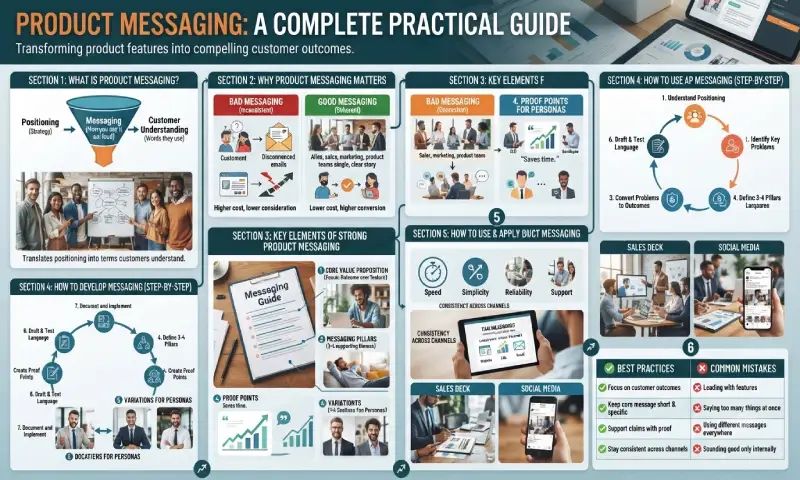
Some companies with great products have failed due to the fact that every piece of communication on their website, every email and even every presentation said something different. Others with less exciting products have managed to gain traction due to good messaging. Here, we’ll explore product messaging meaning, its significance, types and approaches, how to create messaging and put it into action, as well as the common mistakes in product messaging.
Product Messaging: Meaning and Key Concepts
“Messaging” is all about how you position your product through communication. It consists of the value proposition, the benefits, the proof points, and the communications used to deliver the message in websites, ads, sales tools, emails, and even the product.
This element lies between positioning and the words used by customers. The positioning aspect determines which position you should occupy. The messaging element helps you articulate this positioning effectively.
Key elements of strong product messaging usually include:
- Core value proposition (reason why it matters to the customer)
- Messaging pillars (3-4 core pillars of the messaging that back up the value proposition)
- Benefits/outcomes (advantages for the customer)
- Proof points (examples supporting the above)
- Variations for different buyer personas (tailoring the messaging to specific customers)
- Tone and voice guidelines
A simple way to think about it:
Positioning is the strategy. Messaging is how you say it out loud.
Why Product Messaging Matters
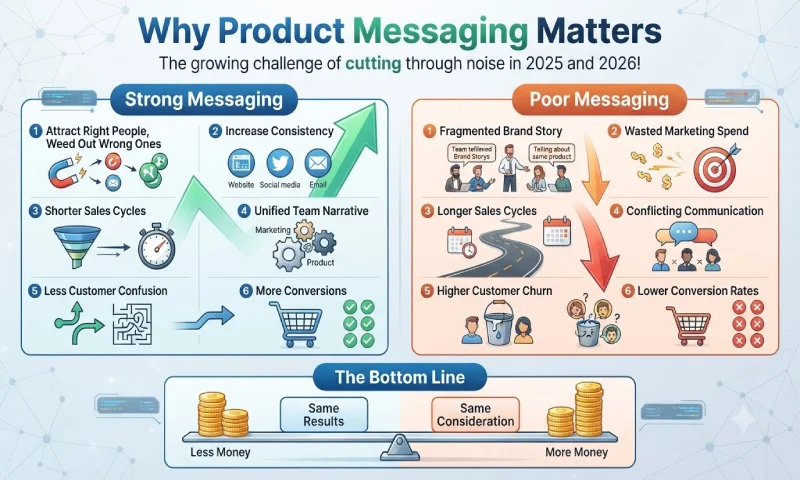
Good communication improves the efficiency of marketing and selling efforts. Bad communication means that each team member must create his or her own story.
Strong product messaging helps you:
- Get the right people and weed out the wrong ones
- Increase consistency in your website and advertising copy
- Sales cycles will be shorter since it is easy to understand the value proposition
- Leverage marketing, sales, and products on the same narrative
- Less confusion for customers
- More conversions
Buyers in 2025 and 2026 will experience even more messages than ever before. Buyers quickly determine if a message is relevant or not. Messaging that is clear, specific and goal-oriented works better than product specifications and general statements. Those brands which will have coherent messaging strategy will reap its benefits, compared to those brands which have their touchpoints communicate differently.
Bad messaging means you will have to spend more money to get the same consideration. Good messaging means getting the same results for less money.
Poor messaging means spending more to achieve the same level of consideration. Effective messaging achieves greater results with the same effort.
Key Types, Methods, and Examples
There are various ways of organizing product messages. However, the best way includes a value proposition that is supplemented with just a few pillars.
| Messaging Element | What It Does | Example Direction |
| Core Value Proposition | Main reason the customer should care | “Get X result without Y pain” |
| Messaging Pillars | 3–4 supporting themes | Speed, simplicity, reliability, support |
| Benefits / Outcomes | What the customer gains | Save time, reduce risk, grow revenue |
| Features (supporting) | How the product delivers the benefit | Specific capabilities that enable outcomes |
| Proof Points | Evidence that makes claims believable | Numbers, case studies, testimonials |
| Objection Handling | Answers to common doubts | Clear responses to price, risk, complexity |
Common methods to develop messaging:
- Begin from positioning and target customer
- Determine key problems which the product solves
- Converting problems to outcomes
- Grouping the best outcomes in 3-4 messaging pillars
- Bolstering each messaging pillar with proof
- Creating short versions for various channels
- Having the wording tested on actual consumers
- Tracking all in writing for further implementation by the whole team
How to Use or Apply Product Messaging
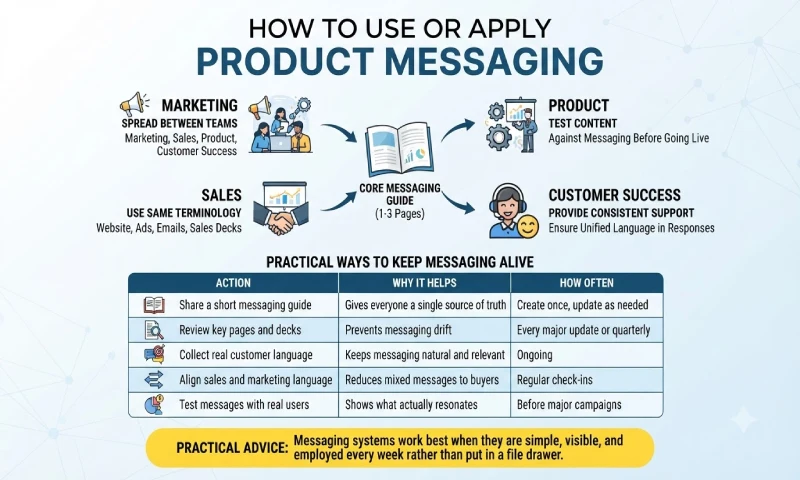
Messaging development is meaningless if it is not applied by anyone. There are many teams that develop an excellent messaging model but leave it idle and continue to write content in their own way. This happens only when the messaging serves as the corporate language.
Here’s how to apply it in practice:
- Record your core message, the 3-4 pillars, the main benefits and proof points in one concise guide
Put everything in writing. It is best to write 1-3 pages rather than create an overly long playbook that will be forgotten.
- Spread it between marketing, sales, product, and customer success teams
Consistency in messaging is possible when everyone within the go-to-market organization shares the same terminology. Check whether your decks, webpages, emails, and customer success support responses contain the same language.
- Use the same terminology on your website, in ads, in emails, and sales decks
Your customers will see the consistent message through different channels. It helps to build their awareness and trust in your solution.
- Create concise versions for social media and comprehensive versions for sales discussions and website pages
Your core message is supposed to remain the same, but its length may vary depending on how you deliver it – through social media posts, sales discussions or webpages.
- Test new content against messaging before it goes live
Test new pages, campaigns, and decks against the agreed-on messaging to make sure they reinforce it. It’s an easy fix that stops you from drifting.
- Keep the messaging up to date with any major change to the product or market
Change the messaging when the product, target customer, or the competitive environment is changing in a big way. Be careful about tweaking all the time; keep it simple.
- Include the messaging in training for new team members
Get new employees trained on the messaging early, especially if they are writing, selling, or supporting customers.
Practical Ways to Keep Messaging Alive
| Action | Why It Helps | How Often to Do It |
| Share a short messaging guide | Gives everyone a single source of truth | Create once, update as needed |
| Review key pages and decks | Prevents messaging drift | Every major update or quarterly |
| Collect real customer language | Keeps messaging natural and relevant | Ongoing |
| Align sales and marketing language | Reduces mixed messages to buyers | Regular check-ins |
| Test messages with real users | Shows what actually resonates | Before major campaigns |
Practical advice: Make sure your messaging document is short enough that people will actually look at it. Frameworks that are too lengthy tend to be ignored. Messaging systems work best when they are simple, visible, and employed every week rather than put in a file drawer after the workshop.
Messaging systems that are applied consistently mean that the customer hears one story and that everyone isn’t wasting time inventing their own description.
Best Practices and Common Mistakes
Best practices:
- Focus on customer outcomes, not just product features
- Keep the core message short and specific
- Support every claim with proof
- Stay consistent across channels
- Test language with real customers
- Make the messaging easy for the whole team to use
- Review and refine based on what actually converts
Common mistakes:
- Leading with features instead of benefits
- Trying to say too many things at once
- Using different messages in different channels
- Creating messaging that sounds good internally but does not resonate with customers
- Never documenting the messaging so everyone invents their own version
- Changing the core message too often
- Ignoring proof points
One of the biggest problems I see is teams that create a nice messaging framework and then let website copy, ads, and sales decks drift in different directions. Consistency is what turns good messaging into real results.
Frequently Asked Questions
What is product messaging?
It is the language and structure you use to explain the value of your product to customers. It turns positioning into clear, repeatable words.
How is product messaging different from positioning?
Positioning is the strategic choice of the space you want to own. Messaging is how you express that position in words across every channel.
How many messaging pillars should I have?
Most teams work well with three or four clear pillars. More than that usually creates confusion.
How often should product messaging be updated?
Review it when the product, market, or customer priorities change significantly. Avoid constant small changes that create inconsistency.
Who should own product messaging?
Product marketing usually leads it, but marketing, sales, and product teams all need to use and support it.
Conclusion
Product messaging is a way to articulate a well-formulated position into a language your target audience will easily understand. The impact of messaging becomes more apparent when it is focused on the outcome, based on evidence, and consistent across the organization.
Focus on the problem and the expected result of the customer. Develop a succinct core message and a few supporting pillars for it. Document it and communicate in all places possible. Experiment with what sticks.
While clear messaging is not the key to success, unclear messaging rarely leads to success. Organizations that see messaging as an overall system and not a one-off activity tend to be more successful.
The related guides on Go-To-Market Strategy, Product Positioning, Product Launch Strategy, Product Adoption, and Product Marketing Metrics discuss the other components complementing good messaging.