

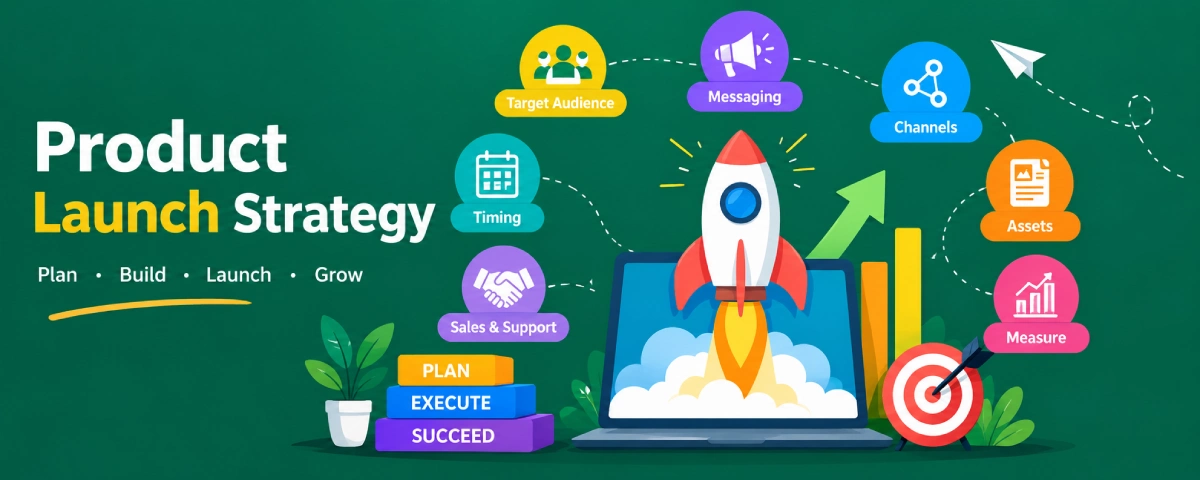
Many products are developed and launched with no particular strategy. They have no defined approach, no well-defined target audience, and no cohesive marketing strategy behind them. These products are typically doomed to poor performance at launch.
A product launch strategy is a plan for the successful introduction of a product (or a significant feature of a product) into the market by ensuring that its right target audience gets the information about it, understands it and acts on this information. It includes elements such as timing, messaging, communication channels, assets, sales enablement, etc.
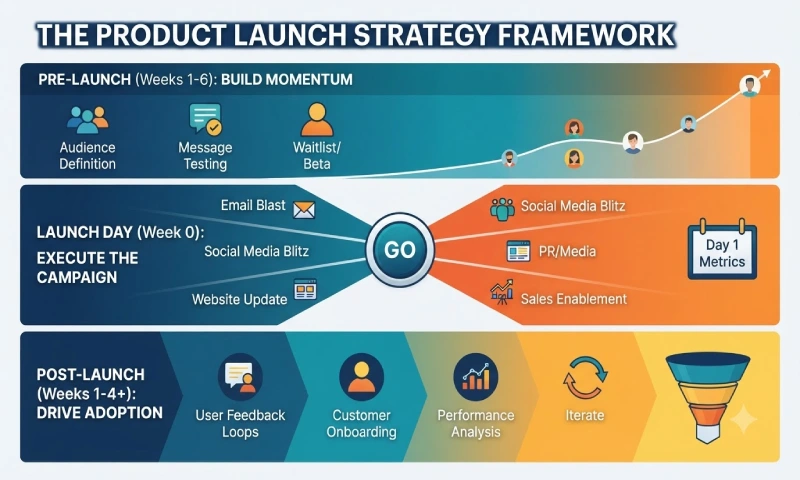
I’ve seen many cases when a well-designed product was launched with minimal preparation efforts resulting in low traffic and poor sales. A proper product launch strategy could change everything. This guide covers such questions as what a product launch strategy is and why it matters, the types of launch strategies, planning and conducting a product launch strategy, and some of the pitfalls to avoid.
Product Launch Strategy: Meaning and Key Concepts
Product launch is the process through which a product gets launched from being ready for internal use to becoming available and visible in the market. This involves who will be targeted by the launch, what the message will be, which channel will be used, required assets, and how marketing and sales teams will coordinate to ensure accountability.
Product launch differs from the release of a product in that while product release involves making the product available, product launch aims at creating awareness and interest around the product.
Key elements usually include:
- Clear target audience for the launch
- Positioning and Messaging
- Activities before launch (waitlist, content, outreach)
- Channels used on launch day and tactics
- Enabling sales and customer success
- Assets (website updates, demos, email, social, ads)
- Indicators of success and timeline
- Action Plan Post-launch
In layman’s terms, a product launch strategy means converting a product launch into a strategic campaign with a definite beginning and end.
Why Product Launch Strategy Matters
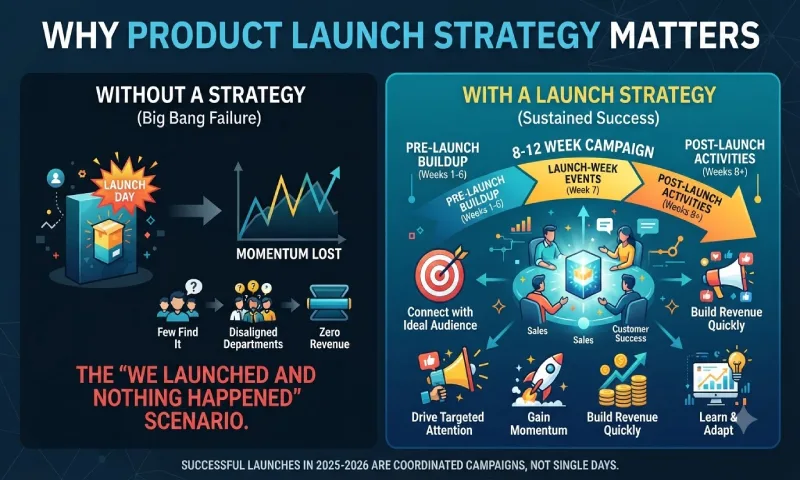
Good products can sometimes fail to take off without a launch strategy in place. We hope people find it. Some do, and most don’t. Momentum is lost, and reversing it becomes increasingly difficult.
Having a product launch strategy allows you to:
- Connect with your ideal audience when you want them to
- Drive targeted attention instead of chaos
- Bring marketing, sales, product, and customer success efforts into alignment
- Gain early users, validation, and social proof
- Build pipeline or revenue more quickly
- Learn what works in terms of messaging and channels
- Steer clear of the usual “we launched and nothing happened” scenario
In 2025 and 2026, successful launches are typically more coordinated and last longer than “big bang” days. More companies now view product launches as 8-12 week (or longer) campaigns involving pre-launch buildup, launch-week events, and post-launch activities. Companies that carefully plan the entire sequence usually have more success than those who only plan the launch day itself.
Key Types, Methods, and Examples
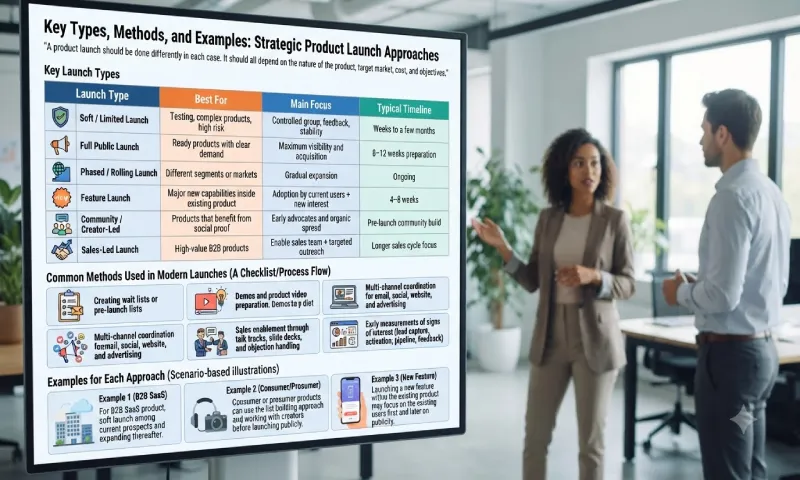
A product launch should be done differently in each case. It should all depend on the nature of the product, target market, cost, and objectives..
| Launch Type | Best For | Main Focus | Typical Timeline |
| Soft / Limited Launch | Testing, complex products, high risk | Controlled group, feedback, stability | Weeks to a few months |
| Full Public Launch | Ready products with clear demand | Maximum visibility and acquisition | 8–12 weeks preparation |
| Phased / Rolling Launch | Different segments or markets | Gradual expansion | Ongoing |
| Feature Launch | Major new capabilities inside existing product | Adoption by current users + new interest | 4–8 weeks |
| Community / Creator-Led | Products that benefit from social proof | Early advocates and organic spread | Pre-launch community build |
| Sales-Led Launch | High-value B2B products | Enable sales team + targeted outreach | Longer sales cycle focus |
Common methods used in modern launches:
- Creating wait lists or pre-launch lists
- Content creation for education and excitement building
- Demos and product video preparation
- Multi-channel coordination for email, social, website, and advertising
- Sales enablement through talk tracks, slide decks, and objection handling
- Early measurements of signs of interest (lead capture, activation, pipeline, feedback)
Examples for each approach:
- For B2B SaaS product, soft launch among current prospects and expanding thereafter.
- Consumer or prosumer products can use the list building approach and working with creators before launching publicly.
- Launching a new feature within the existing product may focus on the existing users first and later on publicity.
How to Use or Apply Product Launch Strategy
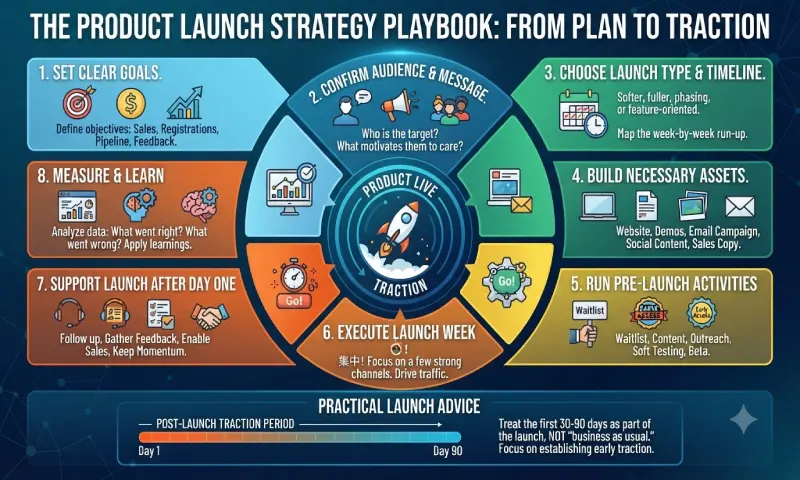
Here is a practical way to plan and run a launch.
- Set clear goals
What is to be achieved? (Registrations, sales, activation, pipeline, volume of feedback). - Confirm the audience and message
What people is this launch targeted at, and what single factor must motivate them to be interested? - Choose the launch type and timeline
Softer, fuller, phasing or feature-oriented. Plan out the week-by-week run-up to your launch date. - Build the necessary assets
Website revisions, demonstration, e-mail campaign, social media content, sales copy, supporting documents. - Run pre-launch activities
Waitlist, content, outreach, early access, or soft testing. - Execute launch week with focus
Concentrate on a few strong channels instead of trying to be everywhere. - Support the launch after day one
Follow up with early users, gather feedback, enable sales, and keep momentum going. - Measure and learn
What went right and wrong? Learn from the experience and apply the knowledge to your next venture.
Practical advice: Consider the first 30–90 days post-launch as part of your product’s launch period and not as “business as usual.” Some products require such a period to establish traction.
Best Practices and Common Mistakes
Best practices:
- Start planning weeks (or months) before the release date
- Focus on a clear audience and one main message
- Prepare sales and support before launch day
- Build some demand or a waitlist in advance when possible
- Concentrate on a few channels done well instead of many channels done poorly
- Measure early leading indicators, not only final revenue
- Plan the post-launch period, not just launch day
- Gather and use early feedback quickly
Common mistakes:
- Treating launch as a single day instead of a campaign
- Launching without clear goals or success metrics
- Spreading effort across too many channels
- Neglecting sales and customer success enablement
- Leading with features instead of customer outcomes
- Ignoring pre-launch warm-up
- Disappearing after launch day
- Changing the core message too many times during the launch
One of the biggest problems I see is teams that put all their energy into the release date and then have no plan for the weeks that follow. Momentum dies quickly when follow-through is missing.
Frequently Asked Questions
What is a product launch strategy?
It is the coordinated plan for introducing a product or major feature to the market, including audience, messaging, channels, assets, timing, and measurement.
How long should a product launch take?
Many effective launches now span 8–12 weeks of preparation plus focused launch and post-launch activity. Simple feature launches can be shorter. Complex or high-stakes launches often take longer.
What is the difference between a soft launch and a full launch?
A soft launch releases the product to a limited audience for testing and feedback. A full launch aims for broader visibility and acquisition.
What should I measure during a launch?
Early signals such as waitlist conversion, sign-ups, activation, engagement, pipeline created, and qualitative feedback. Revenue matters, but leading indicators help you adjust faster.
What is the most common launch mistake?
Launching without enough preparation or treating launch day as the end of the process instead of the beginning of a longer effort.
Conclusion
A product launch strategy makes the release an intentional campaign. It allows the right people to become aware of the product, understand its significance, and move on from there.
If the strategy is in place, everything else falls into place. Coordination between people involved, the clarity of communication, and the creation of initial momentum come easy. If the strategy is not in place, even the best products tend to get off to a slow start and find it difficult to recover.
Identify the target audience and the primary rationale behind the product launch. Pick a realistic launch type and schedule. Prepare your assets and your teams for the launch. Focus the process and follow through. Measure what you’ve done.
This no-nonsense method guarantees better outcomes than simply relying on a product to find its audience.
The guides on Go-To-Market Strategy, Product Positioning, Product Messaging, Product Adoption, and Product Marketing Metrics provide more information about all these aspects necessary for launching the product.