


One thing is getting people signed up. Another is having them use the product and continue using it.
Product adoption is the transition of users from being aware of or signing up for your product to actively using it and benefiting from it. It is the difference between having a large number of registered users and a steadily growing customer base that actually uses your product.
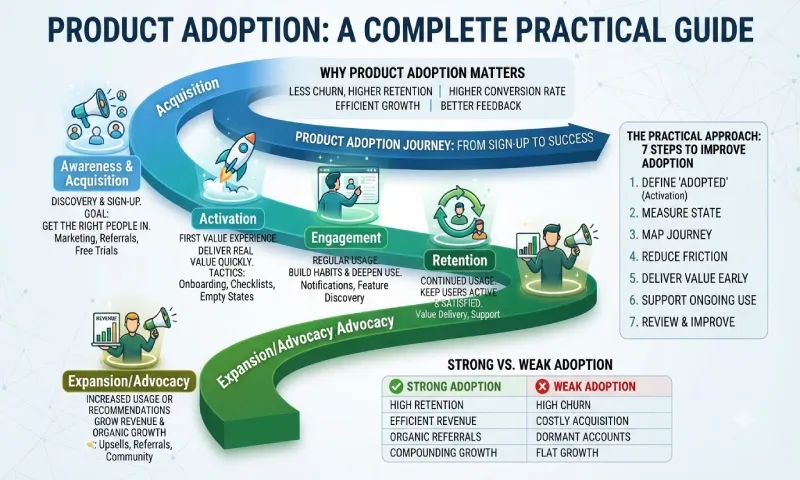
I have seen products with high sign-up rates fail because the users did not reach the stage where they could consider the product useful. I have also seen products with a steady growth in the number of users because the team put a lot of effort into making the users successful early.
Product Adoption: Meaning and Key Concepts
Product adoption is the process that an individual goes through when he starts using a product up to being a frequent user of it.
It usually includes several stages:
Awareness & Acquisition (discovery of the product)
- Activation (first experience of true value from the product)
- Engagement (repeated usage of the product)
- Retention (continued usage of the product)
- Expansion/Advocacy (increased usage or recommendations of the product)
Adoption is different from acquisition. Acquisition is how you get them to come in. Adoption is what follows once they step inside.
Key ideas you will see often:
- Time to value (time taken for a new user to get first value)
- Activation rate (the percentage of new users performing an important action)
- Habit Formation (when use becomes habitual)
- Onboarding (guided process by which new users achieve success)
Here’s an expanded version of the section “Why Product Adoption Matters”. You can replace your current version with this one.
Why Product Adoption Matters
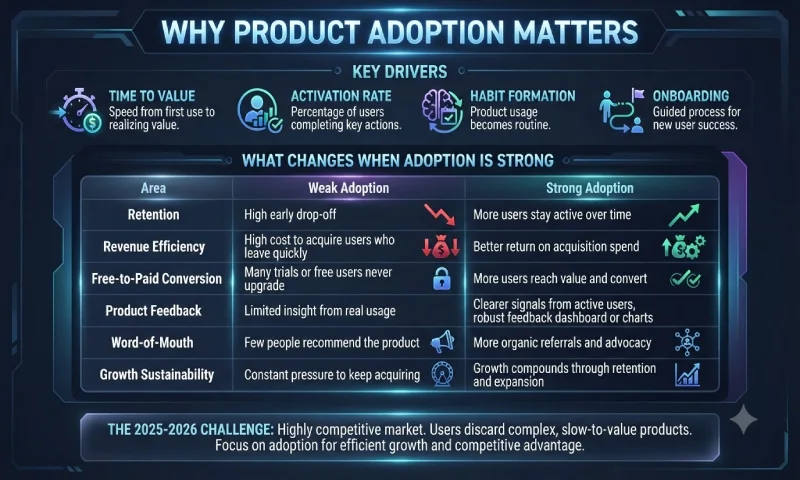
- Time to value (time taken for a new user to get first value)
- Activation rate (the percentage of new users performing an important action)
- Habit Formation (when use becomes habitual)
- Onboarding (guided process by which new users achieve success)
When adoption is healthy, several things improve:
- Less churn and higher retention
- Higher conversion rate to paying customers (freemium or trial model)
- Less costly expansion sales on existing customers
- More referral opportunities
- Better feedback because of actual product usage
- Efficient growth – more bang for your buck
This period, ranging from 2025 to 2026, is highly competitive and challenging when it comes to the fact that people try out different products but end up discarding those which are complex and take a lot of time to prove useful. Companies focusing on adoption gain more customers than others.
Poor adoption is costly. It costs you money to bring in new customers only to let them go before experiencing what makes them stick..
What Changes When Adoption Is Strong
| Area | Weak Adoption | Strong Adoption |
| Retention | High early drop-off | More users stay active over time |
| Revenue Efficiency | High cost to acquire users who leave quickly | Better return on acquisition spend |
| Free-to-Paid Conversion | Many trials or free users never upgrade | More users reach value and convert |
| Product Feedback | Limited insight from real usage | Clearer signals from active users |
| Word-of-Mouth | Few people recommend the product | More organic referrals and advocacy |
| Growth Sustainability | Constant pressure to keep acquiring | Growth compounds through retention and expansion |
Why This Matters Even More Now
A few clear realities make adoption more important than before:
- Customers test more products and make decisions on what to continue with quickly
- People have higher expectations of seeing quick returns
- Acquisition costs in many marketing channels are high, making losing users early costly
- It’s cheaper to earn money off expanding revenue from existing customers rather than searching for new ones all the time
- Products that are perceived to be difficult and hard to work with are more easily substituted
Those companies for which adoption is a top priority have been known to retain a much larger share of their customer base than those who emphasize sign-ups and end up with many dormant accounts.
Practical Impact
When teams improve adoption, several things usually get better:
- More users get to the stage where the product becomes useful for them
- Retention charts become better
- The customer success and support teams have fewer cases like “I don’t know how to start”
- Marketing and sales can refer to more evidence that the product works well for customers
- The business receives more from each of the people it tries hard to attract
A basic analogy can be used here:
Acquisition comprises the top end of the funnel.
Adoption is what will determine how effective that effort is in converting into loyal customers.
In an era of increased choice and decreased tolerance from consumers, success in the early stages becomes one of the most pragmatic ways to safeguard your growth and increase efficiency.
Key Types, Methods, and Examples
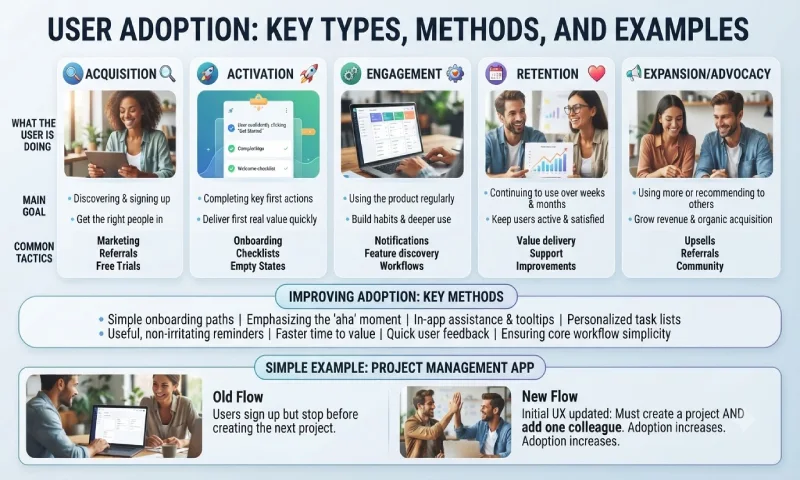
Adoption looks different depending on the product, but most products move users through similar stages.
| Stage | What the User Is Doing | Main Goal for the Product | Common Tactics |
| Acquisition | Discovering and signing up | Get the right people in | Marketing, referrals, free trials |
| Activation | Completing key first actions | Deliver first real value quickly | Onboarding, checklists, empty states |
| Engagement | Using the product regularly | Build habits and deeper use | Notifications, feature discovery, workflows |
| Retention | Continuing to use over weeks and months | Keep users active and satisfied | Value delivery, support, improvements |
| Expansion/Advocacy | Using more or recommending to others | Grow revenue and organic acquisition | Upsells, referrals, community |
Common methods to improve adoption:
- Simple and concise onboarding paths
- Emphasizing the “aha” moment
- In-app assistance and tooltips
- Personalized task lists or progress bars
- Useful email or in-app reminders that don’t irritate
- Faster time to value
- Gathering user feedback quickly
- Ensuring simplicity in the core workflow
Simple example:
A project management application finds that there are a lot of new users who sign up but do not go on to make another project. They change their initial user experience in such a way that the user must make a project and add one colleague.
How to Use or Apply Product Adoption
Improving adoption is a continuous effort. Here’s a practical approach:
- Define what “adopted” means for your product
Choose one or two clear activation actions that show a user has experienced real value. - Measure the current state
Track how many new users reach that activation point and how long it takes. - Map the early user journey
Look at where people drop off between signup and activation. - Reduce friction and clarify the path
Simplify steps, improve empty states, and guide users toward the key actions. - Deliver value as early as possible
Focus on shortening time-to-value. - Support ongoing use
Help users discover more value after the first success. - Review and improve regularly
There is always more to be done in adoption practice. Always experiment and improve.
One piece of practical advice would be to focus on one specific activation metric that should be communicated to everyone. If everyone knows what success means for a new user, decisions will become easier.
Best Practices and Common Mistakes
Best practices:
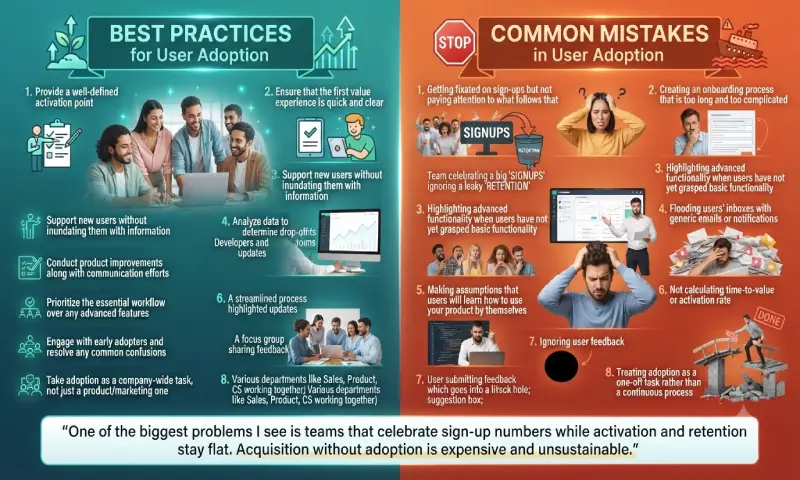
- Provide a well-defined activation point
- Ensure that the first value experience is quick and clear
- Support new users without inundating them with information
- Analyze data to determine drop-off points
- Conduct product improvements along with communication efforts
- Prioritize the essential workflow over any advanced features
- Engage with early adopters and resolve any common confusions
- Take adoption as a company-wide task, not just a product/marketing one
Common mistakes:
- Getting fixated on sign-ups but not paying attention to what follows that
- Creating an onboarding process that is too long and too complicated
- Highlighting advanced functionality when users have not yet grasped basic functionality
- Flooding users’ inboxes with generic emails or notifications
- Making assumptions that users will learn how to use your product by themselves
- Not calculating time-to-value or activation rate
- Ignoring user feedback
- Treating adoption as a one-off task rather than a continuous process
One of the biggest problems I see is teams that celebrate sign-up numbers while activation and retention stay flat. Acquisition without adoption is expensive and unsustainable.
Frequently Asked Questions
What does product adoption mean?
It means the process through which one convinces users to move from registration to using the product.
What distinguishes adoption from acquisition?
Adoption pertains to convincing users to register or use the service for the first time, while acquisition refers to convincing users to use the product efficiently and consistently.
What is an activation metric?
This term denotes the concrete action that demonstrates the user’s receipt of value. This includes activities such as creating a project, inviting a colleague, performing a key workflow, or hitting a certain usage milestone.
How much time does onboarding require?
As little as possible but enough to allow the user to achieve some value. The majority of products try to create the first value for the user in minutes, not days.
Who is responsible for product adoption?
This responsibility typically falls on several teams such as product, product marketing, customer success, and growth.
Conclusion
Adoption is how you convert new users to paying customers. Getting people to reach their value fast and adopt a habit of using the product increases retention, makes your revenue more predictable, and accelerates your growth.
Think about the early experience. Figure out what success means for a new user. Reduce friction. Help people take the steps that bring them value. Measure your progress and continuously improve.
Acquisition helps you get people’s attention. Adoption helps you make that attention stick. The products that equally emphasize acquisition and adoption usually generate better growth.
The guides on Go-to-Market Strategy, Product Positioning, Product Messaging, Product Launch Strategy, and Product Marketing Metrics will help you with the other pieces necessary for good adoption.