


The failure of most products lies not in the product itself, but in the fact that the company does not know how to make the right marketing strategy to reach its customers properly. This is what a go-to-market strategy is about.
Go to market strategy (GTM) can be described as a distribution plan for your product or service. In simple terms, it addresses all the important questions like – Who is our ideal customer? How would he know about us? Why should he pick us and not others? How are we going to make a deal and keep him?
It is very sad to see that while the team spends a lot of time developing an excellent product, it does not care about anything other than just launching the product without any strategy for reaching customers. Consequently, the product remains in the warehouse, there is no traffic and no sales either. All this could have been avoided with a proper GTM strategy. This guide is all about GTM strategies.
Go-To-Market Strategy: Meaning and Key Concepts
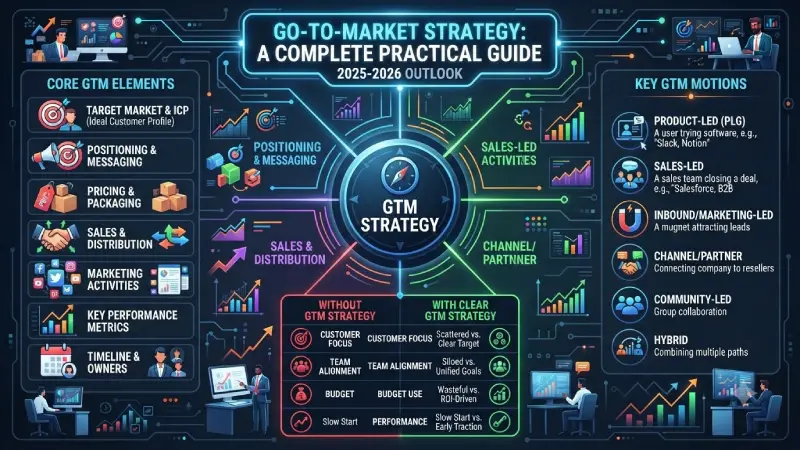
The go-to-market strategy is an approach to selling and delivering products to their intended consumers through a combination of market, customers, offer, channels, pricing and integration of sales and marketing activities. It is not the same as the marketing plan which focuses mainly on marketing campaigns and marketing contents. The GTM strategy is more comprehensive than the marketing plan in that it entails product positioning, sales motion, pricing and distribution among other elements.
Key pieces of a GTM strategy usually include:
- Target market and Ideal Customer Profile (ICP)
- Positioning & Messaging
- Pricing & Packaging
- Sales & Distribution
- Marketing activities driving the motion
- Key performance metrics
- Timeline and owners
In a nutshell, GTM is the connection between “we made something” and “people are buying it.”
Why Go-To-Market Strategy Matters
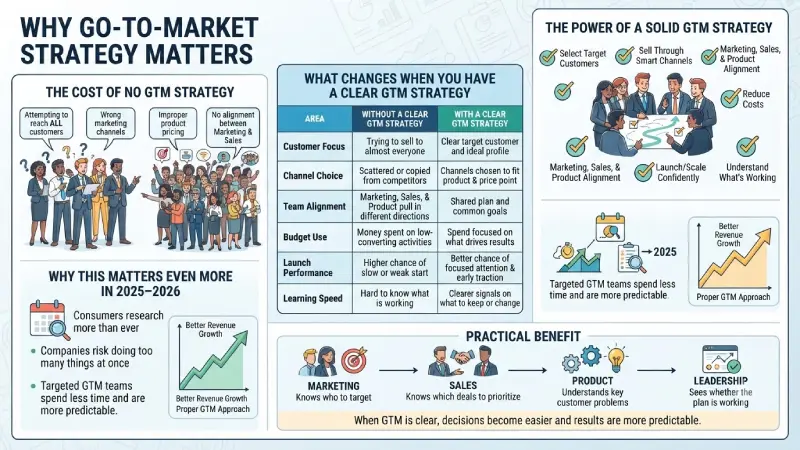
A lack of a GTM strategy makes costly errors unavoidable for companies. They attempt to reach out to all customers. They use wrong marketing channels. They price their products improperly. There is no alignment between marketing and sales.
A solid go-to-market strategy helps you:
- Select target customers rather than trying to reach all customers
- Sell through channels that make sense for your products and pricing
- Make your marketing, sales, and product development processes work together
Save money by reducing costs for non-converting activities
Feel confident to launch or scale up your product
Understand more about what is working and what isn’t
The recent observations from 2025 and 2026 indicate that organizations with a proper GTM approach often experience better revenue growth and greater success of launches compared to those for which go-to-market approach is not important at all. It is hard to implement GTM in practice even if there is a strategy behind that.
At the moment, the market requires you to provide buyers with more information and a clearer GTM approach.
What Changes When You Have a Clear GTM Strategy
| Area | Without a Clear GTM Strategy | With a Clear GTM Strategy |
| Customer Focus | Trying to sell to almost everyone | Clear target customer and ideal profile |
| Channel Choice | Scattered or copied from competitors | Channels chosen to fit product and price point |
| Team Alignment | Marketing, sales, and product pull in different directions | Shared plan and common goals |
| Budget Use | Money spent on low-converting activities | Spend focused on what actually drives results |
| Launch Performance | Higher chance of slow or weak start | Better chance of focused attention and early traction |
| Learning Speed | Hard to know what is working | Clearer signals on what to keep or change |
Why This Matters Even More in 2025–2026
Consumers research and analyze more options and get more clarity about their value proposition than ever before. Meanwhile, lots of companies attempt to do too many things at once and even make sharp turns. Targeted GTM teams spend less time and are more predictable.
Even though a smart go-to-market strategy does not guarantee success, it avoids the greatest mistakes that could have a disastrous effect on your project – wrong consumers, wrong communication channels, and lack of coordination between teams.
Practical Benefit
When the GTM is clear and actually used, decisions become easier. Marketing knows who to target. Sales knows which deals to prioritize. Product understands which customer problems matter most. Leadership can see whether the plan is working.
Without it, the same teams often stay busy while results stay unpredictable.
Key Types, Methods, and Examples
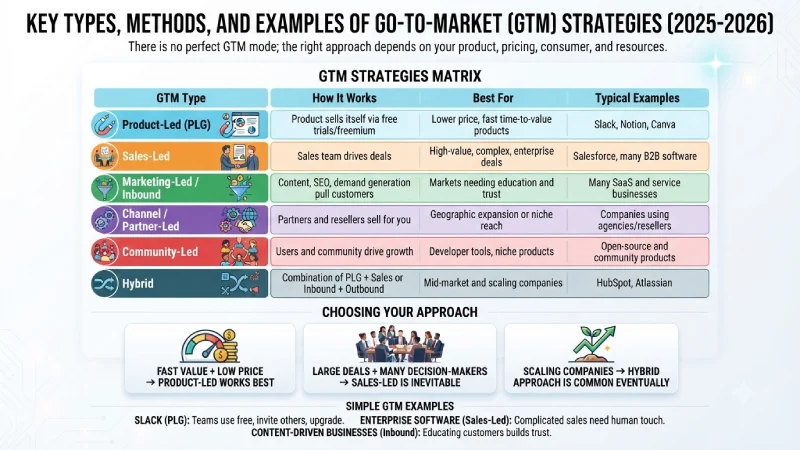
It does not exist any perfect mode of entering the market. Your way of entering the market would depend upon your product, pricing, consumer, and resources. Below are some of the most commonly used methods in 2025-2026.
| GTM Type | How It Works | Best For | Typical Examples |
| Product-Led (PLG) | The product sells itself through free trials or freemium | Lower price, fast time-to-value products | Slack, Notion, Canva |
| Sales-Led | Sales team drives the deals | High-value, complex, enterprise deals | Salesforce, many B2B software tools |
| Marketing-Led / Inbound | Content, SEO, and demand generation pull customers in | Markets that need education and trust | Many SaaS and service businesses |
| Channel / Partner-Led | Partners and resellers sell for you | Geographic expansion or niche reach | Companies using agencies or resellers |
| Community-Led | Users and community drive growth | Developer tools, niche products | Open-source and community products |
| Hybrid | Combination of PLG + sales or inbound + outbound | Mid-market and scaling companies | HubSpot, Atlassian |
Choosing between approaches:
- When there’s a fast value delivery and the price is not high, product-led approach works best.
- For large deals that include many decision makers and are customized, sales-led is inevitable.
- The vast majority of scaling companies go for a hybrid approach eventually.
Simple examples:
- The growth of Slack was largely driven by product-led motion, where teams would use the platform for free, invite others to join, and then upgrade.
- Most enterprise software companies still drive motions through a sales-led motion because the sale is complicated.
- Those who educate their consumers a lot practice inbound marketing in GTM.
How to Use or Apply Go-To-Market Strategy
The process of making GTM is pointless unless you implement it. This is how you can use it effectively.
- Define the target customer clearly
Write a specific ideal customer profile. Vague targets lead to vague marketing. - Clarify positioning
Think about what distinguishes your offer and how it is important to the target customer. - Choose the primary motion
Pick one main way of reaching and converting customers. Add a second motion only if needed. - Set pricing and packaging that match the motion
Product-led products need simple, self-serve pricing. Sales-led products can support more complex packages. - Align the teams
Marketing, sales, product, and customer success all have to know the same strategy. - Define the key metrics
Measure both leading (pipeline, activation, conversion) and lagging (revenue, retention) indicators. - Launch, measure, and adjust
Treat the first 90 days as a learning period. Keep what works. Drop what does not.
A practical tip: Write your GTM on one or two pages first. Long documents often get ignored. A short, clear plan that the whole team understands is more useful.
Best Practices and Common Mistakes
Best practices:
- Define the ideal customer first, rather than the entire market
- Pick one core GTM motion and back it up
- Coordinate messages between marketing and sales teams
- Look at early indicators, not just eventual sales numbers
- Keep it simple so people can actually use it
- Revisit and refine each quarter
- Ensure that the product experience matches your motion
Common mistakes:
- Trying to run too many motions at once
- Building a detailed plan and then ignoring it
- Choosing channels because competitors use them
- Ignoring the handoff between marketing and sales
- Setting pricing without testing value perception
- Launching without clear success metrics
- Changing the strategy too often before giving it time to work
One of the biggest problems I see is companies that create a GTM document for the board or investors and then go back to doing whatever they were doing before. The strategy will be effective only if it influences weekly decisions.
Frequently Asked Questions
What is a go-to-market strategy?
It is the roadmap which describes how you’ll approach, convince and sell to your potential clients. GTM answers questions about who is the target client, how to reach him, positioning and closing deals.
How does GTM differ from marketing plan?
Marketing plan focuses on campaigns and channels. GTM is more wide concept including sales motions, pricing, positioning, customer acquisition across the organization etc.
What are the most common GTM models?
The most popular of these are: product-driven, sales-driven, marketing-driven/inbound, channels/partnership driven
How long does it take to create a GTM strategy?
A concentrated GTM can be built within 3-4 weeks if the team knows its customer and product. The hardest part is usually the execution and alignment.
What is the biggest GTM failure?
Trying to serve everyone and running too many channels/motions simultaneously.
Conclusion
Go to market strategy need not be a complex document. It is an unambiguous plan that helps define your target audience, marketing channels, and methods of conversion.
If your plan is clear and well executed, then launches will go smoothly, funds will be used effectively, and growth will become predictable. Without a strategy, even a great product will find itself in trouble.
Start with your customers. Pick a primary motion. Get your teams aligned. Define metrics. Iterate. This straightforward approach is still superior to many complex methodologies.
The related guides on Product Positioning, Product Messaging, Product Launch Strategy, Product Adoption, and Product Marketing Metrics explore in detail the components of a go-to-market strategy.