


Why Target Marketing Most businesses want to target everybody. It sounds safe. However, in actuality, it is one of the best methods for wasting money.
A target market is nothing more than the particular group of people who are most likely to purchase your products or services. Once you know exactly who those people are, all other marketing activities become easier – messaging, media channels, offers, even product design.
I’ve seen small businesses turn their fortunes around just from ceasing to think “everybody is my customer” and focusing on specifics. This guide will help you understand what target markets are, why they are important, various types of target markets, ways to select your own target market, and mistakes to be avoided.
Target Market: Meaning and Key Concepts
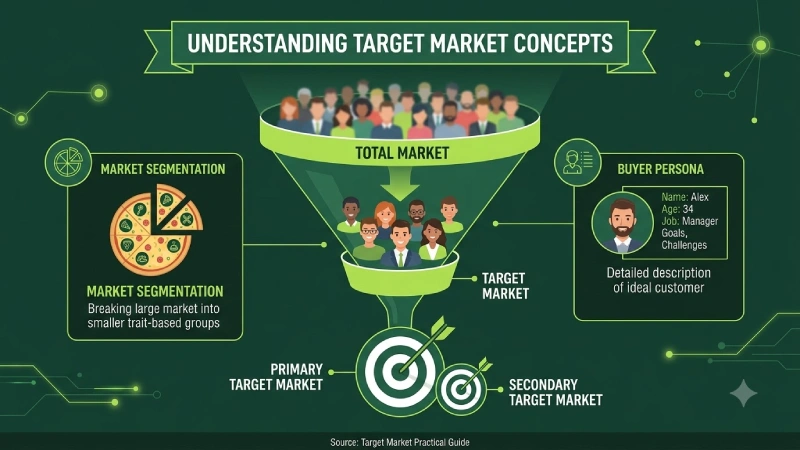
Target Market refers to the selected customers that your business decides to serve. These are the customers who face the problems that you solve, have enough money to spend, and are willing to buy.
This is in contrast to Total Market which includes all those customers that can potentially buy. However, target market is a subset of total market.
Main concepts for comprehension:
- Segmentation of the market: Separating an entire market into several smaller segments possessing common qualities.
- Target market: A particular segment (segments) that you have chosen to concentrate on.
- Buyer persona: A semi-fictional profile of your perfect buyer.
- Primary target market: Your main focus, which is also the most valuable market.
- Secondary target market: Other markets that can also purchase from you, but are secondary in importance.
Common ways to define a target market:
| Segmentation Type | What It Looks At | Simple Example |
| Demographic | Age, gender, income, education, job | Women 28–40, household income $70k+ |
| Geographic | Location, climate, urban/rural | People living in major cities in the US |
| Psychographic | Values, lifestyle, interests, personality | Eco-conscious, minimalist, health-focused |
| Behavioral | Buying habits, usage, loyalty, benefits sought | People who buy premium products online regularly |
| Firmographic (B2B) | Company size, industry, revenue | SaaS companies with 10–50 employees |
Most strong target markets combine at least two or three of these.
Why Target Market Matters
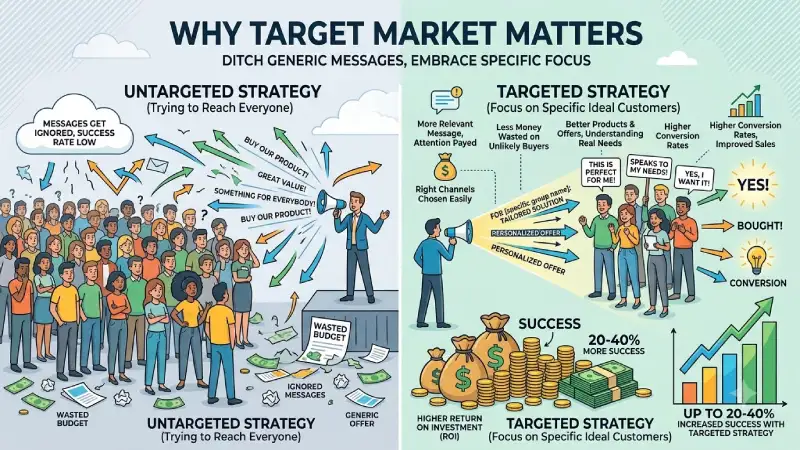
Trying to reach everyone usually means your message becomes generic. Generic messages get ignored.
Here’s why getting specific helps:
- Your marketing becomes more relevant, so people pay attention.
- You waste less money on people who were never going to buy.
- You can create better products and offers because you understand real needs.
- Your conversion rates usually improve.
- It becomes easier to choose the right channels.
Studies in recent times have shown that those organizations that manage to precisely define their target customers and provide personalization in their strategy have witnessed a higher return on their marketing investment. They have achieved anywhere between 20 to 40 percent more success compared to other organizations with untargeted marketing strategies.
Briefly put, having a narrower focus tends to yield greater success than being all things to all people.
Key Types, Methods, and Examples
There is no single “best” way to define a target market. The right approach depends on your business.
Main types of target markets:
| Type | Best For | Strength | Limitation |
| Demographic-focused | Consumer products, apps | Easy data, clear targeting | Doesn’t explain why people buy |
| Psychographic-focused | Brands with strong identity | Deeper connection and loyalty | Harder to measure |
| Behavioral-focused | E-commerce, SaaS, services | Based on real actions | Needs good data |
| Geographic-focused | Local businesses, regional products | Practical for location-based offers | Can be too narrow |
| Hybrid (most common) | Almost every business | More accurate picture | Takes more work to define |
Comparison of Main Segmentation Types
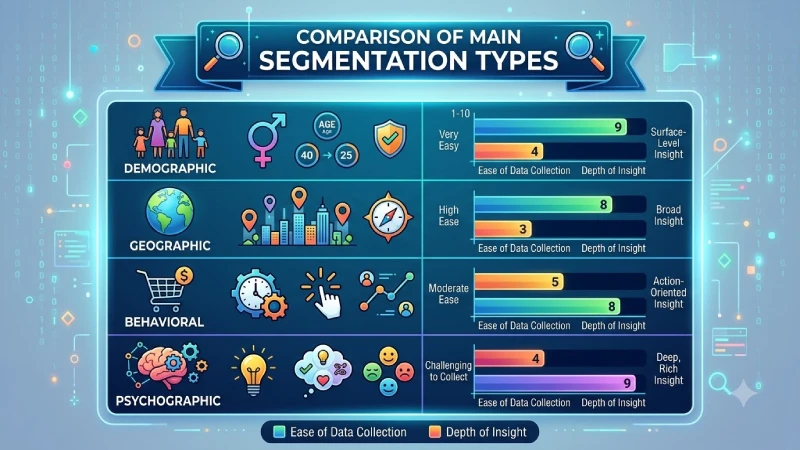
| Segmentation Type | Ease of Data Collection (1-10) | Depth of Insight (1-10) |
| Demographic | 9 | 4 |
| Geographic | 8 | 3 |
| Behavioral | 5 | 8 |
| Psychographic | 4 | 9 |
Real-world style examples:
- The fitness application can target: Professionals age group 30-45 who look for efficiency, exercise 2-3 times in a week and are ready to pay for convenience.
- The accounting service can target: Online service business with 5-20 staffs who get fed up with using spreadsheet.
- The sustainable fashion can target: Women age group 25-40 who are environmentally conscious and prefer to buy quality products online.
Methods to find your target market:
- Look at your current best customers (if you have any).
- Study competitors and see who they focus on.
- Communicate with prospective clients through surveys and interviews.
- Conduct research from web and advertising analytics to determine existing engagement.
- Craft basic buyer personas with the gathered data.
Where to add a bar chart:
In this section, after the types table, add a bar chart comparing the four main segmentation types (Demographic, Psychographic, Behavioral, Geographic) by “Ease of Data Collection” and “Depth of Insight.” This helps readers quickly see the trade-offs.
How to Use or Apply Target Market
Defining your target market is only useful if you actually use it.
Here’s a practical way to apply it:
- Write a clear description
One or two paragraphs that describe your ideal customer in plain language. - Create a simple buyer persona
Give them a name, age range, job, main problems, goals, and where they spend time. - Use it to guide decisions
- Content topics
- Ad targeting
- Website language
- Product features
- Pricing
- Channels you choose
- Test and refine
Run small campaigns and see who actually responds. Adjust your target based on real results. - Share it with anyone who helps with marketing
Freelancers, agencies, or team members should all work from the same target description.
A simple monthly habit: Once a month, look at your new customers and ask, “Are we attracting the people we said we wanted?” If not, adjust.
Best Practices and Common Mistakes
Best practices:
- Start narrower than you think you should. You can always expand later.
- Combine different types of data (not just age and location).
- Update your target market as you learn more.
- Focus on the customers who bring the most value, not just the easiest ones to reach.
- Make the description specific enough that it guides real decisions.
- Talk to real customers regularly instead of only looking at data.
Common mistakes:
- Saying “everyone” is your target market
- Making the description too vague (“women who care about health”)
- Only using demographic data and ignoring behavior or values
- Creating a target market and then never using it
- Chasing large markets just because they look big
- Ignoring your actual best customers
- Changing the target too often before giving it time to work
One of the biggest problems I see is businesses creating a nice-looking persona document and then ignoring it when they make marketing decisions. The target market only helps if it actually influences what you do.
Marketing Performance Before and After Narrowing the Target Market
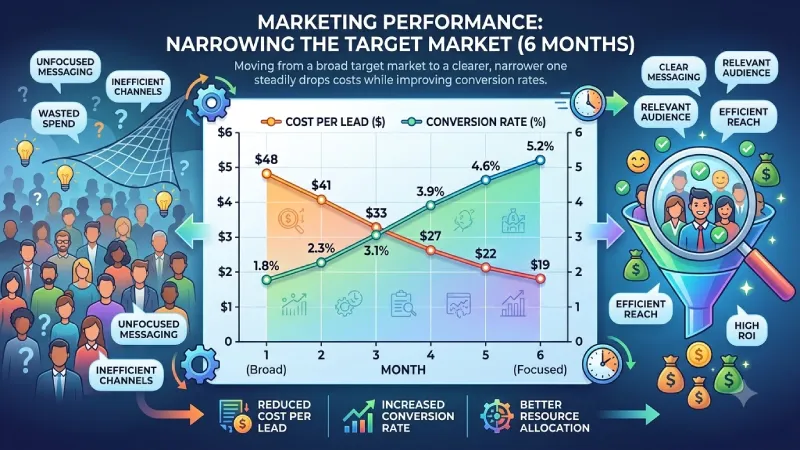
| Month | Cost Per Lead | Conversion Rate |
| Month 1 (Broad) | $48 | 1.8% |
| Month 2 | $41 | 2.3% |
| Month 3 | $33 | 3.1% |
| Month 4 | $27 | 3.9% |
| Month 5 | $22 | 4.6% |
| Month 6 (Focused) | $19 | 5.2% |
A very clear illustration of what is likely to occur when a business narrows down its target market from being broad can be seen in the following scenario. While the cost of leads was decreasing monthly, the conversion rate was rising in a six-month span of time..
Frequently Asked Questions
What is the difference between target market and target audience?
The target market is the larger pool of people you want to serve. The target audience is usually the smaller segment of people you choose to focus on with the help of a campaign.
How many target markets does a business need?
It is better for small and medium sized firms to choose one primary target market and possibly one or two secondary ones. Too many would be confusing.
How often should I update my target market?
Every 6-12 months or anytime you see major changes among the buyers.
Can the target market change over time?
Certainly. With any change in the product, pricing or market itself, the ideal target market may change too.
What if I have more than one customer type which is profitable for me?
Pick out the one that provides maximum profits or is easy to reach out to first.
Conclusion
Defining a clear target market is perhaps the greatest asset you could ever develop in marketing. This will make your communication more precise, your expenditures more efficient, and your decisions easier to make.
You do not necessarily need complete information to begin with. Start with your existing customers, define them precisely, and then base your further actions on this definition. And always continue to learn and improve.
It is these companies that have grown consistently which have had a precise understanding of who they serve. And this understanding will outperform any sophisticated marketing technique.