


The reason why most business ventures fail is not the lack of quality in the product they are offering but rather the lack of a strategy for presenting that product to their market. A marketing plan is just that; a guide in writing that outlines your strategies, the target audience, the methods you will use to approach them and how you will measure the success.
I have come across individuals who start out by advertising immediately, and although they receive a lot of likes and clicks, nothing much is realized. This kind of a strategy is avoided through proper marketing plans.
In this guide, we will cover all about marketing plans, including what marketing plans entail, importance of having one, the various types of marketing plans, how to develop one and use it, and mistakes that cost much time and money.
Marketing Plan: Meaning and Key Concepts
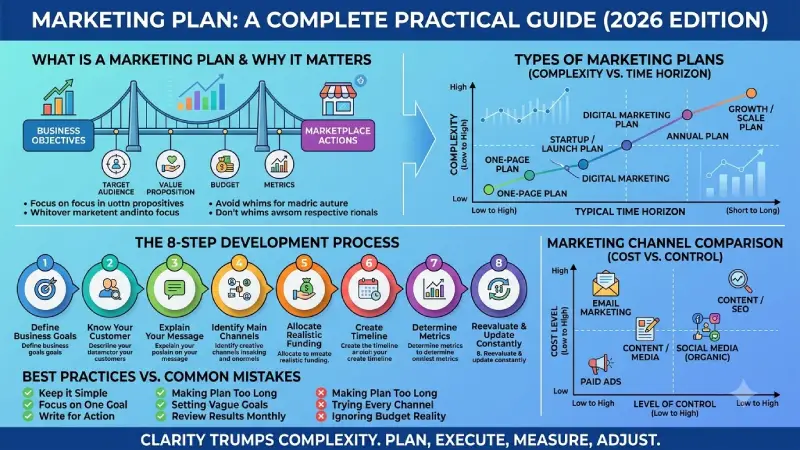
Marketing plans can be defined as written statements that describe your marketing objectives and how to achieve them. It bridges your objectives and what actions you will be undertaking in the marketplace to accomplish your goals.
Marketing plans essentially answer some basic questions:
- Who are we trying to reach?
- What do we want them to do?
- How will we reach them?
- How much will it cost?
- How will we know if it’s working?
It is not synonymous with the business plan. The business plan addresses all aspects of the business (the product, operational aspects, financial aspects, and the team). Marketing plans address only customer acquisition and retention.
Key concepts you should understand:
- Target Audience: Who are those specific individuals that you are targeting.
- Value Proposition: The clear value proposition which would make anyone choose you.
- Marketing Channels: The channels you will use to reach out to the audience via marketing (social networks, search engines, email campaigns, advertisements etc.)
- Budget: What is the budget you think is realistic for you?
- Metrics: The measurements for success.
- Timeline: Timing.
The marketing strategy of the company can either be short and simple if the company is small or detailed and formal if it is a big company. Size does not matter; only clarity counts.
Why Marketing Plan Matters
In the absence of a plan, marketing becomes a haphazard process where you act on whims, resort to desperate advertising, and make frequent changes to your course of action. This approach seldom succeeds but usually ends up costing you much more.
A clear marketing plan helps in several practical ways:
- You are forced to become more precise on whom you are targeting.
- It prevents you from being tempted by every new fad.
- It helps you in deciding what to reject.
- It enables you to have a benchmark for success and not just “feeling busy.”
- It is helpful when you are trying to convince your partner or an investor about your strategy.
Even a simple one-page plan is better than no plan. I’ve watched small businesses double their results just by writing down their target customer, main offer, and three main channels — then sticking to that for a few months.
With all the tools that exist by 2026, a plan becomes essential because there will be a lot to distract you. A plan will help you focus on those things that really matter to your business.
Key Types, Methods, and Examples
Marketing strategy is not uniform across the board; some strategies may suit some businesses at particular levels of development better than others.
Here are the most common types:
| Type of Marketing Plan | Best For | Focus | Typical Length | Time Horizon |
| Startup / Launch Plan | New businesses or new products | Getting first customers | Short to medium | 3–6 months |
| Annual Marketing Plan | Established businesses | Full-year strategy and budget | Detailed | 12 months |
| Product Launch Plan | New product or service | Creating awareness and first sales | Medium | 1–3 months |
| Digital Marketing Plan | Online-focused businesses | Website, content, ads, email | Medium to detailed | 3–12 months |
| Growth / Scale Plan | Businesses ready to expand | Increasing reach and revenue | Detailed | 6–18 months |
| Simple One-Page Plan | Solopreneurs and small teams | Clarity and focus | Very short | 1–3 months |
Comparison of Different Marketing plan Types by Two Things
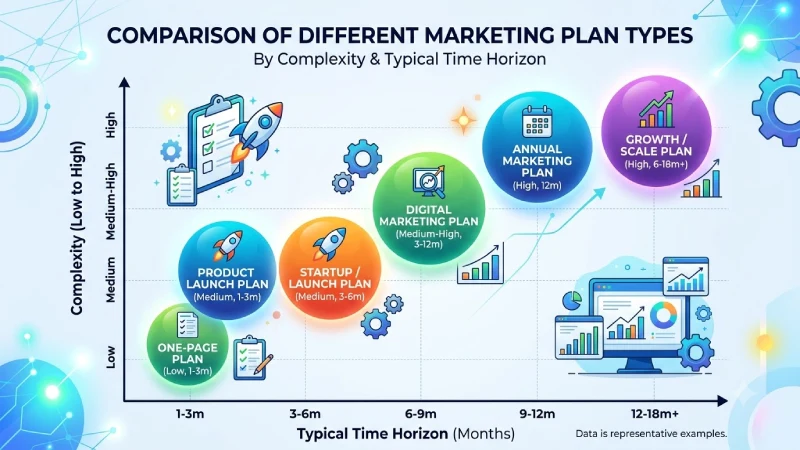
- Complexity (Low to High)
- Typical Time Horizon
Example data for the chart:
| Type of Plan | Complexity | Time Horizon |
| One-Page Plan | Low | 1–3 months |
| Startup / Launch Plan | Medium | 3–6 months |
| Product Launch Plan | Medium | 1–3 months |
| Digital Marketing Plan | Medium-High | 3–12 months |
| Annual Marketing Plan | High | 12 months |
| Growth / Scale Plan | High | 6–18 months |
Common methods used inside marketing plans:
- Content marketing (blogs, videos, guides)
- Search engine optimization (SEO)
- Paid advertising (Google, Meta, LinkedIn, etc.)
- Email marketing
- Social media marketing
- Partnerships and affiliate programs
- Events or webinars
- Referral programs
Simple example for a small online service business:
- Desired result: 30 new clients within 3 months
- The target audience: owners of small businesses, who have problems with accounting
- Main ways: Google searches, LinkedIn content, email follow-ups
- The key activities: writing 2 useful articles monthly, publishing LinkedIn posts and offering a 15-minute free consultation
- Budget: $800 per month
- Main indicators: requests from the website, appointments, new clients
A detailed document is not required. What is required is something that is simple enough that it is obvious what should be done next.
How to Use or Apply a Marketing Plan
Having a plan is useless if it sits in a folder. Here’s how to actually use one.
Step 1: Start by defining your business goals
Where do you want your marketing efforts to take your business in the next three to twelve months? More leads? Sales? Better customers? Retention?
Step 2: Know your customer
Who is your ideal customer? Age, location, profession, problems, goals, and their hangouts.
Step 3: Explain what you’re offering and your message
What is it that you’re offering, and why should anyone care? Express it in simple terms.
Step 4: Identify your main channels
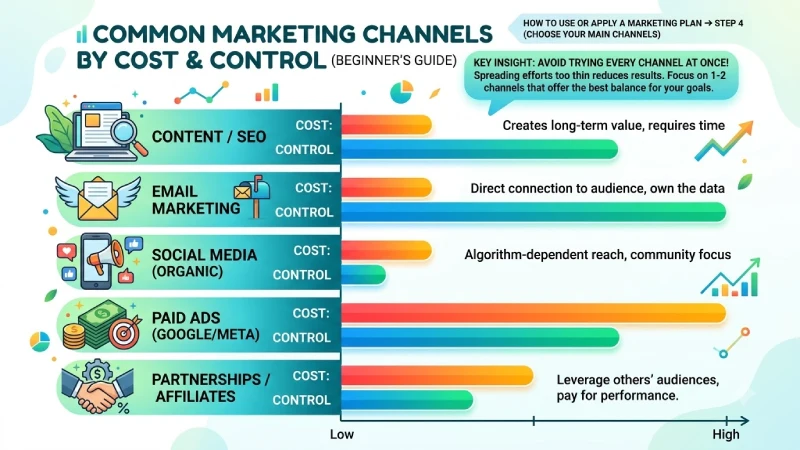
Select a few good channels to concentrate your efforts on rather than being everywhere. Most small businesses will perform better with 2-4 channels than 8.
A comparison of popular channels on two factors:
- Cost level (Low to High)
- Level of control you have
Channels to include:
- Content / SEO
- Email Marketing
- Social Media (Organic)
- Paid Ads (Google/Meta)
- Partnerships / Affiliates
This helps beginners understand why they shouldn’t try every channel at once.
Step 5: Allocate realistic funding
Make provision for tools, ads, content creation, and assistance you might require, as well as for your time.
Step 6: Timeline creation
What will you do in this month? In the coming month? What will be the key milestones?
Step 7: Determine how you will measure progress toward your objectives
Select two to three metrics (for example, number of leads, sales, cost per lead, conversion rate, etc.).
Step 8: Reevaluate and update your marketing strategy constantly
Check your plan monthly. Keep what works and change what doesn’t. This is not an assignment but a plan that should be checked each month and constantly changed if needed.
Practical way to start implementation: Make a list of marketing activities to do during one month based on your plan. List 5-7 the most important marketing activities and execute them.
Best Practices and Common Mistakes
Best practices that actually help:
- Keep the plan simple enough that you will use it
- Focus on one primary goal at a time
- Write for action, not for impressing anyone
- Include both free and paid methods if your budget allows
- Review results monthly and adjust
- Make sure every activity connects back to your target customer and goal
- Document what you learn so you don’t repeat the same mistakes
Common mistakes to avoid:
- Making the plan too long and complicated
- Setting vague goals (“get more customers”)
- Trying to use every marketing channel at once
- Ignoring the budget reality
- Not defining the target customer clearly
- Writing the plan and then never looking at it again
- Trying new strategies every week rather than following through on one until it is understood
- Not measuring the right thing (measuring vanity metrics rather than actual business results)
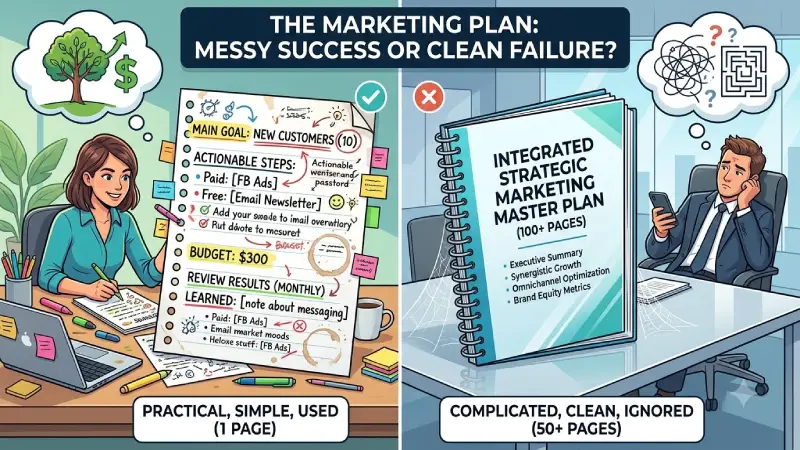
The most important problem that I can notice is when marketing plan is perceived by people as an assignment in school and made to look professionally, without even applying it for decision making process. One dirty and disorganized page that is used in real life is better than twenty clean pages which gather dust.
Frequently Asked Questions
How long should my marketing plan be?
The shortest possible while maintaining utility. For many small companies, it could be 1-4 pages. For big businesses, it could take longer.
How frequently should I update my marketing plan?
On a monthly basis. Conduct major updates quarterly or at least when there are significant changes to your business or marketplace.
Is it necessary to have a marketing plan if I am new to business?
Sure. This would help you in avoiding any mistakes and from wasting your efforts. Additionally, you can modify it in the future.
What is the difference between marketing plan and marketing strategy?
Strategy is an overarching vision of your business movement. Plan is its documentified embodiment.
Can I make my marketing plan on my own?
Yes, you can. In most cases, small business owners manage to develop a decent plan independently.
Conclusion
In order for a marketing strategy to work well, it is important that it is not complex. All that is required is for it to be clear. The information needed from it is that of who to target, what they want them to do, how to get to them, how much money will be spent, and the way to measure its success.
Businesses that achieve consistent results tend to those who prepare a simple marketing plan, stick to it long enough to understand how it affects the business, and make changes to their marketing strategies depending on the facts and not the feelings.
Prepare a simple marketing plan, make it specific, and use it every month.