

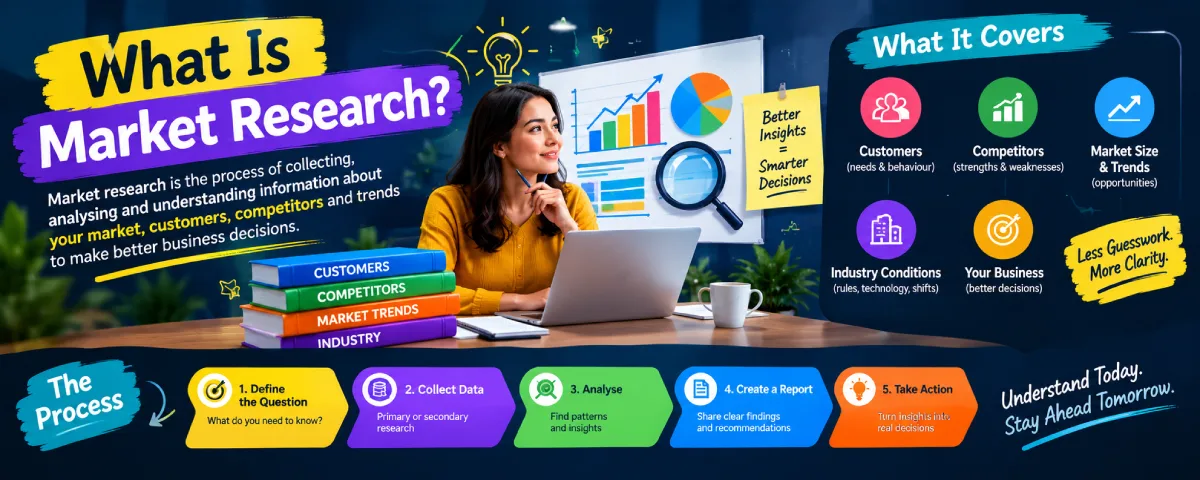
Market research is the process of gathering, analyzing, and interpreting information about the market, customers, competitors, and market trends. But why is it necessary? Just to stop guessing and making right decisions.
Many companies rely too heavily on guessing. They produce a product, determine price, use certain marketing strategy assuming what their customers require from them. It works sometimes. However, very often it is just a waste of valuable time and money. Market research can help you get rid of assumptions and use the facts instead.
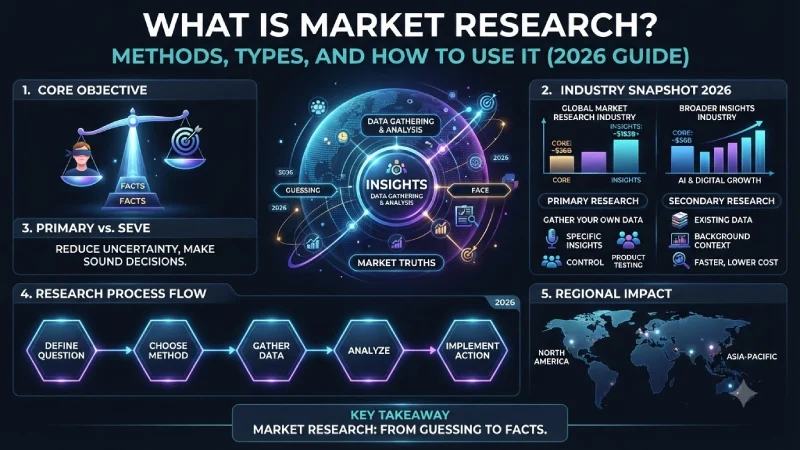
In this manual, we will analyze what market research is, why it is carried out by businesses, difference between primary and secondary research, how to conduct research and how to implement research results into the business..
What Is Market Research?
The market research process involves systematically gathering and analysing data concerning:
- Customers and potential customers
- Their needs, problems, and behaviour
- Competitors
- Market size and trends
- Industry conditions
It can be formal or informal, large-scale or small, expensive or low-cost. The core purpose stays the same: help the business understand the market well enough to make better decisions.
How Big Is the Market Research Industry?
Market research is not an insignificant activity. This is a massive and well-established industry in the world. In recent years, the main market research industry has been estimated at the level of around $50-56 billion, whereas the overall industry of insights (consisting of research, research software, and other consultancies) has been assessed at about $140-153 billion.
The development is moderate but stable, not explosive. There are many reports demonstrating single-digit annual growth in recent years, especially for digital technologies, AI-driven research, and analytics.
| Year / Period | Approximate Global Size | Notes |
| 2023–2024 | Core market research ~$50–56 billion Broader insights ~$140–153 billion |
Mature and consolidated market |
| 2025–2026 | Continued steady growth (low-to-mid single digits in many reports) | AI and digital research methods rising |
| Longer-term outlook | Projected continued growth into 2030 | Digital and AI-related segments growing faster than traditional methods |
The figures fluctuate slightly based on whether the analysis is limited to just traditional market research or the whole spectrum of analytics and insights. The bottom line is that companies around the world keep spending big bucks on their market knowledge.
Market Research vs the Broader Insights Industry
People sometimes use “market research” and “insights” interchangeably, but there is a practical difference:
- Market Research can be said to encompass traditional activities associated with gathering and analyzing customer, competitor, and market information.
- While Insights Industry is a broader term which may include Market Research along with research software platforms, data analytics solutions, and consultancy services enabling organizations to take decisions through data.
In any case, what matters to the business owner and marketer is less the difference than the practical result of obtaining better information.
Regional Picture
North America (particularly the USA) continues to be the largest market for market research. Europe is the next biggest continent. Asia Pacific has shown the greatest growth rates in recent times due to its burgeoning digital economy, growing consumer market, and increasing reliance on online market research in places like India, China, and South-East Asia.
Despite the size and professionalism of the industry, effective market research does not need to be expensive or elaborate. Many medium-sized firms find considerable benefit from straightforward market research.
Key elements of market research
| Element | What It Means | Why It Matters |
| Clear question | What you want to learn | Keeps research focused |
| Data collection | Gathering information | Provides the raw material |
| Analysis | Making sense of the information | Turns data into insight |
| Interpretation | Understanding what the findings mean for the business | Links research to decisions |
| Action | Using the findings | Creates real value |
Market research does not only involve gathering data. Market research involves answering significant business queries based on better information than speculation.
Why Businesses Conduct Market Research
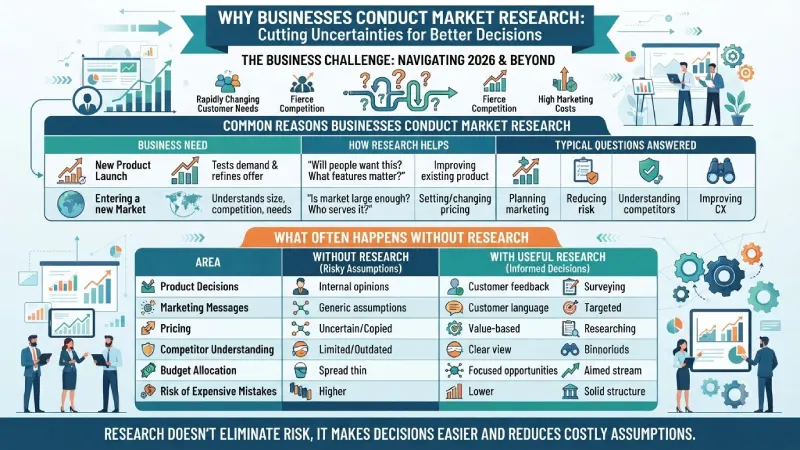
Market research is done by businesses to cut down on uncertainties. All business decisions come with an element of risk, whether it is the development of a new product, exploring a new market, pricing, or doing marketing. Though the research doesn’t eliminate risks, it makes decisions easier and reduces costly assumptions.
The year 2026 will be more challenging in making decisions than any other time. Customers’ needs change fast, competitions are fierce in almost all industries, and marketing costs continue being high. Businesses that conduct research find out things that don’t work early enough.
Common reasons businesses conduct market research
| Business Need | How Research Helps | Typical Questions Answered |
| Launching a new product | Tests demand and helps refine the offer | Will people want this? What features matter most? |
| Entering a new market | Understands size, competition, and customer needs | Is the market large enough? Who already serves it? |
| Improving an existing product | Identifies pain points and unmet needs | What frustrates customers? What do they wish was better? |
| Setting or changing pricing | Understands perceived value and market range | What are customers willing to pay? |
| Planning marketing campaigns | Improves messaging and channel choices | What messages resonate? Where do customers spend time? |
| Reducing risk | Challenges assumptions before major investment | What are we getting wrong? |
| Understanding competitors | Reveals positioning, strengths, and gaps | How do alternatives compare? Where can we stand out? |
| Improving customer experience | Highlights friction points in the journey | Where do customers struggle or drop off? |
What often happens without research
| Area | Without Research | With Useful Research |
| Product decisions | Based mainly on internal opinions | Guided by customer needs and feedback |
| Marketing messages | Generic or based on assumptions | Closer to real customer language and priorities |
| Pricing | Uncertain or copied from competitors | Informed by value perception and market range |
| Competitor understanding | Limited or outdated | Clearer view of strengths, weaknesses, and gaps |
| Budget allocation | Spread across many untested ideas | Focused on higher-potential opportunities |
| Risk of expensive mistakes | Higher | Lower |
Research vs No Research: Practical Impact
Business that forego research end up identifying their mistakes only after it is too late because money would have already been spent on something such as a product that fails to sell, a marketing campaign that flops, or even customer churn.
Research is especially valuable when:
- The choice is time and money-consuming
- There are robust, yet unproven, assumptions
- The market situation or customers’ behavior has changed
- Several alternatives are under consideration, and there is a need for clarification
Market research is not supposed to give you absolute certainty. Instead, it is intended to replace blind guessing with more knowledge to enable sounder decisions to be made. Organizations that view research as a component of the decision-making process will find themselves adjusting much faster without wasting their time on non-market-oriented concepts..
Why Market Research Matters Even More in 2026
Several factors have made good research more valuable in recent years:
- The degree of competition has risen in most sectors, rendering generic messages irrelevant.
- The needs of consumers change fast, especially when it comes to convenience, price visibility, and the web.
- The costs of advertising in various media stay high, meaning that any money wasted through ineffective messaging carries greater consequences than before.
- The development of new technologies has simplified and made research more cost-effective, increasing the divide between companies that conduct research and those that simply assume their conclusions without it.
Companies that view research as a component of decision-making are able to adjust much quicker and avoid costly mistakes. Companies that depend on assumptions alone end up learning about problems long after spending money.
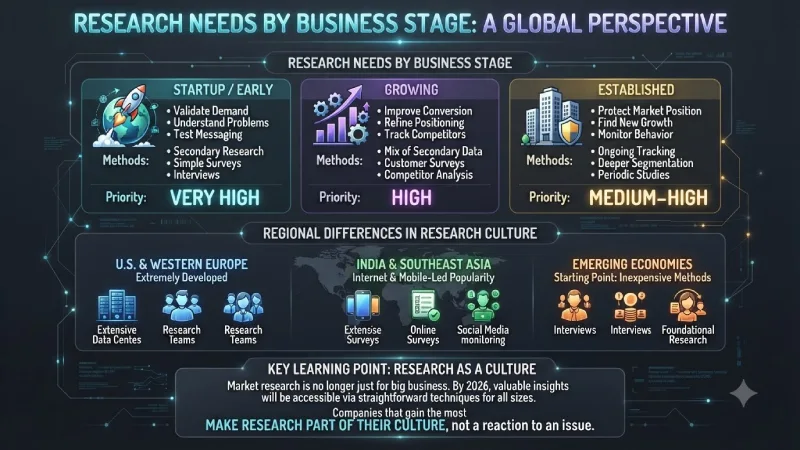
Research Needs by Business Stage
Different stages of business need different levels and types of research.
| Business Stage | Main Research Focus | Typical Methods | Priority Level |
| Startup / Early | Validate demand, understand core customer problems, test messaging | Secondary research + simple surveys and interviews | Very High |
| Growing | Improve conversion, refine positioning, understand segments, track competitors | Mix of secondary data, customer surveys, and competitor analysis | High |
| Established | Protect market position, find new growth opportunities, monitor shifts in customer behaviour | Ongoing tracking, deeper segmentation, periodic primary studies | Medium–High |
Start-up firms receive the maximum value from research because there is a huge risk involved when developing an unsuitable product or designing for an unsuitable audience. Expanding firms leverage research to help them expand more effectively. Firms that have already expanded use research to keep them updated and prevent decline.
Regional Differences
Research culture and methods are not exactly the same everywhere:
- Market research in the U.S. and most of Western Europe is an extremely developed field. Numerous organizations allocate funds for carrying out both primary and secondary research.
- In some Asian countries (India and Southeast Asia), internet-based and mobile-led research approaches have gained widespread popularity. Online surveys, social media monitoring, and rapid secondary research have become common practice, particularly among newly founded organizations.
- Across emerging economies, organizations tend to begin their market research journey from inexpensive secondary research and customer interviews.
The underlying principles are consistent in all locations – ask precise questions, apply the least invasive technique to answer those questions, and take the results and act on them. The difference lies in the specific techniques used, how quickly digital technology is adopted, and how formal the research process typically is.
Key learning point
Market research is not just for big business anymore. By 2026, it will be possible to get valuable information using relatively straightforward techniques even for smaller groups. The companies that stand to gain the most are those who make market research part of their culture, not a reaction to an issue.
Primary vs Secondary Market Research
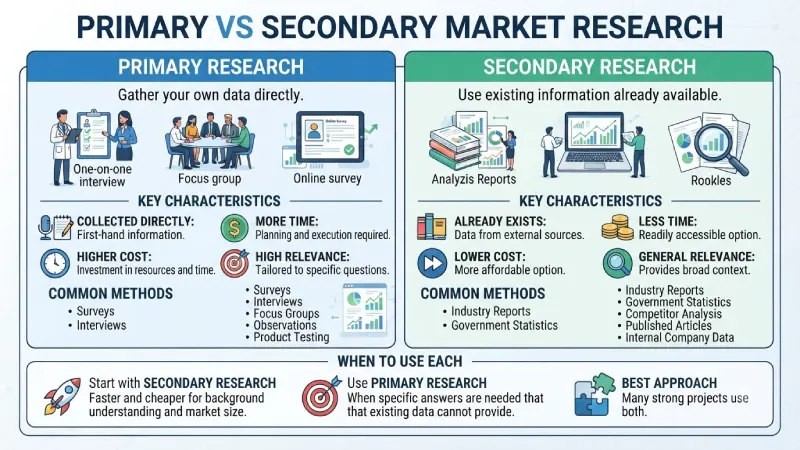
There are two main categories of market research: primary and secondary.
Primary research
You gather your own data (or have it gathered for you). It may be in the form of surveys, interviews, focus groups, product testing, and observations..
Secondary research
You use information that is already available. This includes industry reports, government statistics, competitor sites, company information, and research publications..
Clear comparison
| Aspect | Primary Research | Secondary Research |
| Source of data | Collected directly | Already exists |
| Cost | Usually higher | Usually lower |
| Time required | More | Less |
| Relevance | High (specific to your question) | Can be general or slightly outdated |
| Control | High | Limited |
| Best used for | Specific customer insights, testing ideas | Background understanding, market size, trends |
| Common methods | Surveys, interviews, tests, observation | Reports, statistics, competitor reviews, internal data |
When to use each
- Start with secondary research in most cases. It is faster and cheaper.
- Use primary research when you need specific answers that existing data cannot provide.
- Many strong research projects use both.
Advantages and Disadvantages in More Detail
Both kinds of research can be helpful. Which is best for you will depend on your question, schedule, and financial considerations.
Primary Research – Advantages and Disadvantages
| Advantages | Disadvantages |
| Highly specific to your exact question | Takes more time to complete |
| You control the questions and the sample | Usually costs more |
| Can reveal new insights that do not exist yet | Needs careful design to avoid bias |
| Excellent for testing ideas before launch | Harder to do well with very limited resources |
| Data is fresh and reflects current conditions | Results depend heavily on who you ask |
Secondary Research – Advantages and Disadvantages
| Advantages | Disadvantages |
| Much faster to complete | May not perfectly match your specific question |
| Lower cost (often free or low-cost) | Data can be outdated |
| Good for market size, trends, and competitors | You have limited control over how data was collected |
| Helps you avoid starting from zero | Quality varies widely between sources |
| Useful for building initial understanding | May lack the depth needed for final decisions |
Cost and Time Comparison (Realistic 2026 Ranges)
| Research Type | Typical Time Required | Typical Cost Range (Small to Mid-sized Business) | Notes |
| Secondary research | A few days to 2 weeks | $0 – $2,000 | Many useful sources are free |
| Simple primary (online surveys) | 1–3 weeks | $100 – $2,500 | Depends on tools and incentives |
| Interviews / qualitative | 2–6 weeks | $500 – $5,000+ | Higher if done by an agency |
| Mixed research project | 3–8 weeks | $1,000 – $10,000+ | Combines both approaches |
These ranges vary by industry, country, and whether the work is done in-house or outsourced. Secondary research remains the clear winner for speed and cost in most situations.
When to Start with Secondary vs Primary
| Situation | Better Starting Point | Why |
| You need market size, trends, or competitor overview | Secondary research | Faster and usually enough for background |
| You want to understand your exact customers’ opinions | Primary research | Existing data is rarely specific enough |
| You are testing a new product, price, or message | Primary research | You need direct reactions |
| You have very limited time or budget | Secondary research first | Reduces unnecessary primary work |
| Existing data does not answer your key question | Primary research | New data becomes necessary |
| You want both context and specific answers | Start secondary, then primary | Most efficient sequence |
How Most Teams Combine Both in One Project
One of the most pragmatic approaches is the following:
- Conduct secondary research about the general market and competition and gather any possible information.
- Based on the results of this research, improve your question and find the gaps in your knowledge.
- Conduct primary research specifically targeted at filling these gaps.
- Analyse all information together.
- Make conclusions based on the general context and your particular findings.
Example
First, the company undertakes secondary research by studying industry reports and competitive offerings. It allows to realize that the product feature in question becomes popular in the industry. Then, they conduct a quick survey and interview several customers to find out what they think about it (primary research). Based on that information and taking into account the market situation, the decision is made.
Common Tools Used in 2026
| Research Type | Common Tools and Sources |
| Secondary | Google Trends, government statistics, industry reports, competitor websites, company analytics, Statista, research summaries, internal sales and website data |
| Primary | Google Forms, Typeform, SurveyMonkey, Zoom or phone for interviews, basic user testing tools, on-site feedback tools |
You do not need expensive software to start. Many useful projects begin with simple survey tools and publicly available data.
Typical Mistakes When Choosing Between the Two
- Jumping straight into primary research when good secondary data already exists
- Relying only on secondary research when the question needs specific customer answers
- Treating one secondary report as complete truth
- Designing primary research without first checking what is already known
- Over-investing in complex primary research for a decision that did not require it
- Collecting primary data but never comparing it with existing secondary information
The most efficient approach is usually to begin with secondary research, clarify what is still unknown, and only then invest in primary research to answer the remaining important questions.
How to Conduct Market Research
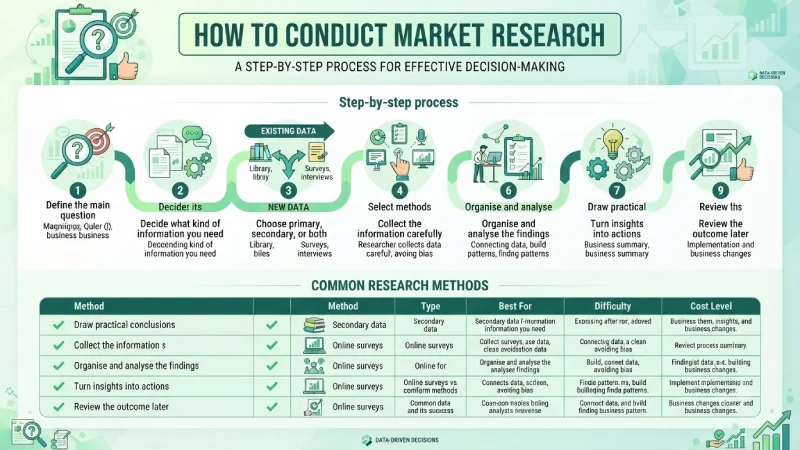
It does not have to be hard work, the research process. The key issue is to remain focused on the decision that you want to make.
Step-by-step process
- Define the main question
What do you need to understand before making a decision? - Decide what kind of information you need
Background data? Customer opinions? Competitor comparison? Behavioural evidence? - Choose primary, secondary, or both
Start with what already exists. Add primary research if needed. - Select methods
Match the method to the question and your resources. - Collect the information carefully
Keep questions clear. Avoid bias where possible. - Organise and analyse the findings
Look for patterns, not just individual comments or data points. - Draw practical conclusions
What do the findings mean for the business? - Turn insights into actions
Decide what will change based on the research. - Review the outcome later
Check whether the decisions improved results.
Common research methods
| Method | Type | Best For | Difficulty | Cost Level |
| Secondary data review | Secondary | Background and market context | Easy | Low |
| Online surveys | Primary | Structured feedback from many people | Easy–Medium | Low–Medium |
| Customer interviews | Primary | Deep understanding of motivations | Medium | Medium |
| Competitor analysis | Mixed | Positioning and offer comparison | Medium | Low–Medium |
| Product or concept testing | Primary | Reactions to new ideas | Medium | Medium |
| Website / behaviour data | Secondary/Primary | Understanding real user actions | Easy–Medium | Low |
Detailed Breakdown of Each Step
An effective process helps to guide research towards relevance. Below is an analysis of each stage:
Define the main question
Make it clear what decision needs to be taken and frame a good research question based on that decision..
This can be illustrated by, for example, changing the phrase “Should we introduce mid range pricing or not?” into “What is the reaction of our customers to mid range pricing scheme?”
Decide what kind of information you need
Identify if the requirements that you have include background information, customer opinions, competitive intelligence, behavioral research or any combination thereof.
Choose primary, secondary, or both
Secondary research should come first in most instances. Primary research should be introduced only when the data is insufficient.
Select methods
Match the method to the question, timeline, and budget. Simple methods are often enough.
- Collect the information carefully
Keep questions clear and neutral. Avoid leading people toward a preferred answer. - Organise and analyse the findings
Group similar points, look for patterns, and separate strong evidence from weak signals. - Draw practical conclusions
Focus on what the findings mean for the business, not just what the data says. - Turn insights into actions
Decide what will change and who will own the next steps. - Review the outcome later
Check whether the changes improved results. This improves future research.
How to Write Better Research Questions
Strong research questions are clear, focused, and tied to a real decision.
| Weak Question | Stronger Version |
| What do customers think about us? | What are the main reasons customers choose us or leave us? |
| Is our pricing good? | How do customers perceive the value of our current pricing tiers? |
| Do people like the new feature? | How beneficial is the newly introduced feature to users, and does it influence retention? |
| What should we do next? | Which of these three product improvements would create the most value for our core customers? |
| How is the market doing? | Is demand for this type of solution growing, stable, or declining in our target segment? |
Good questions need to be clear and open-ended in order to allow for real learning to occur.
How to Choose the Right Sample / Audience
The quality of research depends heavily on who you ask.
Practical guidelines:
- Focus on people who are in line with your target market customer.
- Always involve your recent customers, current users, or potential prospects where possible.
- For questionnaires, even 50 to 100 responses can offer valuable insights to small businesses.
- For interviews, 8 to 15 interviews tend to yield definite patterns.
- Do not limit yourself to those who like your brand.
- Always include those who thought about it but did not buy.
A few people who know what they are doing are better than many who don’t know what they are doing.
Simple 30-Day Research Plan Example
| Period | Focus | Main Activities |
| Days 1–5 | Clarify the question and review existing data | Define the decision, gather secondary research |
| Days 6–12 | Design and prepare | Create survey or interview guide, identify participants |
| Days 13–22 | Collect information | Run survey and/or interviews |
| Days 23–27 | Analyse findings | Look for patterns and key insights |
| Days 28–30 | Decide and plan action | Share findings, agree next steps, assign owners |
This type of basic timeline is suitable for research work.
Low-Cost vs Higher-Budget Options
| Budget Level | What You Can Typically Do | Best For |
| Low / Near zero | Secondary research, short surveys, customer interviews | Early questions and quick checks |
| Low to medium | Larger surveys, basic incentives, simple testing | Most small business decisions |
| Medium to higher | Professional studies, mixed methods, external help | Major product or market decisions |
A lot of research can be undertaken with small budgets as long as the problem being asked and the methodology is simple.
Common Tools Used in 2026
| Purpose | Common Tools |
| Surveys | Google Forms, Typeform, SurveyMonkey |
| Interviews | Zoom, Google Meet, phone calls |
| Secondary research | Google Trends, government data, industry reports, competitor sites, internal analytics |
| Behaviour and feedback | Website analytics, session recordings, on-site surveys |
| Organisation and notes | Google Docs, Notion, simple spreadsheets |
It does not require any advanced technological tools to begin. What really matters are relevant questions and their pursuit.
Good research always maintains its focus on the decision, uses the simplest way to answer the question, and results in action. When research follows this approach, it is very useful and not very intimidating..
Strong Evidence vs Weak Evidence
However, not all feedback should be treated equally. In learning how to discern good feedback from bad, you won’t be fooled by one single statement alone.
| Type of Evidence | Example | How Much Weight to Give It | Recommended Action |
| Strong | Same point repeated across many customers or data sources | High – prioritise action | Act on it soon |
| Moderately strong | Clear pattern in a reasonably good sample | Medium to high | Plan action after light validation |
| Weak | One or two isolated comments | Low – treat as a signal, not proof | Note it, but do not make big changes yet |
| Conflicting | Different customer groups give opposite feedback | Investigate further before acting | Dig deeper or segment the data |
| Outdated or low quality | Old data or poorly designed questions | Very low | Use only as background |
First look for repeating patterns. An individual opinion is intriguing, but it should rarely determine the outcome of a major decision.
Simple Framework: Insight → Implication → Action → Owner → Deadline
There is a simple formula that can be applied to each finding in order to turn it into an actual result:
| Step | What to Write Down | Example |
| Insight | What the research clearly shows | Many users find the pricing page confusing |
| Implication | What this means for the business | Confusion is likely reducing sign-ups |
| Action | What you will change | Simplify the pricing page and test clearer plan names |
| Owner | Who is responsible | Marketing lead |
| Deadline | When it should be done | Within 3 weeks |
Writing insights in this format makes it much easier to turn research into real work. It also creates clear accountability.
How to Present Findings to a Team
Even the best research may fall victim to poor presentation. An easy and straightforward way to share results appears below:
- Start off with the initial question and its importance.
- State only the major results (don’t state everything you got from the research).
- Present the most compelling patterns first.
- Discuss the implications of the results to the business.
- Conclude with recommendations and responsible parties.
The presentation should be short. In general, team members are more receptive to a short presentation rather than a lengthy report.
How to Measure Whether the Changes Worked
Research creates full value only when you check the results of the actions you took.
Practical ways to measure impact:
- Measure how the important statistic differs pre- and post-change (e.g., conversion rate, sign up rate, or customer support issues).
- Support the change long enough for it to be measurable.
- Also point out other external influences on the outcomes.
- Memorize everything that went well and didn’t work, for the next research to be more accurate..
A simple follow-up note after 30–60 days is often enough. Write down:
- What change was made
- What result you expected
- What actually happened
- What you learned
This habit turns one research project into lasting improvement.
How to Analyze and Use Research Findings
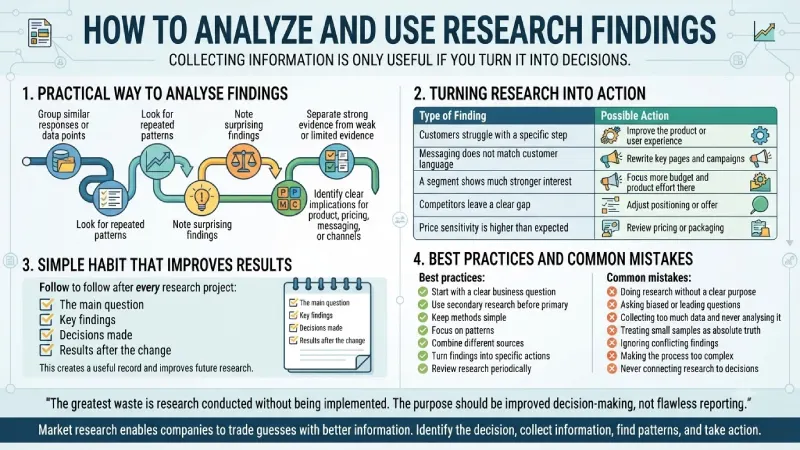
Collecting information is only useful if you turn it into decisions.
Practical way to analyse findings
- Group similar responses or data points
- Look for repeated patterns
- Note surprising findings
- Separate strong evidence from weak or limited evidence
- Compare findings against your original assumptions
- Identify clear implications for product, pricing, messaging, or channels
Turning research into action
| Type of Finding | Possible Action |
| Customers struggle with a specific step | Improve the product or user experience |
| Messaging does not match customer language | Rewrite key pages and campaigns |
| A segment shows much stronger interest | Focus more budget and product effort there |
| Competitors leave a clear gap | Adjust positioning or offer |
| Price sensitivity is higher than expected | Review pricing or packaging |
Simple habit that improves results
After every research project, write down:
- The main question
- Key findings
- Decisions made
- Results after the change
This creates a useful record and improves future research.
Best Practices and Common Mistakes
Best practices
- Start with a clear business question
- Use secondary research before primary when possible
- Keep methods as simple as the question allows
- Focus on patterns, not isolated opinions
- Combine different sources when useful
- Turn findings into specific actions
- Review research periodically as markets change
Common mistakes
- Doing research without a clear purpose
- Asking biased or leading questions
- Collecting too much data and never analysing it
- Treating small samples as absolute truth
- Ignoring findings that conflict with internal opinions
- Making the process too complex for the team to maintain
- Never connecting research to real decisions
The greatest waste is research conducted without being implemented. The purpose should be improved decision-making, not flawless reporting.
Best Thoughts
Market research enables companies to trade guesses with better information. It doesn’t have to be complex or cost too much to be beneficial. Simple market research, if conducted consistently, can benefit product strategy, messaging, pricing, and marketing efforts.
Identify the decision that needs to be made. Collect as much information as possible. Identify any patterns in the information collected and then take action. Companies that conduct market research in this way typically make less mistakes and are aligned with what their customers really want.
Market research becomes more effective the more consistently it is conducted.
Frequently Asked Questions
- What is the primary objective of market research?
It is aimed at reducing uncertainty and making better business decisions based on facts not assumptions.
- Can market research be used by small businesses?
Yes. Small firms may benefit more as they have less margin to make costly errors.
- What is the difference between primary and secondary research?
Primary research generates new data while secondary research uses the existing data.
- How costly is market research?
It may vary greatly. While secondary research is cheap or even free, primary research may include either cheap online surveys or more costly ones.
- How frequently should a firm conduct market research?
There is no specific recommendation on that. Yet, many companies find it beneficial to conduct regular light research and conduct bigger studies when making important decisions.
Conclusion
Market Research entails gathering and analyzing information so as to make business decisions based on evidence rather than intuition. It includes studying the market environment, the customers and the competitors through primary, secondary research or both.
The most successful market research is one that is specific, realistic and geared towards making decisions. Establish the questions that you want answered in the research, select the methodology, analysis and finally make decisions based on this. Companies who conduct this research frequently are bound to have a good grasp of their market and avoid wasting their resources on unrealistic business ventures.