

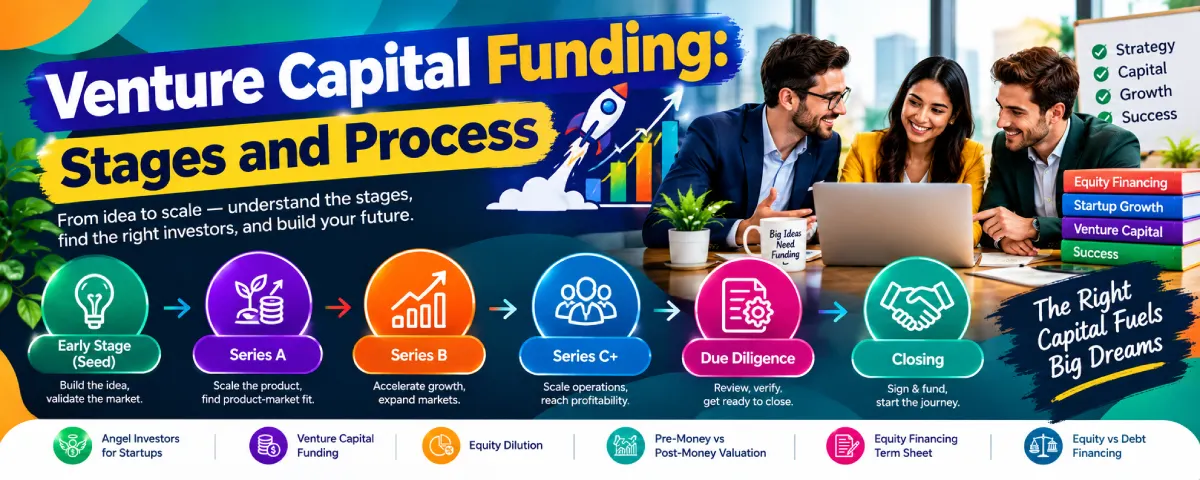
Venture Capital Funding: Stages and Process
Where to begin: Start with the main Equity Financing pillar guide first. Then use this focused guide to understand how venture capital works, which companies fit the model, and what the process actually looks like from first meeting to closing and beyond.
Venture capital is institutional money managed by professional firms. These firms raise capital from limited partners and invest it in high-growth startups in exchange for equity. In 2026 the market remains active, especially in artificial intelligence and related technologies, but investors are more disciplined than in the peak years. They look for clear evidence of product-market fit, repeatable growth, and a path to a large outcome.
This guide explains which businesses fit the venture capital model, how the main funding stages differ, how to research and approach firms, what happens during due diligence and closing, and how board roles and reporting change after the money arrives. The tone stays practical so founders can use the information directly.
Which businesses fit the venture capital model?
Not every good business is a venture-scale business. Venture capital is designed for companies that can grow very large, often into hundreds of millions or billions in value, within a reasonable time frame (usually 7–12 years).
Companies that fit well typically share these characteristics:
- Large addressable market with room for a dominant or meaningful player
- Ability to scale revenue quickly once product-market fit is found
- Potential for high gross margins or strong unit economics at scale
- Defensible advantages (technology, data, network effects, brand, or distribution)
- Team capable of building and leading a much larger organisation
Software, artificial intelligence, fintech infrastructure, climate technology, biotech platforms, and certain marketplace or hardware-enabled models often attract VC interest. Local service businesses, slow-growth consulting firms, traditional retail, or lifestyle companies usually do not, because the potential outcomes are too small to generate the returns VCs need for their funds.
A simple test many founders use: Can you honestly model a path to a $1 billion or larger outcome? If the answer is no, venture capital is probably the wrong tool. Other forms of financing (debt, revenue-based, grants, or profitable growth) may be better.
How do seed, Series A, and later rounds differ?
Funding stages are defined more by the proof a company has achieved than by the label on the round. Here is how the main stages typically look in 2026.
Seed stage
Purpose: Find or confirm product-market fit and early repeatable acquisition.
Typical raise: Often $2–5 million (ranges vary widely).
What investors want: Working product, early users or revenue, clear learning about customers, and a plan for the next 12–18 months.
Dilution: Commonly 15–20%.
Governance: Often light; board seats are less automatic than at later stages.
Series A
Purpose: Scale a model that already shows signs of working.
Typical raise: Frequently $8–18 million or higher in competitive sectors.
What investors want: Stronger evidence of retention, unit economics that can improve, a repeatable go-to-market motion, and a team ready to hire key functional leaders.
Dilution: Often around 18–23%.
Governance: Lead investor almost always takes a board seat. Reporting becomes more formal.
Series B and later
Purpose: Accelerate growth, expand into new markets or products, and build operational strength.
Typical raise: Tens of millions and upward.
What investors want: Clear scaling metrics, predictable growth, stronger financial controls, and a path toward profitability or a major liquidity event.
Dilution: Usually lower percentage than earlier rounds as valuations rise.
Governance: Larger boards, more formal processes, and heavier reporting requirements.
Each stage raises the bar on evidence. Raising a Series A before the company has finished the work of the seed stage often creates pressure and misalignment with the board.
How do you research and approach VC firms?
Targeted research beats mass outreach. The process that works for most founders in 2026 looks like this:
- Build a focused list
Identify 40–80 firms that invest at your stage, in your sector, and at cheque sizes that match your raise. Look at their recent investments, fund size, and whether they still have capital to deploy. - Qualify the partners
Find the specific partners or principals who lead deals in your space. Read their writing, podcast appearances, or portfolio company stories. Note any overlapping connections. - Prioritise warm introductions
Warm intros from portfolio founders, mutual advisors, or other investors convert far better than cold emails. Map your network carefully. - Prepare materials
Have a clear deck, a short one-pager, and a basic data room ready. Be ready to share more detail quickly if interest develops. - Sequence conversations
Start with firms that are good practice fits before approaching your top choices. Use early meetings to refine the story and gather feedback. - Follow up professionally
Most positive responses come after persistent, polite follow-up. Share meaningful progress updates rather than generic “just checking in” messages.
Cold outreach can work if it is highly relevant and concise, but warm paths remain the highest-converting route.
What happens during due diligence and closing?
Once a firm is seriously interested, the process moves from conversation to verification.
Pre-term-sheet diligence is usually lighter. Investors test the core thesis through meetings, customer calls, and basic review of metrics and the team.
Post-term-sheet diligence is more thorough. It typically covers:
- Financial statements and unit economics
- Customer references and revenue quality
- Legal and corporate records (cap table, IP assignments, material contracts)
- Technical or product review
- Background checks on founders and key team members
- Market and competitive analysis
A well-organised data room speeds everything up. Missing or inconsistent documents create delays and doubt.
After diligence is complete and definitive legal documents are negotiated, the round closes. Money is wired, shares are issued, the cap table is updated, and the new board member (if any) formally joins.
Timelines vary. A clean Series A process often takes 6–12 weeks from term sheet to close, sometimes longer if issues surface.
How do board roles and reporting change after funding?
Taking institutional capital changes governance.
Board composition
The lead investor in a Series A or later round almost always receives a board seat. Boards typically expand to include founders, the lead investor, and sometimes an independent director. Decisions that previously required only founder agreement now need board discussion or approval.
Reporting cadence
Most VCs expect monthly or quarterly financial and operational reports. Common contents include revenue, burn, runway, key performance indicators, hiring updates, and major risks or opportunities. The level of detail increases with later rounds.
Protective provisions
Investors usually receive veto rights over significant actions such as selling the company, raising more capital on certain terms, changing the business fundamentally, or large expenditures. These rights are listed in the financing documents.
Information rights
Investors receive regular updates and the right to inspect certain records. This is normal and helps them support the company, but it also means greater transparency is required.
Founders who treat the board as a resource rather than an obligation tend to get more value. Prepare clear materials, share bad news early, and use board meetings for real discussion rather than pure performance theatre.
Practical preparation before approaching VCs
- Confirm the business can realistically support a venture-scale outcome
- Reach the evidence level expected for the stage you are targeting
- Build a clean, current cap table and basic data room
- Create a target list of firms and partners with clear fit criteria
- Practise a concise, metrics-driven narrative
- Line up warm introduction paths
- Decide your raise amount, approximate valuation range, and must-have terms in advance
Common mistakes
- Approaching firms that do not invest at your stage or in your sector
- Raising a later-stage round before the company has the required proof
- Over-optimising for valuation at the expense of partner quality and terms
- Entering diligence with messy records or inconsistent numbers
- Underestimating the ongoing time cost of board and reporting obligations
- Treating every meeting as a close rather than a step in a longer process
Troubleshooting
Firms keep saying it is too early.
They are usually right. Focus on reaching the next set of proof points before trying again, or adjust the target list to earlier-stage investors.
Diligence is taking longer than expected.
Stay responsive, keep the data room updated, and communicate proactively about any open items. Delays often come from missing documents or hard-to-schedule reference calls.
Multiple term sheets arrive.
Compare the full package — valuation, ownership, board, protective provisions, and the quality of the partner — not just the headline number. Speak with founders who have worked with each firm.
The process feels overwhelming.
Break it into stages. Preparation, outreach, meetings, term sheet, diligence, and closing each have their own focus. Experienced counsel and advisors help keep the legal and process side manageable.
Frequently Asked Questions
How long does a typical VC raise take?
From serious outreach to money in the bank, many rounds take 3–6 months. Clean processes with strong traction can move faster; complicated situations take longer.
Do I need a lead investor?
For most priced rounds, yes. A lead sets the terms and helps bring in other investors. Some rounds close with a group of smaller cheques, but a clear lead simplifies the process.
What is the difference between a partner and a principal or associate?
Partners usually have the authority to lead deals and sit on boards. Principals and associates source and evaluate opportunities and support the partners. Building a relationship with the person who will champion the deal inside the firm matters.
How important is the data room?
Very. A clean, complete data room signals operational maturity and reduces friction during diligence. Many deals slow down or die because of disorganised information.
What happens if diligence uncovers problems?
Serious issues can kill the deal or lead to renegotiated terms. Smaller issues are often resolved with explanations, additional documents, or specific closing conditions. Honesty early is almost always better than discovery late.
Conclusion
Venture capital can accelerate growth dramatically for the right kind of company. It brings not only capital but also governance, networks, and pressure to scale. The process rewards preparation, clear evidence, and careful selection of partners.
Match your company’s stage and potential to the right firms, approach them in a targeted way, run a clean diligence process, and understand that the relationship continues long after the wire hits. Founders who treat fundraising as the start of a multi-year partnership rather than a one-time transaction tend to get more value from their investors.
Return to the main Equity Financing pillar page for the full overview. When you need more detail on angels, dilution math, valuation, term sheets, or equity versus debt, move to the relevant cluster guides. Raise deliberately, choose partners carefully, and keep building the business that justified the capital in the first place.