

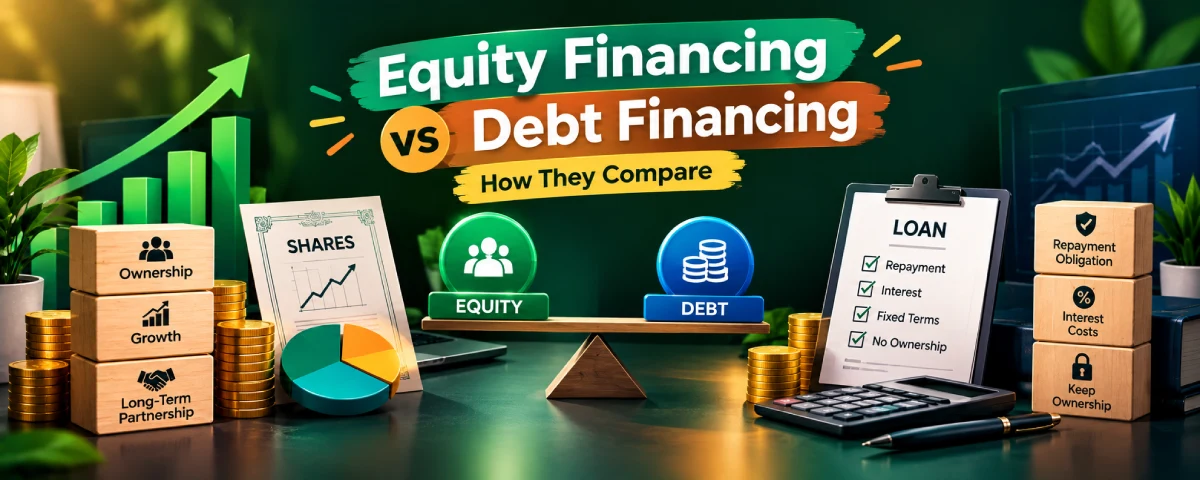
Equity Financing vs Debt Financing: How They Compare
Where to begin: Start with the main Equity Financing pillar guide first. Then use this focused guide to understand the real differences between selling ownership and borrowing money, and when each route (or a mix of both) makes sense.
Every growing company eventually faces the same basic choice: raise money by selling a piece of the business, or borrow money that must be paid back. Equity financing and debt financing solve the same problem — the need for capital — in fundamentally different ways. One permanently changes ownership and governance. The other creates a repayment obligation and usually leaves ownership intact.
In 2026 both tools remain widely used. Equity continues to dominate for high-growth technology and deep-tech companies that need large amounts of capital before they generate reliable cash flow. Debt, including traditional loans, venture debt, and revenue-based financing, has become more accessible for companies that already show predictable revenue. Many successful companies end up using a combination of both.
This guide compares the two approaches across the dimensions that matter most to founders: ownership and repayment, costs and return expectations, control and risk, suitability by stage, and when a hybrid approach works best. The goal is practical clarity so you can choose the tool that fits your company’s actual situation rather than the one that feels most familiar.
How do ownership and repayment obligations differ?
The core difference is simple and permanent.
Equity financing
You sell shares (or instruments that later convert into shares). The investors become owners. There is no legal obligation to repay the capital. If the company fails, the investors usually lose their money. If the company succeeds and is sold or goes public, the investors share in the upside according to their ownership percentage and any liquidation preferences.
Ownership dilution is permanent. Once the shares are issued, those percentage points are gone unless you later buy them back (which is rare and expensive).
Debt financing
You borrow money and agree to repay it, almost always with interest, according to a schedule. The lender does not become an owner. When the debt is fully repaid, the relationship ends (except for any residual warrants in the case of venture debt). Your ownership percentage stays the same.
The obligation to repay is real. If the company cannot make the payments, the lender can take action that ranges from restructuring the debt to forcing a sale of assets or, in extreme cases, pushing the company into insolvency.
Side-by-side view
| Aspect | Equity Financing | Debt Financing |
| Ownership impact | Permanent dilution | Usually none (except warrants in some cases) |
| Repayment obligation | None | Principal + interest on a schedule |
| What happens if company fails | Investors lose their capital | Lenders rank ahead of equity and may recover some value |
| Upside sharing | Investors share in all future value | Lenders receive only interest and principal |
| Balance-sheet effect | Increases equity | Increases liabilities |
This single distinction drives almost every other difference between the two forms of capital.
How do costs and investor return expectations compare?
The visible cost of debt is interest. The visible cost of equity is the ownership percentage sold. The true economic cost of equity is usually much higher once the company grows.
Cost of debt
In 2026, traditional bank or asset-based lending for qualified companies often carries all-in costs in the high single digits to low teens. Venture debt is more expensive — commonly 8–15% interest plus fees and a small warrant component. Revenue-based financing sits in a similar or slightly higher range and is repaid as a percentage of monthly revenue until a fixed multiple (for example 1.3x–1.8x) is reached.
Interest is generally tax-deductible, which lowers the effective cost.
Cost of equity
There is no coupon. The cost appears later as the share of exit proceeds that goes to the investors. If you sell 20% of the company for $5 million and the company is later sold for $100 million, that 20% is worth $20 million. The effective cost of that capital was very high.
Investors in equity expect high returns precisely because they take more risk and have no repayment claim. Venture funds typically target multi-bagger outcomes across their portfolio to deliver acceptable returns to their own limited partners.
Simple comparison of outcomes
Suppose a company needs $3 million:
- Equity route: raises $3 million at a $12 million pre-money ($15 million post-money) → investors own 20%.
- Debt route: borrows $3 million at 12% interest over three years.
If the company is later sold for $60 million:
- Equity investors receive roughly $12 million (20% of $60 million, ignoring preferences).
- Debt has already been repaid with interest (total cost perhaps $3.5–4 million). The founders and remaining shareholders keep the full $60 million minus the debt cost.
The equity path permanently transferred a large share of the upside. The debt path preserved ownership but required the company to generate enough cash to service and repay the loan.
What happens to control, risk, and cash flow?
Control
Equity investors, especially institutional ones, almost always receive governance rights: board seats, protective provisions (veto rights), information rights, and sometimes approval rights over major decisions. Even a minority investor can influence strategy, hiring, fundraising, and exit timing.
Debt lenders usually do not take board seats. Their control is exercised through covenants — rules about how much additional debt you can take, what financial ratios you must maintain, and what you can and cannot do with the money. Breach of covenants can trigger default, but day-to-day strategic control remains with the founders and board.
Risk
Equity shifts more risk to the investors. If the company fails, they lose their capital. Debt keeps more risk with the company and its founders. Missed payments can lead to serious consequences, including personal guarantees in some traditional loans.
Cash flow
Equity does not require monthly or quarterly payments. That makes it suitable for companies that are still investing heavily and are not yet cash-flow positive. Debt creates a fixed or semi-fixed cash outflow. Companies with unpredictable or still-ramping revenue can find those payments stressful or impossible.
Which business stages may suit each funding route?
Very early stage (idea, prototype, pre-revenue)
Equity (angels, pre-seed, seed) is usually the only realistic option. Lenders rarely advance significant capital without revenue, assets, or personal guarantees that most founders prefer to avoid.
Early revenue but still unprofitable
Equity remains the primary tool for companies that need to invest in growth ahead of profitability. Some revenue-based financing or light venture debt may become available once recurring revenue is visible and growing.
Growing with predictable revenue
This is the stage where the choice becomes real. Companies with strong unit economics and visible cash flow can often support debt or venture debt. Using debt here preserves ownership for the next equity round or for the founders themselves.
Later stage / scaling
Many companies use a mix. Equity funds large strategic bets or acquisitions. Debt (including venture debt and traditional facilities) funds working capital, equipment, or extends runway between equity rounds without further dilution.
Mature or cash-flow positive businesses
Debt or retained earnings often become preferable. Selling equity at this stage means giving away a share of a business that can already support itself.
When might a mix of debt and equity make sense?
Hybrid approaches are common and often optimal.
Venture debt alongside equity
A company raises a Series A or B equity round and simultaneously takes venture debt. The debt extends runway, reduces the amount of equity that needs to be sold, or funds specific growth initiatives. Warrants give the lender a small equity kicker, but the dilution is far smaller than raising the same amount as pure equity.
Revenue-based financing as a bridge
Between equity rounds, or while preparing for a larger raise, revenue-based financing can provide non-dilutive capital that flexes with monthly revenue. It is more expensive than bank debt but does not require the same level of collateral or personal guarantees.
Convertible instruments
SAFEs and convertible notes sit between pure equity and pure debt. They start as a form of deferred equity (or debt that converts) and only become permanent equity at a later priced round. They are widely used at the earliest stages precisely because they delay the valuation conversation.
Traditional debt for specific assets
Equipment financing, inventory lines, or receivables financing can fund tangible needs without touching the equity structure at all.
The best capital structures in 2026 are often stacks rather than single instruments: equity for the long-term growth bets that cannot support repayment, debt or revenue-based capital for the parts of the business that already generate cash, and careful sequencing so that each instrument does the job it is best suited for.
Practical decision framework
Ask these questions in order:
- Can the company comfortably service and repay debt with its current or near-term cash flow?
- If no → equity (or convertible instruments) is the realistic path.
- If yes → debt becomes an option worth modelling.
- How important is it to minimise dilution right now?
- High importance and ability to repay → lean toward debt.
- Need for large capital and willingness to share upside → equity.
- What governance and reporting burden is acceptable?
- Prefer to keep full control → debt or revenue-based financing.
- Willing to share governance for larger capital and expertise → equity.
- What is the intended use of the capital?
- Long-term product or market bets with uncertain timing → equity.
- Working capital, inventory, equipment, or short-term growth → debt often fits better.
- What does the next 18–24 months of the plan require?
Model both a pure-equity path and a mixed path. Compare ownership, cash-flow pressure, and strategic flexibility under each.
Common mistakes
- Defaulting to equity because it is familiar, even when the company could support debt.
- Taking on debt without a clear repayment plan, then facing covenant pressure.
- Raising a large equity round and then immediately needing more capital because the plan was under-funded.
- Ignoring the warrant component in venture debt and treating it as pure non-dilutive capital.
- Mixing instruments without understanding how they interact on the cap table and in an exit waterfall.
Troubleshooting
I need capital but have almost no revenue.
Equity or convertibles are the practical options. Focus on angels, pre-seed funds, and accelerators.
I have growing revenue but hate dilution.
Explore revenue-based financing, venture debt, or traditional working-capital facilities. Model the cash-flow impact carefully.
Investors are pushing for equity while lenders are offering debt.
Run the numbers on both. Compare the ownership you keep under the equity path versus the cash-flow burden under the debt path across a range of exit outcomes.
I already have equity investors and want to add debt.
Most equity documents allow it within limits. Check protective provisions and existing covenants. Venture debt is frequently raised alongside or shortly after equity rounds.
Frequently Asked Questions
Is debt always cheaper than equity?
On a pure interest basis, yes. Once you include the long-term cost of the ownership sold, equity is usually far more expensive if the company succeeds.
Can I raise debt if I already have venture investors?
Yes. Venture debt is specifically designed for companies that have already raised equity from reputable investors.
Do I lose control with debt?
You take on covenants and repayment obligations, but you do not normally give up board seats or voting control the way you do with institutional equity.
What happens to debt in an acquisition?
Debt is usually repaid at closing from the purchase proceeds, ahead of any distribution to equity holders.
Should profitable companies still raise equity?
Sometimes, if they need capital for a large strategic move that debt cannot comfortably support, or if they want the expertise and network of particular investors. Many profitable companies prefer debt or internal cash.
Conclusion
Equity financing and debt financing are different tools for different jobs. Equity buys you permanent capital and often strategic partners at the cost of ownership and some control. Debt preserves ownership at the cost of repayment obligations and cash-flow discipline.
The right choice depends on your stage, cash-flow profile, growth ambitions, and tolerance for dilution versus fixed obligations. In 2026 the most resilient companies treat capital as a stack: equity for the long-term bets that cannot yet support repayment, and debt or revenue-based instruments for the parts of the business that already generate cash.
Model both paths honestly. Compare ownership outcomes, cash-flow pressure, and strategic flexibility. Then choose the structure — or the combination — that gives the company the resources it needs while leaving the founders with a meaningful stake and the ability to keep building.
This completes the six-cluster series under the Equity Financing pillar. Return to the main Equity Financing guide for the full overview, or revisit any individual cluster when you need deeper detail on angels, venture capital process, dilution, valuation, or term sheets. Clear thinking about the equity-versus-debt decision is one of the highest-leverage financial skills a founder can develop.