

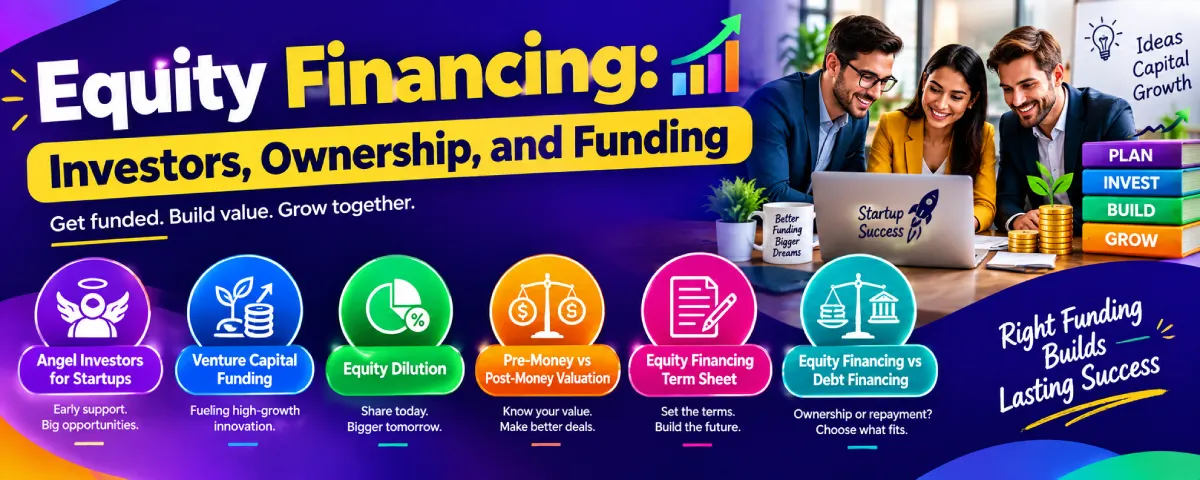
Equity Financing: Investors, Ownership, and Funding
Where to begin: Read this complete Equity Financing guide first. It gives you the full map of how selling ownership works in 2026. After you finish, move to any of the six focused cluster guides for deeper detail on angels, venture capital, dilution math, valuation, term sheets, or equity versus debt.
Raising money by giving away a piece of your company is still the main way most high-growth startups fund themselves. This is equity financing. You trade ownership for capital that does not have to be paid back like a bank loan. The investors become part-owners. If the company grows and is sold or goes public, they share in the upside. If it fails, they usually lose their money.
In 2026 the market is more selective than the boom years of 2021–2022. Capital continues to flow, especially into artificial intelligence, deep technology, climate, and defence-related companies, but investors look harder at traction, unit economics, and founder quality. Median dilution per priced round sits roughly between 15% and 23%. Founders who understand the numbers, the process, and the long-term consequences keep more ownership and build better investor relationships.
This expanded guide covers every major part of equity financing in plain, practical language. It is written for founders who are new to the process or who want a clear, complete reference. We go deep on definitions, real examples, step-by-step processes, common mistakes, and the questions you should ask at every stage.
- What is equity financing and how does it work?
Equity financing is the process of selling shares (or membership units) in your company to investors in exchange for cash. The cash becomes permanent capital on your balance sheet. There is no fixed repayment schedule and no personal guarantee in most standard deals. The investors own a percentage of the company and therefore a percentage of its future value.
How the basic transaction works
Imagine you and a co-founder own 100% of a company. You need $2 million to hire engineers, acquire customers, and reach the next milestones. An investor agrees the company is worth $8 million before their money goes in (this is the pre-money valuation). They put in $2 million. The company is now worth $10 million after the investment (post-money valuation). The new investor owns 20% ($2 million ÷ $10 million). You and your co-founder together now own 80% of a larger company.
That 20% is dilution. Your ownership percentage went down, but the overall pie got bigger. If the company later becomes worth $100 million, the investor’s 20% is worth $20 million and your combined 80% is worth $80 million.
Main types of equity instruments used in 2026
- Preferred shares – the standard security in priced rounds (Seed, Series A, B, etc.). Preferred shareholders usually get liquidation preference and other protective rights.
- Common shares – what founders and employees normally hold.
- SAFEs (Simple Agreements for Future Equity) – very common at pre-seed and seed. Money goes in now; equity is issued later at a future priced round or liquidity event. Most SAFEs in 2026 are post-money SAFEs.
- Convertible notes – debt that converts into equity later, usually with a discount and/or valuation cap.
- Ordinary equity or units – used in some simpler or non-US structures.
Step-by-step process most founders follow
- Decide how much capital you need and what milestones it should achieve.
- Prepare a clear pitch deck, financial model, and data room.
- Identify and approach suitable investors (angels first, then funds).
- Hold meetings, answer questions, and refine the story.
- Receive term sheets (or SAFE/note offers).
- Negotiate valuation, amount, and key terms.
- Complete due diligence.
- Sign final legal documents and receive the money.
- Update the cap table and begin reporting to investors.
The whole process from first serious conversation to money in the bank often takes 3–6 months for a priced round. SAFEs and notes can close in weeks if both sides move quickly.
Advantages of equity financing
- No monthly repayments or interest.
- Investors often bring advice, customers, talent, and follow-on capital.
- Aligns incentives: investors only win if the company grows significantly.
- Can fund ambitious growth that debt alone cannot support.
Disadvantages
- Permanent dilution of ownership and future upside.
- Possible loss of some control (board seats, veto rights).
- Time-consuming process and ongoing reporting obligations.
- Pressure to grow fast and eventually deliver an exit.
Equity is best suited to businesses that can grow into large outcomes. Lifestyle businesses or companies with steady but modest profits often do better with debt or revenue-based financing.
- How do angel investment and venture capital differ?
Angel investors and venture capitalists both provide equity capital, but their motivations, cheque sizes, processes, and expectations are different.
Angel investors in 2026
Angels are individuals investing their own money. Many are former founders or senior executives. Typical cheque sizes range from $25,000 to $250,000, though some write $500,000 or more. They usually invest at the pre-seed or seed stage when the product is still early or traction is just beginning.
Angels often decide faster than funds because they do not need investment committee approval. Many offer practical help: introductions, hiring advice, customer connections, and moral support. Because they have fewer investments, they can spend more time with each company.
Venture capital firms
VC firms manage money raised from limited partners (pension funds, university endowments, family offices, corporations). They have a legal duty to try to return multiples of the capital they manage. Cheque sizes are larger — commonly $1 million to $20 million or more depending on stage and firm.
VCs typically invest when there is clearer evidence of product-market fit or rapid growth. Decision-making involves partners, associates, and sometimes an investment committee. Most take a board seat and expect regular financial and operational reporting. They also reserve capital for follow-on investments (pro-rata rights).
Side-by-side comparison (2026 market)
| Factor | Angel Investors | Venture Capital Firms |
| Source of money | Personal wealth | Limited partner capital |
| Typical cheque | $25k–$250k | $1m–$20m+ |
| Stage focus | Pre-seed, seed, early traction | Seed, Series A, growth |
| Decision speed | Days to a few weeks | 4–12 weeks or longer |
| Board involvement | Sometimes observer or informal | Usually board seat |
| Follow-on capacity | Limited | Strong |
| Reporting expectations | Light | Formal and regular |
| Value-add style | Hands-on mentoring common | Network, hiring, strategy, later capital |
Many successful companies raise from both. Angels often fill the earliest rounds and later participate alongside VCs. Some angel groups and syndicates also write larger collective cheques.
When deciding whom to approach first, match the stage of your company to the investor type. Approaching institutional VCs too early usually leads to “come back when you have more traction.” Approaching only angels when you need $5–10 million will leave you short of capital.
- How are valuation and ownership dilution calculated?
Valuation and dilution are the two numbers that determine how much of your company you keep.
Pre-money and post-money valuation
- Pre-money valuation = agreed value of the company before the new investment.
- Post-money valuation = pre-money + new money raised.
Investor ownership percentage = investment amount ÷ post-money valuation.
Example 1
Pre-money: $12 million
Investment: $3 million
Post-money: $15 million
Investor owns: 20%
Example 2
Pre-money: $40 million
Investment: $10 million
Post-money: $50 million
Investor owns: 20%
The same 20% ownership can cost very different amounts of capital depending on the valuation.
How dilution actually works
When new shares are issued, every existing shareholder’s percentage goes down, but the total value of the company (hopefully) goes up.
Simple multi-round illustration (founders start at 100%):
- After pre-seed (15% sold): founders own ~85%
- After seed (18% sold): founders own ~70%
- After Series A (20% sold): founders own ~56%
- After Series B (18% sold): founders own ~46%
These are approximate medians from 2025–2026 data. Actual results depend on the exact percentages sold and whether an option pool is expanded.
The employee option pool effect
Investors almost always require a pool of shares reserved for future employees (usually 10–20%). The pool is typically created or increased on the pre-money side. That means founders and existing shareholders absorb the dilution, not the new investors.
If a 15% option pool is added before a $10 million investment at $40 million pre-money, the effective valuation for existing shareholders is lower than the headline pre-money number.
Convertible instruments and dilution
SAFEs and convertible notes convert into equity later. A post-money SAFE fixes the investor’s ownership percentage at the time of the SAFE. Multiple post-money SAFEs stack and all dilute the founders. A pre-money SAFE leaves the final percentage uncertain until the priced round.
Founders should model the fully diluted ownership after all outstanding SAFEs and notes convert before signing any new agreement.
- What terms and due diligence shape a funding deal?
The term sheet and due diligence process determine the real cost and control consequences of the round.
Key economic terms on a term sheet
- Valuation (pre- or post-money)
- Investment amount and share price
- Liquidation preference (standard is 1x non-participating)
- Dividend rights (usually none or non-cumulative)
- Anti-dilution protection (broad-based weighted average is market standard)
- Option pool size and timing
- Founder vesting (often 4 years with 1-year cliff, sometimes re-vesting)
Key control and governance terms
- Board composition (how many seats for founders, investors, independents)
- Protective provisions (list of actions that need investor approval)
- Information rights (what reports you must send and how often)
- Pro-rata rights (right to invest in future rounds to maintain ownership)
- Drag-along and tag-along rights
- Right of first refusal on founder share sales
Most early-stage term sheets are 5–12 pages. The majority of clauses are non-binding until final documents are signed. Confidentiality and exclusivity clauses are often binding.
Due diligence checklist investors typically request
- Full current and historical cap table
- Financial statements and bank records
- Customer contracts and revenue breakdown
- Intellectual property assignments and patents
- Employment agreements and outstanding claims
- Corporate formation documents and any previous financing paperwork
- Material contracts and liabilities
- Technical or product documentation (especially for deep-tech)
Clean, organised records speed the process and increase trust. Missing or messy documents slow everything down and can kill a deal.
After the term sheet is signed, lawyers draft the definitive agreements. Closing occurs when all documents are signed and the wire hits your account. Update the official cap table the same day.
- When should you compare equity with debt financing?
Equity is permanent capital with no repayment obligation. Debt must be repaid (with interest) but does not dilute ownership.
Choose equity when
- You need substantial capital and do not yet generate enough cash flow to service debt
- The business has high growth potential that justifies sharing upside
- You want active investors who bring networks and expertise
- You are in a sector where equity is the expected path (most software, biotech, deep tech)
Choose debt (or venture debt) when
- You have predictable revenue and can comfortably make payments
- You want to minimise dilution
- You need a bridge between equity rounds
- The interest cost is lower than the long-term cost of equity dilution
Many companies use both. It is common to raise a priced equity round and then add venture debt to extend runway. In 2026 some large AI companies raised significant debt packages alongside equity.
Hybrid approaches (revenue-based financing, convertible debt, etc.) also exist and can sit between pure equity and pure debt.
Practical recommendations for founders in 2026
- Model dilution across at least three future rounds before accepting any term sheet.
- Keep the cap table clean and up to date from the day the company is formed.
- Treat every investor conversation as the start of a multi-year relationship.
- Build a simple data room early (even if you are not raising yet).
- Get experienced startup counsel for term sheets and closing documents.
- Understand that the best investors often add more value than the pure capital.
- Do not optimise only for the highest valuation. Look at the full package of terms, people, and long-term fit.
How this pillar connects to the six clusters
This page is the complete overview. For deeper practical detail, use the focused guides:
- Cluster 1 – Angel Investors for Startups: How to Prepare
- Cluster 2 – Venture Capital Funding: Stages and Process
- Cluster 3 – Equity Dilution Explained With Cap Table Examples
- Cluster 4 – Pre-Money vs Post-Money Valuation Explained
- Cluster 5 – Equity Financing Term Sheet: Key Terms Explained
- Cluster 6 – Equity Financing vs Debt Financing: How They Compare
Each cluster expands one major topic with more examples, checklists, and step-by-step advice.
Equity financing can change the trajectory of a company, but only if founders understand what they are selling, what they are receiving, and what the long-term consequences will be. Take the time to learn the mechanics, run the numbers honestly, and choose partners carefully. The companies that do this well keep meaningful ownership, build strong boards, and give themselves the best chance of building something lasting.