
Crowdfunding marketing strategy is essentially the process of finding the right people, getting their attention ahead of time, and converting that into pledges after the page has gone live. Following the comprehensive Crowdfunding for Business guide, the crowdfunding platforms comparison, preparation of the campaign, rewards and equity considerations, this page discusses the real marketing system behind funded campaigns which includes defining the target audience, growing an email list before the launch, creating content for outbound efforts, testing paid marketing, and measuring the real metrics. By 2026, the pattern is still evident—successful campaigns usually generate most of their early money from their own warm audience.
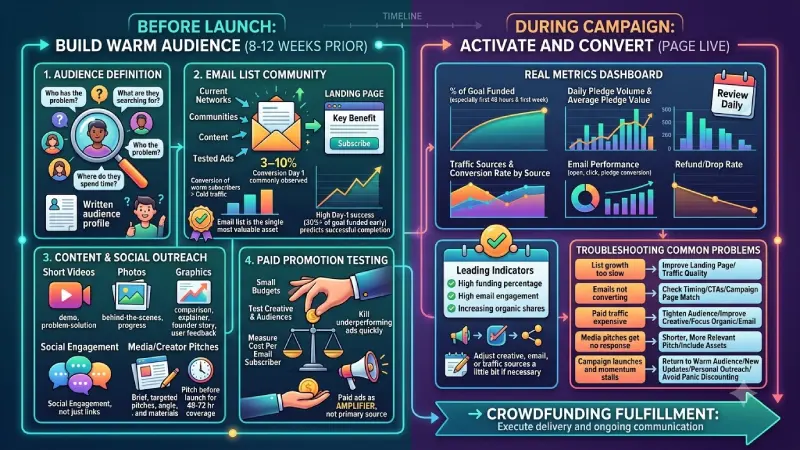
Where This Fits
You already know how to choose a platform, prepare the campaign, and design rewards or equity terms. Now activate the audience. The final related guide is usually:
- Execute delivery and ongoing communication → Crowdfunding Fulfillment
This keeps the information continuous.
Who Is the Target Audience for the Campaign?

Every effective campaign starts with a specific audience, not a generic “everyone who might like this.”
Define the primary audience tightly
Answer these questions in writing:
- Who has the problem your product solves (or the aspiration it fulfills)?
- What are they already buying or searching for?
- Where do they spend time online and offline?
- What language do they use to describe the problem?
- What would make them trust a new product enough to pledge before it ships?
The clearer the primary audience, the easier every later decision becomes—messaging, creative, channels, and partnerships.
Secondary audiences
These can include adjacent groups, industry insiders, or people who influence the primary audience. Treat them as amplifiers, not the core.
Audience research methods that still work
- Review comments and reviews on competing or similar products.
- Talk to 10–20 people who match the profile.
- Look at which past crowdfunding campaigns in your category succeeded and who backed them.
- Check search trends, community forums, and social conversations around the problem you solve.
A well-defined audience lets you build a pre-launch list that converts and keeps paid acquisition costs under control.
How Do You Build a Prelaunch Email Community?
The email list remains the one and only most valuable asset for any crowdfunding campaign. The industry trends clearly indicate that conversion rates of warm subscribers via email are significantly higher than those of cold traffic on social media platforms, and high Day-1 success (which usually amounts to 30% or higher) predicts successful completion of the whole campaign.
Core building process
- Create a landing page which introduces the product, presents the key benefit and provides a reason why to subscribe to the list (early access, launch reminder, special price for the early birds, etc.).
- Direct traffic from your current networks, communities, content and tested ads to the page.
- Send an introduction sequence which is valuable enough and keeps the product in focus without pushing every day.
- If possible, segment the list (by engagement or referring sources).
- Keep building up the list until the launch date.
What “enough” looks like
There is no universal number, but many successful product campaigns want at least several hundred engaged subscribers before launch. Conversion rates of 3–10% of a warm list on Day 1 are commonly observed. A smaller highly engaged list usually outperforms a large cold one.
Tools and practical tips
Use a reliable email platform that handles deliverability well. Keep the signup process friction-low. Make the landing page mobile-friendly. Track which traffic sources produce subscribers who later become backers—those sources deserve more attention.
Building the list is not a side task. For most campaigns it is the central pre-launch activity.
What Content Supports Social Outreach and Media Pitches?
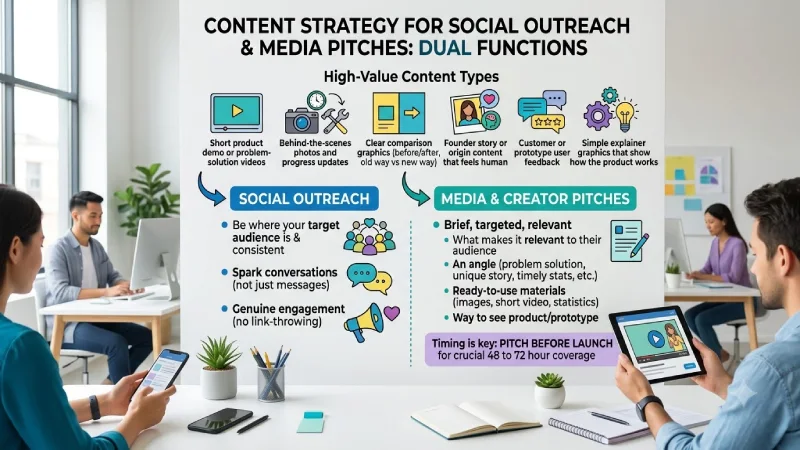
The content has dual functions; it helps to draw the right people before even launching and provides something that’s easy for journalists, producers, and partners to share or cover.
High-value content types
- Short product demo or problem-solution videos
- Behind-the-scenes photos and progress updates
- Clear comparison graphics (before/after, old way vs new way)
- Founder story or origin content that feels human
- Customer or prototype user feedback
- Simple explainer graphics that show how the product works
Social outreach
Be where your target audience is and be consistent. Use your content to spark conversations and not just send out a message. Be genuine in engaging in relevant communities and do not just throw around links.
Media and creator pitches
There are countless media and creator pitches out there. The ones that end up getting read are brief, targeted, and relevant. They include:
- What makes it relevant to their audience
- An angle (solution to a problem that people know about, unique founder story, timely stats, etc.)
- Materials that they can use right away (images, short video, statistics)
- A way to actually see the product or prototype
Try to make sure you pitch them before you launch your campaign so that you will have coverage within the crucial first 48 to 72 hours.
How Do You Test Paid Promotion Without Overspending?
Paid ads can accelerate list growth and later drive pledges, but they can also waste money quickly if untested.
Pre-launch paid testing
- Start with small budgets aimed at email sign-ups, not direct pledges.
- Test creative and audiences systematically.
- Measure cost per email subscriber and, later, cost per backer.
- Kill under-performing ads quickly.
- Scale only the combinations that produce acceptable costs.
During the campaign
With the landing page up, you can now run tests with ads that take traffic directly to your campaign page. Monitor the conversion rates and costs per pledge carefully. Typically, many campaigns will see that the paid traffic converts worse than email traffic or organic community traffic, and the numbers have to work relative to the average pledge amount and margin.
Guardrails
Determine a maximum daily/weekly budget that you can risk losing while you learn. Separate the budget for testing vs. scaling budgets. Avoid ramping up budget just because the campaign seems to be moving slowly—only ramp up when the results show a clear return.
Paid marketing should always be used as an amplifier of a system that has traction already, and not as the primary source of supporters.
Which Conversion and Funding Metrics Should You Track?
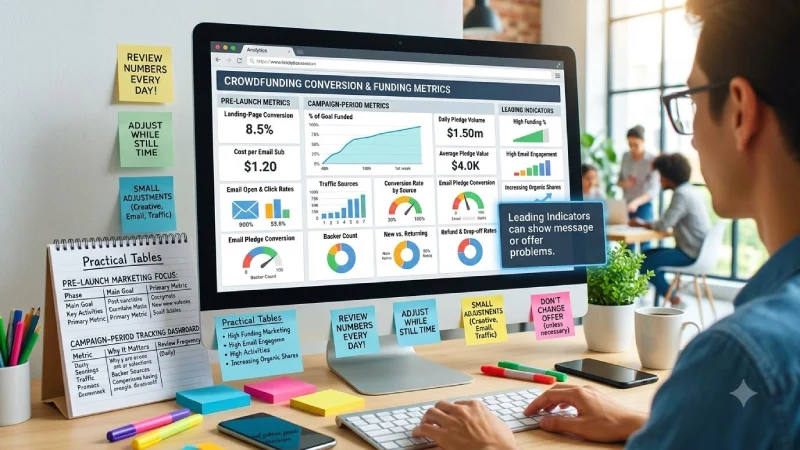
Tracking the right numbers lets you adjust while there is still time.
Pre-launch metrics
- Landing-page conversion rate (visitor to email)
- Cost per email subscriber (if using paid)
- Email open and click rates on the welcome and nurture sequences
- Referral sources of the best subscribers
Campaign-period metrics
- Percentage of goal funded (especially in the first 48 hours and first week)
- Daily pledge volume and average pledge value
- Traffic sources and conversion rate by source
- Email performance (open, click, and pledge conversion from campaign emails)
- Backer count and new vs returning visitors
- Refund and drop-off rates
Leading Indicators
Early signs of good performance are a high funding percentage, high email engagement, and increasing organic shares. Flat traffic with low conversion can be a sign of a message problem or an offer problem, not just a reach problem.
Review the numbers every day throughout the campaign. Adjust your creative, email, or traffic sources a little bit if necessary. Don’t make any offer changes during the campaign unless it’s absolutely necessary.
Practical Tables
Pre-launch marketing focus
| Phase | Main Goal | Key Activities | Primary Metric |
| Audience definition | Clarity on who you are speaking to | Research, interviews, competitor review | Written audience profile |
| List building | Warm owned audience | Landing page, content, targeted traffic | Email subscribers + engagement |
| Content & outreach | Assets and relationships | Video, graphics, media/creator pitches | Coverage and shareable assets |
| Paid testing | Efficient acquisition learning | Small-budget ad tests | Cost per subscriber |
Campaign-period tracking dashboard (example)
| Metric | Why It Matters | Review Frequency |
| % of goal funded | Overall progress and momentum signal | Daily |
| First-48-hour funding % | Strong predictor of eventual success | Once |
| Traffic by source | Shows what is actually working | Daily |
| Conversion rate by source | Reveals quality of traffic | Daily |
| Email pledge conversion | Measures strength of owned audience | Per send |
| Average pledge value | Affects total raised and margin | Daily |
| Refund / drop rate | Early warning of offer or trust issues | Daily |
Frequently Asked Questions
How many subscribers do I need in my pre-launch mailing list?
It depends on the value of the pledges and the conversion rate. A lot of good campaigns start out with only a few hundred to thousands of active subscribers. Engagement and quality beat quantity any day.
When should I build my list?
The earliest you should start is 8 to 12 weeks prior to your product launch campaign.
Can I get away without an email list using just social media?
The algorithms keep changing and your reach becomes unpredictable. Email gets you a connection directly with people who have volunteered themselves. Experienced creators consider email as a must and social as supplementary.
How much should I spend on paid ads?
Only what you can afford to test and learn with. Scale only after you see a cost per backer (or per subscriber) that works with your margins.
What is the most important early-campaign metric?
The percentage of the goal funded in the first 48 hours is one of the strongest practical indicators. Campaigns that reach roughly 30% early have a much higher chance of finishing successfully.
Troubleshooting Common Marketing Problems
List growth is too slow
Improve the landing-page offer or traffic quality. A clearer benefit or stronger lead magnet often moves the number more than simply increasing ad spend.
Emails are not converting to pledges
Check timing, subject lines, and the clarity of the call to action. Make sure the campaign page matches the promise made in the email. Test send times and content.
Paid traffic is expensive and converts poorly
Tighten the audience, improve the creative, or pause paid and focus on organic and email channels. Not every campaign needs heavy paid spend.
Media pitches get no response
Make the pitch shorter, more relevant to the outlet’s audience, and easier to cover (include assets and a clear angle). Follow up once. Build relationships before you need coverage.
Campaign launches and momentum stalls after Day 1
Return to the warm audience with new updates, limited-time reasons to act, and personal outreach. Activate any partners or creators who have not yet posted. Avoid panic discounting that damages margin.
Conclusion
Marketing process via crowdfunding has to be systematized – defined target audience, warmed-up email list before starting marketing, good content to help with marketing, paid tests that are conducted in a systematized way, as well as constant tracking of conversion based on key metrics. All this will give a solid foundation and a marketing campaign will come alive as a result. You can use the frameworks and tables above to systemize your marketing, then move on to the fulfillment chapter below.