

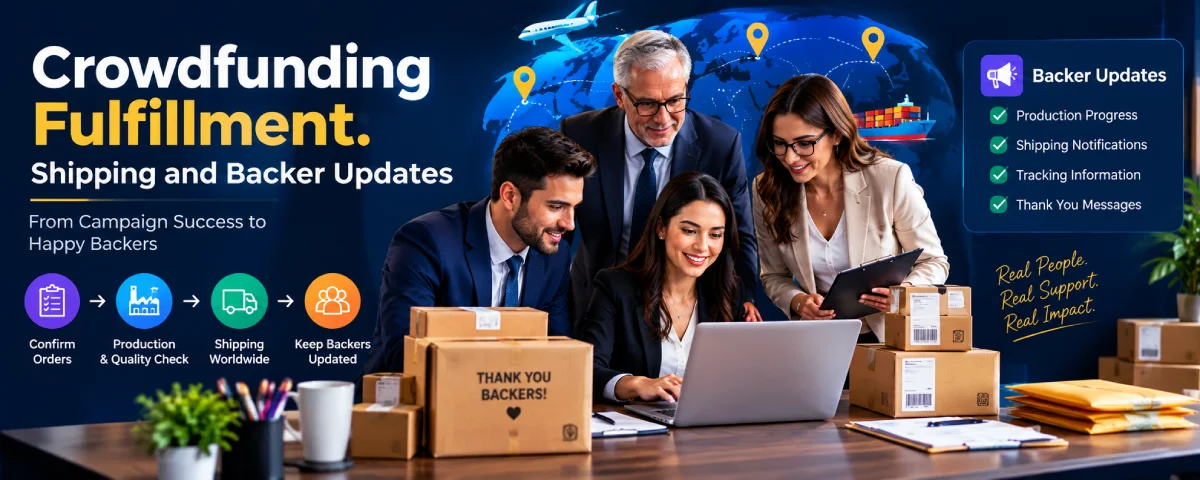
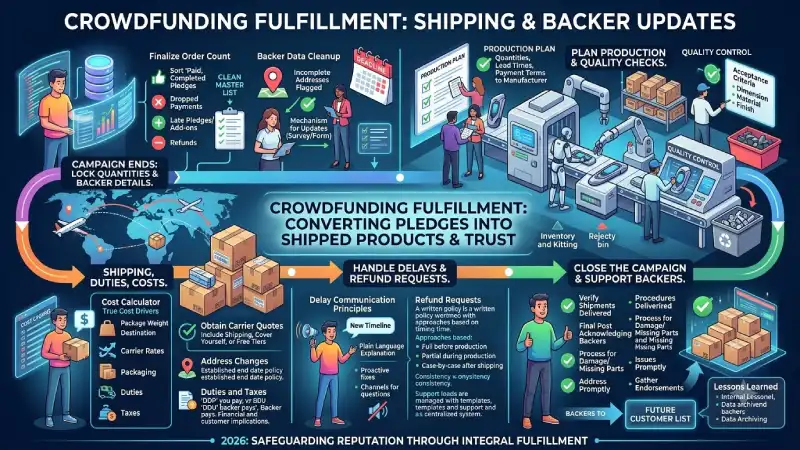
Fulfillment of crowdfunding projects is the phase where a completed campaign is converted to shipped products and trust. Following the main guide of Crowdfunding for Business and the sections of platforms, campaign preparation, rewards design, equity crowdfunding, and marketing, this last page will talk about the details of order confirmation, production management, shipping, costs, and how to handle delay or refund. It is in 2026 when those campaigns which safeguard their reputation consider fulfillment as an integral part of the whole process and not an afterthought.
Where This Fits
You have already planned, launched, and (ideally) funded the campaign. Now execute delivery. This page completes the sequence.
How Do You Confirm Quantities and Backer Details?
The moment the campaign ends, lock down the exact numbers.
Finalize the order count
- Download the full backer report from the platform.
- Separate paid, completed pledges from dropped or failed payments.
- Add any late pledges or add-on orders if the platform allows them.
- Subtract known refunds or cancellations.
- Build a clean master list by reward tier and shipping destination.
This final quantity—not the original funding goal—drives manufacturing and purchasing decisions. Ordering based on the goal instead of confirmed paid orders is a common and costly mistake.
Backer data cleanup
- Verify that every backer has a complete shipping address.
- Flag incomplete, partial, or obviously incorrect addresses early.
- Specify an address confirmation deadline, and ensure that the general public is aware of it.
- Create an easy mechanism for the backers to provide their updated contact details (survey, form, or platform).
Cleaner the data here, cheaper will be your shipments and lower number of support tickets.
How Do You Plan Production and Quality Checks?
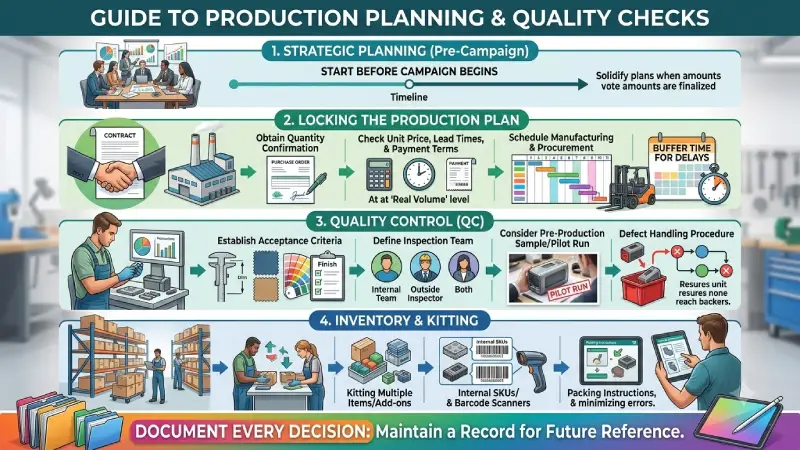
The production plan should start before the campaign begins, although it only solidifies when the amounts are finalized.
Lock the production plan
- Obtain confirmation on quantities from the manufacturer.
- Check unit price, lead times, and payment terms at the real volume level.
- Schedule manufacturing and procurement of components.
- Take into account buffer time for any potential delays.
Quality control
- Establish acceptance criteria prior to unit production (dimension, material, operation, finish).
- Determine the individuals involved in inspections (your team, an outside inspector, or both).
- Consider a pre-production sample or pilot run of your item if it’s new or complicated.
- Have a procedure for dealing with faulty units so that none make their way to backers.
Inventory and kitting
If rewards include multiple items or add-ons, plan how components will be kitted and labeled. Clear internal SKUs and packing instructions reduce errors when volume increases.
Document every decision. When questions arise weeks later, you will need the record.
How Do Shipping, Duties, and Address Changes Affect Costs?
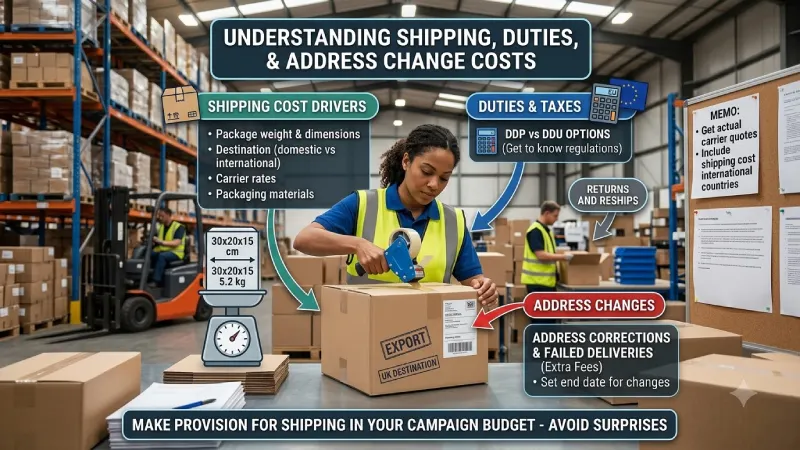
Shipping is frequently the area where budgets break.
True shipping cost drivers
- Package weight and dimensions
- Destination (domestic vs international)
- Carrier rates and service level
- Packaging materials
- Duties, taxes, and brokerage fees on international shipments
- Address corrections and failed deliveries
- Returns and reships
Practical Strategies
- Obtain quotes from the carriers based on actual measurements for your parcel size and weight.
- Make a decision on whether to include shipping cost, cover it yourself, or provide free shipping on particular tiers (and plan your pricing around it).
- Stick to international countries that will not be too costly for you.
- Take into account a fulfillment partner who already has negotiated rates and international experience (if your sales volume is justified).
Changes to addresses
Change requests will come from backers. Establish an end date for changes after which changes cannot happen or a change charge applies. Make this policy clear and consistent. Changes in addresses always take time and sometimes money.
Duties and taxes
In regard to international orders, you must choose whether you will pay for duties yourself (DDP) or whether you will ask the receiver to do so (DDU). Both have financial and customer experience implications. Get to know the regulations for your major destination markets before offering to ship there.
Make provision for shipping in your campaign budget. Under-estimating this cost is one of the most common financial surprises after the campaign.
How Should Delays and Refund Requests Be Handled?
Delays happen. How you communicate them determines whether backers remain supportive or become vocal critics.
Delay communication principles
- Tell backers as soon as you know a meaningful delay is likely.
- Explain what happened in plain language.
- Give a revised timeline or a range.
- Describe what you are doing to fix it.
- Offer a clear channel for questions.
- Update again when the situation changes—even if the update is “still working on it.”
Silence creates more frustration than bad news delivered honestly.
Refund requests
Have a written policy ready before the campaign ends. Common approaches include:
- Full refund before production begins
- Partial refund or store credit once production is underway
- Case-by-case review after shipping has started
Apply the policy consistently. Document every refund. On equity campaigns the rules are different and usually far more restrictive—securities laws and platform agreements govern whether and how investments can be returned.
Management of support loads
Delays create tickets. Prepare your template replies, direct queries to one inbox or help desk, and establish guidelines for responding. It will keep your support system orderly and your brand safe.
How Do You Close the Campaign and Support Backers?
Closing well turns backers into future customers and advocates.
Post-delivery procedures
- Verify that the shipments have been scanned and, if feasible, delivered.
- Submit a final post that acknowledges the backer’s support and provides delivery details, with an option to give feedback.
- Create an easy process for the backer to lodge any complaints such as damaged products and missing parts.
- Take prompt action in addressing the issue.
- Get endorsements and photographs, if the backer gives permission.
- Consider moving backers to the customer communications list.
Internal close-out
- Reconcile final costs against the original budget.
- Record lessons learned while they are fresh.
- Update financial records and, if applicable, investor reports.
- Archive campaign data, backer lists, and correspondence in an organized way.
Longer-term relationship
The people who backed you early are often your most valuable future customers. Treat them with priority support and occasional exclusive updates or offers. Many successful companies trace a significant part of their early customer base to their crowdfunding backers.
Fulfillment timeline example
| Stage | Typical Timing After Campaign End | Main Actions |
| Order confirmation | Week 1 | Clean backer data, lock quantities |
| Production finalization | Weeks 1–2 | Confirm manufacturing, place orders |
| Manufacturing & QC | Weeks 2–10+ (varies widely) | Produce, inspect, correct issues |
| Shipping preparation | 1–2 weeks before ship | Kit, label, generate labels |
| Shipping & tracking | Ongoing once ships begin | Dispatch, monitor, support |
| Issue resolution | Ongoing | Handle defects, missing items, refunds |
| Campaign close-out | After majority delivered | Final update, lessons, archive |
Common cost and risk checklist
| Item | Risk if Under-Estimated | Mitigation |
| Final paid quantity | Over- or under-production | Wait for cleaned backer report |
| International shipping | Margin erosion or surprise bills | Real quotes + limited destinations |
| Duties and taxes | Angry backers or unexpected costs | Decide DDP vs DDU early |
| Address changes | Extra labor and reship costs | Clear cutoff policy |
| Quality failures | Reships, refunds, reputation damage | Pre-production samples + QC plan |
| Delays | Support overload and trust loss | Buffer time + proactive updates |
Frequently Asked Questions
When should I order manufacturing?
Only after you have a cleaned list of paid, confirmed pledges. Ordering against the original goal is risky.
How do I handle backers who never confirm their address?
Set a deadline, send reminders, and then apply a clear policy (for example, hold the package for a period or issue a refund). Document everything.
What is the best way to announce a delay?
Directly, early, and with a revised plan. Use the campaign update system and email so the message reaches people.
Should I offer refunds after shipping has started?
This depends on the case and the policy. In many cases, problems after delivery are solved with replacement or partial compensation rather than a refund. This is what counts the most.
How long should I keep supporting backers?
At minimum through the delivery and initial issue-resolution window. Many companies continue to treat early backers as priority customers indefinitely.
Troubleshooting Common Fulfillment Problems
Manufacturing is delayed
Communicate immediately with a realistic new timeline. Review whether any non-critical stretch goals or extras can be adjusted to protect the core delivery.
Shipping costs are higher than budgeted
Look for carrier alternatives, adjust packaging, or, in future campaigns, price shipping more accurately. For the current campaign, absorb what you can and learn the lesson.
A large number of address issues appear
Pause shipping for the affected group if necessary, run a focused confirmation campaign, and tighten the process for the remaining orders.
Support volume spikes
Use templates, route everything through one system, and set response-time expectations. Bring in temporary help if the volume is temporarily unsustainable.
Some backers are publicly unhappy
Respond calmly and factually on the public channel, then move detailed resolution to private messages. Do not ignore public comments, but do not let individual cases derail the overall communication plan.
Conclusion
Fulfillment is where the promises made during the campaign are kept or broken. Confirm quantities carefully, plan production and quality control with buffers, price and manage shipping realistically, communicate delays early and honestly, and close the loop with clear support and a final thank-you. When this stage is handled with the same discipline as the launch, the campaign becomes a foundation for future customers and credibility rather than a source of ongoing problems. This completes the practical sequence that began with the main Crowdfunding for Business pillar.