


Most companies are focused on selling more by enhancing the product, reducing its cost, or advertising more. These methods may work. Yet, there is an essential question that is not always considered: why consumers buy.
Consumer behavior research is about understanding the process of consumer decisions and purchase choices, including such aspects as time, location, manner, and motivation. This area involves understanding the psychological, emotional, social, cultural, and behavioral factors that affect all purchases and helps marketers target their actions effectively.
In my experience, some companies have invested huge amounts of money into increasing traffic but still could not convert because of ignoring the study of consumer behavior. At the same time, some small companies succeeded due to their focus on this very point. This guide will cover such topics as the definition of consumer behavior and its significance, influencing factors, decision-making process, and analysis. Also, I will describe how the six supporting topics fit into the overall structure.
What Is Consumer Behavior?
Consumer behavior can be defined as the discipline that focuses on the processes of selection, acquisition, and disposal of goods and services, ideas, or experiences for the satisfaction of people’s needs and desires.
Not only does the discipline focus on consumer behavior, but it also looks at the underlying process involved in consumer behavior. The discipline covers simple and complex consumption processes.
Key parts of consumer behavior include:
- What people buy
- Why they buy
- How they search for information
- How they compare options
- What influences the final choice
- How they feel after the purchase
- Whether they buy again or recommend the brand
Marketing cannot be effective without understanding consumer behavior. Development of the product, marketing communications, pricing policy, distribution channels, and consumer experience can be greatly improved if based on actual consumer behavior rather than on assumptions.
Why Consumer Behavior Matters in Business
If companies neglect to consider consumer behavior when developing offers and messages, they will be making decisions that are logical from an internal perspective, but completely irrelevant to their consumers. This leads to money wasted, poor conversions and underperformance.Understanding consumer behavior helps you:
- Create products and offers that match real needs
- Write messages that connect with actual motivations
- Reduce friction in the buying process
- Improve conversion rates
- Build stronger customer relationships
- Adapt faster when habits change
- Make better decisions across marketing, sales, and product
Customers in 2025 and 2026 are better informed and have greater choice and greater expectations. They do more comparison shopping and are less loyal. Companies which keep up with what customers actually do tend to do better than those which make assumptions or go by opinions.
What Changes When You Understand Consumer Behavior
| Area | Without Understanding Behavior | With Strong Understanding of Behavior |
| Product Development | Higher risk of building the wrong thing | Guided by real needs and how people actually use things |
| Messaging | Often generic or too focused on features | Tied to real motivations and concerns |
| Conversion | More drop-offs and hesitation | Smoother path and better results |
| Customer Experience | Designed around internal processes | Designed around how people actually move |
| Budget Use | More money spent on weak assumptions | Better allocation to what works |
| Speed of Adaptation | Slow to notice change | Faster response to new patterns |
| Trust & Loyalty | Harder to build lasting preference | Easier to create repeat customers |
A Simple Real-World Contrast
An online service company kept releasing new products as the management thought that consumers would like more and more tools. However, after conducting some research with the actual customers, it became evident that the majority of them felt overwhelmed and only needed a simpler way to perform their task. The company refined its offer and adjusted its message to emphasize that particular benefit.
Another company conducted the same kind of campaigns for several years before realizing from consumer research that the customers had grown more interested in speed and simplicity rather than in features. The competitors took notice earlier and managed to beat them.
It is not about budget. It is about staying close to reality.
Practical Impact
When consumer behavior sits at the center of decisions, several things usually improve:
- Offers feel more relevant to real needs
- Marketing messages land more effectively
- Fewer people drop off during the buying process
- Teams make fewer expensive assumptions
- The business adapts faster when habits change
The marketing team, the sales team, and the product development team will also have greater coordination because everyone will be operating on the same understanding of the customer.
An easy way to frame it is this:
Trying to guess what consumers want means a scattered approach.
Knowing what consumers do means more focused decision-making and resource management.
In an era when consumers are armed with unprecedented freedom of choice and knowledge, having your finger on the pulse of that is perhaps the most pragmatic strength any company can develop.
What Changes When You Understand Consumer Behavior
| Area | Without Understanding Behavior | With Strong Understanding of Behavior |
| Product Development | Higher risk of building the wrong thing | Guided by real needs and how people actually use things |
| Messaging | Often generic or too focused on features | Tied to real motivations and concerns |
| Conversion | More drop-offs and hesitation | Smoother path and better results |
| Customer Experience | Designed around internal processes | Designed around how people actually move |
| Budget Use | More money spent on weak assumptions | Better allocation to what works |
| Speed of Adaptation | Slow to notice change | Faster response to new patterns |
| Trust & Loyalty | Harder to build lasting preference | Easier to create repeat customers |
Why This Matters Even More Now
A few clear shifts have made consumer behavior more important for results:
- They do their homework before buying and rely very much on online reviews and peer opinions
- The buying process is becoming increasingly indirect and channel-agnostic
- AI-driven solutions begin to impact the decision-making process
- The demands for transparency, timeliness, and relevancy continue to increase
- Many assumptions that were true several years ago no longer work for today’s consumer
Those organizations which continue to study the true behavior of their consumers are at an advantage when making changes to what they offer and how they deliver it. Organizations that make decisions based on their own opinion run into difficulties much later down the road.
Practical Impact
When consumer behavior sits at the center of decisions, several things usually improve:
- Offers feel more relevant to real needs
- Marketing messages land more effectively
- Fewer people drop off during the buying process
- Teams make fewer expensive assumptions
- The business adapts faster when habits change
A simple way to think about it:
Guessing what customers want leads to scattered effort.
Understanding real consumer behavior leads to clearer decisions and better use of resources.
In a world where people have the most freedom and know the most about their choices ever before, one of the most practical strengths a company can develop is getting closer to reality.
Factors That Influence Buying Decisions
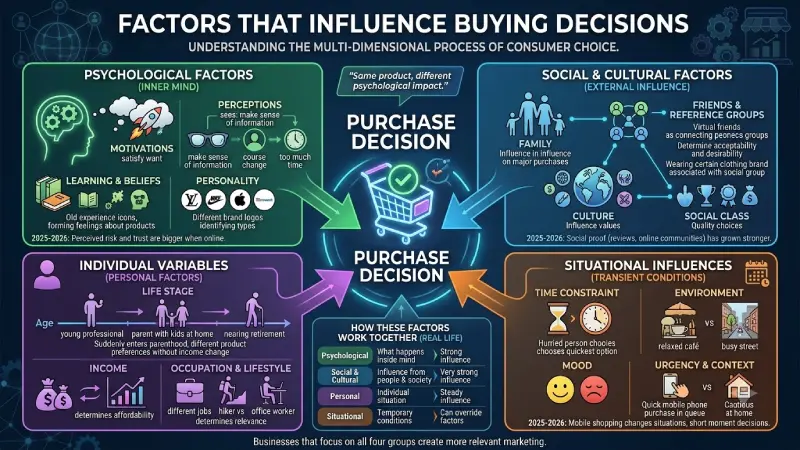
Buying decisions are rarely shaped by only one force. Several groups of factors work together. Some come from inside the person. Others come from the people and world around them. When you understand these factors, your marketing becomes more accurate. When you only look at one factor, you often miss important reasons why people buy or walk away.
Here are the main groups of factors that influence buying decisions.
Psychological factors
It is the set of psychological processes which affect how consumers interpret, think, and choose products. It comprises of motivations, perceptions, learning, beliefs, attitudes, and personality.
Motivations refer to the psychological force behind the desire to satisfy a want. Perceptions are concerned with how consumers make sense of information. Learning arises from previous experiences while beliefs and attitudes help form perceptions and feelings about products. Personalities determine the types of brands consumers identify with.
Example: Two people see an online training course advertised on social media. While one feels motivated by the prospect of changing career, the other perceives the course as taking up too much time in relation to how they perceive their daily schedule. Same product, different psychological impact.
Social and Cultural Factors
This refers to external influences that emanate from other people and society at large. Some of them are: family, friends, reference groups, social class, culture, and subculture.
The family can exercise considerable influence on major purchases. The social influence of friends and virtual friends determines acceptability and desirability. The culture influences values and acceptability. Social class influences choices based on quality, prestige, or value.
Example: One could choose a certain brand of clothes not only because of its appeal to them, but also because of their association with the type of social group they belong to.
Individual Variables
These pertain to personal circumstances and personal factors. These variables include the individual’s age, income, occupation, lifestyle, stage in life, and economic circumstances.
A young professional would usually have other concerns compared to a parent with kids at home or one who is nearing retirement. Income determines affordability. Lifestyle determines relevance.
Illustration: An individual who has just entered parenthood may suddenly have different product preferences compared to what he had two years ago even without much change in his income level.
Situational Influences
This refers to the transient factors that characterize the particular purchase experience. This will include time constraint, environment, mood, urgency, and context.
The hurried individual might go for the quickest option. The individual in a relaxed environment will have more time to compare alternatives. The mood of the individual could also be a factor in determining the willingness of the person to purchase.
Example: A person might buy something quickly through the mobile phone in a queue situation, but if the same person was home he/she would have been more cautious.
How These Factors Work Together
| Factor Group | Main Influence | Typical Strength | Example Impact on Decision |
| Psychological | What happens inside the person’s mind | Strong in most decisions | Motivation and perception shape interest |
| Social & Cultural | Influence from people and society | Very strong in many categories | Family or peer opinion can decide the choice |
| Personal | Individual situation and characteristics | Steady influence over time | Life stage changes priorities |
| Situational | Temporary conditions of the purchase | Can override other factors | Time pressure leads to faster decisions |
But in reality, these factors hardly work individually. One can be motivated psychologically, socially influenced through a friend’s suggestion, consider his or her finances, and make a hasty decision owing to being in a hurry.
Observations from 2025–2026
In recent years, a few patterns have become clearer:
- Social proof and peer influence have grown stronger because of reviews, social media, and online communities.
- Psychological factors such as perceived risk and trust play a bigger role when people research online.
- Situational factors have changed with mobile shopping — many decisions now happen in short moments during the day.
- Personal factors such as life stage and lifestyle continue to create clear differences in what people want.
Businesses that pay attention to all four groups usually create more relevant marketing than those that focus on only one.
Understanding these factors does not mean you need to control them. It means you can design better messages, offers, and experiences that fit how people actually make decisions.
The Consumer Decision-Making Process
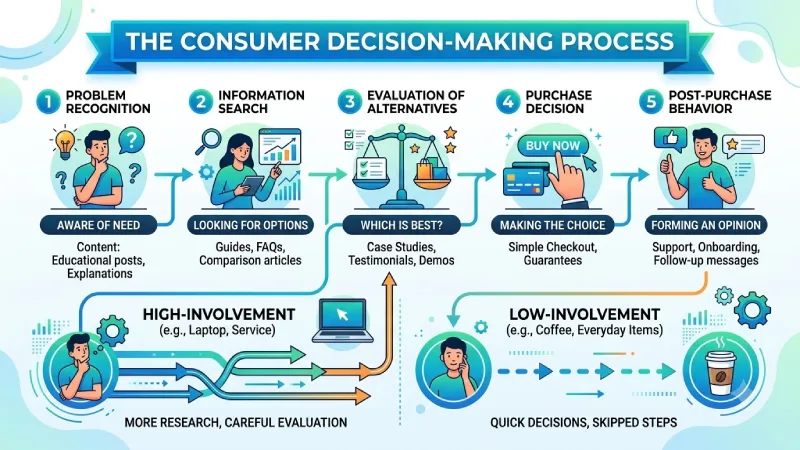
Buying process usually takes certain sequence in most cases, but it does not have to be neat or complete in any way. Stages in the process include Problem Recognition, Information Search, Evaluation of Alternatives, Purchase Decision and Post-Purchase Behavior. Knowledge about them will help you to provide appropriate content at the appropriate stage, not trying to sell right from the start to everyone.
All the five stages may not be covered equally deep by each purchase decision. There is a tendency for low-involvement purchases to either omit some of the stages completely or go through them very fast.
Here is a closer look at each stage.
- Problem Recognition
By this time, individuals become aware of the need for change or the problem existing in their situation. This need can be internal, such as hunger, dissatisfaction or aspirations or external, like advertising, information from friends or a change in environment.It is not about any particular brand in this case, just that a certain action needs to be taken by the consumer.Best way to support: Content that acknowledges and explains the problem. It may include instructional posts, tutorials and other informative content.
- Information Search
Once the need is established, then individuals begin their quest for solutions. This could be done via the Internet, asking friends, watching video clips, or surfing the web. This quest for solutions would depend on the importance and risk involved with making that purchase.Here, the customer starts gathering alternative options and understanding them.
Most effective help: Guides, comparative analysis pieces, FAQ sections, video tutorials, and explanations. Make it convenient for people to access useful information.
- Evaluation of Alternatives
Here the person assesses all the possible alternatives that have been identified by him or her by considering different things like features, cost, review, brand, and how well it will solve his or her problem. Here preference development process starts.Now, the consumer tries to identify the best alternative for him or her.
Support that works best: Comparison content, case studies, testimonials, demonstrations, and information about pros and cons. Make the comparisons clear.
- Purchase Decision
Of them, one is chosen by the consumer and bought. At this point too, the consumer may alter his/her choice, if he/she finds that the procedure is complex and not easy enough.In this phase, the customer expects the process of purchasing to be an easy one, devoid of any risk.Best Service: Easy checkout and registration process, price information, assurances, and guarantees, and ease of getting help when required.
- Post-Purchase Behavior
Following the purchase, the customer uses the product or service, developing an opinion. The customer can feel satisfied, dissatisfied, or confused. This phase has a large influence on whether the customer repurchases, leaves reviews, or recommends the brand to others. At this stage, the customer is evaluating whether they made the right decision.
Best support: Good onboarding, helpful support, follow-up messages, and easy ways to give feedback or get help.
Stage-by-Stage Overview
| Stage | Customer Mindset | Best Marketing Action |
| Problem Recognition | “I have a problem or need” | Talk about the problem clearly |
| Information Search | “What are my options?” | Provide helpful and easy-to-find information |
| Evaluation of Alternatives | “Which option is best for me?” | Make comparison simple and build trust |
| Purchase Decision | “I am ready to choose” | Make buying easy and low-risk |
| Post-Purchase Behavior | “Did I make a good decision?” | Support the customer and encourage loyalty |
High-Involvement vs Low-Involvement Purchases
During high involvement decisions (such as purchasing a laptop, registering for a course, or buying a service), individuals tend to go through all the steps and take more time to compare.
The marketing strategies must correspond to the type of purchase. Information and building up trust would be more effective in high involvement decisions. Simplicity and being present would be more effective in low involvement decisions.
By understanding the decision making process, you no longer create one size fits all marketing but rather approach individuals with what they need at their step.
How to Analyze Consumer Behavior
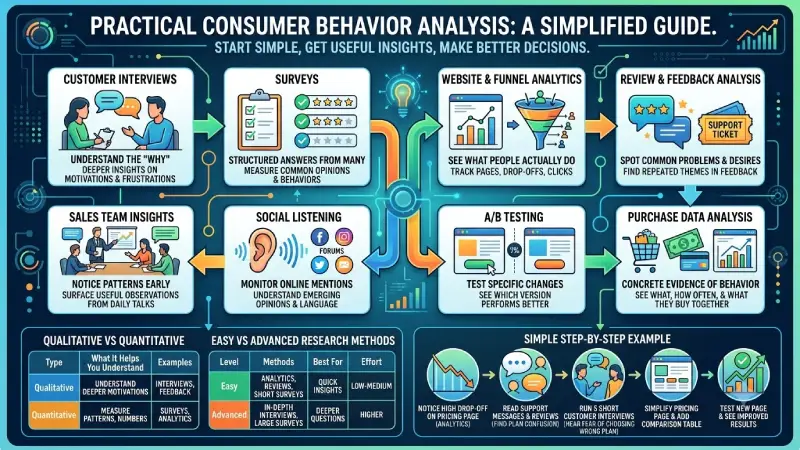
There is no need for complicated research to get started with the analysis of consumer behavior. You can begin your analysis using simple tools but you will still be able to gain valuable insights from them. Research itself is not the point. Better decision-making is.
Among the effective tools, you may consider customer interviews, surveys, website/funnel analytics, reviews/feedback analysis, sales team insights, social media listening, A/B tests, and purchasing data analysis.
Customer Interviews
Personal interviews will tell you about the ‘why’ of behavior. They are especially valuable if you are looking for deeper insight on motivation, frustration, and decision-making process. As few as 8–12 interviews may provide you with clear patterns.
Surveys
Surveys assist in collecting responses from a greater number of people in an organized manner. They are useful in instances where you need to determine the frequency of certain ideas or actions. Make your surveys brief.
Website and Funnel Analytics
Analytics show what people actually do on your site or app — where they come from, what pages they visit, where they drop off, and what they click. This is one of the most practical starting points.
Review and Feedback Analysis
Customer reviews, support tickets, and direct feedback often contain repeated themes. Looking at these regularly helps you spot common problems and desires.
Insights from the Sales Team
Those who interact with your customers on a daily basis usually spot trends early on. Frequent interaction with your sales/support team will help uncover insights.
Social Listening
Listening to what is said about your company, product type, or competition on various online platforms such as social networks or discussion forums can provide you with trends in opinion and language used by your customers.
A/B Testing
This approach allows you to test specific elements (such as alternative headlines, designs, and offers) for their efficiency.
Analysis of Purchase Behavior
Examining actual purchase data in terms of frequency and combination allows you to see the true purchasing pattern.
Qualitative vs Quantitative Methods
| Type | What It Helps You Understand | Best Used When | Examples |
| Qualitative | Deeper motivations and feelings | You need to understand the “why” | Interviews, open feedback |
| Quantitative | Patterns, numbers, and scale | You need to measure “how many” or “how much” | Surveys, analytics, A/B tests |
In most cases, effective research involves both approaches. Qualitative research enables you to understand the cause. Quantitative research helps you determine the extent of the cause.
Easy vs Advanced Research Methods
| Level | Methods | Best For | Effort Level |
| Easy | Analytics, reviews, short surveys, sales feedback | Quick insights and regular learning | Low to Medium |
| Advanced | In-depth interviews, large surveys, experiments, detailed data analysis | Deeper or more strategic questions | Higher |
However, most companies should begin with the easy techniques and proceed to advanced research once they have well-defined problems.
Simple Step-by-Step Example
Assume that you operate an internet business where lots of individuals browse through your pricing page but fail to subscribe.
- You check analytics and see a high drop-off on the pricing page.
- You read recent support messages and reviews and notice confusion about the differences between plans.
- You run five short customer interviews and hear that people are afraid of choosing the wrong plan.
- You simplify the pricing page and add a clear comparison table.
- You test the new page and see that more people move forward.
This is a practical example of using research to improve results.
Common Mistakes When Doing Research
- Starting research without a clear question
- Asking leading questions that push people toward certain answers
- Listening only to what people say and ignoring what they actually do
- Collecting data but never turning it into decisions
- Treating one study as final truth
- Making the process too complicated
- Ignoring changes in behavior over time
Good research stays focused, honest, and connected to real decisions.
A simple process many businesses use:
- Decide what you need to understand
- Choose a suitable method
- Collect real customer evidence
- Look for patterns
- Turn the findings into decisions
- Test the changes
- Repeat as behavior evolves
When you analyze consumer behavior regularly, you replace assumptions with evidence. Over time, this leads to clearer marketing, better offers, and fewer expensive mistakes.
Final Thoughts
Consumer behavior is the key to successful marketing. If you know how consumers really think, make decisions and act, all other aspects of doing business will become much easier to handle.
Begin with basics. Learn the major determinants of consumer decision-making. Examine their process of thinking and decision-making. Study behavior rather than just attitudes. Then implement it in your communications and offers to the customers.
Those organizations that follow true consumer behavior are more likely to be correct, use fewer resources, and adapt quickly.
This outline is to be used as a starting point. You may move on to studying additional six subjects to get more detailed information about each aspect of the system.