

Introduction
The emergence of cloud computing has been among the top most significant technological developments for contemporary business. Cloud computing allows enterprises to have access to computing power without having to purchase costly servers. It also helps to cut down costs, enhance efficiency and enable flexibility for conducting business processes from any location.
In the current environment, cloud computing technology is used by businesses across different sectors for various purposes like running business operations, storing customer information, application development, and collaborating with team members. The importance of cloud computing technology cannot be overemphasized as it enables businesses to compete in today’s ever-changing environment. As remote work, artificial intelligence, and digital services continue to grow, cloud computing has become an essential part of business success.
For the overarching strategy, read our complete guide on Cloud Computing.
The most significant benefit that businesses derive from the adoption of cloud computing is scalability. Companies have the chance to adjust their computer capabilities depending on changes in business requirements without having to purchase extra hardware. Cloud providers perform the updates to the software, provide the maintenance for the infrastructure of the company, and perform many of the tasks related to security.
Another advantage is an increase in productivity because it provides secure access to documents and applications anywhere in the world where there is Internet. Employees can work simultaneously on one document, exchange them in a second and continue the work regardless of the location of their co-workers.
This guide offers information about the advantages of cloud computing and describes the reason behind the adoption of cloud computing by companies.
What Are the Benefits of Cloud Computing?
Cloud computing is full of benefits that enable organizations to run their business smoothly at the same time decreasing the cost related to technology. By leveraging the power of Internet, organizations are no longer required to spend huge amounts of money for purchasing physical facilities. Cloud computing is flexible, economical and easy to maintain compared to other IT infrastructure.
Below are some of the top benefits of cloud computing:
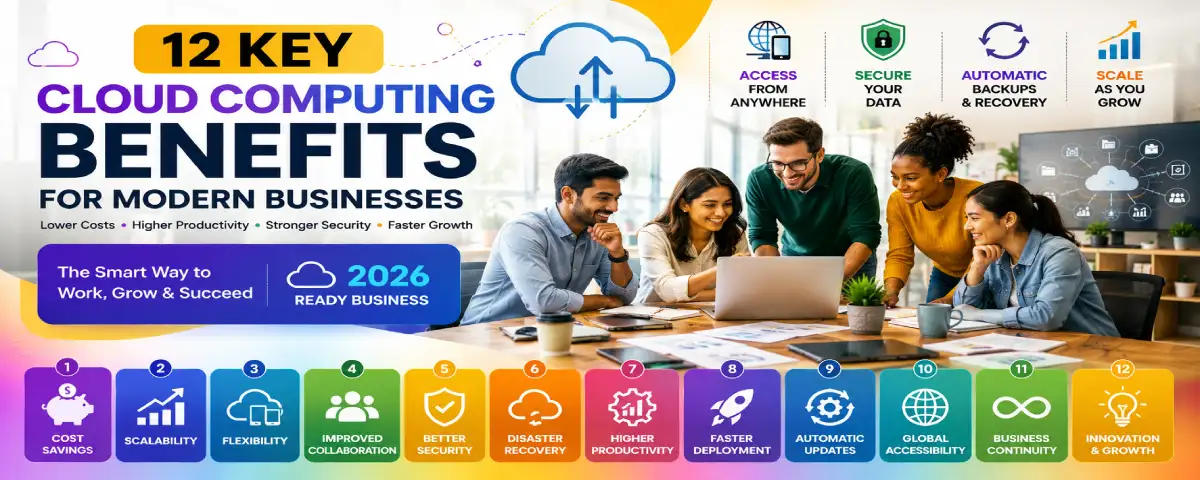
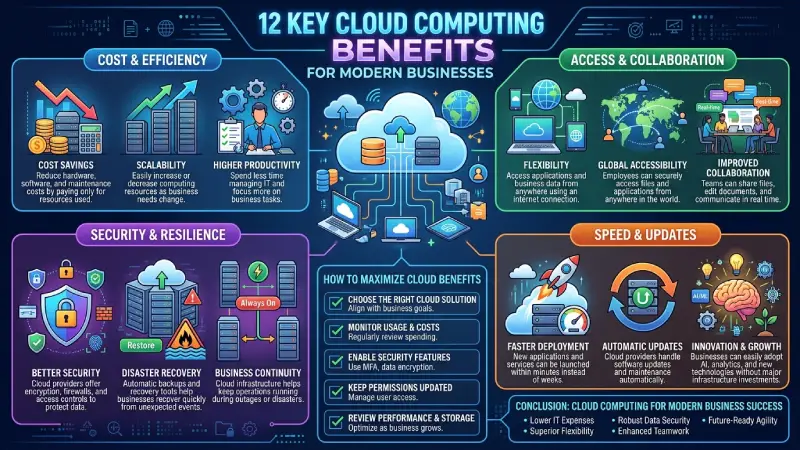
12 Key Cloud Computing Benefits for Modern Businesses
| No. | Benefit | Short Explanation |
| 1 | Cost Savings | Reduce hardware, software, and maintenance costs through payment for what you actually use. |
| 2 | Scalability | Increase/decrease computing power as your firm expands. |
| 3 | Flexibility | Use Internet access to reach applications and business information from any location. |
| 4 | Improved Collaboration | Teams are able to collaborate on file sharing, document editing, and communication. |
| 5 | Better Security | Cloud providers offer encryption, backups, firewalls, and access controls to protect data. |
| 6 | Disaster Recovery | Automatic backups and recovery tools help businesses recover quickly after unexpected events. |
| 7 | Higher Productivity | Employees spend less time managing IT and more time focusing on business tasks. |
| 8 | Faster Deployment | New applications and services can be launched within minutes instead of weeks. |
| 9 | Automatic Updates | Cloud providers handle software updates and maintenance automatically. |
| 10 | Global Accessibility | Employees can securely access files and applications from anywhere in the world. |
| 11 | Business Continuity | Cloud infrastructure helps keep operations running during outages or disasters. |
| 12 | Innovation and Growth | Businesses can easily adopt AI, analytics, machine learning, and new technologies without major infrastructure investments. |
Why Businesses Are Moving to the Cloud
The trend of organizations continuing to migrate towards the cloud is driven by the desire to increase their efficiency and competitiveness. The cloud computing environment enables remote work, enhances customer services, ensures security of sensitive information, and fast development and deployment of new applications and services. There is no need for any expensive investment in hardware due to the cloud computing environment.
With the ongoing advancements in technology, cloud computing has become an integral aspect of digitalization and development in all sectors.
Cloud Computing Benefits at a Glance
| Benefit | Business Impact |
| Cost Savings | Lower IT expenses and reduced hardware costs |
| Scalability | Grow computing resources as business needs increase |
| Flexibility | Access applications and data from anywhere |
| Security | Better data protection with advanced security features |
| Collaboration | Improved teamwork through real-time file sharing |
| Backup | Automatic backups reduce the risk of data loss |
| Productivity | Faster workflows and improved business efficiency |
| Reliability | High availability with less downtime |
Cloud computing keeps assisting enterprises in cost reduction, performance improvement, and quick adjustment to market changes, thus becoming one of the most useful technologies for today’s companies.
Benefits of Using Cloud Computing
Among other advantages of cloud computing is saving cost on business operations. In fact, rather than spending huge amounts of money on buying pricey servers, networking devices, and software licensing, businesses will be able to rent cloud infrastructure for a certain period of time and only pay for services that they consume. Businesses do not need to make costly upfront investments. Besides, cloud computing providers will take care of software upgrading, hardware and system maintenance, thus saving on IT personnel.
Scalability and Flexibility
Cloud computing allows companies to scale up without having to replace their IT systems. Businesses can simply upgrade storage space, computing capacity, or number of users depending on high demand and revert when there is less demand. It is easier for businesses to manage expenses and expand in the future. Users of such software have an ability to work remotely as long as they have access to the Internet.
Improved Collaboration and Remote Work
The use of cloud computing provides opportunities for better collaboration between people irrespective of their locations. The employees have access to the shared files, edit files simultaneously, and communicate using cloud applications. This leads to increased efficiency and better working despite remote working or working from home. For instance, the marketing team can simultaneously create presentations, spreadsheets, and reports.
Conventional IT Technologies versus Cloud Computing
| Feature | Traditional IT | Cloud Computing |
| Initial Cost | High | Low |
| Hardware | Business-owned | Provider-managed |
| Scalability | Limited | Easy and flexible |
| Maintenance | Managed by business | Managed by provider |
| Remote Access | Limited | Available from anywhere |
| Software Updates | Manual | Automatic |
| Data Backup | Business responsibility | Automatic options |
| Business Growth | Requires new hardware | Scale on demand |
Cloud computing enables organizations to reduce costs, collaborate better, and respond quickly to changing organizational requirements. Hence, cloud computing is a good investment decision.
Disaster Recovery and Business Continuity
With cloud computing, organizations are able to regain their activities fast following any unforeseen event like system crashes, cyber attacks, or disasters. Majority of cloud service providers provide automatic backup and disaster recovery services to ensure that business information is not compromised. Following any crash of the system, organizations are able to retrieve all their applications and files without any difficulties.
Security and Compliance Benefits
The providers of cloud computing services ensure the safety of client data by putting efforts into the implementation of security measures. Examples of such measures are encryption of the stored data, MFA (Multi-Factor Authentication), firewalls, identification and access control management, as well as constant security monitoring. In addition, many businesses adhere to industry regulations, thereby helping business organizations to keep their confidential information secure.
To take the next step, see our detailed guide on cloud computing services
More Advantages of Cloud Computing
The benefits of cloud computing extend beyond this to include numerous other features which help businesses thrive.
- Automatic Software Updates: The security patches and software updates take place automatically and save time.
- Improved Application Performance: The improved cloud computing framework results in increased efficiency of applications.
- Accessible from Anywhere: It is easy for employees to access files and applications through the Internet from any place..
- Rapid Deployment: It becomes easy to deploy new applications and services within minutes rather than days.
- Innovative Technologies: Companies can easily implement innovative technologies such as artificial intelligence and machine learning.
- Environmental Sustainability: Cloud service providers use green data centers which save energy and make it possible for businesses to conduct environmentally sustainable operations.
The above merits indicate that cloud computing is a reliable method that can help organizations increase efficiency, security, and sustainability through digital means.
Maximizing Cloud Value for Companies
Cloud computing could be very beneficial to organizations if they are able to choose solutions that are right for them and their future plans. Before engaging in cloud computing, one should consider their business workloads, data storage, security issues, and finances. Employee training to use cloud computing applications is very helpful too.
For maximizing cloud computing’s advantages, organizations need to:
- Select the appropriate cloud service for them.
- Periodically check on their cloud usage and cost.
- Utilize security functions such as Multi-Factor Authentication (MFA).
- Ensure regular backups of important business information.
- Maintain updated access permissions.
- Check performance and storage capacity as the business expands.
Common Mistakes to Avoid
Many companies do not benefit fully from cloud computing due to their lack of proper planning. Some common errors include:
- Choosing cloud services without clear business goals.
- Ignoring security settings and access controls.
- Not backing up important data.
- Overspending on unused cloud resources.
- Failing to train employees.
- Not monitoring cloud performance and costs regularly.
Frequently Asked Questions
Describe some of the strengths of cloud computing.
Cloud computing benefits include reduced costs, scalability, collaboration, security, back up, and flexibility.
Is cloud computing cost effective?
Yes, because firms do not need to invest in expensive hardware and incur costs based on the utilization of cloud services.
Is cloud computing safe?
Indeed, the big cloud service providers provide their customers with encryption services, firewalls, identity management and continuous security monitoring.
How does cloud computing enhance collaboration?
Collaboration is improved in cloud computing because employees have the capability to access and share files at any place from their cloud applications.
Why do firms go to the cloud?
Firms decide to go to the cloud to cut down their IT costs and increase efficiency, among other reasons.
Conclusion
Cloud computing is an essential technology that modern businesses rely on because of its capacity to be cost-effective, flexible, secure, and scalable at the same time. Cloud computing enables decreasing costs associated with the infrastructure of the company, making it possible to collaborate and protect data while working remotely. In addition, cloud computing makes it possible to react to changes on the market fast and be prepared for future growth thanks to automatic updates, backups, and availability of resources.