

Business Grant Reporting: Records and Requirements
Where to begin: Start with the main Business Grants pillar guide first, then use this focused guide to manage reporting, records, and closeout once you have received an award.
Winning a grant is only the beginning. Once the money is awarded, you enter the reporting phase. Funders need clear evidence that the funds were spent correctly, the planned activities happened, and the expected results were achieved. In 2026 the rules around reporting, record-keeping, and closeout remain strict. Good systems from day one make the process manageable. Poor systems create stress, delayed payments, or even repayment demands.
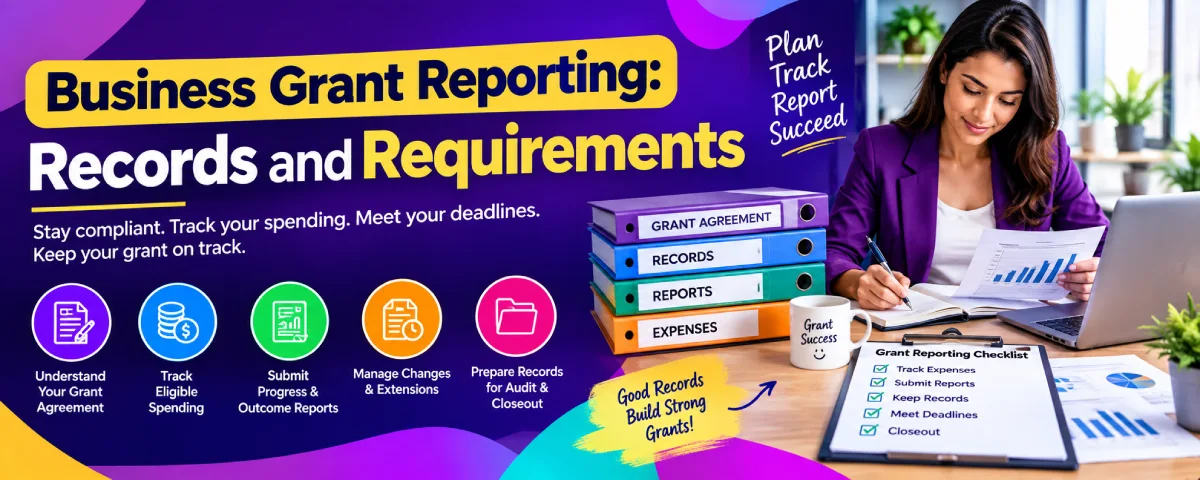
This guide covers the five practical areas every grant recipient needs to handle: understanding the grant agreement, tracking eligible spending, submitting progress and outcome reports, managing project changes and extensions, and preparing records for audits and final closeout. The advice stays straightforward so small businesses and startups can apply it without a large compliance team.
What Does the Grant Agreement Require?
The grant agreement (sometimes called the award notice, contract, or terms and conditions) is the rule book for the entire project. Read it carefully as soon as you receive it and keep a marked-up copy accessible.
Key sections to note immediately:
- Period of performance – the official start and end dates
- Reporting schedule – due dates for progress reports, financial reports, and final reports
- Allowable costs – what you may and may not charge to the grant
- Matching or cost-sharing requirements – if any
- Payment method – advance, reimbursement, or milestone-based
- Special conditions – any extra rules attached to your specific award
- Record retention period – how long you must keep documents after the project ends
- Change and amendment procedures – how to request modifications
Create a simple one-page summary of deadlines and key obligations. Share it with everyone who will touch the project or the finances. Many problems start because team members did not know a reporting date or a spending restriction.
In the United States, federal awards follow the Uniform Guidance (2 CFR Part 200). Other countries have their own national rules, but the principle is the same: the written agreement governs.
How Should You Track Eligible Spending?
Only costs that are allowable, allocable, and reasonable under the grant agreement can be charged. Tracking must be accurate and supported by documentation from the first day of spending.
Best practices used by successful recipients in 2026:
- Set up a separate cost centre, project code, or account in your accounting system for the grant.
- Code every invoice, payroll entry, and payment to that code.
- Keep original invoices, receipts, contracts, and proof of payment.
- For staff time, use timesheets or time-tracking software that shows hours worked on the grant versus other work. Signed timesheets remain the gold standard for audits.
- Reconcile the grant ledger to the approved budget at least monthly.
- Never mix grant funds with general operating money without clear allocation records.
A simple monthly tracking table helps:
| Budget Category | Approved Budget | Spent to Date | Remaining | Notes / Supporting Documents |
| Personnel | Timesheets + payroll | |||
| Equipment | Invoices + delivery notes | |||
| Travel | Receipts + purpose | |||
| Consultants | Contracts + invoices | |||
| Other |
If the grant is reimbursement-based, you will need to spend first and claim later. Plan cash flow accordingly. Some programs allow advances, but you must still account for every dollar.
Which Progress Reports and Outcomes Are Needed?
Most grants require periodic progress (or performance) reports plus a final report. Financial reports are usually separate.
Progress / performance reports typically ask for:
- Activities completed during the period
- Progress toward objectives and milestones
- Challenges encountered and how they were handled
- Updated timeline if needed
- Quantitative data (numbers served, units produced, jobs created, etc.)
- Qualitative results and lessons learned
Financial reports usually require:
- Expenditures by budget category
- Comparison to the approved budget
- Explanation of any significant variances
- Matching funds contributed (if required)
- Unspent balance
Final reports summarise the entire project from start to finish, not just the last period. They compare actual results against the original goals and explain any differences.
Submit reports on time, even if the news is not perfect. Late or missing reports are one of the fastest ways to damage your relationship with a funder and risk future eligibility. Use the exact templates or portals the funder provides.
How Do Project Changes and Extensions Work?
Projects rarely go exactly as planned. Equipment delivery delays, staff changes, or unexpected technical issues are common. Most funders allow changes, but they must be requested properly.
Typical rules:
- Minor changes (small budget shifts within the same category, minor timeline adjustments) can often be made without formal approval, but document them internally.
- Significant changes (major scope changes, large budget transfers between categories, key personnel changes, or extending the end date) usually require a written amendment request.
- Submit the request early, before the change happens if possible. Explain why the change is needed and how it still achieves the original objectives.
- Never assume verbal approval is enough. Get everything in writing.
Extensions of the project end date are common when justified. Request them well before the original end date. Late requests are harder to approve.
Budget increases are rare. Most amendments stay within the original award amount.
Keep a log of every change request, the funder’s response, and the final decision. This log becomes important at closeout and during any audit.
What Records Are Needed for Audits and Closeout?
Closeout is the formal process of finishing the grant. For many federal awards the recipient has 120 calendar days after the period of performance ends to submit all final reports and liquidate obligations. Other funders set their own deadlines — check your agreement.
Core closeout documents usually include:
- Final financial report (often SF-425 or equivalent)
- Final progress / performance report
- Inventory or disposition report for any equipment purchased
- Return of unspent funds (if required)
- Any other forms listed in the agreement
Records you must retain (typical minimum three years from the date of the final financial report, longer in some programs):
- Original grant agreement and all amendments
- All financial records and supporting invoices, receipts, and timesheets
- All progress and financial reports submitted
- Correspondence with the funder
- Procurement documentation
- Equipment records
- Evaluation data and outcome evidence
Organise these records in a clear digital folder structure (and physical if required) so you can retrieve any document quickly. Auditors and funders can request records years after the project ends. Closeout does not end the right to audit.
A practical closeout checklist:
- Reconcile all spending to the final budget.
- Confirm all obligations are paid or cancelled.
- Prepare and submit final reports by the deadline.
- Return any unspent funds if required.
- Archive the complete grant file.
- Note the record retention end date on your calendar.
- Confirm the funder has accepted the closeout package.
Country and Program Notes for 2026
United States (federal)
Uniform Guidance (2 CFR 200) applies. Final reports generally due within 120 days. SF-425 is the standard financial form. Record retention starts from the final expenditure report date. Single Audit rules may apply above certain expenditure thresholds.
United Kingdom, Canada, Australia, India, EU
National or programme-specific rules apply. Many follow similar principles: timely progress and financial reports, clear documentation of eligible costs, formal approval for major changes, and multi-year record retention. Always follow the exact terms in your award letter.
Troubleshooting Common Reporting Problems
I am behind on a report.
Contact the funder as soon as you realise it. Explain the delay and give a realistic new submission date. Silence is worse than a late report with an explanation.
My actual spending does not match the budget categories.
Document the reasons and request a budget realignment if the difference is significant. Do not simply move money without approval when the rules require it.
Staff did not keep proper timesheets.
Fix the process immediately for future periods. For past periods, reconstruct the best available evidence and note the limitation. Prevention is far easier than reconstruction.
The project is finishing early or late.
Request an amendment for the end date if needed. Do not simply stop work or continue spending past the official end date without approval.
I cannot find an old invoice.
Search thoroughly. If it is truly missing, document the search and the alternative evidence you have. Missing support for costs can lead to disallowance.
Frequently Asked Questions
How often will I have to report?
It varies. Common schedules are quarterly, semi-annual, or annual progress reports, plus financial reports on the same or a different cycle. The agreement states the exact dates.
What happens if I underspend?
You usually return the unspent portion unless the funder approves a different use. Do not assume you can keep it.
Can the funder still audit me after closeout?
Yes. The right to review records continues for the full retention period (and longer if there are unresolved issues).
Do I need special software?
A clear spreadsheet or basic project accounting system is enough for most small awards. Larger or more complex grants benefit from dedicated grant management tools.
Who inside my company should own reporting?
Assign one person overall responsibility, even if others contribute data. Clear ownership prevents missed deadlines.
Conclusion
Grant reporting is about proving you did what you promised with the money you received. The grant agreement sets the rules. Accurate spending records, timely progress and financial reports, proper handling of changes, and complete closeout documentation keep you compliant and protect your reputation for future funding.
Build simple systems on day one — separate tracking codes, monthly reconciliations, and organised digital folders — and the reporting burden stays manageable. Treat every report as both a compliance duty and a chance to show the value of the work you are doing.
This completes the cluster series on Business Grants. Return to the main Business Grants pillar page for the full overview and links to all related guides. Consistent, careful reporting turns a one-time award into a foundation for stronger future applications.