

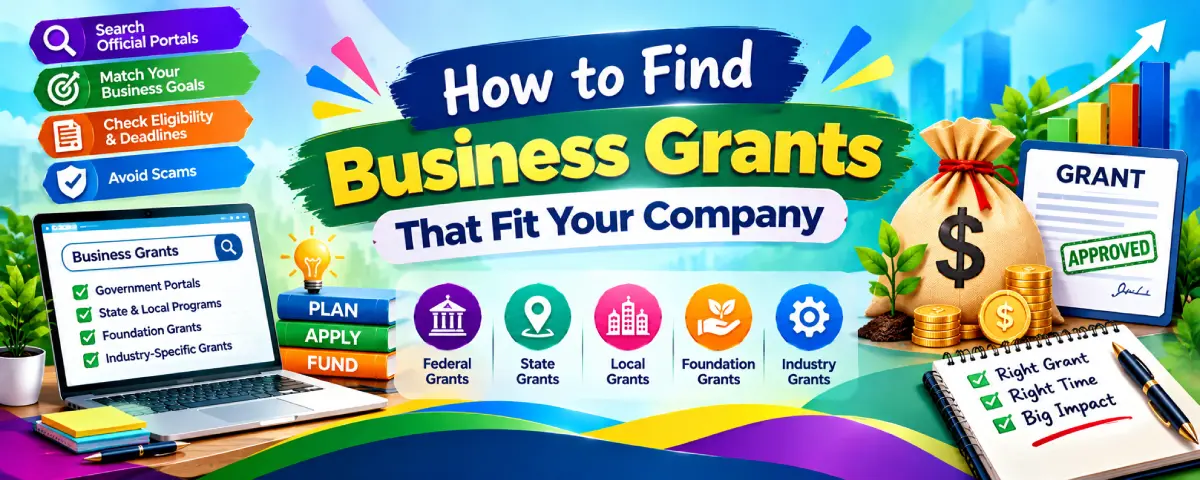
How to Find Business Grants That Fit Your Company
Where to begin: Start with the main Business Grants pillar guide first, then use this focused guide to locate the right funding opportunities for your company.
Finding the right business grant can feel overwhelming at first. You open a search engine, type “how to find business grants,” and suddenly you’re drowning in lists, paid databases, and promises of free money. I’ve helped many small business owners and startups cut through that noise. The truth is simpler than it looks once you know where to look and what questions to ask.
In 2026, the landscape is clearer than it was a few years ago. Official government portals have improved their search tools, more countries publish forecasts in advance, and scam awareness is higher. Still, the basic process stays the same: search official sources first, match the grant to your actual goals, check deadlines carefully, and stay alert for red flags. This guide walks you through exactly that process in plain language.
Where Can You Search Official Grant Portals?
Start with government portals. These are free, updated regularly, and the only places that publish real funding opportunities. Private “grant finder” sites can be useful later for filtering, but they pull from the same official sources.
Here’s a practical 2026 snapshot of the main official portals by region:
| Country / Region | Main Official Portal | What It Covers | Notes for 2026 |
| United States | Grants.gov | Federal grants from most agencies | Use “Posted” status filter. Simpler.grants.gov is the default search for many users. Register early on SAM.gov for a Unique Entity ID. |
| United States (R&D) | SBIR.gov | Small Business Innovation Research & Technology Transfer | Reauthorized through 2031. Strong for tech and research-focused companies. |
| United Kingdom | Find a Grant (GOV.UK) + Innovate UK | Central government + innovation funding | Devolved nations (Scotland, Wales, Northern Ireland) have their own portals. Many local Growth Hub schemes appear here or on regional sites. |
| Canada | Official departmental sites + provincial portals | Federal and provincial programs | Aggregators exist, but always verify on the government page. Focus on innovation, export, and sector programs. |
| Australia | GrantConnect (grants.gov.au) + business.gov.au | Commonwealth grants | GrantConnect is the mandatory register. business.gov.au is friendlier for SME-focused programs. |
| European Union | EU Funding & Tenders Portal | Horizon Europe, Digital Europe, and other EU programs | Many opportunities require partners. National portals still hold a large share of funding. |
| India | Startup India portal + MSME schemes (msme.gov.in, Udyam) | Seed funds, design support, PMEGP, and state schemes | DPIIT recognition is often the first step for startup benefits. State and sector schemes vary widely. |
A few practical tips I give every client:
- Create free accounts on the main portals in your country. Set up email alerts for keywords that match your industry and location.
- Always filter by open or posted status. Forecasts are useful for planning but not yet open for applications.
- Check agency websites directly sometimes. Some post opportunities a few days before they appear on the central portal.
- For local grants, look at your city or regional economic development office, chamber of commerce, and industry associations. These rarely appear on national portals.
In the US, Grants.gov remains the single most important starting point for federal money. In Australia, GrantConnect is the authoritative list. In the UK, Start with Find a Grant and then dig into Innovate UK for technology and R&D support. In India, begin with the Startup India portal and your state’s startup or MSME policy page.
How Do Local and Industry-Specific Grants Differ?
Not all grants are the same. Understanding the difference saves time and disappointment.
Local and regional grants usually focus on place-based outcomes. They want to create jobs in a specific town, revitalize a downtown, support rural businesses, or help a priority industry in that area. Amounts are often smaller ($5,000–$100,000 is common), competition is lower, and decisions can come faster. Eligibility is tightly tied to location. You generally need to operate or invest in that specific region.
Industry-specific or national grants target a sector or a national policy goal — clean energy, advanced manufacturing, digital transformation, health innovation, export growth, and so on. These can be larger, more competitive, and more paperwork-heavy. Many require a clear technical or innovative component. R&D grants (like SBIR in the US or Innovate UK projects) fall into this category.
Here’s a simple comparison:
| Aspect | Local / Regional Grants | Industry-Specific / National Grants |
| Typical focus | Job creation, local investment, community benefit | Sector growth, innovation, national priorities |
| Average size | Smaller | Often larger |
| Competition | Lower | Higher |
| Speed | Often faster | Can take months |
| Documentation | Usually lighter | More detailed technical and financial plans |
| Best for | Expansion, equipment, hiring, local projects | R&D, product development, scaling innovation |
| Risk of mismatch | High if you ignore location rules | High if your project doesn’t match the policy goal |
In practice, many businesses start with local grants because they are more accessible, then move to industry-specific ones once they have a stronger track record and clearer project. Stacking is possible in some cases — a local match can strengthen a national application — but always check the rules carefully.
How Do You Assess a Grant Against Business Goals?
This is the step most people skip, and it costs them time. A grant that looks good on paper can still be a poor fit.
Ask these questions every time:
- Does this grant fund the exact type of expense or activity I need right now? (Many restrict funds to equipment, R&D, training, or specific project costs.)
- Can I meet the matching or cost-sharing requirement if there is one?
- Will the reporting and compliance burden be realistic for my team size?
- Does the timeline match my project calendar?
- Is the maximum award worth the effort of applying?
A quick decision table I use with clients:
| Question | Strong Fit | Weak Fit | Action |
| Aligns with current business priority | Yes | No | Prioritize or drop |
| Eligible expenses match needs | Yes | Partial / No | Check fine print or skip |
| Match funding available | Yes or none required | High match required | Calculate carefully |
| Reporting capacity | Team can handle | Overwhelming | Consider capacity first |
| Award size vs effort | Worth it | Too small for work involved | Deprioritize |
Write your answers down. It takes ten minutes and prevents weeks of wasted application work. If a grant only partially fits, look for better matches before investing time.
How Can You Check Deadlines and Funding Status?
Deadlines move. Funding can run out. Status changes happen.
Best practices in 2026:
- On Grants.gov and similar portals, always look at the official “Open Date,” “Close Date,” and any amendment notices.
- Subscribe to email alerts for specific opportunities and for saved searches.
- Check the agency’s own website in addition to the central portal — updates sometimes appear there first.
- Look at past award notices. Seeing what was funded previously gives you a sense of typical project size and successful applicant profiles.
- For multi-stage programs (common in EU and some R&D schemes), note both the first and final deadlines.
- Set calendar reminders 2–3 weeks before closing dates so you have time to gather documents.
After you submit, most systems give you a tracking number. Use the portal’s “Check Application Status” or equivalent function. Once the agency takes over, follow up through their system or contact person listed in the notice.
Funding status is trickier. Some programs publish remaining funds or note when a round is fully committed. Others do not. When in doubt, contact the program officer listed in the official notice. A short, polite email asking whether funding remains available for the current round is normal and expected.
What Warning Signs Suggest a Grant Scam?
Scams still exist and have become more sophisticated with AI-generated messages and fake videos. The rules have not changed.
Never pay any fee to receive a grant. Legitimate government grants do not charge application, processing, insurance, or “release” fees. Registration on official portals is free.
Clear red flags in 2026:
- Someone contacts you first about a grant you never applied for.
- They guarantee approval or say you are already selected.
- They ask for payment by gift card, wire transfer, cryptocurrency, or cash.
- The website is not a .gov (or your country’s official domain) and tries to look official.
- They pressure you to act immediately or keep the offer secret.
- They request bank details or sensitive personal information early in the process.
If any of these appear, stop. Verify everything on the official government portal. Report suspicious offers to the relevant consumer protection agency or the portal’s fraud page.
A Simple 7-Day Search Plan
Day 1–2: Create accounts on your main national portals. Set up keyword alerts for your industry, location, and business stage.
Day 3: Search local and regional economic development sites and industry associations.
Day 4: Review 5–10 promising opportunities using the assessment questions above. Shortlist 2–3.
Day 5: Check deadlines, eligibility details, and required documents carefully.
Day 6: Note any matching funds or partners needed. Decide whether to pursue.
Day 7: Add the shortlisted grants to your calendar with internal deadlines two weeks earlier than the official close date.
Repeat this process every 4–6 weeks. New opportunities appear regularly.
Country Notes (2025–2026 Snapshot)
- United States: Grants.gov + SAM.gov registration is essential for federal work. SBIR/STTR remains one of the strongest options for innovative small businesses.
- United Kingdom: Mix of Innovate UK, Find a Grant, and regional schemes. Local Growth Hubs can be surprisingly useful.
- Canada: Federal and provincial layers both matter. Provincial programs are often faster.
- Australia: GrantConnect is the official register; business.gov.au is more user-friendly for many SME programs.
- European Union: Funding & Tenders Portal for EU-level calls. Many still require consortia.
- India: Startup India recognition plus MSME schemes and state policies. Seed Fund and design support programs are active routes for early-stage companies.
Always verify current details on the official site — programs and dates change.
Troubleshooting Common Problems
I can’t find any grants that fit.
Widen the search slightly (include related industries or nearby regions) or look at smaller local programs first. Many businesses start with $10,000–$25,000 local grants before moving to larger ones.
The portal is confusing.
Most official sites now have improved search filters and help sections. Use the “Posted” or “Open” status first. Contact the help desk if needed — they exist for a reason.
Deadlines feel too tight.
Set internal deadlines earlier. Build a simple document checklist so you’re not starting from zero each time.
I’m worried about scams.
Stick to official .gov or equivalent domains. Never pay fees. When in doubt, walk away.
Frequently Asked Questions
Do I need a special registration to search?
No. Searching is free and open on most portals. Registration is usually required only to apply or set alerts.
Are there grants for very small or new businesses?
Yes, especially local programs, some startup-focused schemes, and certain industry competitions. Eligibility rules vary — always read them.
Can I apply for more than one grant at a time?
Usually yes, as long as the rules allow it and you can manage the work and any matching requirements.
How long does it take to hear back?
It varies widely — from a few weeks for small local grants to several months for large competitive national programs.
What if I miss a deadline?
Look for the next round or similar programs. Many opportunities repeat annually or have multiple cut-offs.
Conclusion
Finding business grants that actually fit your company is a process of focused searching, careful matching, and realistic assessment. Start with official portals, understand the difference between local and industry-specific options, check every opportunity against your real goals and capacity, stay on top of deadlines, and protect yourself from scams.
Once you have a shortlist of strong matches, the next steps are eligibility review and the application itself. Those topics are covered in the other cluster guides in this series.
Return to the main Business Grants pillar page for the full overview, then move to the eligibility or application cluster when you’re ready. Take it one clear step at a time. The right funding is out there — you just need a practical system to find it.