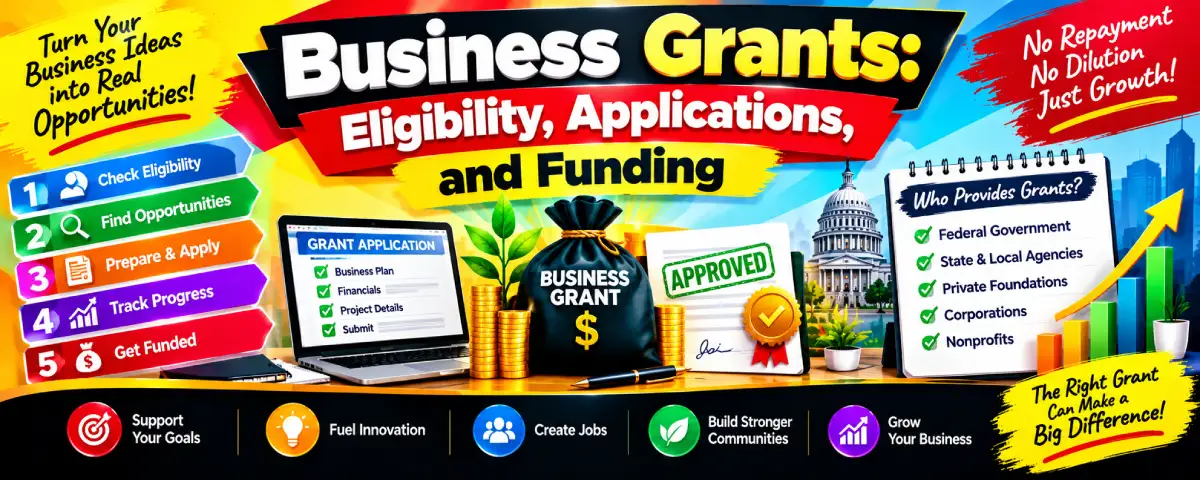
Business grants continue to be the most misunderstood form of capital that entrepreneurs face in 2026. When they hear about “free money,” they think about an effortless check coming to their mailbox. However, grants are funds provided for specific purposes or projects related to the objectives of the funding party. They are not diluting the equity nor creating debt; however, they have certain terms and regulations.

During my practice as a consultant in this area, I’ve helped dozens of business owners deal with this matter. Those who succeed treat the grant application as a professional dialogue rather than playing lottery. They perform a detailed research, find the connection between their project and the funding party’s objectives, provide all required documentation and organize everything properly after receiving the grant. This manual will help you get through all key steps of this process in order to understand whether business grants are right for your company and how to receive them.
According to the tracking statistics from grant aggregation sites that cross-check their information against the actual sources, as of September 2026, there are about 158 small business grants available in the United States. The federal grants (especially SBIR/STTR) continue to lead in the large award segment, whereas states, cities, and private foundations provide most of the small grants. The median value of the max available awards for currently active programs is approximately $30,000.
What Are Business Grants and Who Provides Them?
A business grant can be defined as funds provided by governmental agencies, foundations, corporations, or other organizations to fund a particular project without expecting repayment or providing equity. There is a certain objective that the business grant aims to achieve and which could include promoting technologies, generating employment in troubled areas, women-owned businesses, minorities, enhancing the economy of rural regions, or commercializing research.
While a loan requires the recipient to pay interest and principal, equity entails a share of ownership; a business grant is neither of them. In return, the recipient has an obligation to spend funds on specified areas and report the results.
Main sources of business grants in 2026
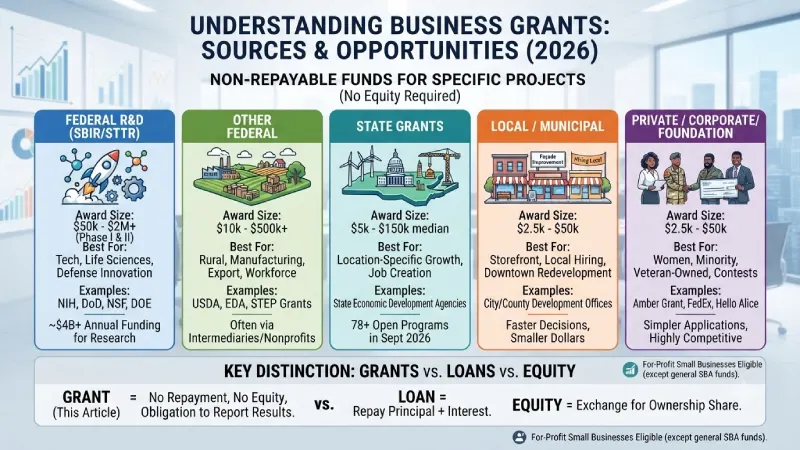
| Source Type | Typical Award Size | Best For | Key Examples (2026) | Notes | |
| Federal R&D (SBIR/STTR) | $50k–$323k Phase I; up to ~$1.8M–$2M+ Phase II | Tech, life sciences, defense, energy, agriculture innovation | NIH, DoD, NSF, DOE, USDA SBIR/STTR | Largest pool of true non-dilutive capital; ~$4B+ annually across 11 agencies | |
| Other Federal | $10k–$500k+ (often via intermediaries) | Rural, manufacturing, export, workforce | USDA Rural Business Development Grants, EDA programs, STEP export grants | Many go to nonprofits or local governments that then help businesses | |
| State | $5k–$150k median | Location-specific growth, job creation, industry priorities | State economic development agencies, tourism, manufacturing, workforce grants | 78+ open programs tracked in Sept 2026 | |
| Local / Municipal | $2.5k–$50k | Façade improvements, storefront, local hiring | City or county economic development offices | Often faster decisions, smaller dollars | |
| Private / Corporate / Foundation | $2.5k–$50k | Women-owned, minority-owned, veterans, specific industries | Amber Grant, FedEx Small Business Grant, Hello Alice programs, various corporate contests | Usually simpler applications; highly competitive |
However, the Small Business Administration (SBA) does not offer general grants for regular operations of small business concerns itself. The majority of the SBA budget is used for loan guarantees, counseling provided by Small Business Development Centers (SBDCs) and various special programs. Grants of the SBA go directly to intermediaries (SBDCs, Women’s Business Centers, SCORE) that provide free assistance to you. Excepting for-profit small businesses, the special cases of such grants are SBIR and STTR programs that the SBA provides support but the funds come from participating federal agencies.
SBIR (Small Business Innovation Research) and STTR (Small Business Technology Transfer) programs still are the best programs for those who run research-oriented business. For FY2026 the amount of funding for these two programs is over $4 billion. The Phase I funding is provided for the feasibility study (up to 6 months, up to about $275,000-$323,000 per project depending on the agency). The funding for the Phase II covers research and development (up to about $1.8 million or more). The only exception is the age of the business – there is no minimum requirement; the newly created business also can apply if the ownership requirements are met.
Private and corporate grants may not be large in amounts but they can be easier to apply. The Amber Grant gives out three grants worth $10,000 per month to female business owners and year-end large grants. There are also corporate contests that give out from $10,000 up to $50,000 depending on the program like FedEx, which have smaller requirements to meet.
Grants from state and local sources usually target economic development objectives such as employment, downtown redevelopment, exports, or assistance for particular industries such as manufacturing, agriculture, and clean energy. There is often a requirement to provide matching fund or hire locally.
Understanding who provides the money helps you avoid the biggest early mistake: applying for the wrong type of funding. A general “I need money to start my café” request will not succeed on Grants.gov. The plan to carry out a marketing project related to rural tourism and innovation in food safety is quite feasible.
How Do You Find Legitimate Grant Opportunities?
The rule that will remain unchanging in 2026 is also that which is unchanged to date – legitimate government grants never charge a fee for application purposes or as means to unlock the funding. Unsolicited emails, texts, or social media messages claiming to be notifying you that you have been pre-approved for a government grant is a scam.
Trusted places to search
- Grants.gov – the official federal portal. Every legitimate federal grant opportunity is listed here. Filter by eligibility category “Small Business.”
- SBIR.gov – centralized listings for all SBIR and STTR solicitations from the 11 participating agencies.
- Your state’s economic development agency or commerce department website.
- Local Small Business Development Center (find yours at sba.gov or America’s SBDC network). Counselors know the current state and local programs and will help you free of charge.
- SAM.gov – required registration for almost all federal awards. Start this early; it can take days to weeks.
- Respected private trackers that can be verified by means of primary sources (useful for discovery, but be sure to visit the program’s actual site).
A practical weekly routine many successful applicants use:
- Allocate 30-45 minutes each Monday searching Grants.gov and SBIR.gov for grants aligned to your NAICS codes or your specific technology.
- Visit the website for your state’s economic development agency, as well as your city or county websites monthly.
- Have a quarterly conversation with your SBDC counselor because they often know about opportunities long before others.
- Create calendar alerts for periodic grant programs (monthly Amber Grant, periodic state grants, etc.).
Red flags that signal a scam
- Requests for payment before the process starts.
- The fact that the money can go away soon and demands that you hurry.
- The claim that you’ve already been picked and that you don’t need to apply.
- Requiring you to share your bank information or your social security number.
- Sites that look like the actual sites but aren’t .gov or .foundation domain.
- The promise of receiving funds.
If there is any confusion, look up the program name with “Grants.gov,” or go to the agency website. The agency should be contacted through its phone number or email address on the official website, not any contact details from an unknown source.
Additionally, most owners spend countless hours on “grant finder” programs that cost hundreds of dollars when such lists are freely available online. In most cases, the official website and the SBDC advisor will be more than enough.
Which Eligibility Rules Apply to Your Business?
Eligibility is never one-size-fits-all. Every program writes its own rules. However, common categories appear again and again.
Typical eligibility factors
- Business structure and size: Most require a for-profit business entity (sole prop, LLC, corporation). Size is generally defined by number of employees (often less than 500 employees for federal R&D programs) or by revenues/ net worth compared to SBA size definitions in the business category.
- Ownership and control: Federal programs generally require that there be majority ownership and control by United States citizens or residents. Special programs also exist for women, minority, veteran, or HUBZone-owned businesses, although these generally have separate certifications.
- Location: Rural development programs, state and local grants are geographically limited programs. Certain federal programs favor certain geographic locations or labor surplus areas.
- Industry or project type: SBIR/STTR fund R&D with commercial potential. USDA programs favor agriculture and rural. Manufacturing, clean energy, export, and workforce training each have dedicated pots.
- Business stage: Some grants allow pre-revenue or start-up companies (SBIR). Others require two or more years of operation or revenue.
- Funding application: Grants are invariably tied to allowable costs such as personnel, equipment, supplies, travel, and consultants in regard to the project. It seldom includes general working capital or salary for the owner.
- Matching: A number of programs mandate a matching amount from the business, either cash or in kind.
- Compliance: In good standing with taxes and not debarred; clean character of principal people.
Quick self-check before you invest time
Ask yourself:
- Is my project consistent with the objective of the funding agency?
- Do I qualify in terms of size, ownership and location requirements?
- Will I be able to verify each and every eligibility criterion using my tax returns, certificate of formation, ownership details and financials?
- Am I ready to account for every single dollar invested for the entire duration of the grant period (usually 1 to 3 years)?
If you answer “No” or “I am not sure” to any of these questions, stop and consult with an SBDC adviser or go through the Notice of Funding Opportunity (NOFO) carefully. It is a waste of time applying if you know that you are ineligible for a particular grant.
In case of special situations such as start-up firms, women and minority firms, rural firms and tech firms, eligibility criteria may be more lenient.
How Do Applications and Grant Proposals Work?
The process is systematic and requires many documents. There is also a predictable pattern for federal grants.
Common timeline and process to apply to federal grants
Register ahead of time
- Get a Unique Entity Identifier (UEI) and SAM registration. This is a requirement for almost all federal awards and can take anywhere from 7 to 14 days or more depending on problems that might occur.
- Set up accounts on Grants.gov and agency-specific sites (such as NIH ASSIST or NSF Research.gov)
Be familiar with the Notice of Funding Opportunity (NOFO)
This is your rule book. It contains information on eligibility, allowable costs, page limitations, required forms, and evaluation criteria, as well as the specific deadline date and time zone. Double check. Many applications get rejected due to a missing attachment or exceeding the page limitation.
Gather core documents
Common requirements include:
-
- Business formation documents and bylaws/operating agreement
- Tax returns (business and personal, often 2–3 years)
- Financial statements or projections
- Resumes of key personnel
- Project narrative / technical proposal
- Detailed budget and budget justification
- Letters of support or collaboration agreements (especially for STTR)
- Certifications and representations
Write the proposal
Strong proposals answer three questions clearly:
-
- What problem are you solving and why does it matter to the funder?
- What exactly will you do, by when, and with what measurable outcomes?
- Why is your team the right one to do it, and how will you manage the money responsibly?
Use the criteria for evaluation from the funder as a guide for your outline. For example, if the NOFO states that your proposal will be graded according to “Innovation (30%), Approach (25%), Team (20%), Commercialization (15%), Budget (10%),” make sure to address these topics in order.
- Create a Realistic Budget
Budget expenses according to the funder’s acceptable expense categories (Personnel, Fringe, Equipment, Travel, Supplies, Other Direct Costs, Indirect Costs). Make sure every line item makes sense. Certain expenses have restrictions for many grants (Entertainment Expenses, Lobbying, Overhead).
- Submit Early and Verify Receipt
Federal grant portals can be notoriously slow during deadlines. Try to make sure your application gets submitted at least 48 hours before the deadline date. Download the confirmation receipt.
While state, local, and private grant applications tend to be brief—a few pages with an online application form, some narrative, and financial data—the same guidelines still hold true: match the mission and follow instructions carefully.
Success rates vary widely. SBIR Phase I can be highly competitive (sometimes under 15–20% in popular topics). Smaller private awards are likely to succeed simply by virtue of being sought by fewer applicants. The recipients of these awards are business owners who approach the process in terms of professional sales techniques involving researching the client and presenting themselves in the right light.
What Happens After a Grant Is Awarded?
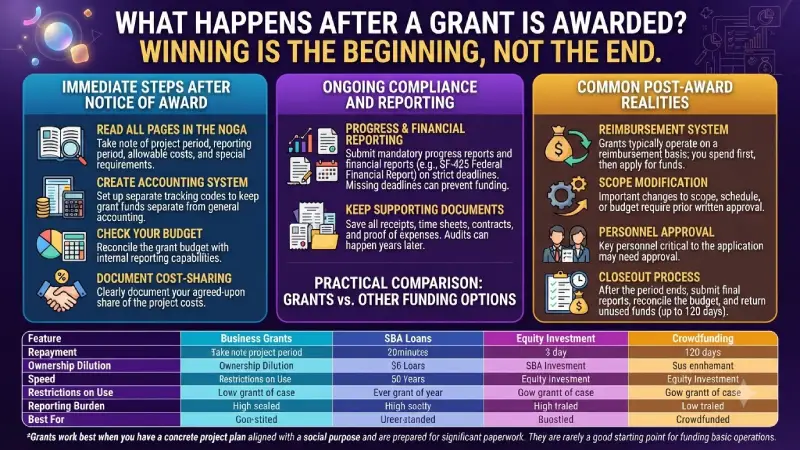
Winning is the beginning of a new set of responsibilities, not the end.
Immediate steps after the Notice of Award
- Read all pages in the award notice or Notice of Grant Award (NOGA). Take note of the actual period of the project, reporting period, allowable costs, and any special requirements.
- Create an accounting system (or at least tracking codes) that will keep the grant funds apart from your general accounting.
- Check your budget against what you can report internally.
- If there is cost-sharing on the award, document your share well.
Ongoing compliance and reporting
The most common requirement for the majority of grants is progress reporting and financial reporting. The most frequently used documents for federal grants are the SF-425 Federal Financial Report and the progress report according to the program requirements. The deadlines are strict, and missing them can prevent funding.
All supporting documents must be kept for all expenses: receipts, invoices, time sheets, contracts, and evidence of the necessity and reasonableness of the expenditure. Audit can happen many years after, so organization should start immediately.
Common post-award realities
- Cash flow: Grants usually operate on a reimbursement system. You spend the money first, and then you apply for reimbursement. Take note.
- Modification of scope: Important modifications in scope of work, schedule, and budget may necessitate prior written approval.
- Personnel: Personnel whose qualifications are critical in the application are also required to be approved.
- Closeout: Once the period of performance is concluded, you should turn in your final reports, reconcile the budget, return any unused money, and file any property/inventions if necessary. The normal federal closeout takes 120 days from the completion of the period of performance.
Failure to comply with reporting is the quickest way to ensure your award becomes a compliance issue. Those businesses which consider grant management as part of their operational processes never experience such problems.
Practical Comparison: Grants vs. Other Funding Options
| Feature | Business Grants | SBA Loans / Traditional Loans | Equity Investment | Crowdfunding / Contests |
| Repayment | None | Yes, with interest | None (but ownership given) | Varies |
| Ownership dilution | None | None | Yes | Usually none |
| Speed | Slow (months) | Moderate | Variable | Faster for some contests |
| Restrictions on use | High | Moderate | Low | Moderate to high |
| Reporting burden | High | Moderate | Moderate to high | Low to moderate |
| Best for | Project-specific, mission-aligned work | Working capital, equipment, real estate | High-growth scaling | Marketing + capital + community |
They work best when you have a concrete plan for a project that aligns with a social or charitable purpose and when you are prepared to shoulder the paperwork involved. Grants are rarely a good starting point for funding operations.
Common Mistakes That Cost Applicants Time and Money
- Applying to programs that clearly do not match the business or project.
- Submitting incomplete packages or ignoring page limits and formatting rules.
- Writing vague narratives that never connect to the funder’s stated priorities.
- Underestimating the time required for registrations and document gathering.
- Treating the budget as an afterthought.
- Ignoring post-award requirements until the first report is due.
- Paying third-party “grant writers” or “finders” who guarantee results or charge large upfront fees.
The fix for most of these is simple: read the NOFO carefully, talk to free counselors (SBDC, SCORE, APEX Accelerators), and start early.
FAQ Section
Does the SBA give grants to small businesses?
Direct general grants to ordinary small businesses are rare. SBA primarily provides loans, counseling, and coordinates SBIR/STTR. Most “SBA grants” you see advertised are either loans or programs run by intermediaries.
How long does the process take?
From finding an opportunity to receiving funds often takes 3–9 months or longer for federal programs. State and private grants can be faster.
Can a brand-new startup get a grant?
Yes, especially through SBIR/STTR and certain private programs. Many other grants prefer or require some operating history.
Do I need a professional grant writer?
Not necessarily. Clear writing, strong project design, and careful compliance with instructions matter more. Many owners write successful proposals themselves with free help from SBDCs.
What if my application is rejected?
Request feedback when available, improve the proposal, and apply to the next relevant cycle or a better-matched program. Rejection is normal; persistence with better targeting wins.
Are there grants for specific groups (women, veterans, minorities, rural)?
Yes. Many targeted programs exist. Certification (WOSB, SDVOSB, 8(a), HUBZone, etc.) can open additional contracting and funding doors, though certification itself is separate from grant applications.
Troubleshooting Common Problems
Issue: Stuck at SAM.gov registration.
Resolution: Look for missing or conflicting sections, name issues, or bank problems. Reach out to the Federal Service Desk and give yourself plenty of time.
Issue: There aren’t any grants available that suit me.
Resolution: Look into other types of projects, talk to your SBDC counselor, and assess if a loan or some other form of capital is the way to go.
Issue: The budget justification is insufficient.
Resolution: Connect every dollar to an activity in the work plan and show how it will lead to the expected result.
Issue: I won the grant but am cash strapped due to reimbursement.
Resolution: Consider bridge financing options and document the expenses as fast as possible while communicating with the program officer on time if there are any delays.
Issue: The funder/auditor questions the expenditure.
Resolution: Retrieve the invoice, the time card or contract, the budget line the cost has been posted to, and the relevant part of the NOFO or award document.
Conclusion
The reality of business grants in 2026 is that they are valuable, not easy, and definitely competitive. It goes to businesses that have solutions for the challenges faced by the funding entity, are clear about everything, and consider the relationship to be a partnership for the future and not just an immediate injection of funds. Although it is never going to be “easy free money,” yet it is worth the effort in order to get capital that doesn’t dilute ownership.
First thing to do is identify the project clearly and check the eligibility criteria through Grants.gov, SBIR.gov, and your state economic development website. Also, contact the free counselor at your local SBDC. Then start exploring the detailed cluster guides for identification of opportunities, eligibility verification, application preparation, grant proposal writing, special consideration for startups, and management of reporting after getting the grant.
It is these owners who are successful because they treat it as a professional skill and not an uncertain venture. Now you have the complete guide. The only thing left is to choose the right path.