


Almost all brands emphasize their features and benefits. Nevertheless, the most memorable brands are those which have something to say.
Brand storytelling refers to the method used to expose your brand through the story of the brand. It is not about spinning tales. It is all about uncovering the truth behind your brand and making that truth clear to your customers.
If done right, brand storytelling is going to make your brand memorable, credible, and attractive. However, when done poorly, your brand will appear to be dishonest.
This guide will attempt to expose you to the elements of brand storytelling, its importance, different forms of storytelling, how to effectively use it and mistakes to avoid..
Brand Storytelling: Meaning and Key Concepts
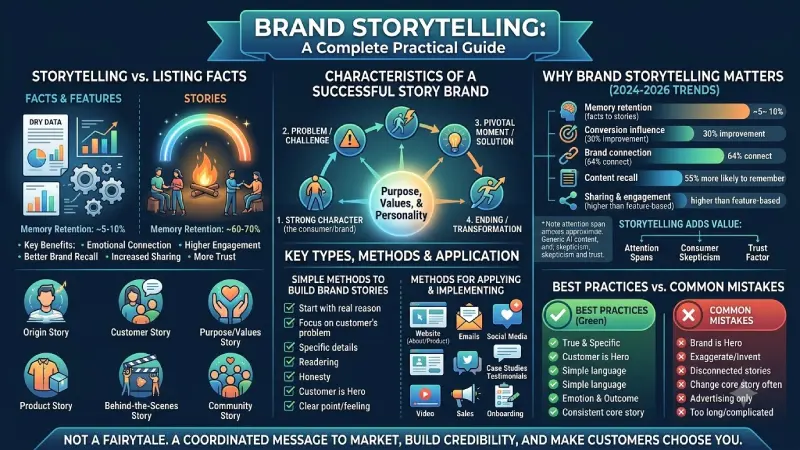
Brand Storytelling refers to the use of stories to convey the brand’s purpose, values, and personality.
Characteristics of a successful story brand include:
- Strong character (usually the consumer or the brand)
- Some sort of problem or challenge
- The pivotal moment/solution
- The ending or transformation
It is different from traditional advertising. Advertising often pushes features. This is because storytelling attracts people through emotional involvement and identification within the story itself.
Key idea: People rarely remember lists of facts. They remember stories.
Why Brand Storytelling Matters
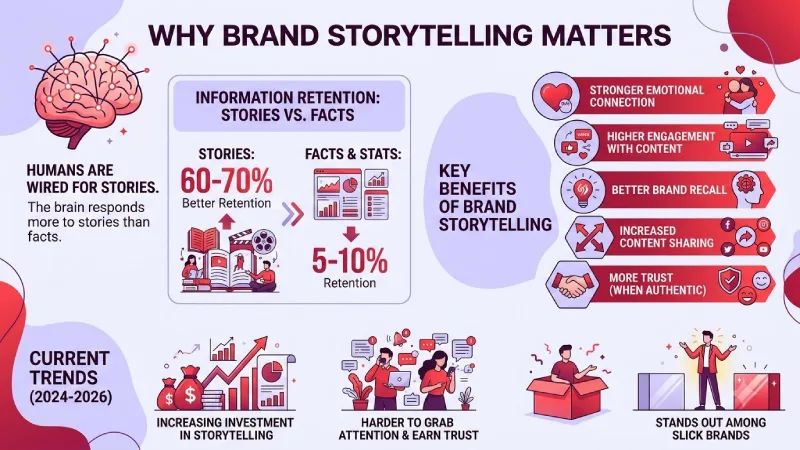
Stories succeed because the human brain responds to them. Years of research has found that people are much more likely to retain information when it is presented in a storytelling format than when it is presented as a list of facts. Studies have even shown that people can retain information about 60–70% better by telling a story, compared to just using statistics at a rate of about 5-10%.
Other observed benefits include:
- Stronger emotional connection with the audience
- Higher engagement with content
- Better brand recall
- Increased likelihood that people will share the content
- More trust when the story feels authentic
Currently (2024-2026), marketing departments are investing more in storytelling as it becomes harder to grab people’s attention and earn their trust. A brand that has an articulate and human story usually stands out among many slick brands.
What the Numbers Show
The research and reports in the industry indicate that there are clear benefits when brands adopt storytelling:
| Benefit | Approximate Impact | Why It Matters |
| Memory retention | From 5–10% (facts only) to ~60–70% (stories) | People remember your message longer |
| Conversion influence | Around 30% improvement in some studies | Stories can move people to take action |
| Brand connection | 64% of consumers say stories help them connect | Builds preference beyond product features |
| Content recall | 55% more likely to remember a brand story | Higher chance of being remembered later |
| Sharing and engagement | Higher than feature-based content | Stories travel further organically |
This does not mean that the figures are certain for all brands. There is a common trend: people will be more engaged and remember better when the information is provided in the form of story.
Why This Matters Even More Now
By 2025 and 2026, a number of market facts have rendered storytelling increasingly valuable:
- Attention spans are under pressure from constant content
- AI-generated content has made generic messaging more common
- Consumers are more skeptical and look for authenticity
- Trust has become a stronger factor in purchase decisions
Under these conditions, brands that simply feature lists of benefits often tend to get lost among many others. The stories that brands tell people allow them to create an emotional connection and make people memorize them.
Storytelling can be of use within an organization too. When the team understands the basic story behind the brand, it would be easy for them to make decisions and create consistent content.
In conclusion, storytelling by brands is not only an art but a means through which memory, connection, and clarity can be enhanced within the highly competitive market setting.
Key Types, Methods, and Examples
There are several common types of brand stories. Most brands use more than one over time.
| Type of Story | What It Focuses On | Best Used For | Example Direction |
| Origin Story | How and why the brand started | Building credibility and connection | Founder story or company beginning |
| Customer Story | Real results and transformations | Proof and social proof | Case studies and testimonials |
| Purpose / Values Story | What the brand believes in | Emotional connection and loyalty | Mission-driven narratives |
| Product Story | How the product solves a real problem | Explaining value in a human way | Problem → solution stories |
| Behind-the-Scenes Story | How things are made or done | Building transparency and trust | Process or team stories |
| Community Story | Shared experiences of customers | Belonging and advocacy | User-generated or community tales |
Simple methods to build brand stories:
- Start with the real reason the brand exists
- Focus on the customer’s problem more than your product
- Use specific details instead of vague claims
- Keep the story honest
- Make the customer the hero when possible
- End with a clear point or feeling
How to Use or Apply Brand Storytelling
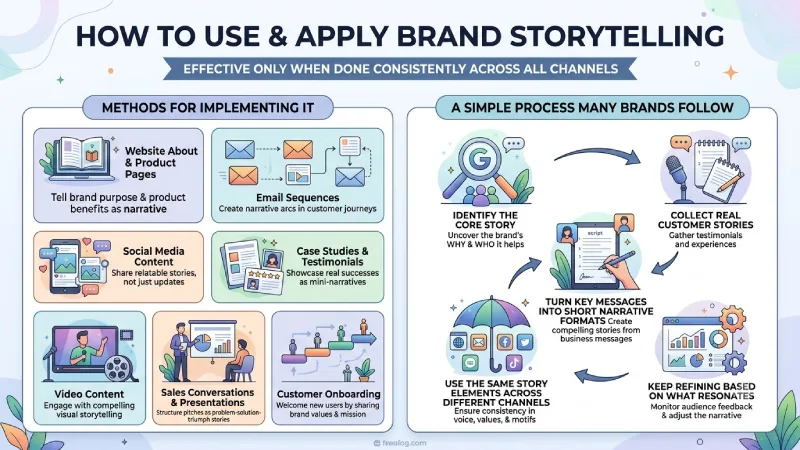
However, storytelling is effective only when it is done consistently and not just for large-scale marketing programs.
Methods for implementing it:
- Website About page and product pages
- Email sequences
- Social media content
- Case studies and testimonials
- Video content
- Sales conversations and presentations
- Customer onboarding
A simple process many brands follow:
- Identify the core story (why the brand exists and who it helps)
- Collect real customer stories
- Turn key messages into short narrative formats
- Use the same story elements across different channels
- Keep refining based on what resonates
Best Practices and Common Mistakes
Best practices:
- Keep stories true and specific
- Make the customer the hero whenever possible
- Use simple language
- Focus on emotion and outcome, not just features
- Repeat the core story consistently across channels
- Update stories with new real examples over time
Common mistakes:
- Making the brand the hero instead of the customer
- Exaggerating or inventing details
- Telling stories that feel disconnected from the actual product or service
- Changing the core story too often
- Using storytelling only in advertising and ignoring it in everyday communication
- Making stories too long or complicated
Another major problem is a story about an origin that is crafted beautifully by a brand but never used again. Storytelling works well if it becomes an integral part of the communication flow of the brand.
Frequently Asked Questions
- Brand Storytelling
Using storytelling in communicating the essence, purpose, and benefits that a brand offers its customers.
- Why does storytelling have such a strong impact on marketing?
It is easier to memorize a story rather than some facts and features. Also, stories evoke emotions, and that makes the brands closer to people.
- Does the small business need brand storytelling?
Yes. Small companies receive even more benefits from brand storytelling because it helps them to distinguish themselves from others without spending much money on marketing.
- How to build an authentic story?
Telling a story through details, being honest, and focusing on the customer rather than the brand’s features.
- When should a brand renew its stories?
Core stories can remain unchanged for years. However, customer stories and proof points must be frequently updated.
Conclusion
Brand Storytelling is Not about Creating a Fairytale Brand storytelling is not about creating some kind of fairytale but rather finding out the truth about your brand and presenting it to your audience.
An organized message sent in a consistent manner will make it easier for you to market, create instant credibility, and provide another good reason for your customers to choose you. Begin with the truth. Make it simple and coordinated. This strategy works much better than most marketing strategies out there.