

The majority of companies believe that brand identity refers only to logo and a color scheme. This assumption is true, but incomplete.
Brand identity consists of all visual and non-visual features that allow identifying your company as distinctive one. They may be associated with the way you look, speak, operate and behave. If these aspects are coherent and well-defined, people will easily recognize you. In case of confusion or ambiguity, you will be forgotten.
This guide will help you understand the essence of brand identity, its importance, different types and approaches to create it. You will find out the ways to implement your brand identity and mistakes which prevent you from doing it properly.
Brand Identity: Meaning and Key Concepts
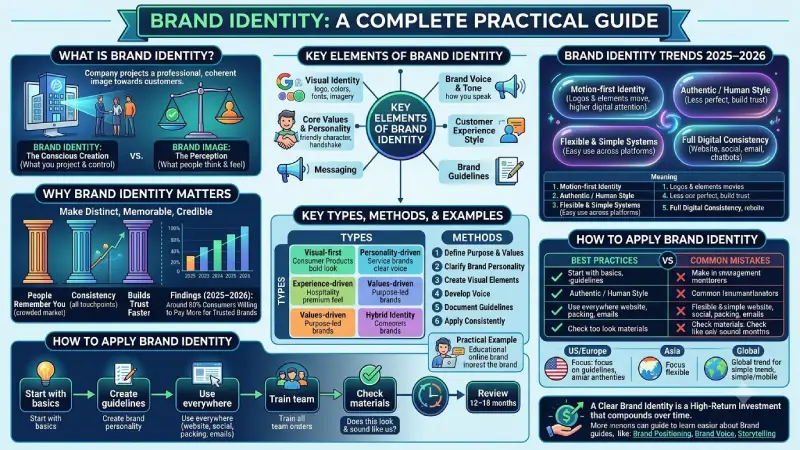
Brand identity is the image which the firm desires to project in front of its customers.
This is the conscious creation of elements that influence perceptions.
This is not the same thing as brand image. Brand identity is something that you create and control, while brand image is what people really think and feel about you. The aim is for both of these things to be the same.
Key elements of brand identity usually include:
- Visual identity (logo, colors, fonts, imagery style)
- Brand voice and tone (how you speak)
- Core values and personality
- Messaging and key phrases
- Customer experience style
Brand guidelines that keep everything consistentAn easy way to understand it:
Brand identity is the appearance, personality, and actions that you decide to portray in your company every single day.
Why Brand Identity Matters
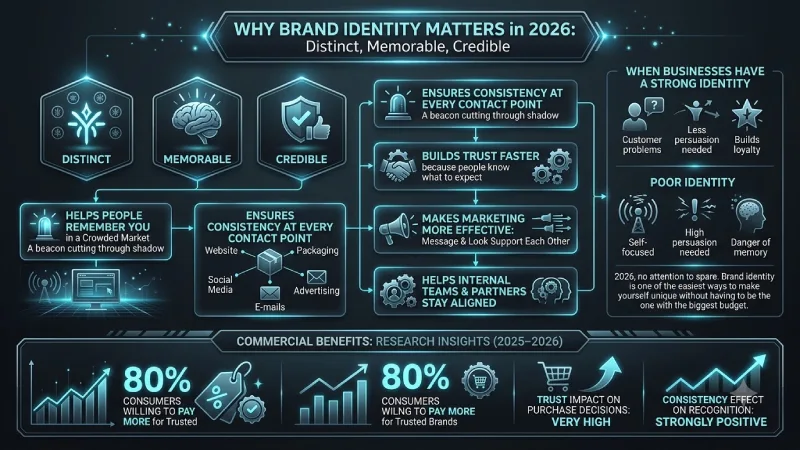
having a unique brand identity will make your business distinct, memorable, and credible.
Here’s why that’s important:
Here’s why it matters in practical terms:
- It helps people remember you in a crowded market
- Ensures that there is consistency at each point of contact (website, social media, packaging, e-mails, advertising)
- It builds trust faster because people know what to expect
- It makes marketing more effective because your message and look support each other
- It helps internal teams and partners stay aligned
When businesses have a strong identity, they don’t waste time talking about themselves but rather about what problems the customer faces. Poor identity makes customers need more persuasion and may still forget about you at all.
In 2026, there is no attention to spare and competition is fierce in every single market out there. Brand identity is one of the easiest ways to make yourself unique without having to be the one with the biggest budget.
It has been shown by recent research that strong identity is still relevant and provides commercial benefit. It has been found that around 80% of people prefer to spend extra on trusted brands. In addition, consistency of branding and communication in respect to the appearance of the brand becomes the fastest way to do so.
| Finding (2025–2026) | Approximate Insight |
| Consumers willing to pay more for trusted brands | Around 80% |
| Trust impact on purchase decisions | Very high across most markets |
| Consistency effect on recognition | Strongly positive |
Key Types, Methods, and Examples

A brand identity may be taken up differently based on the nature of the business.
| Type of Brand Identity | Best For | Main Focus | Example Style |
| Visual-first Identity | Consumer products, fashion, food | Strong look and feel | Bold colors, distinctive logo, clear imagery |
| Personality-driven Identity | Service brands, personal brands | Character and voice | Friendly, expert, bold, or calm tone |
| Experience-driven Identity | Hospitality, premium services | How it feels to interact | Consistent service style + atmosphere |
| Values-driven Identity | Purpose-led brands | Beliefs and stance | Clear principles shown in actions |
| Hybrid Identity | Most modern businesses | Mix of visual + voice + values | Balanced and consistent system |
Common methods to build brand identity:
- Define your core purpose and values
- Clarify your brand personality (e.g., reliable expert, friendly guide, bold innovator)
- Create visual elements (logo, color palette, typography)
- Develop voice and messaging guidelines
- Document everything in simple brand guidelines
- Apply the identity consistently across all channels
Practical example:
An educational online brand that is small opts to have “a clear, calm, and practical” personality. The colors chosen are clear blue and grey, as well as plain font styles and writing styles. The consistency of the content, email messages, and posts on social media sites adheres to the selected personality of the branding. Eventually, the brand is recognizable without referring to its name.
Brand Identity Trends in 2025–2026
Then include this content:
By 2025 and 2026, brand identity has transcended beyond the brand’s logo and its color scheme. The main trends of developing business identities are:
- Identity through motion: Dynamic logos, movement elements, and kinetic identities are increasingly popular, particularly with those that are digital-first brands.
- Human imperfection over perfection: In light of AI-generated imagery becoming mainstream, many companies are shifting towards an authentic and human style.
- Efficiency and mobile responsiveness: Streamlined and versatile identities that function well on mobile platforms and social media channels tend to do better.
- Consistency across all digital touchpoints: Website design, social media presence, email branding, advertising, and even chatbot tone are increasingly seen as one and the same.
| Trend (2025–2026) | What It Means | Why It Matters for Online Brands |
| Motion-first identity | Logos and elements that move | Higher attention on digital platforms |
| Authentic / human style | Less perfect, more real look and feel | Builds trust in an AI-heavy environment |
| Flexible & simple systems | Easy to use across platforms | Faster content creation and consistency |
| Full digital consistency | Same identity on all channels | Stronger recognition and trust |
How to Use or Apply Brand Identity

Creating a brand identity is only useful if you actually apply it.
Here’s how to put it into practice:
- Start with the basics — logo, colors, fonts, and voice
- Create simple brand guidelines that anyone can follow
- Use the same identity across website, social media, emails, proposals, and packaging
- Train team members or freelancers on the guidelines
- Check new materials against the identity before publishing
- Review the identity every 12–18 months to see if it still fits the business
A practical tip: Before you publish anything, ask one question — “Does this look and sound like us?” In case of no, change it.
Best Practices and Common Mistakes
Best practices:
- Keep the identity simple enough to use consistently
- Make sure visual elements and voice support the same personality
- Document the rules in a short, clear guide
- Apply the identity everywhere, not just on the website
- Let the identity evolve slowly rather than changing it often
- Focus on recognition over creativity for its own sake
Common mistakes:
- Treating brand identity as only a logo
- Changing colors, fonts, or voice too frequently
- Creating a complex identity that is hard to maintain
- Ignoring the identity on social media or in customer communication
- Copying another brand’s look too closely
- Building the identity without understanding the target customer
Among other challenges is the fact that many companies choose to have a good-looking logo and graphic identity but then leave every employee and/or freelance designer to follow their own style.
Country & Regional Notes (2025–2026)
Brand identity practices show some regional differences:
- There are numerous companies in the United States and Western Europe who place great importance on developing brand guidelines and visual identity system.
- However, there are firms in rapidly developing Asian countries who prefer to be quick and flexible, thus compromising consistency.
- All over the world, there is an increasing trend of developing simple and clear identities which can easily fit the mobile devices and social networks.
They are employed all over the world in the exact same manner; however, it is their consistent employability that matters the most.
Final Thoughts
The brand identity is not all about making your company look beautiful. Rather, it is about making your company identifiable and consistent.
When customers find it easy to identify your company, relate to your values and anticipate your actions, it increases their trust on your company, which in turn makes other marketing efforts easier.
Start by laying a solid foundation. Keep it simple and consistent. Review it occasionally. A clear brand identity is one of the highest-return investments a business can make — and it compounds over time.
The supporting guides on Brand Positioning, Brand Voice, Brand Storytelling, Brand Guidelines, and Brand Awareness go deeper into the individual pieces that make up a complete brand system.