


The majority of companies wish to be known by even more people. This is a simple definition of brand awareness.
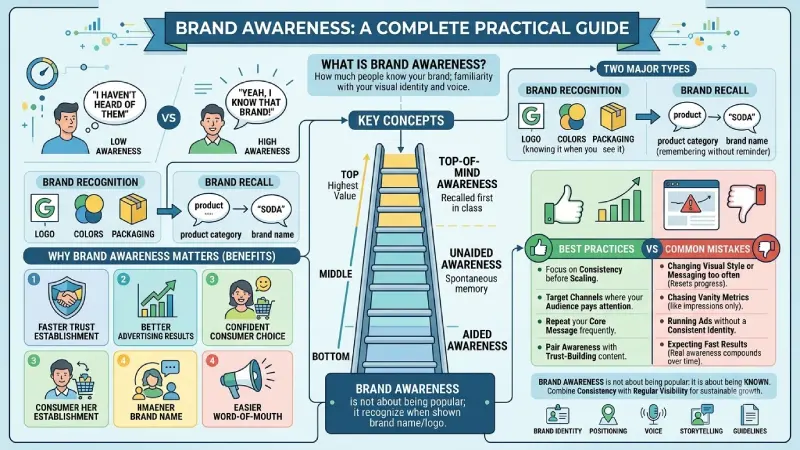
Brand awareness can be understood as people’s familiarity with your brand. Brand awareness is the difference between one person who says “I haven’t heard of them,” and another who responds with “Yeah, I know that brand.” With higher brand awareness, other aspects of marketing tend to become much easier – faster trust establishment, better advertising results, and more confident choice from the customer.
I have seen companies spend huge sums on advertisements and content creation without any consideration of the fact if anyone knows their brand or not. There is a big difference between awareness and attention. Attention is temporary, while awareness isn’t.
This guide will cover all important aspects of brand awareness.
Brand Awareness: Meaning and Important Concepts
Brand awareness means how much people know about your brand.
There are two major types that are usually explained in the following way:
- Brand recognition: When consumers recognize your brand (the logo, colors, name and package).
- Brand recall: Brand recall is easy (without reminder; for example, when consumers think about certain product category, they recall the name of your brand).
In other words, brand awareness is such that you may assume that people will remember your brand. Otherwise, your brand will be forgotten or will not be recognized by your consumers.
Brand awareness is high when your brand is easily recognizable. Brand awareness is low when your brand can even be forgotten about.
Key related ideas:
- TOP OF MIND AWARENESS (Brand name which is recalled first in product class)
- Aided awareness (people recognize you when shown your name or logo)
- Unaided awareness (people remember you without any help)
Why Brand Awareness Matters
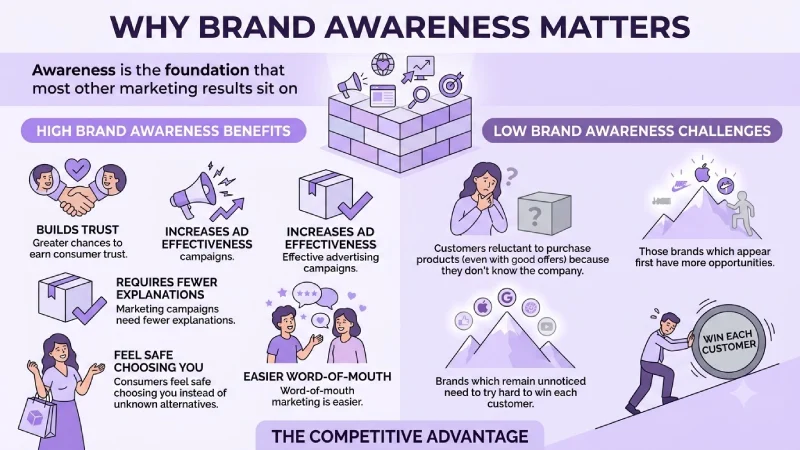
Awareness is the foundation that most other marketing results sit on.
When people already know your brand:
You have greater chances to earn their trust
- The effectiveness of your advertising campaigns will increase
- Your marketing campaigns require fewer explanations
- Consumers will feel safe choosing you instead of some unknown alternative
- Word-of-mouth marketing will be easier
Low awareness leads to the exact opposite result. Even when there are some good offers, customers will be reluctant to purchase products because they don’t know anything about the company.
In a competitive market, awareness can become a true benefit. Those brands which appear first have more opportunities, while those brands which remain unnoticed need to try hard to win each customer.
Key Types, Methods, and Examples
Brand awareness can be built in different ways. Some methods create quick visibility. Others build deeper, longer-lasting recognition.
| Type of Awareness | What It Means | How It Is Usually Built | Strength |
| Recognition | People know it when they see it | Visual consistency, repeated exposure | Fast to build |
| Recall | People remember it without help | Strong positioning + consistent presence | More powerful long-term |
| Top-of-mind | First brand that comes to mind | Category leadership + frequent relevance | Highest value |
| Aided Awareness | Recognition when prompted | Advertising and content | Easier to measure |
| Unaided Awareness | Spontaneous memory | Strong brand building over time | Harder but more valuable |
Common methods that actually work:
- Visual identity across all channels
- Repetition through content and ads
- Strong brand positioning
- Useful/entertaining content that sticks with you
- Public Relations and media coverage
- Partnering and collaboration
- The community and word-of-mouth strategy
- Distinctive elements of the brand (logo, colors, styles, etc.)
Simple example:
An example of a company that has used consistency as a strategy for visual identity, voice, and message strategy during the period of two years is the online education startup’s website, emails, and social media. Little by little, the brand has managed to get recognition even among busy social media newsfeeds. Awareness was built without just relying on paid ads.
How to Use or Apply Brand Awareness
It is not a one-time process but rather an ongoing process.
Ways to use it practically:
- Make sure your visual identity and voice are consistent first
- Show up regularly in the places your audience already spends time
- Focus on being memorable, not just visible
- Use both paid and organic methods
- Track whether people actually recognize and remember you
- Protect consistency even when you try new channels
- Combine awareness activity with clear next steps (so attention can turn into action)
A practical tip I often give:
It is not the question of awareness regarding the number but the nature of the awareness that would make people prefer you when they decide to buy something.
Best Practices and Common Mistakes
Best practices:
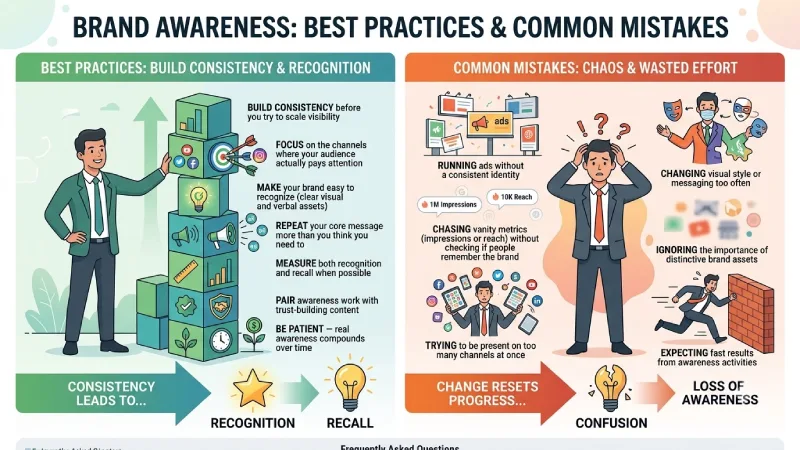
- Build consistency before you try to scale visibility
- Focus on the channels where your audience actually pays attention
- Make your brand easy to recognize (clear visual and verbal assets)
- Repeat your core message more than you think you need to
- Measure both recognition and recall when possible
- Pair awareness work with trust-building content
- Be patient — real awareness compounds over time
Common mistakes:
- Running ads without a consistent identity
- Changing visual style or messaging too often
- Chasing vanity metrics (impressions or reach) without checking if people remember the brand
- Trying to be present on too many channels at once
- Ignoring the importance of distinctive brand assets
- Expecting fast results from awareness activities
One of the biggest problems I see is businesses that keep changing how they look and sound. Every change resets some of the awareness they had already built. Consistency will be what changes attention to recognition.
Frequently Asked Questions
What is brand awareness?
It is the degree of recognition that the brand has in the consumer’s mind as to whether the consumer can recognize and recall the brand name.
Why is brand awareness important?
As people tend to have greater trust in, and therefore select, brands they recognize. Efficiency in the marketing process will be achieved due to the recognition of brands.
What are some strategies a business could use to promote brand awareness for their organization?
Consistency is necessary in appearance and in messaging. First of all, consistency is required in visiting the places frequented by your target audience. Professionalism and consistency are definitely preferable to inconsistency all the time.
How long does it take to create brand awareness?
There is no specific time to create brand awareness because it might take months.
What is the difference between brand awareness and brand recognition?
Brand recognition is defined as when the consumer recognizes the brand through seeing it.
Conclusion
Brand awareness is not about being popular; it is about being known.
The more aware you make your target market about your brand, the easier everything else becomes for marketing. You’ll be trusted quicker. Your ads will get better results. You’ll get more referrals.
First, concentrate on consistency. Then gain regular visibility. Track whether people really recall you or if they’ve simply seen you.
Over time, those two together will help you develop real awareness — the kind that enables sustainable growth.
The other guides that complement this one and offer information for building successful marketing strategy are Brand Identity, Brand Positioning, Brand Voice, Brand Storytelling, and Brand Guidelines.