

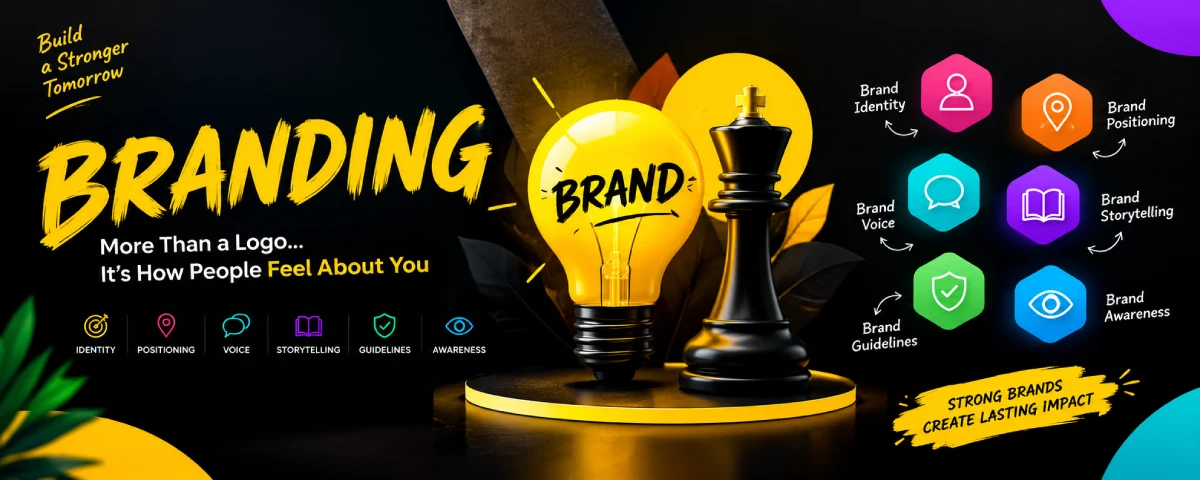
Most individuals think that branding is about a logo, some colors, or having a pretty website. But this is just the iceberg tip.
Brand identity consists of all the feelings that people have toward your business. Branding is everything that they believe and feel when they hear about you, consume your content or interact with your product. Good branding makes your business memorable, credible and easy to pick from the rest. Poor branding does just the opposite – makes you forgettable and disposable.
This is an informative and practical guideline. This includes definition of the term, significance of branding for the vast majority of organizations, fundamental aspects of the strong brand, creation and assessment of the brand strategy. In addition, this includes role of six more subjects within the broader context (Brand Identity, Brand Positioning, Brand Voice, Brand Storytelling, Brand Guidelines, Brand Awareness).
What Is Branding?
Branding refers to the process through which you create the meaning of your business in the mind of your consumers.
It includes everything that shapes perception:
- The way that you look (your visual identity)
- The way that you talk (your voice/messaging)
- The things that matter to you (values/positioning)
- The way that you act (the customer experience)
Branding is different from marketing. The marketing process involves the promotion and sales. Branding refers to how people think of your company when they stop marketing you.
The easiest way to comprehend it:
Marketing creates awareness. Branding determines what this awareness becomes.
When you have a good brand, then people would immediately recognize your firm and trust you more than others. Without proper branding, the best form of marketing will not be able to give any lasting results.
Why Branding Matters for a Business

Branding affects almost every part of a business, even if it is not always obvious.
Here’s why it matters in practical terms:
- Your business becomes more memorable
- Sales happen quicker based on trust, not only on product or price
- Yields pricing power in the long run
- Makes marketing more effective
- Builds confidence for customers when deciding on your offer
- Gives your team a sense of direction
- Helps turn occasional customers into regular ones
In a competitive market environment, products and services are easy to replicate. It is much harder to duplicate a brand that is present in the minds of its customers.
Brands with good branding focus more on solving the customers’ problems rather than on introducing themselves. Companies without good branding require additional effort to earn even an ounce of attention and respect from their potential audience.
In 2026, surrounded by an abundance of information, advertising, and artificial intelligence, branding becomes one of the most trustworthy ways of standing out..
What Strong Branding Actually Changes
When branding is clear and consistent, several things start working in your favor:
It becomes much easier to be recognized.
Your brand will be noticed faster amid numerous feed streams, search results, and discussion streams. You do not have to spend so much effort trying to get noticed.
Trust comes with less friction.
Familiarity means low risk perception by the customer. People generally prefer buying things from a known brand than from an unknown brand.
Marketing becomes more effective.
With the same marketing budget, you get better results since people already know something about your company.
Price pressure decreases.
Once your brand is perceived as clear and trustworthy, customers will not make their choice only based on price.
Internal decisions get easier.
A distinct brand provides a benchmark for the team. It gets easier to make decisions on content to produce, offers to launch, and ideas to disregard.
Strong Branding vs Weak Branding
| Area | Strong Branding | Weak Branding |
| Customer Memory | People remember the brand easily | Brand is quickly forgotten |
| Trust | Builds faster | Takes more time and proof |
| Marketing Performance | Better results from the same effort | Higher cost for similar results |
| Pricing Power | Easier to protect value | More pressure to discount |
| Customer Confidence | Feels safer to choose | Feels riskier |
| Team Clarity | Clear direction for decisions | Mixed messages and confusion |
| Long-term Growth | Compounds over time | Progress resets more often |
Why This Matters Even More in 2026
In fact, the existing environment requires branding even more than before. The world is being flooded with more and more content. It has become easier to generate average content thanks to various AI solutions. Attention is costly and earning trust is difficult.
It is under such circumstances that the brands which will thrive in this environment will not be those which shout the loudest. Instead, it is the brands which are clear, coherent and distinctive.
Brand strengthens the efficiency of achieving certain results. Brand weakness requires extra effort from you for each customer and each new campaign.
This is why branding is not something that happens outside your core business systems. This is actually one of the core systems that affects the degree of difficulty of growing your company.
Core Elements of a Strong Brand
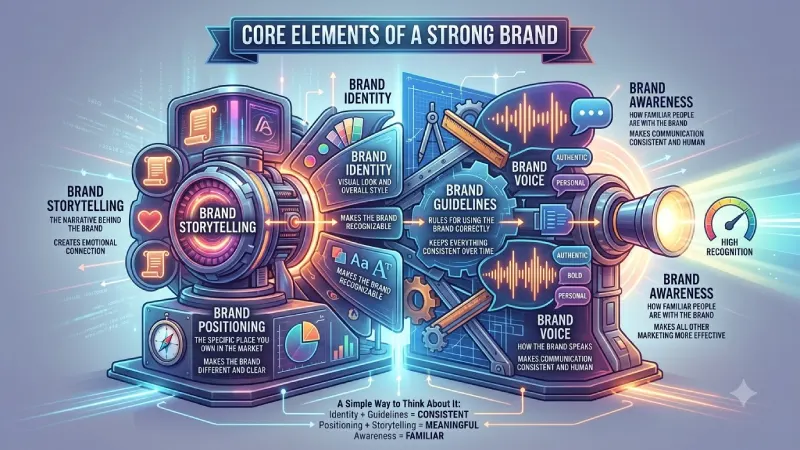
A strong brand is built from several connected pieces. When these pieces work together, the brand feels solid. When one or more are weak, the brand feels incomplete or confusing.
Here are the core elements most businesses need:
- Brand Identity
This refers to the look of the brand. These elements are the logo, color scheme, font, image style, and visual communication style of the brand. An identifiable brand identity makes the brand easily recognizable.
- Brand Positioning
It is the exact place the brand occupies on the market. It defines why customers would rather choose your brand than others. The positioning makes the brand clearer and unique.
- Brand Voice
This is because of the tone in which the brand communicates. Brand voice consists of three major aspects including tone, language, and personality. Unique voice of the brand makes it personalized.
- Brand Storytelling
This is the story about the brand. Why is it here? What does it represent? It builds an emotional bond between the customer and the brand.
- Brand Guidelines
They are the rules which make the brand consistent. These are the rules about how to use visual identity, voice, and other brand elements properly. Guidelines save the brand when it becomes popular.
- Brand Awareness
It is the level of recognition of the brand. It is the measure of success of all other brand elements in reaching the target audience. With lack of brand awareness, everything else is useless.
| Core Element | What It Covers | Why It Matters | What Happens If It Is Weak | Related Cluster Article |
| Brand Identity | Visual look and overall style | Makes the brand recognizable | Brand looks inconsistent or forgettable | Brand Identity |
| Brand Positioning | The specific place you own in the market | Makes the brand different and clear | Brand blends in with competitors | Brand Positioning |
| Brand Voice | How the brand speaks | Makes communication consistent and human | Brand sounds different everywhere | Brand Voice |
| Brand Storytelling | The narrative behind the brand | Creates emotional connection and memory | Brand feels flat or purely transactional | Brand Storytelling |
| Brand Guidelines | Rules for using the brand correctly | Keeps everything consistent over time | Brand slowly drifts and loses clarity | Brand Guidelines |
| Brand Awareness | How familiar people are with the brand | Makes all other marketing more effective | Even a strong brand stays invisible | Brand Awareness |
All the components should work together. For instance, positioning is supposed to inform your tone. Identity should inform your story-telling process. The rules you set should safeguard what you have established. All that makes for a very strong and easily scalable brand.
A simple way to think about it:
Identity and guidelines make the brand consistent.
Positioning and storytelling make the brand meaningful.
Awareness makes the brand familiar.
How to Build a Brand Strategy
Brand creation does not require huge amounts of funding. It requires just clarity and consistency. Here is how you can create a brand.
- Step 1: Know your ideal customers
A brand has to have its target consumers. The more you know about them, the easier it is to make the rest of the decisions regarding brand building.
- Step 2: Define your position
Define what you want your brand to be known for and which problem it solves. These two factors form the basis of positioning.
- Step 3: Work out the visual identity elements
It is such elements as brand name, logo, colors palette and others that constitute the visual identity of the brand. Make sure they are recognizable enough.
- Step 4: Establish the brand voice
Define how your brand should be speaking. Write it down and establish the rules.
- Step 5: Develop the brand story
Create the brand story that will tell the world why the brand is unique from other brands belonging to the same product line.
- Step 6: Prepare easy-to-follow guidelines
Create the guidelines for using the elements of the visual identity and the brand voice. They should be useful.
- Step 7: Maintain consistency
Deploy your brand everywhere you have a chance to – your website, social media accounts, email messages, packaging, sales materials and everything else.
- Step 8: Increase the awareness
Here’s a richer, more useful version of the section “How to Measure Brand Performance”. You can replace your current version with this one.
How to Measure Brand Performance
Even though branding appears to be something you cannot measure, you still can use several metrics. The most important thing is not to spend money on complicated tools but rather to monitor some indicators that prove if the brand grows or not.
Common ways to track brand performance include:
- Brand awareness (with and without prompting)
- Brand recognition and recall
- Voice share in your product category
- Customer perception and sentiment
- Visual and verbal brand consistency
- Influence on conversion and pricing
- Customer loyalty and repeat business
- Qualitative data (people’s views about your brand)
No sophisticated instruments are required at first. Even asking basic questions such as “Are we recognized by people?” and “How do people perceive us?” can give you plenty of information.
Measurement does not mean creating sophisticated reports. Measurement should help you evaluate the progress of your brand-building process.
Practical Ways to Measure Brand Performance
| What to Measure | Simple Way to Track It | What Good Looks Like |
| Brand Awareness | Ask customers or run simple surveys | More people recognize or recall the brand |
| Brand Recognition | Show logo or name and ask if people know it | High recognition among target audience |
| Brand Recall | Ask people what brands they remember in your category | Your brand comes up without prompting |
| Consistency | Internal audit of website, social, emails, ads | Visual and verbal style stay aligned |
| Customer Perception | Reviews, feedback, and direct conversations | People describe the brand the way you intend |
| Business Impact | Conversion rate, pricing power, repeat purchases | Brand supports better results over time |
| Loyalty | Repeat purchase rate and referral activity | Customers come back and recommend you |
Leading vs Lagging Brand Signals
It helps to separate two types of indicators:
- Leading signals give early clues (for example, rising recognition, more consistent messaging, better engagement with branded content).
- Lagging signals show longer-term results (for example, improved conversion rates, stronger pricing power, higher customer loyalty).
Both matter. Leading signals help you adjust early. Lagging signals show whether the brand is creating real business value.
Simple Review Questions
Every few months, ask:
- Are the right people recognizing us now than they did before?
- How do customers describe us?
- Do our visuals and words match each other?
- Are we improving marketing or inhibiting it through the brand?
- Are we creating preference or just gaining attention?
It is normally more important to have an occasional look at something than to prepare a comprehensive report which goes unread.
The development of a strong brand should ease future growth efforts. If the data and the feedback reveal increased recognition, increased trust, and preference, the brand is succeeding in what it needs to do. If not, that is an indication that the brand has some catching up to do.
Frequently Asked Questions
What is branding?
The branding refers to the process through which the image of the business is shaped.
Why is branding important for the business?
It is essential since it enables easier identification of the business, helps establish credibility fast, improves the pricing power, and makes marketing more efficient. Without branding, a company finds it challenging and costly to develop.
What are the key elements of the branding?
The following are the branding elements that include Brand Identity, Brand Positioning, Brand Voice, Brand Storytelling, Brand Guidelines, and Brand Awareness, and all these elements go hand in hand.
How does branding differ from marketing?
While the marketing refers to promotion and sales of the product or services of the business, the branding refers to the way of thinking about and remembering it once the marketing process is completed.
Final Thoughts
Branding isn’t about being pretty. It’s about being clear, recognizable, and trustworthy to the people whose problems you solve.
Consistent and powerful branding makes everything easier – marketing becomes simpler, trust develops more quickly, and customers have a greater incentive to pick you. Inconsistent and generic branding makes every other process even harder.
Start with clarity. Construct the building blocks thoughtfully. Execute consistently. Measure meaningfully. Iterate continuously.
Powerful branding creates positive feedback loops. Companies that treat branding as an ongoing process – and not just a single undertaking – are usually those that create their greatest competitive advantage.
Use this primer as a starting point. And dig deeper into the six additional topics.