

B2B Buyer Journey: A Complete Practical Guide
In B2B, people rarely buy the moment they hear about a product. They research, talk to colleagues, compare options, and move back and forth before making a decision. This full path is called the B2B buyer journey.
Understanding the buyer journey helps marketing and sales teams show up with the right message at the right time. When companies ignore it, they often push product details too early or disappear when buyers need support the most.
This guide explains what the B2B buyer journey is, why it matters, the main stages and methods, how to apply it, and the common mistakes teams make. The language stays simple and practical.
B2B Buyer Journey: Meaning and Key Concepts
The B2B buyer journey is the full process that a company goes through from first realizing they have a problem to choosing a solution and becoming a customer.
Unlike a simple consumer purchase, B2B journeys usually involve:
- Multiple people (a buying committee)
- Longer research periods
- Higher risk and more internal discussion
- A mix of digital research and conversations with sales
Key points to understand:
- The journey is often non-linear. Buyers move forward, go back, pause, and restart.
- Most of the research happens before buyers talk to sales.
- Different people in the same company care about different things (cost, risk, ease of use, results).
- The journey does not always end at the purchase. Onboarding and expansion are also part of the bigger picture.
In short, the B2B buyer journey is the complete path a buying group takes when solving a business problem.
Why B2B Buyer Journey Matters
When teams do not understand the buyer journey, marketing and sales often work with the wrong assumptions. They may promote features when buyers are still trying to understand the problem, or they may push for a meeting too early.
Understanding the buyer journey helps you:
- Create content that matches what buyers actually need at each stage
- Improve the timing of outreach
- Reduce friction in the buying process
- Support the full buying committee, not just one contact
- Align marketing and sales around the same view of the customer
- Increase conversion rates and shorten sales cycles over time
In 2025 and 2026, B2B buyers do more independent research than before. Many complete a large part of their journey digitally before speaking with a sales representative. Companies that map and support this journey usually create better experiences and win more deals.
Key Types, Methods, and Examples
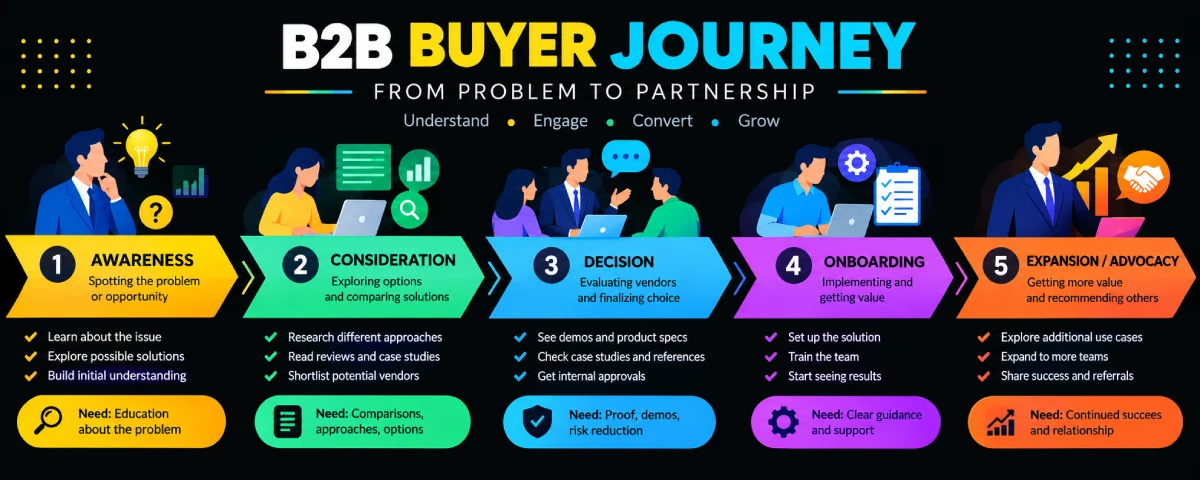
Most B2B buyer journeys can be understood through a few core stages. While the exact names vary, the common stages are:
| Stage | What the Buyer Is Doing | What They Need |
| Awareness | Realizing there is a problem or opportunity | Education about the problem |
| Consideration | Exploring possible ways to solve it | Comparisons, approaches, options |
| Decision | Evaluating specific vendors | Proof, demos, risk reduction, consensus |
| Onboarding (Post-purchase) | Implementing the solution | Clear guidance and support |
| Expansion / Advocacy | Getting more value or recommending others | Continued success and relationship |
Awareness Stage
Buyers notice a problem (for example, slow processes, rising costs, or missed targets). They are not yet looking for a specific product. They want to understand the issue better.
Consideration Stage
Buyers start exploring different types of solutions. They compare approaches, read reviews, and begin building a shortlist.
Decision Stage
Buyers evaluate specific companies. They look at demos, case studies, pricing, security, and internal approval processes.
Methods Used to Support the Journey
- Buyer journey mapping workshops
- Content created for each stage
- Intent data and behavioral signals
- Multi-threaded outreach (reaching more than one person in the account)
- Sales enablement materials for later stages
- Customer success support after the purchase
Simple Example
A company selling project management software might see this journey:
- Awareness: A manager searches “why projects keep missing deadlines”
- Consideration: The team compares different types of tools and methods
- Decision: They shortlist 3–4 vendors, watch demos, and check references
- Onboarding: They need help setting up the tool and training the team
How to Use or Apply B2B Buyer Journey
Here is a practical way to apply the buyer journey in your company.
Step 1: Map the current journey
Talk to customers and salespeople. Document what buyers do, think, and feel at each stage. Note where they get stuck.
Step 2: Identify the buying committee
List the common roles involved (for example, end user, manager, finance, IT, executive). Understand what each role cares about.
Step 3: Create stage-specific content and support
Match your content and outreach to the stage:
- Awareness → educational content
- Consideration → comparison and solution content
- Decision → proof, demos, and risk-reduction materials
Step 4: Align marketing and sales
Both teams should share the same view of the journey and know how to support buyers at each stage.
Step 5: Reduce friction
Make the next step clear and easy at every point (clear calls to action, helpful resources, fast follow-up).
Step 6: Measure progress by stage
Track how accounts move through the journey, not just individual leads.
Step 7: Review and improve
Update the journey map regularly based on real customer feedback and sales insights.
Best Practices and Common Mistakes
Best Practices
- Treat the journey as non-linear
- Support multiple stakeholders, not just one contact
- Create content for every major stage
- Use data and customer conversations to build the map
- Align marketing, sales, and customer success
- Make the next step obvious and easy
- Continue supporting customers after the purchase
- Review the journey map at least once or twice a year
Common Mistakes
- Assuming the journey is a straight line
- Focusing only on the decision stage
- Creating generic content that ignores buyer stage
- Ignoring the full buying committee
- Pushing product details too early
- Poor handoff between marketing and sales
- Forgetting about onboarding and post-purchase experience
- Never updating the journey map
Teams that avoid these mistakes usually create smoother experiences and convert more of the right accounts.
Simple Stage-to-Action Table
| Stage | Buyer Mindset | Best Marketing & Sales Action |
| Awareness | “We have a problem” | Educational content, problem-focused ads |
| Consideration | “What are the possible solutions?” | Comparison guides, webinars, case studies |
| Decision | “Which option is safest and best?” | Demos, proof, references, clear proposals |
| Onboarding | “How do we get value quickly?” | Clear setup guides, training, proactive support |
| Expansion | “How else can we benefit?” | Success reviews, advanced use cases |
FAQs
- How long is a typical B2B buyer journey?
It varies widely by industry and deal size. Many B2B journeys take several months. Complex enterprise deals can take six months to over a year. - How many people are usually involved in a B2B purchase?
Most B2B buying groups include multiple stakeholders. It is common to see 5–10 or more people involved in larger decisions. - Is the B2B buyer journey still linear?
No. Most modern B2B journeys are non-linear. Buyers move back and forth between stages and may pause for long periods. - Who should own the buyer journey inside a company?
Marketing and sales should share ownership. Customer success also plays an important role after the purchase. The best results come when these teams work from the same map. - How often should a company update its buyer journey map?
At least once a year, or whenever you notice major changes in buyer behavior, sales feedback, or market conditions.
Final Thoughts
The B2B buyer journey is the full path companies take when solving a problem and choosing a solution. It is usually longer, more complex, and less linear than many teams expect.
Companies that map the journey, support buyers at each stage, and align their teams around it usually create better experiences and win more business. Those that ignore it often push the wrong message at the wrong time.
Start by understanding how your real customers buy. Build content and processes that support that path. Keep improving based on feedback and results.
When marketing and sales both understand the buyer journey, everything else becomes easier — from content creation to outreach to closing deals.