

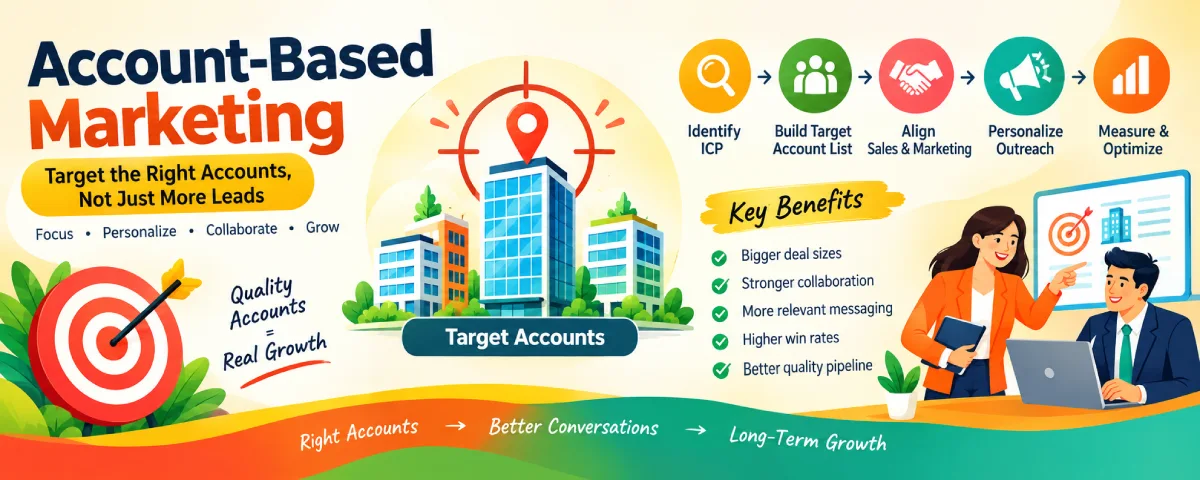
Accounts. There is no need for getting more leads. The aim is getting the right accounts.
This guide will clarify what Account-Based Marketing is, its significance, key types and approaches, how to implement it in practice, and most common pitfalls of the process. The language used is clear and pragmatic for practical application of concepts.
Instead of trying to attract as many leads as possible, ABM concentrates on a well-selected set of valuable companies. The marketing and sales teams cooperate to acquire those specific accounts. There is no need for getting more leads. The aim is getting the right accounts.
This guide is intended to explain what Account-Based Marketing means, why it matters, what kinds of it exist, how to apply it, and the most frequent mistakes people make while doing it. The vocabulary used is clear and realistic for real application of knowledge.
Account-Based Marketing: Meaning and Key Concepts
ABM or Account Based Marketing refers to a B2B marketing approach whereby the accounts are treated like one customer market each. The company identifies its ideal clients and then designs specific marketing and sales processes geared towards such clients.
While traditional marketing takes the bull by the horn and aims at catching any fish in the net, ABM begins with the fish and then constructs the net.
Key ideas behind ABM:
- Focus on quality accounts rather than quantity of leads
- Marketing and sales work on the same target list
- Messaging and content are personalized for each account or group of similar accounts
- Success is judged based on engagement and revenue rather than number of leads
ABM strategy thrives where deals tend to be complex and of high value.
Why Account-Based Marketing Matters
A lot of companies out there waste a huge amount of time and money trying to convert leads who will never end up purchasing their products or services. ABM is a solution that attempts to fix this problem through targeting companies that are most likely to become your clients.
So, why is it becoming increasingly popular among marketing teams?
- Bigger deal size is often achieved when focus is sharp
- Sales and marketing don’t compete with one another anymore
- The message is more relevant to the prospect
- Targeting accounts that matter
- Easy to measure what works for each account
New findings from 2025 and 2026 demonstrate that organizations with structured ABM campaigns can boast about having higher win rates and better quality pipelines than organizations utilizing lead generation tactics. However, success depends greatly on execution.
ABM is not sorcery. ABM is effective when your target accounts have been picked wisely and the outreach seems helpful.
Key Types, Methods, and Examples
Not every ABM program looks the same. Most teams use one of three main approaches, often called tiers.
| Type | Number of Accounts | Personalization Level | Resource Need | Best For |
| 1:1 (Strategic) | 5–50 accounts | Very high (custom) | High | Top strategic or enterprise deals |
| 1:Few (Cluster) | 50–200 accounts | Medium (by industry/role) | Medium | Mid-market or vertical focus |
| 1:Many (Programmatic) | 200–1000+ accounts | Lower (tech-assisted) | Lower | Broader but still targeted reach |
1:1 ABM
This is the most personalized approach. Customized content, microsites or executive outreach is developed by teams for a limited set of high value clients. More time and resources go into each client.
1:Few ABM
Accounts are divided according to industry, company size, or other common needs. The messaging is customized for the group. This is often the case for many B2B businesses..
1:Many ABM
Technology is used to extend personalized efforts on a larger list. Marketing messages, emails, and content become targeted but less customized.
Common Methods Used in ABM
- Account selection and tiering
- Intent data and research
- Personalized ads (LinkedIn, display)
- Custom or semi-custom content
- Coordinated email and sales outreach
- Direct mail for high-value accounts
- Account-specific landing pages or hubs
- Regular sales and marketing reviews
Simple Example
A software company selling to mid-sized manufacturers might create three tiers:
- Tier 1: 15 large target manufacturers (custom research + executive outreach)
- Tier 2: 80 similar companies in the same industry (industry-specific content + ads)
- Tier 3: 300 broader manufacturing accounts (targeted ads + nurture sequences)
How to Use or Apply Account-Based Marketing
Here is a practical way to start or improve an ABM program.
Step 1: Identify Your Ideal Customer Profile (ICP)
State clearly what type of company size, industries, location, technologies, and other considerations make an account ideal.
Step 2: Develop and Tier Your Target Account List
Identify which accounts align with your ICP. Then segment those accounts into tiers.
Step 3: Sales & Marketing Alignment
Sales and Marketing have to be aligned with respect to target account list, messaging, and success criteria.
If there is no alignment between Sales and Marketing, ABM initiatives normally fail.
Step 4: Research Accounts
Learn about accounts’ pain points, recent developments, people, technologies.
The better is the research, the more relevance in the approach.
Step 5: Develop Plays
Create personalized/specialized messaging, ads, emails, sales interactions for the accounts or groups of accounts.
Step 6: Run coordinated campaigns
Use multiple channels in a planned sequence rather than random outreach.
Step 7: Measure and adjust
Track account engagement, meetings booked, opportunities created, and revenue. Review results regularly and improve.
A simple 90-day starting plan many teams use:
- Days 1–30: Finalize ICP, build target list, align teams
- Days 31–60: Create first campaigns and begin outreach
- Days 61–90: Review results, refine messaging, expand what works
Best Practices and Common Mistakes
Best Practices
- Start with a realistic number of accounts
- Keep sales and marketing tightly aligned
- Focus on useful content, not just promotional messages
- Use data to decide which accounts deserve more attention
- Measure account-level results, not only individual leads
- Review and update the target list regularly
- Treat ABM as a long-term approach, not a short campaign
Common Mistakes
- Choosing too many target accounts
- Treating ABM as only a marketing activity
- Creating generic content and calling it personalized
- Ignoring the buying committee (multiple people influence the decision)
- Expecting fast results without consistent effort
- Poor tracking of what is actually working
- Letting the target list go stale
Those who do well generally maintain focus, keep the list small, and approach ABM from an integrated sales and marketing perspective.
Practical Tips for Different Company Sizes
| Company Stage | Suggested ABM Approach | Focus Area |
| Early-stage / Small | Light 1:Few or selective 1:1 | Tight ICP and high-touch outreach |
| Mid-market | Mix of 1:Few and 1:Many | Balance of personalization and scale |
| Enterprise | Strong 1:1 + supporting 1:Few | Deep account research and multi-threading |
Final Thoughts
ABM will be successful only when it remains focused on the right accounts, which requires the sales and marketing teams to work together. ABM does not involve pursuing all leads that may possibly exist. It involves giving relevance to the right accounts.
Build an accurate Ideal Customer Profile, make a realistic list of targets, align your organization, make it relevant and measure things that matter at account level.
Account based marketing is not an easy way to conduct marketing operations. However, for many B2B firms that sell high-value solutions, it is one of the most successful approaches to generate pipeline and attract better customers.
Those organizations that perceive ABM as a process and not as a marketing campaign achieve the greatest success in this field.