

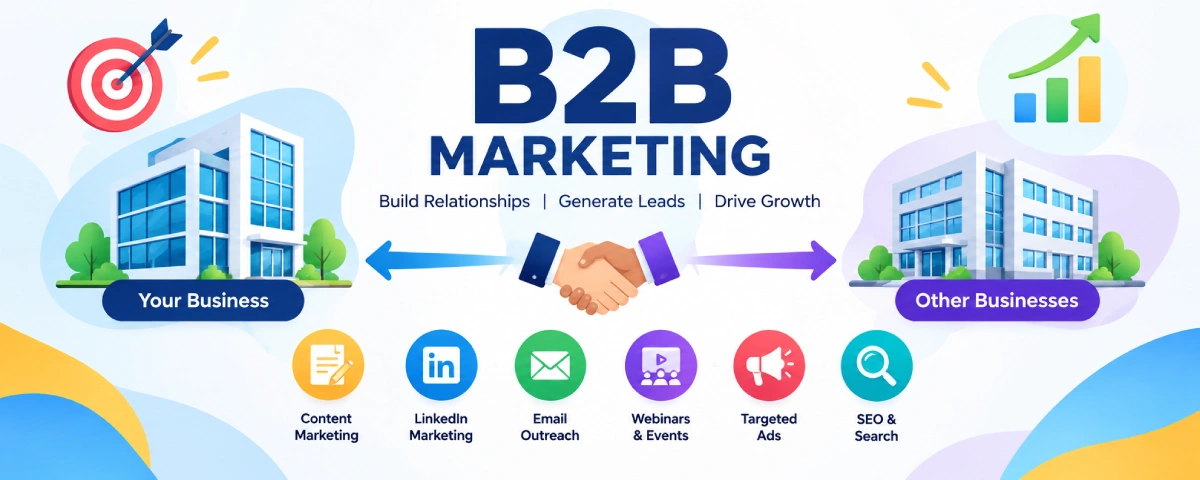
What Is b2b marketing? A Complete Guide for 2026
B2B marketing is the practice whereby a company advertises its goods or services to other businesses. There are many ways B2B marketing differs from B2C marketing. For starters, the buyers are businesses, the decision-making process takes more time, and there are more stakeholders who take part in deciding on which vendor to choose.
Most organizations conduct their B2B marketing as though it were consumer marketing, in terms of volume, generic advertising, and feature pushing. This does not work as intended because the buyers are more concerned with finding solutions to problems, minimizing risks, and getting ROI on their money.
This guide will discuss what B2B marketing entails, how it contrasts with B2C marketing, what marketing channels work for the purposes, what a good strategy looks like, and how you should go about measuring results.
What Is B2B Marketing?
B2B marketing refers to the creation and implementation of activities that facilitate the attraction of one business by another business through customer engagement. It involves the establishment of relationships over time and not impulse purchases.
Common activities used in B2B marketing include content marketing, LinkedIn activities, emails, webinars, advertisement, events, and collaboration with the sales team.
Key characteristics of B2B marketing
| Characteristic | What It Means in Practice | Why It Matters |
| Longer sales cycles | Decisions can take weeks or months | Marketing must support the full journey |
| Multiple decision-makers | Several people influence the final choice | Messaging needs to address different concerns |
| Higher average deal size | One customer can be worth a lot | Quality of leads matters more than pure volume |
| Relationship-driven | Trust and credibility play a big role | Consistent, useful communication wins |
| Logic and ROI focused | Buyers want proof and clear business value | Features alone are rarely enough |
The power of B2B marketing lies more in helping buyers make well-informed decisions than in interrupting them
How B2B Marketing Has Changed
Marketing was historically about sending out brochures, attending tradeshows, cold calling, and using relationship selling. There wasn’t enough information for the buyer, and hence, the sales reps called all the shots.
This scenario has now shifted. The buyers today spend a great deal of time researching independently well before they contact a sales rep. This involves reading, evaluating, watching videos, exploring LinkedIn, and asking for recommendations from their peers. By the time they call up the sales rep, buyers already have their list prepared.
What it means is that marketing has become crucial at early and mid-stages of the customer’s buying journey. Organizations ignoring these stages are missing a lot.
Traditional B2B Marketing vs Modern B2B Marketing
| Aspect | Traditional Approach | Modern Approach |
| Main focus | Selling features and building personal relationships | Helping buyers understand problems and solutions |
| Buyer control | Sales controlled most of the information | Buyers research independently first |
| Content | Brochures, case studies, product sheets | Educational content, comparisons, practical guides |
| Channels | Trade shows, cold calls, print | LinkedIn, content, email, webinars, search, targeted outreach |
| Goal of early marketing | Generate awareness and hand leads to sales | Build trust and stay useful throughout the journey |
| Success measure | Number of leads or meetings | Pipeline quality and revenue contribution |
Modern B2B marketing is not an alternative to selling. It facilitates the selling process by ensuring that the buyers are aware of the problem and view your organization as a reliable solution.
Who Is Usually Involved in B2B Buying Decisions
Buying in B2B is not typically the responsibility of a single individual. There are several different players involved in the decision-making process.
| Role | What They Care About | How Marketing Should Speak to Them |
| End user | Ease of use, daily impact, whether it solves their problem | Practical benefits and real-life examples |
| Manager / Team lead | Team performance, efficiency, risk | How it improves results and reduces friction |
| Executive / Decision maker | ROI, strategic fit, overall business impact | Clear business outcomes and proof |
| Procurement / Finance | Cost, terms, risk, vendor reliability | Transparency, trust signals, and commercial clarity |
| IT / Technical evaluator | Security, integration, technical requirements | Clear technical information and reliability |
Effective B2B marketing takes all these factors into account rather than using one blanket statement.
Simple Examples Across Industries
SaaS / Software
The development of a project management application includes creating content around issues related to effective team coordination, running LinkedIn campaigns for operations managers, and providing a clearly defined free trial. Marketing efforts concentrate on proving that the software eliminates inefficiencies.
Professional Services
Consulting services provider develops useful content addressing the most pressing industry-related concerns, organizes webinars and maintains its visibility through LinkedIn activities. This allows building up credibility so that the need arises, a company is ready to meet it.
Manufacturing / Industrial
Equipment vendor uses case studies, technical guidelines, as well as LinkedIn activities in order to address managers of plants and their procurement departments. Marketing helps to support long sales cycle and prove reliability/performance.
Agencies or Consultants
Often such businesses have to rely on content creation, personal branding on LinkedIn, referrals and targeted outreach activities. Marketing efforts are focused on building authority and making engagement easy.
As one can see, all the above examples are united by the same approach – useful content, clear targeting and consistency of effort.
B2B Marketing vs B2C Marketing
The difference between B2B and B2C is not just the audience. The entire approach changes.
Clear comparison
| Aspect | B2B Marketing | B2C Marketing |
| Buyer | Businesses and professionals | Individual consumers |
| Decision process | Often involves multiple people | Usually individual or household |
| Sales cycle | Weeks to months (sometimes longer) | Minutes to days |
| Main motivation | Solving business problems, efficiency, ROI | Personal wants, emotions, convenience, status |
| Message style | Practical, proof-based, problem-focused | Emotional, aspirational, benefit-driven |
| Channels that often work | LinkedIn, email, content, webinars, search, events | Social media, influencer, paid social, TV, retail |
| Relationship length | Often long-term | Can be transactional or loyalty-based |
Very important practical consideration
Some approaches overlap. Content, e-mail and paid search marketing can be effective in both contexts. But the key lies in the message, the duration of the relationship, and measurement of success. Consumerization of business-to-business purchasing almost always produces poor results.
Core B2B Marketing Channels
Not every channel works equally well for every B2B company. The best results usually come from focusing on a smaller number of channels and doing them well.
Common B2B marketing channels
| Channel | How It Helps | Best For | Difficulty |
| Visibility, thought leadership, direct outreach | Almost all B2B companies | Medium | |
| Content & SEO | Attracts people searching for solutions | Companies that can create useful content | Medium–High |
| Nurturing leads and staying in touch | Most B2B businesses | Medium | |
| Webinars & virtual events | Education and lead capture | Complex or higher-consideration offers | Medium |
| Paid search (Google Ads) | Captures high-intent demand | Offers with clear search demand | Medium |
| LinkedIn Ads | Targeted visibility to specific roles and companies | Companies with budget | Medium |
| Outbound / Sales outreach | Direct conversations with target accounts | Higher-ticket offers | Medium–High |
| Partnerships & referrals | Warm introductions | Companies with strong customer relationships | Low–Medium |
| Industry events | Face-to-face relationships | Relationship-heavy industries | Medium–High |
Practical advice on channels
Most companies perform better when they master one or two primary channels before adding more. Spreading effort across too many places usually leads to average results everywhere.
Buyer Psychology Differences
The biggest difference between B2B and B2C is not the channel. It is how people decide.
In B2C, many purchases are driven by emotion, convenience, status, or immediate desire. A person can see something, like it, and buy it relatively quickly.
In B2B, the decision is usually more careful. Buyers are spending company money, not just their own. They often need to justify the choice to other people. They worry about risk, implementation effort, and whether the solution will actually deliver results. Because of this, trust, proof, and clarity matter more than clever or emotional advertising.
B2B buyers also tend to move through a longer process. They research options, compare vendors, talk to colleagues, and sometimes run trials or demos before deciding. Marketing that only tries to create instant excitement usually falls short.
Messaging Style Examples (B2B vs B2C)
Here is how the same type of offer might be framed differently:
| Type of Offer | Typical B2C Style Message | Typical B2B Style Message |
| Project management tool | “Get organised and feel in control of your life” | “Help your team reduce missed deadlines and wasted time” |
| Training or course | “Transform your career in 30 days” | “Give your team practical skills that improve performance” |
| Software subscription | “Join thousands of happy users” | “Reduce manual work and improve accuracy across your process” |
| Consulting service | “Unlock your potential” | “Solve specific operational problems with a clear approach” |
B2C messaging often focuses on how the individual will feel. B2B messaging works better when it focuses on the business problem, the outcome, and the reduced risk.
When B2B and B2C Tactics Can Overlap
Some methods work in both worlds:
- Clear and useful content
- Email follow-up
- Search marketing (Google Ads or SEO)
- Strong landing pages
- Social proof (reviews, testimonials, case studies)
The tactics can look similar, but the message and the level of detail usually need to change. A B2B case study, for example, needs more concrete results and business context than a typical consumer testimonial.
Common Mistakes When B2B Companies Copy B2C Approaches
| Mistake | What Usually Happens | Better Approach |
| Using overly emotional or hype-driven language | Feels unprofessional or exaggerated to business buyers | Focus on clear problems and outcomes |
| Chasing high volume of low-quality leads | Sales gets flooded with poor-fit conversations | Prioritise lead quality and fit |
| Relying mainly on short-form social content | Limited trust and weak pipeline impact | Combine visibility with deeper useful content |
| Expecting fast purchase decisions | Frustration when deals take longer | Support the full buying journey |
| Ignoring multiple stakeholders | Message only connects with one type of buyer | Address the concerns of different roles |
The companies that perform better in B2B usually adapt their approach to the way businesses actually buy, instead of forcing consumer-style marketing into a business environment.
Deeper Look at the Most Important Channels
LinkedIn remains to be among the most effective tools of B2B marketing. LinkedIn can be used not only for visibility but also for outreach programs. Companies that share valuable insights on a regular basis and maintain professionalism while reaching out will have better chances of success than companies that only advertise or make connections on LinkedIn.
Content and SEO
Content is powerful when addressing actual pain points of the buyer. Comparative guides, guides that address certain problems, and how-to articles are likely to do better than pure thought leadership. SEO is a time-consuming process, but once pages are ranking they will start generating a steady flow of inbound interest without any ad spend.
Email Marketing
Email marketing still continues to be an extremely effective tool when working with people that you know. You can use it to develop leads, provide updates and support your sales conversations. When it comes to B2B email marketing, you should ensure that the email is relevant and useful. Lengthy pushy emails usually get ignored.
Outbound / Direct Outreach
Outbound marketing is successful when it is targeted and customized. Generalized communication is unlikely to result in even an acceptable response rate. Outbound marketing is successful when it is
Channel vs Best Goal
| Channel | Awareness | Lead Generation | Nurture | Supporting Close |
| LinkedIn (organic) | Strong | Medium | Medium | Medium |
| LinkedIn Ads | Strong | Strong | Low | Low |
| Content & SEO | Strong | Strong | Medium | Low–Medium |
| Low | Medium | Strong | Medium | |
| Webinars | Medium | Strong | Medium | Medium |
| Paid Search | Medium | Strong | Low | Low |
| Outbound outreach | Low | Strong | Low | Medium |
| Events & partnerships | Medium | Medium | Medium | Strong |
No single channel does everything well. Most companies need a small combination.
How to Choose Primary vs Secondary Channels
A practical way to decide:
- Choose one primary channel you can run consistently every week.
- Choose one supporting channel that helps the primary one.
- Treat everything else as experimental until the first two are working.
For example:
- Primary: LinkedIn + Content
- Supporting: Email nurture
- Experimental: Paid ads or webinars
Companies that try to run five or six channels at full effort usually end up doing all of them poorly.
Realistic Expectations in 2026
| Channel | Realistic Expectation | Common Misconception |
| LinkedIn organic | Steady visibility and conversations over time | Fast flood of leads from posting only |
| Content & SEO | Takes months to build, then compounds | Immediate traffic |
| Strong for nurture and re-engagement | High conversion from cold email alone | |
| Outbound | Works with good targeting and messaging | High reply rates from generic templates |
| Paid channels | Can generate leads quickly but needs optimisation | Easy set-and-forget results |
Most channels need consistency for at least 60–90 days before you can fairly judge them.
Simple Channel Mix Examples by Company Size
Small team / early-stage
- Primary: LinkedIn (content + light outreach)
- Supporting: Simple email follow-up
- Focus: Start conversations and learn what messaging works
Growing company
- Primary: Content/SEO + LinkedIn
- Supporting: Email nurture + selective outbound
- Focus: Build a steady flow of qualified leads
Established company
- Primary: Content + targeted paid + LinkedIn
- Supporting: Webinars, email, partnerships
- Focus: Pipeline contribution and efficient growth
The ideal mix of channels will be the one that works well for you and your team. A simple mix that works well rather than a complicated one that doesn’t work at consistently almost always beats a complicated system that is only half-executed.
How to Create a B2B Marketing Strategy
A good B2B marketing strategy does not need to be a long document. It needs to be clear enough that the team knows what to do and what to ignore.
Steps to take in order to develop a strategy
- Define your target customer
Specify the company size, industries, the buyer persona and the key challenges that they have.
- Identify your value proposition
Create a statement which describes your challenge and your unique solution to it.
- Specify the goals
Examples may include numbers of qualified leads, pipeline revenue or sales accepted opportunities.
- Determine the channels
One or two channels that are going to be used regularly.
- Messages and themes
The most important challenges of your buyer personas.
- Alignment with Sales
Definition of a good lead and a lead handing off process.
- Developing an operation rhythm
Week-by-week activities with a monthly review of the results.
- Retrospective every 90 days
Keep what works and remove what doesn’t.
Simple one-page strategy format
Many teams find it useful to keep the strategy visible on one page:
- Target customer
- Main problem we solve
- Key message
- Primary channels
- Content themes
- Monthly goals
- Main metrics
This keeps everyone aligned without overcomplicating things.
Detailed Breakdown of Each Step
- Define your ideal customer
Be specific. Broad descriptions like “mid-sized companies” are usually too vague. Clarify industry, company size, main challenges, and the roles involved in the decision. - Clarify the value you offer
Write a plain statement of the problem you solve and the outcome you help create. Avoid internal jargon. - Set a small number of goals
Choose goals that connect to revenue, such as qualified leads, sales-accepted opportunities, or pipeline value. Avoid tracking only traffic or social engagement at this stage. - Choose primary channels
Pick one or two channels you can run consistently. It is better to do two channels well than five channels poorly. - Decide your main messages and content themes
Focus on the problems your buyers already care about. Product features can come later. - Align with sales
Agree on what a good lead looks like, how leads will be handed over, and what feedback sales will give marketing. - Create a simple operating rhythm
Decide what happens weekly (content, outreach, posting) and what happens monthly (review of results). - Review and adjust every 90 days
Look at what produced real conversations and opportunities. Keep the effective parts and improve or stop the rest.
How to Define an Ideal Customer Profile (ICP)
A clear ICP keeps marketing and sales focused on the same type of company.
| Element | What to Define | Example |
| Industry / Type | Which sectors you serve best | B2B SaaS companies |
| Company size | Employee count or revenue range | 50–300 employees |
| Key problem | Main pain you solve | Manual reporting takes too much time |
| Decision roles | Who is usually involved | Head of Operations, Finance Manager |
| Triggers | What makes them look for a solution | Rapid growth, new compliance needs, failed tools |
| Poor-fit signals | Who you should avoid | Companies with no dedicated operations person |
The more clearly you define the ICP, the easier it becomes to create relevant messages and choose the right channels.
How to Write a Strong Value Proposition
A good value proposition is clear and specific. It should answer three questions:
- Who is it for?
- What problem does it solve?
- What meaningful outcome does it create?
Weak example:
“We offer innovative solutions to help businesses grow.”
Stronger example:
“We help operations teams in mid-sized companies reduce manual reporting so they can spend less time on spreadsheets and more time improving performance.”
The second version is easier for a buyer to understand and harder for a competitor to copy vaguely.
Example of a Simple 90-Day B2B Marketing Plan
| Period | Main Focus | Key Activities |
| Days 1–30 | Foundation | Finalise ICP, clarify messaging, set up basic tracking, choose primary channels |
| Days 31–60 | Consistent execution | Publish content regularly, run outreach or campaigns, begin lead follow-up |
| Days 61–90 | Review and improve | Analyse which activities created conversations or opportunities, adjust messaging and channel effort |
This kind of simple plan is realistic for most small and mid-sized teams.
How to Align Marketing and Sales Properly
Poor alignment is one of the most common reasons B2B marketing underperforms.
Practical ways to improve alignment:
- Agree in writing on what a qualified lead looks like
- Decide how quickly sales will follow up
- Create a simple feedback loop (sales tells marketing which leads were good and which were not)
- Review pipeline contribution together each month
- Use the same language when talking about targets and results
When both teams share the same definition of success, marketing stops optimising for volume alone and sales receives better opportunities.
Common Strategy Mistakes at This Stage
| Mistake | What Usually Happens | Better Approach |
| Making the strategy too broad | Team tries to reach everyone | Narrow the ICP first |
| Choosing too many channels | Effort becomes scattered | Start with one or two |
| Focusing only on lead volume | Sales receives many low-quality leads | Measure quality and pipeline too |
| Writing a long strategy document that no one uses | Strategy stays theoretical | Keep it short and visible |
| Never reviewing the strategy | Team keeps doing the same things even when results are weak | Review every 90 days |
| Creating messaging that sounds good internally but not to buyers | Low engagement and weak conversion | Test messaging with real prospects |
A useful strategy is one that the team can actually follow every week. Clarity and focus almost always beat complexity.
How to Measure B2B Marketing
Measuring B2B marketing is different from measuring consumer campaigns. Vanity metrics such as likes or total website visits matter less than pipeline and revenue contribution.
Useful B2B marketing metrics
| Metric | What It Tells You | Why It Matters |
| Marketing Qualified Leads (MQLs) | Volume of leads that meet basic criteria | Early indicator of activity |
| Sales Accepted Leads / Opportunities | Leads that sales agrees are worth pursuing | Better measure of quality |
| Pipeline generated | Value of opportunities influenced by marketing | Shows real business impact |
| Revenue influenced or sourced | Closed deals connected to marketing | Ultimate measure of contribution |
| Cost per opportunity | Efficiency of generating real opportunities | Helps control spend |
| Win rate of marketing leads | How often marketing leads turn into customers | Shows quality of leads |
| Content or channel engagement | Which topics and channels attract the right people | Guides future effort |
Practical measurement approach
- Track leads all the way to opportunity and revenue when possible.
- Review performance monthly.
- Compare channels by quality, not just volume.
- Pay attention to trends over time rather than just responding to one good or bad week.
Those organizations which gauge marketing performance through the pipeline and revenue perform better than organizations measuring performance by traffic and lead generation.
Leading vs Lagging Metrics
Not all metrics tell you the same thing.
- Leading indicators measure the action and early success. They allow you to determine whether your marketing machine is getting any movement. Examples include account-specific website visits, downloaded content, email reply rate, and conversation starters.
- Lagging indicators measure the ultimate outcomes of your business. They include generated pipeline, created opportunities, influenced revenues, and closed deals.
Both have their uses. Leading measures allow you to control the process on a weekly basis. Lagging measures tell you whether your process is really adding value for the business. Businesses which rely solely on leading measures are always busy but can’t demonstrate any impact. Businesses which rely only on lagging measures discover too late that there is a problem.
Metrics by Goal
| Goal | Useful Metrics | What They Help You Understand |
| Awareness | Reach, impressions, branded search, content views from target roles | Whether the right people are seeing you |
| Demand generation | MQLs, form fills, webinar registrations, content offers taken | Whether interest is being captured |
| Pipeline | Sales-accepted leads, opportunities created, pipeline value | Whether marketing is creating real sales potential |
| Revenue | Closed-won revenue influenced or sourced, win rate of marketing leads | Whether marketing is contributing to actual growth |
| Efficiency | Cost per opportunity, cost per qualified lead | Whether the results are coming at a reasonable cost |
The further a metric is from revenue, the more carefully you should treat it. A high number of leads means little if very few become opportunities.
How to Build a Simple Monthly Reporting Rhythm
A light and effective monthly review can look like this:
- Look at the volume of qualified leads or conversations.
- Check how many of those became sales-accepted opportunities.
- Review pipeline value influenced by marketing.
- Compare performance by channel.
- Note what improved and what declined.
- Decide one or two changes for the next month.
Keep the report short. A one-page summary is often more useful than a long dashboard that nobody reads.
What Good Performance Can Look Like
Exact numbers vary widely by industry, deal size, and sales cycle. Still, some practical patterns appear often:
- Many B2B teams are satisfied when a reasonable percentage of marketing-sourced leads become sales-accepted opportunities.
- Channels that consistently create opportunities (not just leads) deserve more budget.
- A rising cost per opportunity is usually a warning sign, even if lead volume looks healthy.
- Win rates on marketing-sourced opportunities that are close to overall win rates suggest lead quality is acceptable.
Instead of chasing universal benchmarks, compare your own results month to month and channel to channel. Improvement over your own baseline matters more than matching someone else’s numbers.
How to Avoid Vanity Metrics
Vanity metrics look good in reports but do not help much with decisions. Common examples include total website traffic, social media likes, raw lead volume without quality filters, and email open rates taken in isolation.
A simple test helps: ask “If this number improves, are we likely to create more pipeline or revenue?” If the answer is unclear, the metric should not be a primary success measure.
Focus most of your attention on metrics that connect marketing activity to sales opportunities and revenue. That shift alone usually improves the quality of marketing decisions.
Best Practices and Common Mistakes
Best practices
- Target only one main audience at a time first
- Ensure sales and marketing are on the same page regarding what constitutes an ideal prospect
- Co-create solutions to the buyer’s problems through your content
- Stick to a few selected channels and be consistent
- Monitor the pipeline and revenue contribution
- Conduct regular reviews of your progress
- Develop trust, rather than forcing meetings right away
Common mistakes
- Trying to target too many types of customers
- Copying consumer marketing tactics without adaptation
- Chasing lead volume at the expense of quality
- Changing strategy every month
- Creating product-focused content that ignores buyer problems
- Running channels without proper follow-up
- Measuring only vanity metrics
The biggest problem in B2B marketing is usually not lack of activity. It is lack of focus and consistency.
Focus on one target audience first and then broaden
Teams that attempt to connect with too many customer types will end up sending a message that is too broad and generalized. Beginning with a specific customer in mind ensures that the content created, the communications, and the entire campaign are more targeted. You can move to another target audience after successfully reaching the first one.
Ensure that marketing and sales have the same lead qualification process
This is a major source of frustration among teams. It leads to inefficiency and lack of trust between both departments. A unified process ensures that there is less inefficiency and no miscommunication.
Create content that solves customer problems
Customers tend to favor companies that are willing to educate them on important topics. Content that focuses solely on company products is less effective compared to one that provides solutions to customers’ problems.
Be consistent on a few communication channels
Most B2B teams achieve success by being more present in one or two channels and not being inconsistent in many channels.Measure contribution to pipeline and revenue
Tracking only leads or traffic can create a false sense of progress. Linking marketing activity to opportunities and closed revenue gives a clearer picture of what is actually working.
Review results regularly and adjust
A strategy that is never reviewed slowly becomes outdated. A simple monthly or quarterly review helps the team keep what works and stop what does not.
Build trust over time instead of pushing for instant meetings
B2B buyers often need time. Helpful visibility and useful follow-up usually create better conversations than aggressive calls-to-action from the first interaction.
Expanded Common Mistakes
Trying to target too many types of customers
The message becomes diluted and campaigns lose relevance. Results usually improve when the focus narrows.
Copying consumer marketing tactics without adaptation
Emotional or hype-driven approaches that work in B2C often feel out of place in B2B. Business buyers tend to respond better to clarity and proof.
Chasing lead volume at the expense of quality
High lead numbers can look good in reports while creating little pipeline. Sales teams become frustrated and marketing loses credibility.
Changing strategy every month
Constant changes make it hard to know what is working. Most channels need consistent effort for at least a couple of months before fair judgment is possible.
Creating product-focused content that ignores buyer problems
When content talks only about the company and its features, it rarely attracts serious buyers. Problem-led content performs better.
Running channels without proper follow-up
Generating interest and then responding slowly (or not at all) wastes the effort. Speed and relevance of follow-up matter a lot.
Measuring only vanity metrics
Likes, raw traffic, or total leads can create a false picture of success. These numbers matter less when they do not connect to opportunities and revenue.
Focused B2B Marketing vs Scattered B2B Marketing
| Aspect | Focused Approach | Scattered Approach |
| Audience | Clear ideal customer | Tries to reach many different types of companies |
| Channels | One or two primary channels done well | Many channels with inconsistent effort |
| Messaging | Consistent and problem-focused | Changes often or stays generic |
| Content | Built around real buyer challenges | Mostly product announcements and promotions |
| Measurement | Pipeline and revenue contribution | Mostly leads, traffic, and engagement |
| Sales relationship | Shared definition of good leads | Frequent disagreement about lead quality |
| Results over time | More predictable pipeline | Busy activity with uneven outcomes |
The difference is usually not about working harder. It is about working with more focus. Teams that narrow their audience, simplify their channels, and measure the right outcomes tend to make steadier progress.
Best Thoughts
The key to successful B2B marketing lies in thinking of it as a system of establishing and nurturing business relationships. The winners in this game always know their market, talk about the pain points, reach out systematically in the relevant places, and track what is really producing pipeline and revenue.
You do not have to use all channels and create an elaborate plan. You have to be clear about your strategy, execute it regularly for a couple of months, and then analyze the outcomes and improve.
Frequently Asked Questions
- What is the main difference between B2B and B2C marketing?
B2B focuses on business buyers with longer decision cycles and multiple stakeholders. B2C focuses more on individual consumers and shorter purchase decisions. - Which channel is best for B2B marketing?
There is no single best channel. LinkedIn, content, email, and targeted outreach work well for many companies. The right choice depends on your audience and resources. - How long does it take for B2B marketing to show results?
Some activities (like outreach or paid campaigns) can generate conversations relatively quickly. Content and brand-building efforts usually take longer but create more lasting value. - Should small B2B companies invest in marketing?
Yes. Even simple, focused marketing helps small companies start conversations and build credibility. The key is to stay focused and consistent. - What matters more in B2B — leads or pipeline?
Pipeline and revenue matter more. A smaller number of good-fit opportunities is usually better than a large number of low-quality leads.
Conclusion
B2B marketing is about helping other businesses understand how you can solve their problems and making it easier for them to choose you. The most effective approaches are clear, focused, and consistent. Define your audience, speak to their real challenges, choose a small number of channels you can run well, and measure the impact on pipeline and revenue. Companies that follow this practical path usually build more reliable growth than those that treat marketing as a series of disconnected campaigns.