

Introduction
The companies using AI Automation Tools currently have much more data, customer interaction, digitization, and workflow to manage compared to before. The conventional automation tools can help in carrying out repetitive tasks, but today’s businesses require an advanced solution that not only analyzes but also makes decisions, generates content, and streamlines workflow.
This is where AI automation tools become important.
Artificial Intelligence automation refers to integration between artificial intelligence and automation processes in a business environment. As per the IBM Intelligent Automation guide, intelligent automation refers to the process of integrating artificial intelligence and automation processes in a business environment in order to optimize business processes, increase efficiency, and enhance decision-making processes. This is different from traditional automation which is simply rule-based.
By 2026, firms in all sectors are employing the concept of AI automation in improving their productivity, customer support, marketing, analysis, operations, and workflow management.
This is the case from small companies right up to enterprises.
This guide covers AI automation tool functionalities, platforms, business uses, implementation approaches, and future trends in intelligent business automation.
What Are AI Automation Tools?
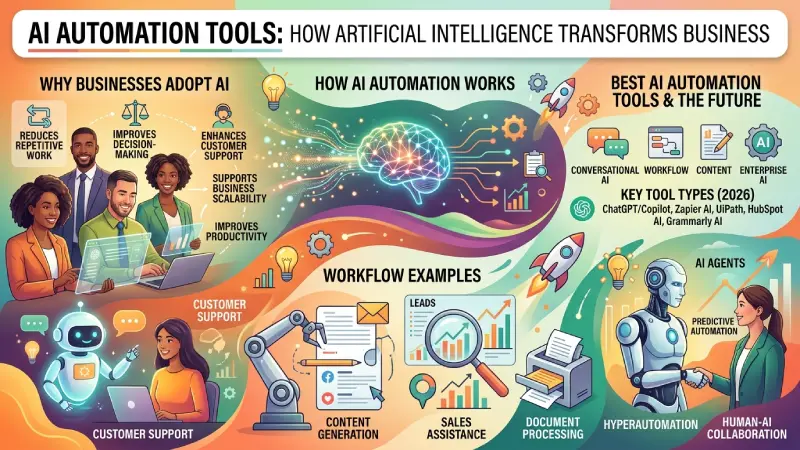
AI automation tools are software platforms that combine automation systems with artificial intelligence technologies.
These tools can:
- automate repetitive work
- analyze data
- generate content
- understand language
- make recommendations
- improve workflows
- support decision-making
In contrast to traditional automation processes that operate on pre-set command lines, AI-based automation systems are capable of adapting themselves based on patterns, user activity, and business information.
For example:
- AI chatbots can answer customer questions
- AI assistants can summarize reports
- AI systems can organize workflows automatically
- AI tools can generate emails and content
This allows businesses to automate more complex operational activities.
How AI Automation Works
AI automation systems combine multiple technologies including:
- machine learning
- natural language processing
- workflow automation
- predictive analytics
- data processing
The systems gather information, analyze patterns, and then take action automatically based on the results.
The process usually works like this:
- System collects data
- AI analyzes information
- Automation workflow is triggered
- AI generates actions or recommendations
- Results improve over time through learning
For example:
| Business Activity | AI Automation Action |
| Customer support request | AI chatbot responds automatically |
| Sales data analyzed | AI predicts customer trends |
| New marketing campaign | AI generates email suggestions |
| Employee schedules managed | AI optimizes workflow planning |
| Documents uploaded | AI extracts and organizes data |
AI automation helps businesses move beyond simple repetitive automation into more intelligent operational systems.
Why Businesses Use AI Automation Tools

Businesses increasingly adopt AI automation to improve efficiency and handle more advanced digital operations.
Reduces Repetitive Work
AI systems automate tasks such as:
- report generation
- customer responses
- scheduling
- content creation
- data organization
This reduces manual operational workload.
Improves Decision-Making
Artificial intelligence systems are capable of analyzing large volumes of information faster than people can do manually.
Businesses use AI automation for:
- forecasting
- recommendations
- customer insights
- operational planning
Enhances Customer Support
AI bots and virtual assistants help companies respond to customers quicker.
These systems can:
- answer common questions
- route support tickets
- guide customers
- provide instant assistance
Supports Business Scalability
AI automation helps businesses manage:
- larger customer bases
- growing operational workloads
- complex workflows
- increased digital activity
without significantly increasing manual staffing.
Improves Productivity
Automation combined with AI allows employees to focus more on:
- creativity
- strategy
- customer relationships
- business growth
instead of repetitive administrative tasks.
Best AI Automation Tools in 2026
Different AI automation platforms support different business requirements.
| Tool | Best For | Main Features |
| ChatGPT | AI assistance and content generation | Conversational AI |
| Microsoft Copilot | Workplace productivity | AI document assistance |
| Zapier AI | Workflow automation | AI-integrated workflows |
| Notion AI | Team productivity | AI writing and organization |
| Jasper | AI marketing content | Content automation |
| UiPath AI Center | Enterprise AI automation | Intelligent automation |
| HubSpot AI | Marketing and CRM automation | AI-powered customer workflows |
| Grammarly AI | Writing assistance | AI editing and communication |
Businesses should compare tools based on:
- workflow needs
- integrations
- pricing
- scalability
- AI features
- ease of use
AI Workflow Automation Examples
Practical examples help businesses understand how AI automation works in real operations.
Example: AI Customer Support
A business may use AI chatbots to:
- answer customer questions
- provide product recommendations
- route support requests
- reduce waiting times
This improves customer experience while reducing support workload.
Example: AI Content Generation
Marketing teams use AI tools to:
- generate email drafts
- create social media captions
- write product descriptions
- summarize reports
This speeds up content production workflows.
Example: AI Sales Assistance
AI systems help sales teams by:
- analyzing customer behavior
- identifying potential leads
- recommending follow-up actions
- predicting sales opportunities
Example: AI Document Processing
Businesses upload documents and AI systems automatically:
- extract data
- organize records
- summarize content
- categorize files
This reduces manual data handling.
AI Automation for Small Business
Increasingly, small businesses are relying on AI automation since current AI platforms are becoming cheaper and more user-friendly.
Why Small Businesses Use AI Automation
Small businesses use AI systems to:
- save time
- improve customer communication
- automate repetitive tasks
- create content faster
- manage operations more efficiently
Affordable AI Automation Tools
| Tool | Best For |
| ChatGPT | AI assistance |
| Canva AI | Design automation |
| Grammarly AI | Writing support |
| Zapier AI | Workflow automation |
| Notion AI | Team organization |
No-Code AI Automation
Many AI platforms now offer:
- drag-and-drop workflows
- simple automation builders
- beginner-friendly dashboards
This allows smaller businesses to adopt AI without advanced technical knowledge.
AI Automation vs Traditional Automation
Many businesses confuse AI automation with traditional automation systems.
Although both improve efficiency, they work differently.
| AI Automation | Traditional Automation |
| Learns from data | Follows fixed rules |
| Adapts to patterns | Performs repetitive actions |
| Handles unstructured information | Uses structured workflows |
| Supports decision-making | Executes predefined tasks |
| Uses machine learning | Uses rule-based logic |
Classic automation is suited for mundane jobs, but AI automation allows companies to work with more intelligent workflows.
Common AI Automation Mistakes
Companies tend to jump into using AI automation without much planning at all.
Over-Reliance on AI
An AI system should only complement human decisions and judgment.
Poor Data Quality
AI systems depend heavily on accurate and organized data.
Poor-quality data can reduce automation accuracy.
Ignoring Employee Training
Employees should understand how AI systems work and how to use them effectively.
Using AI Without Clear Goals
Businesses should identify specific operational problems before implementing AI automation.
Benefits of AI Automation Across Industries
| Industry | Common AI Automation Usage |
| Ecommerce | Product recommendations |
| Healthcare | Patient scheduling |
| Finance | Fraud detection |
| Marketing | Content generation |
| Customer Support | AI chatbots |
| HR | Resume screening |
Future of AI Automation
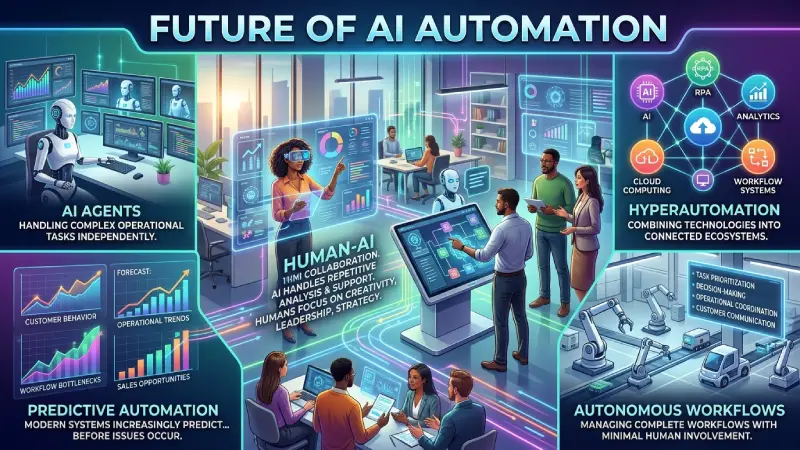
AI automation technology continues evolving rapidly as businesses adopt more intelligent digital systems.
AI Agents
AI agents are becoming more advanced and capable of handling complex operational tasks independently.
Predictive Automation
Modern AI systems increasingly predict:
- customer behavior
- operational trends
- workflow bottlenecks
- sales opportunities
before issues occur.
Hyperautomation
Businesses are combining:
- AI
- RPA
- analytics
- cloud computing
- workflow systems
into connected intelligent automation ecosystems.
Autonomous Workflows
Future AI systems may manage complete workflows with minimal human involvement.
This may include:
- task prioritization
- decision-making
- operational coordination
- customer communication
Human and AI Collaboration
The future of automation will likely focus on collaboration between employees and intelligent AI systems rather than complete replacement.
AI handles repetitive analysis and operational support, while humans continue focusing on creativity, leadership, and strategic decisions.
Frequently Asked Questions
What are AI automation tools?
These are tools that incorporate AI along with workflow automation in order to automate their processes.
Who uses AI automation?
Examples of businesses using AI automation include startups, e-commerce businesses, SaaS businesses, enterprises, healthcare businesses, and marketing departments.
How is AI automation different from RPA?
In contrast to RPA, which follows pre-defined rules and executes routine activities, AI automation interprets data and makes decisions based on the analysis.
Are AI automation tools costly?
Today, most of the AI automation tools have plans available at a reasonable cost for small businesses and startups.
Is it possible to replace employees with AI automation?
AI automation tools assist employees in their work rather than replace them.
Conclusion
The technology behind the development of AI automation software is changing the dynamics of how businesses run their digital operations in the year 2026.
From customer service to content generation, as well as predictive analytics and process automation, AI has been helping businesses automate more complex operations for improved efficiency and productivity.
The right implementation of AI automation software will enable a business to benefit in terms of saving on redundant activities and making smarter business decisions.
With time and increasing advancements in AI technology, AI automation will become all the more important for business technologies.