
Equity crowdfunding for business refers to the fundraising technique that enables you to acquire funds through issuing stock in your firm to many people, accredited and non-accredited investors included, through an online platform. Following the main Crowdfunding for Business resource, the comparison of platforms, the launch campaign section, and the in-depth exploration of rewards, this particular page highlights equity: what is different from rewards, applicable laws and platforms, required disclosure, valuation and investors’ rights, and responsibilities following the issuance. By 2026, it still remains a proper securities offering rather than a marketing campaign using a different term.

Where This Fits
The crowdfunding ecosystem as well as the rewards campaign is familiar to you. Let’s look at the equity option now. Here are the obvious things that follow:
- Built audience and conducted live raise → Crowdfunding Marketing Strategy
- Communication management and post-raise duties → Crowdfunding Fulfillment (adjusted for investors)
This keeps the information continuous.
How Does Equity Crowdfunding Differ from Rewards?
In reward crowdfunding, you basically sell your product ahead of time and own all of it, while with equity crowdfunding, you actually sell off part of your company.
- What investors receive
Investors get shares, SAFEs, convertible notes, or similar instruments that give them an economic interest in the future value of the business. They are not buying a product; they are buying a stake.
- What you give up
You dilute ownership. Even if each investor holds a tiny percentage, the total can add up, and you now have a larger, more diverse group of shareholders. You also take on legal and reporting obligations that do not exist in a pure rewards campaign.
- Regulation
Rewards campaigns are largely governed by consumer-protection and advertising rules. Equity campaigns are securities offerings Within the United States, the most popular means of obtaining greater participation by investors is the use of Regulation Crowdfunding, whereby an organization can raise $5 million in any one year. There are other exemptions (Regulation A+, Reg D). In foreign jurisdictions, the regulations are determined by the local securities commissions.
- Typical raise size and cost
Successful equity raises are often larger than typical rewards campaigns (commonly mid-six figures to low seven figures under Reg CF). Platform fees are between 6–10%, along with potentially some warrants on some platforms, while legal and accounting fees are higher than for reward-based financing.
- Relationship going forward
In a rewards fundraising effort, all you have to do is provide the product and take care of customer service. With an equity fundraising effort, you have a number of people who have invested in your business who now have the right to information.
Equity is the right approach for your company if you are looking for growth capital and are okay with dilution and investor relations. Rewards is the right approach if product validation and pre-sales are your main goals.
Which Local Securities Rules and Platforms Apply?

Rules vary across jurisdictions. This part highlights mainly the U.S. system most foreign founders have to deal with when utilizing popular platforms, including a note about the necessity of considering the local legislation.
United States – Regulation Crowdfunding (Reg CF)
- The maximum amount of money which can be raised in 12 months is $5 million (as per the latest regulations).
- The investment by both the accredited investor and non-accredited investors depends on their income/net worth.
- The offering is required to go through the intermediaries (Funding Portal/Broker-Dealer).
- You have to file Form C (including amendments, if any) to SEC and also provide financials meeting the tiered assurance standards, based on the funds raised.
- There is an annual reporting requirement after raising the money.
Major U.S. platforms (2026 landscape)
- Wefunder — High volume of Reg CF deals, generally founder-friendly fee structure (cash fee, typically no equity warrant).
- StartEngine — Large investor base, secondary-market features, accepts a broad range of companies.
- Republic — More selective, community-oriented, offers Reg CF and other structures.
Other US-based alternatives
Reg A+ offers higher raise amounts ($75 million maximum) along with more disclosure. Reg D is popular for exclusive raises to accredited investors only. Some companies may follow hybrid strategies.
Outside the United States
There are also many countries that have their own regimes of equity crowdfunding or crowdfunding exemption (United Kingdom, Canada, Australia, different members of European Union, and so forth). The amount that can be raised, disclosure requirements, and investor protection provisions are different from the U.S. one. In case your company is registered not in the USA, Reg CF will not work for you.
Eligibility filters common on platforms
Most platforms exclude certain industries (pure funds, some financial services, etc.) and require a clear business plan, use of proceeds, and a team that can be diligenced. Selective platforms reject a high percentage of applicants.
What Financial Disclosures and Risk Information Are Needed?
There is a need for proper disclosures in equity crowdfunding. While the specific contents may vary according to the type of exemption used and the amount of capital being raised, the idea remains the same: the investor should have access to all the information that a sensible individual would desire.
Common disclosure elements under Reg CF
- Description of the business and its previous operating history
- Use of proceeds
- Directors, officers, and principal shareholders
- Capital structure and how the new securities fit into it
- Related-party transactions
- Risk factors specific to the business and the offering
- Financial statements (the level of review or audit rises with the amount raised)
- Any material contracts or litigation
- Valuation method and how the price per share (or SAFE terms) was determined
Risk-factor section
This is not a template. It needs to be customized to address the actual risk factors of your particular business, marketplace, technology, team, competition, and securities (liquidity issues, dilution, potential complete loss of the investment, etc.). Generic risk language lowers your credibility; optimistic language creates liability.
Financial statement requirements
Smaller raises may allow unaudited or reviewed statements. Larger raises under Reg CF require higher levels of assurance. Budget time and money for the accountant early.
Practical preparation tip
Start assembling the disclosure package months before you want to launch the raise. Platforms and lawyers will request iterations. Clean, consistent numbers and a coherent story speed the process.
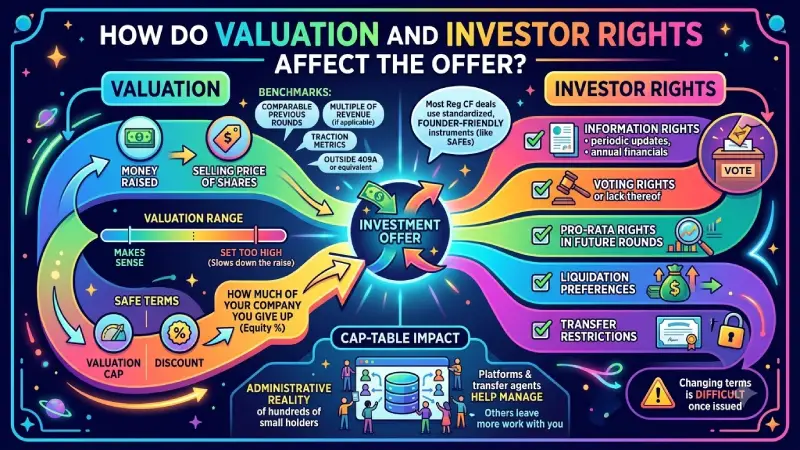
How Do Valuation and Investor Rights Affect the Offer?
Valuation
How much of your company you give up based on how much money you raise depends on the selling price of the shares (and the valuation cap and discount on the SAFE). There isn’t one right valuation, but there is a range that should make sense. These benchmarks could include comparable previous funding rounds, multiple of revenue (if you have revenue), other traction metrics, and outside 409A or equivalent valuation if it exists. If it’s set too high, it will slow down the raise.
Investor rights
The securities you issue come with terms. These may include:
- Information rights (periodic updates, annual financials)
- Voting rights or lack thereof
- Pro-rata rights in future rounds
- Liquidation preferences (more common in priced equity than in simple SAFEs)
- Transfer restrictions
Most Reg CF deals use relatively standardized, founder-friendly instruments, but you still need to understand exactly what you are granting. Once the securities are issued, changing the terms is difficult.
Cap-table impact
Even small investments add shareholders. Plan for the administrative reality of hundreds of small holders. Some platforms and transfer agents help manage this; others leave more of the work with you.
What Reporting and Shareholder Duties May Follow?
Closing the raise is not the end of the relationship.
Ongoing reporting (U.S. Reg CF)
You generally must file an annual report with the SEC and provide it to investors until you reach certain exit or size thresholds that allow termination of the reporting obligation. Many companies also provide informal quarterly updates to keep investors engaged.
Shareholder Communication
Good, clear, and consistent communication lessens the burden on you while building goodwill that will make it easier to ask for increases in the future. Make your plans early about who will be in charge of investor relations and how frequently you will communicate.
Cap Table and Administrative Tasks
Keep track of who owns what. If there is any future funding, M&A activity, or issuing of shares to employees, you need to know about the current crowd round. Starting out with a good cap table software program makes life much easier down the road.
Exit and Liquidity Issues
Equity crowdfunding investment is typically illiquid for many years. While there may be secondary markets on some platforms, they do not necessarily provide buyers at any particular price point. Be upfront about this issue in the offering documents and ongoing communications.
Other Ongoing Obligations
Depending on the terms of your offering and the applicable law, you may have other reporting obligations.
Practical Comparison Tables
Rewards vs Equity at a glance
| Factor | Rewards Crowdfunding | Equity Crowdfunding |
| What is sold | Product or perk | Ownership stake |
| Ownership impact | None | Dilution |
| Main regulation | Consumer / advertising | Securities law (e.g., Reg CF) |
| Typical successful raise | Often $10k–$500k | Often $100k–$2M+ |
| Platform fees (approx.) | ~8% | 6–12% + possible equity |
| Ongoing duties | Deliver product | Reporting, investor updates, cap table |
| Best for | Product launch & validation | Growth capital |
Key preparation items for an equity raise
| Item | Why It Matters | Typical Timing |
| Financial statements | Required disclosure | Start early |
| Use of proceeds | Investors and platforms scrutinize this | Draft early |
| Risk factors | Legal and credibility requirement | Iterate |
| Valuation rationale | Affects dilution and investor appetite | Before launch |
| Cap-table model | Shows impact of the raise | Before launch |
| Legal review | Securities compliance | Essential |
Frequently Asked Questions
Can I do both rewards and equity crowdfunding?
Yes, but usually sequentially rather than at the same time with the same story. Many companies use rewards for product validation and later equity for scale.
How long does an equity raise take?
Preparation (disclosure, financials, platform diligence) often takes 1–3 months or more. The live raise period is commonly 30–60 days.
Do I need a lawyer?
Yes. Equity crowdfunding is a securities offering. Platform templates help, but jurisdiction-specific legal advice is strongly recommended.
What happens if I do not reach the minimum goal?
Under all-or-nothing rules the offering fails, investor commitments are canceled, and you receive nothing (except possible costs already incurred).
How much dilution is normal?
It depends on the valuation and the amount raised. Model different scenarios before you set terms.
Troubleshooting Common Equity Crowdfunding Issues
Platform rejects the application
Ask for feedback. Strengthen traction evidence, clarify the use of proceeds, improve financial presentation, or consider a different platform while you address the gaps.
Investors are slow to commit
Warm introductions and a strong existing community convert better than cold traffic. Review whether the valuation, story, or terms need adjustment.
Disclosure preparation is taking longer than expected
This is common. Start earlier next time and budget realistically for accounting and legal iterations.
Post-raise investor questions are overwhelming
Set a clear communication cadence and a single channel for updates. Proactive, regular information reduces one-off inquiries.
Conclusion
Equity crowdfunding is a highly effective method for raising growth capital and creating a community of shareholder customers, but equity crowdfunding is an official, regulated securities offering procedure that involves dilution, disclosure, and obligations. You can use the differences, regulations, requirements of disclosure, valuation concerns, and other obligations described above to make sure that equity crowdfunding is suitable for you and get ready for it properly. If your legal ground, numbers, and investors’ story are strong, the funding will be very likely to go smoothly and facilitate your further growth.