

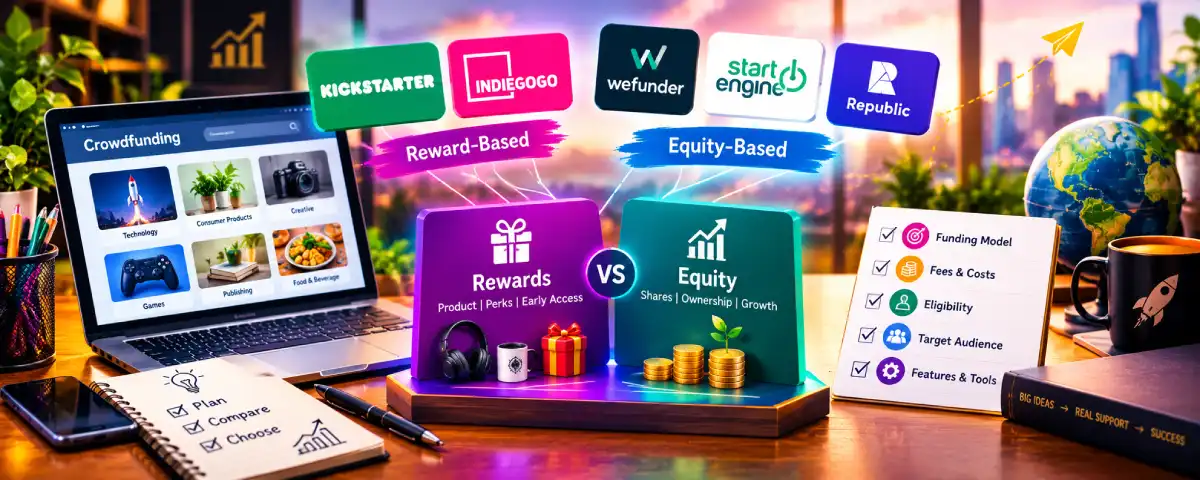
Crowdfunding websites for business purposes mean that the founders use online websites where they run their campaigns, receive their funding, and deal with their investors or supporters.
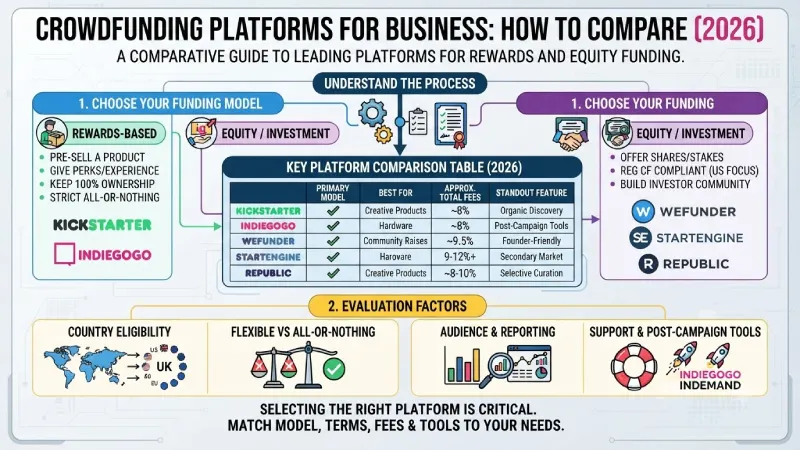
Following the completion of our Crowdfunding for Business guide, this page provides a straightforward and comparative view of leading crowdfunding platforms to enable you to select a platform that suits your product, investment amount, geographic location, and objectives. In 2026, there exists a dichotomy of the crowdfunding market into two categories that include reward crowdfunding platforms (Kickstarter and Indiegogo being the main) and equity crowdfunding platforms (Wefunder, StartEngine, Republic among others).
Where This Fits
You already understand the overall crowdfunding process. Now select the platform. The natural next steps are usually:
- Prepare the full campaign → How to Start a Crowdfunding Campaign
- Design rewards and pricing → Rewards-Based Crowdfunding
- Know the rules → Equity Crowdfunding for Business
- Leverage your audience → Crowdfunding Marketing Strategy
- Logistics after the campaign → Crowdfunding Fulfillment
This keeps the information continuous and practical.
Which Crowdfunding Models Does Each Platform Support?
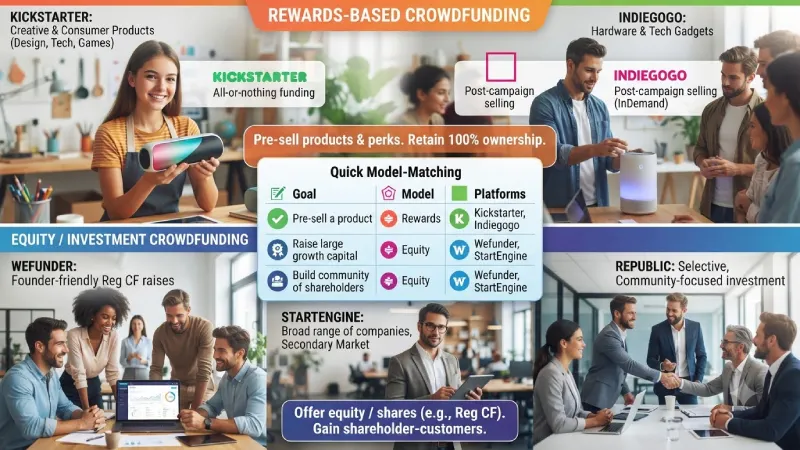
The first and most important filter is the funding model. Not every platform supports every type of raise.
Rewards-based platforms
These platforms enable you to pre-sell a product or give your investors something real in return. They will receive the product, exclusive rights, limited editions, perks, or an experience. The ownership of the business remains with you in its entirety.
Kickstarter remains the largest and most recognized rewards platform. It is strongest for creative and consumer products — design objects, games, technology gadgets, publishing, food, and fashion. Kickstarter is strictly all-or-nothing and has built the largest organic discovery engine for many categories.
Similarly, Indiegogo focuses on rewards as well. By tradition, Indiegogo is lenient with regards to funding, and it has an amazing platform for selling post-campaign (InDemand/Late Pledge). Indiegogo is ideal for hardware projects, technology-based products, and products which are still salable even after the campaign period.
Equity / investment platforms
Here, you will be able to offer ownership (in the form of shares, SAFEs, or other similar instruments) in accordance with securities laws. In the US, the most popular way is Reg CF.
Wefunder handles a high volume of Reg CF raises. It is generally regarded as founder-friendly on fees (cash fee, typically no equity warrant) and has a large community of repeat investors.
- StartEngine accepts a broad range of companies, maintains a large registered investor base, and operates its own secondary market that can offer limited post-raise liquidity.
- Republic is more selective in the companies it accepts. It emphasizes community and offers both Reg CF and other structures.
Other models that appear on some platforms
- Donation-style platforms (such as GoFundMe) work better for causes than for commercial product launches.
- Debt or revenue-sharing models exist on a smaller number of specialized platforms.
- Though some platforms have hybrid and white label models, they are more rare in relation to initial fundraising efforts.
Quick model-matching table
| Your Primary Goal | Recommended Model | Strong Platform Fits |
| Pre-sell a physical product | Rewards | Kickstarter, Indiegogo |
| Validate demand with real pre-orders | Rewards | Kickstarter, Indiegogo |
| Raise larger growth capital | Equity | Wefunder, StartEngine, Republic |
| Keep 100% ownership | Rewards | Kickstarter, Indiegogo |
| Build a community of shareholder-customers | Equity | Wefunder, StartEngine, Republic |
| Continue selling after the campaign | Rewards + post-campaign tools | Indiegogo (strongest here) |
Start by deciding whether you are running a rewards campaign or an equity raise. That decision immediately narrows the list of suitable platforms.
How Do Country and Business Eligibility Rules Differ?
The accessibility of platforms and legal requirements vary greatly from country to country and depending on the type of enterprise.
Rewards platforms
Both Kickstarter and Indiegogo platforms have expanded to a wide array of countries that include the US, the UK, Canada, Australia, and many countries of the European Union. Most limitations are based on the location of the creator and the opportunity to get paid. Funders can be almost from any country. Some product categories (medical devices, alcoholic products, firearms, and others) need additional control or are prohibited.
Equity platforms (U.S. focus)
Regulation Crowdfunding is a kind of securities exemption in America. Normally, it needs to be an American corporation or meet the requirements for being an American nexus entity. Accredited and non-accredited investors from America can take part in this kind of campaign with a limit depending on their income/net worth. A pure Regulation CF portal will normally not be able to accept an offer from an organization outside of America due to its legal structure requirement. Other countries have different rules for equity crowdfunding (FCA in UK, Canada, Australia and Europe).
Business-type filters
Most platforms exclude pure financial services, certain investment funds, and businesses that cannot clearly explain the use of proceeds. Equity crowdfunding websites do further diligence on the team, traction, financials, and the business model. Reward-based crowdfunding websites are concerned about the ability to ship the product according to law and the completeness of the campaign page.
Practical advice
If you are based outside the United States and want to raise equity, research platforms authorized under your local securities regime first. For rewards campaigns, confirm both creator eligibility and reliable payout methods for your country before investing time in campaign preparation.
How Do Platform Fees and Payment Processing Compare?
Fees directly reduce the net amount you receive. Always calculate the true cost on your target raise size.
Typical 2026 fee ranges
| Platform | Model | Platform Fee | Payment Processing | Other Notes | Approx. Total on Successful Raise |
| Kickstarter | Rewards | 5% | ~3% + $0.20 per pledge | Strictly all-or-nothing | ~8% |
| Indiegogo | Rewards | 5% | ~3% + $0.20 | Strong post-campaign sales tools | ~8% |
| Wefunder | Equity | ~7.5% | ~2% | Usually no equity warrant | ~9.5% |
| StartEngine | Equity | 7–10% | Varies | Often includes a 2% equity warrant | 9–12%+ |
| Republic | Equity | ~6% cash | Varies | + 2% securities / Crowd SAFE | ~8–10% |
What these percentages mean in real numbers
In a rewards program worth $100,000, you are likely to earn about $91,000-$92,000 after the fees (minus refunds, chargebacks, and taxes). In an equity financing program worth $500,000, the fees alone can be anywhere between $30,000 and $50,000, apart from any equity that is given out to the platform itself.
Easy-to-miss costs
- Dropped pledges and failed payments (budget 3–8% on rewards campaigns)
- Chargebacks and post-campaign refunds
- Payment processing variations by country or card type
- Annual maintenance or secondary-market fees on some equity platforms
- Legal, Accounting, and Escrow Fees Associated with Equity Financing (often running into thousands of dollars)
Always request the current fee schedule in writing and run the numbers on your specific target raise. A platform with a slightly higher headline fee but better tools, higher success rates in your category, or stronger post-campaign features can still be the better overall choice.
What Do All-or-Nothing and Flexible Funding Mean?
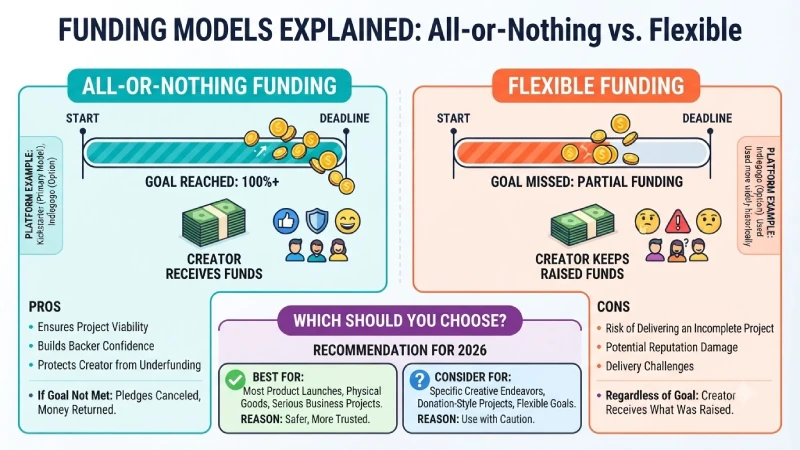
All-or-nothing funding
You receive the money only if the campaign reaches or exceeds the stated goal by the deadline. If you fall short, all pledges are canceled and no money changes hands (except possible processing fees on some platforms). This is the standard model on Kickstarter and has become the primary model on Indiegogo as well.
All-or-nothing protects creators from having to deliver a product when the budget is incomplete. It also signals seriousness to backers — they know the project will only proceed if it is properly funded.
Flexible funding
You keep whatever is raised even if the goal is missed. This model used to be more widely available. It can be useful for projects that can still move forward with partial funding, but it carries the risk of accepting money you cannot fully deliver on. Many experienced creators avoid flexible funding for physical-product campaigns precisely because partial funding often leads to delivery problems and damaged reputations.
Which should you choose in 2026?
For most product launches, all-or-nothing is the safer and more trusted option. It forces realistic goal-setting and gives backers confidence. Flexible funding is occasionally still useful for certain creative or donation-style projects, but it is less common for serious business product campaigns.
Which Audience, Reporting, and Support Features Matter?
In addition to costs and regulations, the practical aspects of campaigning involve the tools and support offered by the platform itself.
Audience and discovery
- Kickstarter still offers the strongest organic discovery for many consumer and creative categories.
- Equity platforms rely more heavily on the creator’s own network plus the platform’s existing investor community.
- Look at recent successful campaigns in your exact category and study where their traffic and pledges actually came from.
Analytics and reporting
Strong platforms provide real-time data on pledge sources, conversion rates, traffic referrers, and backer demographics. Equity platforms also offer investor dashboards and tools for ongoing updates.
Communication tools
Easy update posting, comment management, and messaging systems save significant time. The ability to segment backers by reward tier is especially helpful during fulfillment.
Support and success services
Some platforms offer campaign reviews, marketing guidance, or directories of preferred partners for fulfillment and PR. Selective equity platforms (such as Republic) perform heavier diligence up front, which can improve campaign quality but also means higher rejection rates.
Post-campaign features
Indiegogo’s continued sales tools are a clear advantage if you expect demand to continue after the main campaign. Equity platforms differ in secondary-market options — StartEngine has a more developed internal marketplace than some competitors.
Practical evaluation checklist
- Does the platform already have successful campaigns similar to yours?
- How easy is it to build and message your audience on the platform?
- What does the mobile experience look like for backers?
- How responsive is platform support during a live campaign?
- Which tools are there following the end of the campaign (post-campaign sales, investor reporting, secondaries liquidity)?
Platform Comparison – High Level (2026)
High-Level Platform Comparison (2026)
| Platform | Primary Model | Best For | Funding Rule | Approx. Total Fees | Selectivity | Standout Feature |
| Kickstarter | Rewards | Creative & consumer products | All-or-nothing | ~8% | Open | Strongest organic discovery |
| Indiegogo | Rewards | Hardware & continued sales | Mostly all-or-nothing | ~8% | Open | Post-campaign sales tools |
| Wefunder | Equity | Community-driven Reg CF raises | All-or-nothing | ~9.5% | Moderate | Founder-friendly fee structure |
| StartEngine | Equity | Broad access + secondary market | All-or-nothing | 9–12%+ | Moderate | Secondary market |
| Republic | Equity | Curated, community-oriented | All-or-nothing | ~8–10% | Higher | Selective quality filter |
Frequently Asked Questions
Which platform is best for a physical product launch?
Crowdfunding platforms like Kickstarter or Indiegogo for most consumer products and devices. Analyze recent similar crowdfunding efforts and explore the sales options after the campaign if there is an expectation of continuous demand.
Which platform is best for raising equity?
It depends on your traction, raise size, and preference for fee structure versus secondary liquidity. The three companies are WeFunder, StartEngine, and Republic. Talk to each one before choosing.
Can I run the same campaign on two platforms at the same time?
Generally no for the same offer. Some creators run a rewards campaign first and an equity raise later (or vice versa).
Do platforms help with marketing?
They provide the page and some discovery, but 70% or more of successful campaign traffic usually comes from the creator’s own list, network, and outreach. Treat platform discovery as a bonus, not the main plan.
How long does platform approval take?
Rewards platforms are usually fast (days). Equity platforms can take weeks because of diligence and securities filings.
Troubleshooting Common Platform-Choice Problems
You cannot decide between two rewards platforms
Look at the last 10–20 funded campaigns in your exact category on each platform. Where did the successful ones get traction? Which platform’s backers look more like your customers?
An equity platform rejected your application
Ask for feedback if available. Strengthen traction metrics, clarify the use of funds, improve financial presentation, or consider a different platform while you address the gaps.
Fees feel high
Calculate the net amount you will actually receive and compare it with alternative funding sources. Sometimes a higher-fee platform with better tools or a higher success rate in your category still produces a better overall outcome.
You are outside the United States and want equity crowdfunding
Start with those research platforms which are approved according to your local securities laws first. Using U.S. Reg CF platform across borders will be restricted.
Conclusion
Selecting the right crowdfunding platform is not just choosing the best one but matching the model, terms of service, fees, target audience and tools to your raise needs. Use the information from the sections above to filter your choices, then proceed to the guidelines on campaign planning, rewards selection, equity issuance, marketing and fulfillment. When you have the platform which fits your project, everything else becomes much clearer.