

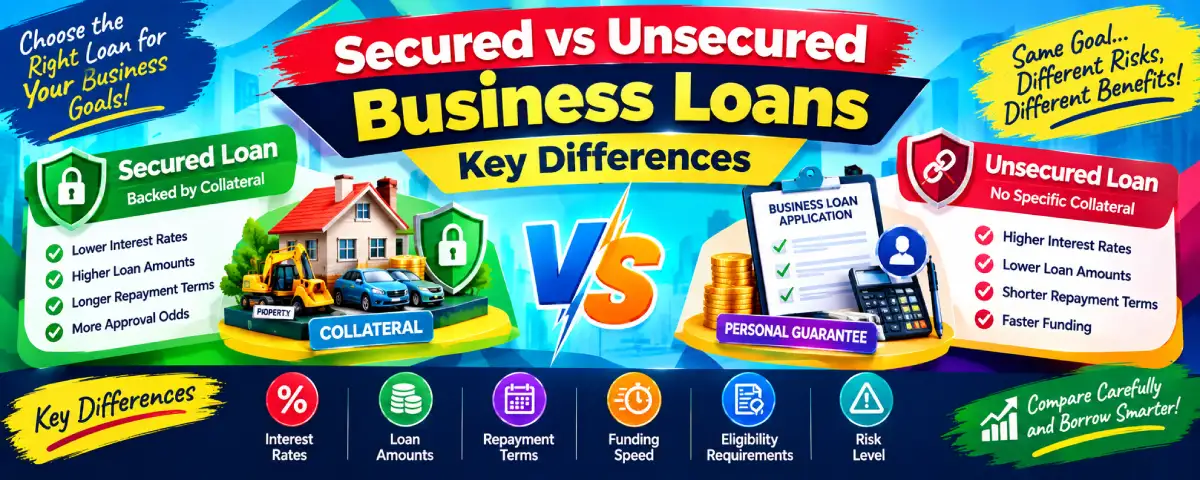
Choice between secured and unsecured business loans is perhaps the single most crucial decision that entrepreneurs need to make while financing through borrowings. The primary distinction between secured and unsecured business loans is that the former is secured with certain assets in case of non-payment while the latter is not secured with anything. The distinction makes a huge difference in the probability of being granted the loan, interest charges, amount, terms, speed of processing and what will happen in case of any difficulty with your business. After the main Business Loans pillar and respective articles, here are the practical distinctions to consider.
Where This Fits
You are aware of the various forms of loans, their criteria for eligibility, fees, and the process of application. The last step in the sequence that is related to this matter would be:
- Plan repayment schedules and cash-flow management → Business Loan Repayment
This keeps the information continuous.
What Makes a Business Loan Secured or Unsecured?
- Secured business loans
The borrower will use certain forms of collateral in securing the loan. Some examples of collateral include commercial property, equipment, cars, inventory, account receivable, or even a blanket lien covering all the assets of the business. The lender will file a lien on the asset, most likely through a financing statement, to claim his/her rights over the asset. If the borrower defaults on the loan, the lender can take possession and sell off the asset.
Since there is a means for recovery, secured loans usually have better interest rates, larger loan amounts, and longer periods available. Equipment financing is one such type of secured loan—where the equipment financed acts as the collateral itself. Real estate loans and other bigger loans at banks and SBA are typical examples.
- Unsecured business loans
None of the assets of the business act as security for the loan. Rather, the lender depends on the income of the business, its credit history, longevity in the market, and personal guarantees from the owners. Several online term loans, some line-of-credit loans provided by banks, and some SBA loans up to certain limits are unsecured in nature.
In cases of unsecured loans, there is no requirement for any process of appraisement. Hence, the process of disbursing funds becomes very fast. The only issue in case of unsecured loans is the high-interest rate.
- Important nuance
“Unsecured” small-business loans normally involve a personal guarantee by the owners having 20% or more equity stake in the firm. This personal guarantee is not a pledge but it gives the lender a route to the owners’ personal assets in case the business fails to pay up. There are also lenders that put a general UCC lien on loans even called “unsecured.”
Conclusion: Secured loans mean specific assets are at stake while unsecured loans involve no specific assets of the business being pledged but still usually include personal guarantees.
How Do Collateral and Personal Guarantees Differ?
Collateral
This is the asset that the company (or individual) puts up as security to the lender. It carries a value that the lender can take possession of by way of repossession or foreclosure.
Examples:
- The delivery van or manufacturing machinery in a loan of this type.
- The commercial property in case of real estate secured term loan or SBA 504 loan.
- The inventory or accounts receivable in an asset based line of credit.
- The blanket lien covering almost all of the assets of the business.
Since the lender now holds something tangible as a guarantee, the risk has been mitigated, resulting in favorable rates for the borrower. The only downside is that the asset will be lost in case of default on the loan.
Personal Guarantee
The personal guarantee means a promise by the owners that they will repay the loan out of their own assets if the business fails to do so. Personal guarantees are used in almost all small-business loans of 2026 irrespective of whether the loan is secured or unsecured. Owners holding 20 percent or more ownership are generally required to make the personal guarantee.
Personal guarantees don’t mean that the creditor has automatic rights to seize any particular asset like a collateral agreement does. The creditor has to resort to legal actions for recovering the money owed.
Main Practical Difference
- The collateral makes specific assets of the business vulnerable and also may help to get better interest rate and terms.
- The personal guarantee makes the owners’ personal net worth vulnerable and is mandatory in practically all cases, even if collateral is provided.
Normally, the loan is not only a collateral but also the personal guarantee. You should get familiar with both parts.
How Do Eligibility, Costs, and Terms Compare?
- Eligibility
With respect to qualification criteria, the secured loan would be easier to secure if the collateral is strong, despite having average credit scores or business experience. Since there is some asset available to the lender in case of default, lenders may be more lenient towards such applications. However, unsecured loans rely more on individual credit ratings and regular revenues. Good credit history and good cash flows would be needed in order to secure the best unsecured deals.
- Interest rates and cost (2026 market snapshot)
As far as the cost of borrowing goes, secured loans have a relatively low rate, due to reduced risk of default. Both bank and SBA secured facilities would fall within the bottom of the 6% to 12% band for qualifying applicants. Unsecured bank loans have higher interest rates, while unsecured online term loans would have rates starting from the mid-teens.
Fees would behave similarly—secured loan could require appraisals, and fees associated with them, while unsecured online loans would charge origination fees, or use factor rate pricing.
- Amounts and terms of loans
Loans that are secured by collateral will enable the borrowing of large sums of money and will require longer periods to repay. Unsecured loans will mostly have limited amounts and short periods of time to facilitate quick repayment.
- Speed
Unsecured loans, especially when they are done online, are easy to arrange since no valuation of the collateral and perfecting of the lien are necessary.
Side-by-side comparison table (typical 2026 ranges)
| Factor | Secured Business Loan | Unsecured Business Loan |
| Collateral | Required (specific assets) | Not required (personal guarantee still common) |
| Typical interest rates | Lower (often 6%–12% for strong files) | Higher (bank ~7%–15%; online 14%–40%+) |
| Loan amounts | Often higher | Often lower |
| Repayment terms | Often longer | Often shorter |
| Approval difficulty | Can be easier with strong collateral | Relies more on credit and cash flow |
| Funding speed | Slower (appraisal/lien work) | Faster (especially online) |
| Main risk to borrower | Loss of the pledged assets | Personal assets via guarantee + higher cost |
Another quick view – cost and flexibility
| Priority | Generally Favors | Reason |
| Lowest possible rate | Secured | Lower lender risk |
| Largest possible amount | Secured | Collateral supports higher limits |
| Fastest funding | Unsecured | No collateral process |
| No specific assets at risk | Unsecured | Nothing pledged |
| Easier qualification with weaker credit | Secured (if collateral is good) | Asset offsets credit risk |
| Simpler documentation | Unsecured | Fewer valuation steps |
These are general patterns. Individual offers vary with credit, revenue, industry, and the specific lender.
What Happens If the Business Cannot Repay?
- In a case where the loan has been secured
In the event that the loan has not been paid, the creditor will have the power to enforce his security interest in the loan. This means seizing equipment, foreclosing on property or taking control of any other pledged item and then sell them off to pay the remaining amount owed. This will be determined by the nature of the security interest and the state law applicable.
- With an unsecured loan
There is no specific business asset the lender can automatically seize. The lender typically relies on the personal guarantee. Collection can involve demands for payment, lawsuits, judgments, and attempts to collect from the owners’ personal assets. Credit damage occurs in both cases, but the path to recovery is different.
- In both structures
Default always affects the credit of an individual and of a business entity and could result in legal action against the borrower and would make it difficult for any future borrowing. It would be a good idea to communicate with the lender at an early stage and before missing out on the payment schedule.
The presence of collateral does not eliminate personal exposure when a guarantee is also in place. It simply gives the lender an additional (and often faster) recovery route.
Which Trade-Offs Should Borrowers Evaluate?
Secured or unsecured is a question of risk and reward. Some things to think about:
Do you have usable collateral?
If you are buying equipment or own real estate or other assets with clear value, a secured structure may deliver meaningfully better rates and terms. If you have few pledgeable assets, unsecured (or lightly secured) options may be the only realistic path.
How important is the lowest possible rate?
Over a multi-year term, even a 3–5 percentage point difference in rate can add up to tens of thousands of dollars. Secured loans usually win on pure cost.
How quickly do you need the funds?
If speed is critical, unsecured online products often fund in days rather than weeks. The higher cost may be acceptable for a short-term need.
What is your risk tolerance for the assets?
Pledging a key piece of equipment or real estate means that asset is at risk if the business cannot pay. Some owners prefer to keep assets free and accept a higher rate instead.
How strong is your credit and cash flow?
Strong files can often obtain reasonable unsecured terms. Weaker files may need the support of collateral to get approved at all or to reach an acceptable rate.
What is the purpose and time horizon of the funds?
Long-term investments (real estate, major equipment, expansion) often pair well with secured, longer-term financing. Short-term working-capital needs may fit unsecured lines or shorter-term products better.
Hybrid and middle-ground options
Equipment financing is secured by design but often easier to obtain than a general bank term loan. Some SBA loans are only partially secured. A few lenders offer “partially secured” structures. Exploring these middle options can produce a better balance of rate, amount, and risk.
Practical Decision Framework
| Your Situation | Lean Toward | Why |
| Strong collateral available, want lowest rate | Secured | Better pricing and terms |
| Need funds in days, limited assets | Unsecured | Speed and accessibility |
| Buying specific equipment | Equipment financing (secured) | Asset matches the purpose |
| Excellent credit and cash flow, no desire to pledge assets | Unsecured (if rates are acceptable) | Avoids putting assets at risk |
| Marginal credit but solid assets | Secured | Collateral can offset credit weakness |
| Long-term real-estate or major expansion | Secured (often SBA 504 or bank) | Matches long horizon and lower cost |
Frequently Asked Questions
Is a personal guarantee the same as collateral?
No. Collateral is a specific asset pledged to the loan. A personal guarantee is a promise to repay from personal assets if the business cannot. Most small-business loans require the guarantee whether or not collateral is also taken.
Can I get an unsecured business loan with average credit?
It is possible through online lenders, but rates will be higher and amounts may be limited. Stronger credit improves both approval odds and pricing.
Do SBA loans require collateral?
It depends on the program and loan size. Smaller SBA loans often have more flexible collateral rules. Larger loans are generally expected to be secured to the extent possible. Personal guarantees are standard.
What assets can be used as collateral?
Common options include equipment, vehicles, real estate, inventory, and accounts receivable. Lenders prefer assets that are easy to value and sell if necessary.
Does securing a loan with collateral hurt my ability to borrow later?
It can, because the asset is already pledged. A blanket lien can also limit future flexibility. This is one reason some owners prefer to keep certain assets free.
Troubleshooting Common Concerns
I don’t want to risk my equipment or property
Begin by looking at unsecured alternatives first and comparing the overall cost. If the rate differential is significant, do the math on how much additional interest will be paid for the entire term, and determine if it’s worth the security.
My credit is only fair but I have solid assets
A secured loan (especially equipment financing or an asset-based facility) is often the more realistic path to approval and reasonable terms.
I need money quickly and have good credit
Start with unsecured online term loans or lines of credit. You can always refinance into a lower-rate secured product later if the need becomes longer-term.
The lender wants both collateral and a personal guarantee
This happens all too often. Know precisely what is being pledged and on what terms the lender has power to act. Seek clear language regarding what is meant by default and enforcement.
Conclusion
Business loans secured and unsecured have their own benefits and risks, depending on the type of funding the company needs. Secured business loans tend to provide more favorable interest rates, loan amounts and terms due to the fact that the loan is protected by collateral. Unsecured loans provide convenience and preserve certain assets of the business but are more expensive and have strict terms. In almost all cases, a personal guarantee is still required, hence personal liability cannot be avoided regardless of the type of loan.
It all depends on which assets can be safely pledged, on how much importance the lowest interest rate holds, how fast the loan is needed and how good the credit and liquidity conditions are. Use the comparison table and the framework presented above to make an informed decision. Then, refer again to the information about the application and repayments of the loan in order to finalize the process. If all elements of funding match the actual needs of the business, financing will be a means of development, not a constant stress factor.