

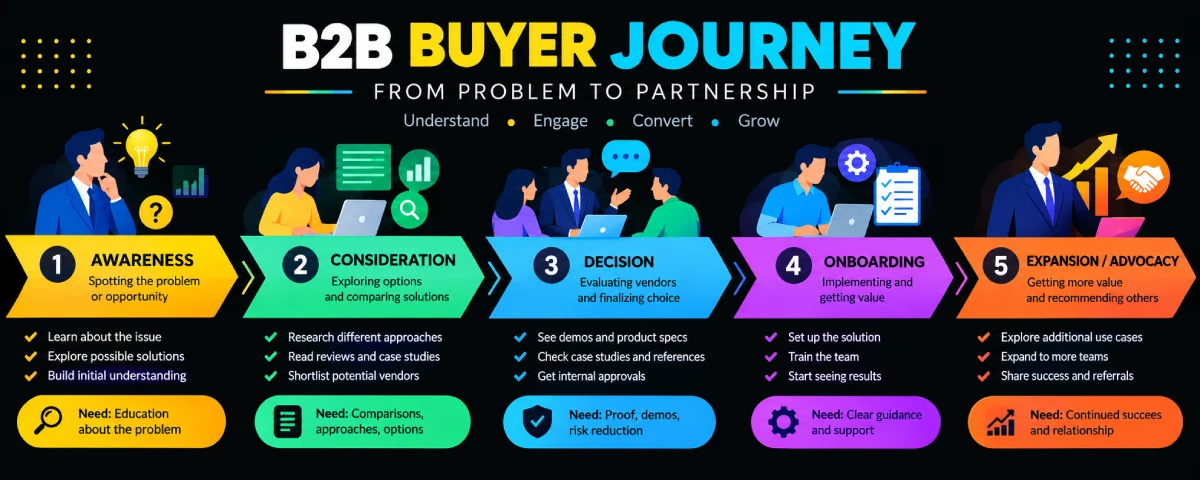
The B2B buyer’s journey does not involve impulse purchases, as people need to do some research, consult with peers, consider several alternatives, and flip-flop before deciding. That entire process is known as the B2B buyer’s journey.
Knowing the buyer’s journey is vital for marketing and sales professionals to be able to appear at the right stage of the journey with their key messages. Ignoring it means that firms might appear too early pushing their products’ features or too late when the buyer needs help the most.
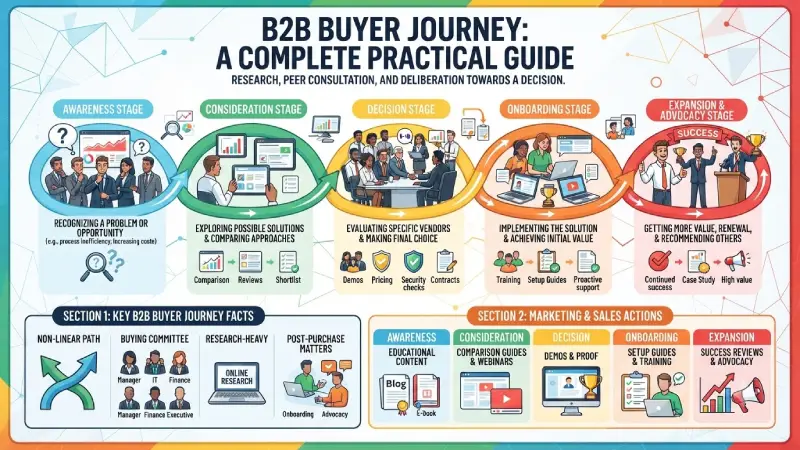
This article describes the B2B buyer’s journey, its significance, the process through which it is completed, approaches used to accomplish it, and mistakes usually made when addressing it.
B2B Buyer Journey: Meaning and Key Concepts
The journey of a business to business (B2B) buyer is the entire process that an organization follows from understanding their problems to finding a solution to these problems and finally becoming customers.
In contrast to a straightforward consumer buying process, B2B journeys typically include:
- Several people (buying committee)
- More time for research
- Higher risks and greater deliberations
- A combination of online research and face-to-face interactions with salespeople
Important facts about the topic:
- The buyer’s journey can be non-linear – it involves moving forward, backward, stopping, and starting again.
- The bulk of the process occurs before the buyer interacts with the sales team.
- Buyers within the organization have different interests (price, risk, usability, outcome).
- The buyer journey doesn’t necessarily stop with the purchase – onboarding and expansion are equally important.
The bottom line is that the B2B buyer’s journey is the entire journey of the buying unit when addressing their business issue.
To summarize, the B2B buying process is the entire journey that a buying team goes through to resolve a business problem.
Why B2B Buyer Journey Matters
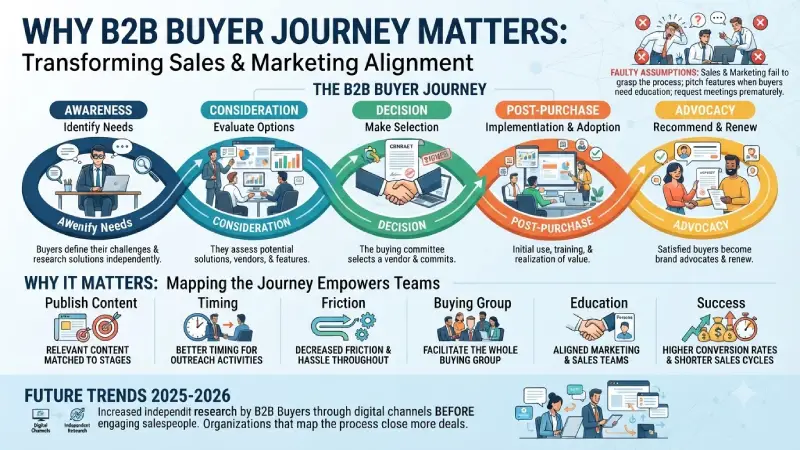
Where teams fail to grasp the buying process, marketing and sales are operating on faulty assumptions. For example, they may be pitching features when buyers are struggling with identifying their needs or requesting a meeting before its time.
Knowing your buyers’ journey allows you to:
- Publish content that corresponds to what buyers really need at each stage
- Make better timing decisions on your outreach activities
- Decrease friction throughout the buying journey
- Facilitate the whole buying group, not just one individual
- Educate your marketing and sales teams on the same buyer persona
- Have better conversion rates and sales cycle times
By 2025 and 2026, there will be increased independent research by business-to-business (B2B) buyers. They conduct much of the process through digital channels before engaging with the salespeople. Organizations that map out and facilitate the process normally provide better experience and close more deals.
Key Types, Methods, and Examples
Most B2B buyer journeys can be understood through a few core stages. While the exact names vary, the common stages are:
| Stage | What the Buyer Is Doing | What They Need |
| Awareness | Realizing there is a problem or opportunity | Education about the problem |
| Consideration | Exploring possible ways to solve it | Comparisons, approaches, options |
| Decision | Evaluating specific vendors | Proof, demos, risk reduction, consensus |
| Onboarding (Post-purchase) | Implementing the solution | Clear guidance and support |
| Expansion / Advocacy | Getting more value or recommending others | Continued success and relationship |
Awareness Stage
A consumer recognizes a need (such as process inefficiency, increasing cost, and failure to meet objectives). The consumers are not yet seeking a solution to the problem at hand.
Consideration Stage
Buyers start exploring different types of solutions. They compare approaches, read reviews, and begin building a shortlist.
Decision Stage
Buyers evaluate specific companies. They look at demos, case studies, pricing, security, and internal approval processes.
Methods Used to Support the Journey
- Buyer journey mapping workshops
- Content created for each stage
- Intent data and behavioral signals
- Multi-threaded outreach (reaching more than one person in the account)
- Sales enablement materials for later stages
- Customer success support after the purchase
Simple Example
A company selling project management software might see this journey:
- Recognition: The manager searches for the reason why projects miss deadlines
- Consideration: They consider various kinds of tools and techniques
- Decision: They decide on 3-4 vendors, watch their demonstrations and take references
- Implementation: They require support in implementing the tool and training the team
How to Use or Apply B2B Buyer Journey
Here is a practical way to apply the buyer journey in your company.
Step 1: Mapping the existing journey
Interview customers and sales representatives. Record the activities, thoughts, and emotions of buyers during each stage. Highlight areas where buyers get stuck.
Step 2: Mapping the Buying Committee
Create a list of the usual buying committee roles (such as End User, Manager, Finance, IT, Executive). Identify the needs of each role.
Step 3: Create stage-specific content and support
Match your content and outreach to the stage:
- Awareness → educational content
- Consideration → comparison and solution content
- Decision → proof, demos, and risk-reduction materials
Step 4: Align marketing and sales
The two should have the same understanding of the journey and know how to help buyers throughout the process.
Step 5: Minimize friction
The buyer should have a clear and easy next step at all times (actionable calls to action, resourceful information, quick response).
Step 6: Progress assessment per stage
Monitor the journey progress of accounts, rather than focusing solely on individual prospects.
Step 7: Review and optimize
Optimize the journey map periodically based on actual feedback from customers and the sales process.
Best Practices and Common Mistakes
Best Practices
- Treat the journey as non-linear
- Support multiple stakeholders, not just one contact
- Create content for every major stage
- Use data and customer conversations to build the map
- Align marketing, sales, and customer success
- Make the next step obvious and easy
- Continue supporting customers after the purchase
- Review the journey map at least once or twice a year
Common Mistakes
- Assuming the journey is a straight line
- Focusing only on the decision stage
- Creating generic content that ignores buyer stage
- Ignoring the full buying committee
- Pushing product details too early
- Poor handoff between marketing and sales
- Forgetting about onboarding and post-purchase experience
- Never updating the journey map
Teams that avoid these mistakes usually create smoother experiences and convert more of the right accounts.
Simple Stage-to-Action Table
| Stage | Buyer Mindset | Best Marketing & Sales Action |
| Awareness | “We have a problem” | Educational content, problem-focused ads |
| Consideration | “What are the possible solutions?” | Comparison guides, webinars, case studies |
| Decision | “Which option is safest and best?” | Demos, proof, references, clear proposals |
| Onboarding | “How do we get value quickly?” | Clear setup guides, training, proactive support |
| Expansion | “How else can we benefit?” | Success reviews, advanced use cases |
FAQs
- How long does the B2B buying journey last?
There is no single answer to that. Some B2B journeys can last several months, and some enterprise-level deals – even half a year or over a year.
- How many people are involved in a B2B purchase process?
In most cases, a buying process involves more than one person. Usually, 5-10 or more people can be involved in making decisions.
- Is the B2B buyer journey linear?
Not any longer. Most contemporary B2B journeys are non-linear and involve back and forth moves between various stages of decision-making.
- Whose responsibility is the B2B buying journey map within the company?
Buying journey should be managed jointly by marketing and sales departments; customer success also takes part after the purchase. The best way to go is when all teams use the same journey map.
- How often should companies update their buyer journey maps?
At least once a year or as soon as you notice any major changes in your customers’ behavior, sales feedback or market conditions.
Final Thoughts
What is called the B2B buyer journey is the complete process which businesses undergo in the course of problem-solving and selecting a solution. Usually, it is much longer and more complicated than the one many people think of.
Those companies which map the buyer journey, help customers in every stage of the process and unify all team members around this strategy typically provide better experience and get more success. Those which neglect buyer journey normally promote the wrong message at the wrong time.
First, make sure you know how the actual customers of your company buy. Create the content and processes for helping them. Continue to evolve based on the feedback and results.
It gets much easier to create any other aspect once both marketing and sales know the buyer journey.