

A lot of products get built and then quietly released. No real plan. No clear audience focus. No coordinated push. The result is usually a slow start and a lot of missed opportunity.
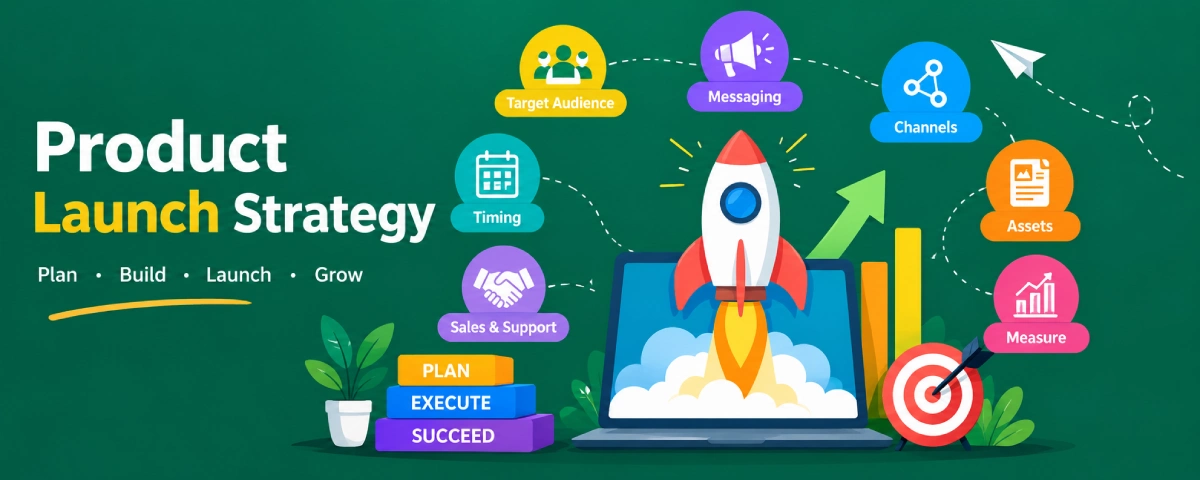
A product launch strategy is the plan for how you will introduce a product (or major new feature) to the market so that the right people notice it, understand it, and take action. It covers timing, messaging, channels, assets, sales enablement, and how you will measure success.
I’ve seen teams spend months building something solid and then launch with almost no preparation. Traffic is low. Sales are slow. Momentum never builds. A focused launch strategy would have changed the outcome. This guide explains what a product launch strategy is, why it matters, the main approaches, how to plan and run one, and the mistakes that quietly kill results.
Product Launch Strategy: Meaning and Key Concepts
A product launch strategy is the coordinated plan that takes a product from “ready internally” to “available and visible in the market.” It includes who you are launching to, what message you will lead with, which channels you will use, what assets you need, how sales and marketing will work together, and how you will track results.
It is different from just “releasing” a product. A release makes the product available. A launch tries to create awareness, interest, and early adoption in a deliberate way.
Key elements usually include:
- Clear target audience for the launch
- Positioning and core messaging
- Pre-launch activities (waitlist, content, outreach)
- Launch-day channels and tactics
- Sales and customer success enablement
- Assets (website updates, demos, emails, social, ads)
- Success metrics and timeline
- Post-launch follow-up plan
In simple terms, a launch strategy turns a product release into a focused campaign with a beginning, middle, and clear goals.
Why Product Launch Strategy Matters
Without a launch strategy, even good products often start slowly. The team hopes people will find it. Some do, but most do not. Early momentum is lost, and recovery becomes harder.
A clear product launch strategy helps you:
- Reach the right people at the right time
- Create focused attention instead of scattered noise
- Align marketing, sales, product, and customer success
- Generate early users, feedback, and social proof
- Build pipeline or revenue faster
- Learn what messaging and channels work
- Avoid the common “we launched and nothing happened” outcome
In 2025 and 2026, successful launches tend to be more coordinated and longer than simple “big bang” days. Many teams now treat launches as 8–12 week (or longer) campaigns that include pre-launch warm-up, launch-week activity, and post-launch follow-through. Companies that plan the full sequence usually get better results than those that only focus on the release date.
Key Types, Methods, and Examples
Not every product needs the same kind of launch. The right approach depends on the product type, audience, price point, and goals.
| Launch Type | Best For | Main Focus | Typical Timeline |
|---|---|---|---|
| Soft / Limited Launch | Testing, complex products, high risk | Controlled group, feedback, stability | Weeks to a few months |
| Full Public Launch | Ready products with clear demand | Maximum visibility and acquisition | 8–12 weeks preparation |
| Phased / Rolling Launch | Different segments or markets | Gradual expansion | Ongoing |
| Feature Launch | Major new capabilities inside existing product | Adoption by current users + new interest | 4–8 weeks |
| Community / Creator-Led | Products that benefit from social proof | Early advocates and organic spread | Pre-launch community build |
| Sales-Led Launch | High-value B2B products | Enable sales team + targeted outreach | Longer sales cycle focus |
Common methods used in modern launches:
- Building a waitlist or early-access list
- Creating content that educates and builds anticipation
- Preparing interactive demos or clear product videos
- Coordinating email, social, website, and paid channels
- Enabling sales with talk tracks, decks, and objection handling
- Measuring early signals (sign-ups, activation, pipeline, feedback)
Simple examples of different approaches:
- A B2B SaaS tool might run a quieter soft launch with existing prospects and then expand.
- A consumer or prosumer product might build a waitlist, work with creators, and run a more visible public launch.
- A major feature release inside an existing product often focuses first on current users and then on external visibility.
How to Use or Apply Product Launch Strategy
Here is a practical way to plan and run a launch.
- Set clear goals
Decide what success looks like (sign-ups, revenue, activation, pipeline, feedback volume). - Confirm the audience and message
Who is this launch for, and what is the one main reason they should care? - Choose the launch type and timeline
Soft, full, phased, or feature-focused. Map the weeks leading up to launch day. - Build the necessary assets
Website updates, demo, email sequences, social content, sales materials, support docs. - Run pre-launch activities
Waitlist, content, outreach, early access, or soft testing. - Execute launch week with focus
Concentrate on a few strong channels instead of trying to be everywhere. - Support the launch after day one
Follow up with early users, gather feedback, enable sales, and keep momentum going. - Measure and learn
Track what worked and what did not. Use the lessons for the next launch.
A practical tip: Treat the first 30–90 days after launch as part of the launch, not as “business as usual.” Many products need that window to gain real traction.
Best Practices and Common Mistakes
Best practices:
- Start planning weeks (or months) before the release date
- Focus on a clear audience and one main message
- Prepare sales and support before launch day
- Build some demand or a waitlist in advance when possible
- Concentrate on a few channels done well instead of many channels done poorly
- Measure early leading indicators, not only final revenue
- Plan the post-launch period, not just launch day
- Gather and use early feedback quickly
Common mistakes:
- Treating launch as a single day instead of a campaign
- Launching without clear goals or success metrics
- Spreading effort across too many channels
- Neglecting sales and customer success enablement
- Leading with features instead of customer outcomes
- Ignoring pre-launch warm-up
- Disappearing after launch day
- Changing the core message too many times during the launch
One of the biggest problems I see is teams that put all their energy into the release date and then have no plan for the weeks that follow. Momentum dies quickly when follow-through is missing.
Frequently Asked Questions
What is a product launch strategy?
It is the coordinated plan for introducing a product or major feature to the market, including audience, messaging, channels, assets, timing, and measurement.
How long should a product launch take?
Many effective launches now span 8–12 weeks of preparation plus focused launch and post-launch activity. Simple feature launches can be shorter. Complex or high-stakes launches often take longer.
What is the difference between a soft launch and a full launch?
A soft launch releases the product to a limited audience for testing and feedback. A full launch aims for broader visibility and acquisition.
What should I measure during a launch?
Early signals such as waitlist conversion, sign-ups, activation, engagement, pipeline created, and qualitative feedback. Revenue matters, but leading indicators help you adjust faster.
What is the most common launch mistake?
Launching without enough preparation or treating launch day as the end of the process instead of the beginning of a longer effort.
Conclusion
A product launch strategy turns a release into a deliberate campaign. It helps the right people notice the product, understand why it matters, and take the next step.
When the plan is clear, teams work together, messaging stays focused, and early momentum is easier to build. When the plan is missing or weak, even good products often start slowly and struggle to recover.
Start with the audience and the main reason they should care. Choose a realistic launch type and timeline. Prepare the assets and the teams. Run the launch with focus. Follow through afterward. Measure what happens and learn from it.
That practical approach still produces better results than hoping a product will find its audience on its own.
The related guides on Go-To-Market Strategy, Product Positioning, Product Messaging, Product Adoption, and Product Marketing Metrics cover the other pieces that support successful launche