

I’ve seen enough companies waste their money on their logo and brand design, only for the whole thing to collapse in a couple of months. Various people start applying various colors, fonts keep changing from post to post, and tone of voice depends on the writer of a particular piece. And slowly, slowly the brand becomes disheveled.
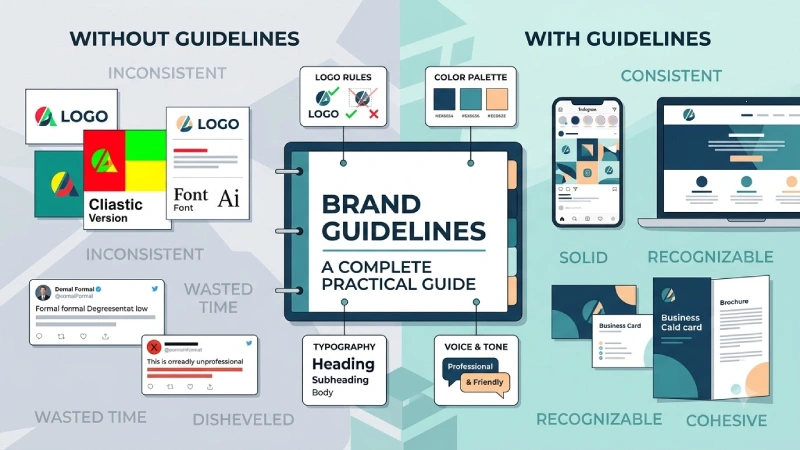
That is precisely the purpose of brand guidelines.
The brand guidelines are just the book of rules which ensures the consistency of the brand. They are there to tell everybody on your team, every freelancer, every agency, partner how the brand should look and behave. When they are strong enough and used by everyone, the brand feels solid and cohesive. But when guidelines are poor or not used at all – brand gets out of shape.
Here you can find everything about brand guidelines – their definition, importance, what should be included, how to create them and apply and what makes them useless.
Brand Guidelines: Meaning and Key Concepts
Brand guidelines (sometimes called a brand book or brand style guide) are a document that explains how to use your brand correctly.
They usually cover:
- Logo usage (what is allowed and what is not)
- Color palette
- Typography (fonts and how to use them)
- Imagery style
- Voice and tone
- Messaging principles
- Examples of correct and incorrect use
Guidelines may be concise and practical. They may be detailed and elaborate. The ideal set of guidelines is one that is simple to follow even for a novice designer or freelancer.
I myself would favor simplicity over grandeur in guidelines.
Why Brand Guidelines Matters
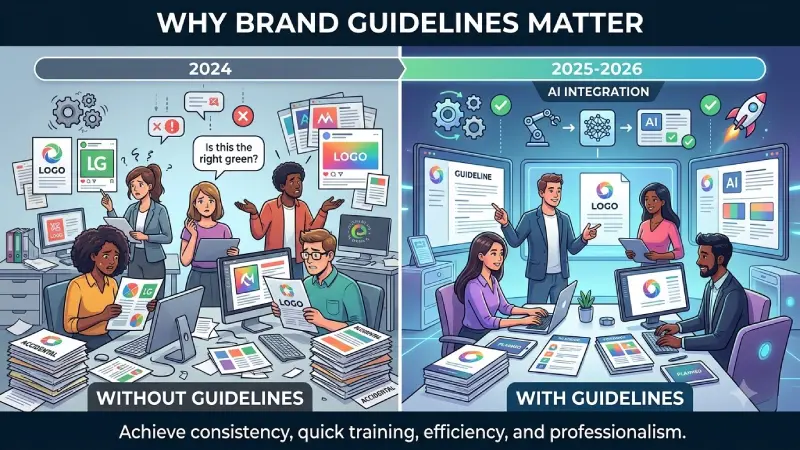
In the absence of guidelines, it is difficult to maintain consistency once more than one individual is involved with the brand.
Here’s what good guidelines help you achieve:
- The consistency of appearance and sound across all channels
- New hires or contractors can be trained more quickly
- There is no wasted time fixing errors
- Brand recognition is quicker because people recognize the consistent patterns
- Increased professionalism and credibility
I have seen companies that were very well-guided and companies with no guidelines at all. The difference becomes quite apparent after a few months. Those that have guidelines seem planned. Those that lack guidelines begin to look like an accident.
The coming years, 2025 and 2026, will see an abundance of content being produced very rapidly (most of which will be created using AI). Guidelines have become indispensable now.
Key Types, Methods, and Examples
Not every business needs the same type of guidelines. The depth depends on the size of the team and how many people use the brand.
| Type of Guidelines | Best For | Typical Length | Main Focus |
| Basic Guidelines | Solopreneurs and small teams | 4–10 pages | Logo, colors, fonts, simple voice rules |
| Standard Brand Guidelines | Growing businesses | 10–25 pages | Visual + verbal identity + examples |
| Comprehensive Brand Book | Larger teams or multiple markets | 30+ pages | Detailed rules + usage across channels |
| Digital-first Guidelines | Online and content-heavy brands | Flexible | Strong focus on social, web, and content |
What most useful guidelines include:
- Logo rules (clear space, minimum size, what not to do)
- Color palette with codes (HEX, RGB, CMYK)
- Typography (primary and secondary fonts + hierarchy)
- Image and illustration style
- Voice and tone guidelines
- Examples of correct and incorrect usage
- Rules for social media and digital applications
Simple example structure many businesses use:
- Introduction and brand purpose
- Logo
- Color
- Typography
- Imagery
- Voice and tone
- Application examples
- Contact for questions
How to Use or Apply Brand Guidelines
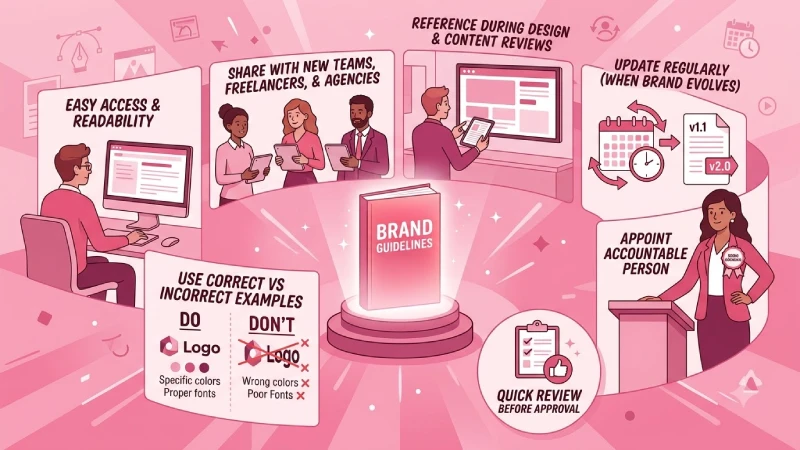
Creating guidelines is only half the work. The real value comes from using them.
This is how you make them really work:
- Maintain access to it and ensure that it’s easy to read
- Supply it to all new team members, freelancers, and agencies
- Reference it while reviewing new designs and content
- Update it regularly, but not too often (when your brand evolves)
- Appoint someone who’ll be accountable for the guidelines
- Use actual examples to clearly show people the difference between correct and incorrect application
One practical tip: Before every new design or big chunk of content is approved, you should quickly go through it in view of the guidelines. That’s enough to avoid almost all consistency issues.
Best Practices and Common Mistakes
Best practices:
- Be clear and straightforward, avoiding complications in wording
- Provide plenty of visual samples
- Balance positive and negative samples
- Keep language simple
- Make document searchable and easily sharable
- Update document only when absolutely necessary
- Take the time to train individuals on the guidelines
Common mistakes:
- Making the guidelines too long and detailed
- Creating them and then never enforcing them
- Allowing exceptions too easily
- Updating the brand visually without updating the guidelines
- Focusing only on visual rules and ignoring voice
- Making the document hard to access
The greatest issue that I see is that of organizations that waste weeks of time making nice-looking guidelines that are ignored. They have to be seen as being mandatory for the guidelines to be effective.
Frequently Asked Questions
What are brand guidelines?
Brand guidelines are a document that provides instructions on what your brand should look like, how to use it, its sound, etc.
Why are brand guidelines necessary?
Without them, each person who uses the brand will use it in their own way, making it inconsistent. This is why brand guidelines are so essential.
What should be in brand guidelines?
The most useful ones include things like use of the logo, color scheme, typography, imagery style, voice and tone, etc. It varies depending on the size of the team.
How long should brand guidelines be?
The less – the better. Many small businesses have great guidelines between 8-15 pages long.
Final Thoughts
Guidelines are not an exercise in control for the sake of control; they protect what you’ve created.
If applied consistently, this results in a powerful and distinctive brand image, but inconsistency will eventually weaken the brand regardless of the fact that each piece may be aesthetically appealing on its own.
Make sure the guidelines are practical. Easy to use. Consistently enforced. This kind of discipline will bring some of the highest returns possible for your brand in the long run.
Other guides about Brand Identity, Brand Positioning, Brand Voice, Brand Storytelling, and Brand Awareness are relevant in building out the rest of the pieces that help to form the brand.