


Most businesses use similar language. They have a safe and clean corporate vocabulary that belongs to anyone. This is why so many messages fall deaf ears.
A brand voice is a distinct way your company communicates. It is the voice of your brand personality through the choice of words in whichever medium such as your website, emails, social media sites, advertisements or even your customer service messages. Either it is clear and consistent to make people recognize you by just your language, or else you get lost in the background noise.
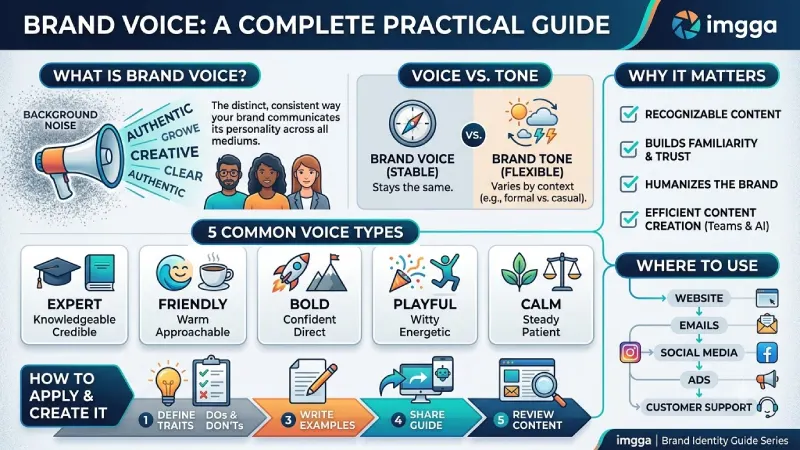
All information regarding the brand voice from its significance, different kinds of brand voice, and how it is created will be elaborated on in this chapter.
Brand Voice: Meaning and Key Concepts
The Brand Voice is what gives your brand consistency across all its different mediums.
It is different from tone. Voice stays relatively stable. Tone can vary according to context (for instance, more formal during a crisis or informal on social media sites).
Key elements that shape brand voice include:
- Personality traits (for example: helpful, bold, calm, witty, expert)
- Word choice and vocabulary
- Sentence length and rhythm
- Level of formality
- Attitude toward the customer
- Things you always say and things you never say
A simplistic approach for understanding the same:
Consider your brand as a person; how will this person speak?
Why Brand Voice Matters
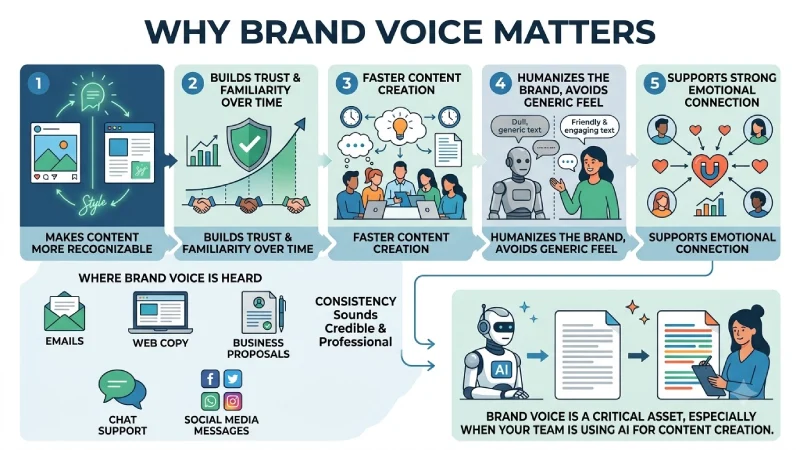
A clear brand voice helps in practical ways:
- It makes your content more recognizable
- It builds familiarity and trust over time
- It helps your team create content faster because they know how to sound
- It makes your brand feel more human and less generic
- It supports stronger emotional connection with the right audience
As writing is used to communicate in online and office settings, voice is all the more essential. The voice is evident in emails, web copy, business proposals, social media messages, and chat support. This is what makes the brand sound more credible and professional. When they feel random, the brand feels less reliable.
For most marketing teams, brand voice is now considered an important asset, particularly when you consider that most of the content being created is done using artificial intelligence programs.
Key Types, Methods, and Examples
There are certain personality types which are usually used for creating brand voices. Typically, one personality type is chosen to serve as the main one.
| Voice Type | Personality Description | Best For | Example Style |
| Expert / Authoritative | Knowledgeable, clear, confident | Professional services, B2B, education | Straightforward and credible |
| Friendly / Helpful | Warm, approachable, supportive | Customer service, lifestyle brands | Conversational and encouraging |
| Bold / Direct | Strong, confident, no-nonsense | Performance brands, challenger brands | Short sentences, strong statements |
| Playful / Witty | Light, clever, energetic | Consumer brands, younger audiences | Humor and personality |
| Calm / Reassuring | Steady, patient, clear | Health, finance, complex services | Simple language, low pressure |
Common methods to develop brand voice:
- Define 3–5 personality traits that fit your brand
- Decide what you want to sound like — and what you want to avoid
- Study how your best customers speak
- Create simple do’s and don’ts
- Write example sentences for different situations
- Document everything in a short voice guide
- Train the team and review content against the guide
Practical example:
Project management software determines that its voice will be “clear, calm, and practical.” It does not use any hype words; uses short sentences; and concentrates on providing help for the client to accomplish his tasks. Gradually, clients become accustomed to the company’s clear voice.
How to Use or Apply Brand Voice
The voice of a brand will be useful only if it is utilized by people.
How to utilize it in our day-to-day work?
- Briefly describe the brand voice (in one paragraph should be sufficient)
- Come up with an easy-to-follow list of dos and don’ts
- Give examples of good and weak writing
- Please share this guide with all writers who work on the brand
- Use this for writing website content, emails, social media posts, advertisements, and support messages
- Review content against the voice before publishing
- Update the guide only when the brand or audience clearly changes
In office and online settings, brand voice should appear in:
- Website and landing pages
- Email marketing and sales emails
- Social media posts and comments
- Customer support replies
- Proposals and presentations
- Internal documents that represent the brand externally
Suggestion made easily: Each time there comes a new member in the team or whenever an existing member starts making use of AI writing tools, provide the voice guide to him/her.
Best Practices and Common Mistakes
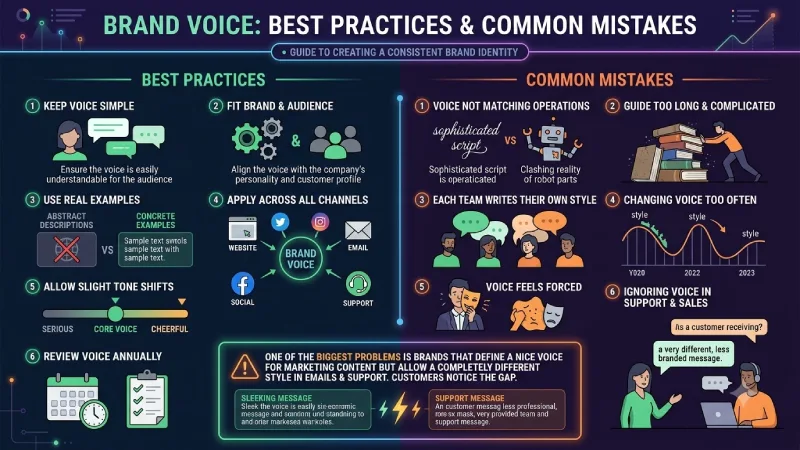
Best practices:
- Keep the voice simple enough that people can actually follow it
- Make sure the voice fits both the brand and the audience
- Use real examples instead of only abstract descriptions
- Apply the same voice across all major channels
- Allow slight tone shifts by situation while keeping the core voice stable
- Review the voice once a year
Common mistakes:
- Creating a voice that sounds impressive but does not match how the business actually operates
- Making the guide too long and complicated
- Letting every team member write in their own style
- Changing the voice too often
- Using a voice that feels forced or unnatural
- Ignoring voice in customer support and sales communication
One of the biggest problems is brands that define a nice voice for marketing content but allow a completely different style in emails and support. Customers notice the gap.
FAQ about Brand Voice
What is brand voice?
It is the consistent voice your brand uses in all communications — from website copy to emails, ads, customer support, and social media.
What is the difference between brand voice and tone?
While voice remains fairly consistent, the tone might vary depending on the situation — from serious in response to complaints to playful on social media, for instance, while always maintaining the same voice.
Why does brand voice matter?
Your voice will be consistent enough to ensure you look believable, credible, create good content on a consistent basis, and make your brand appear human and not just generic.
How do I create a brand voice?
First, define 3–5 personality traits your brand has. Secondly, determine the type of language that will be used. Thirdly, write down some sample sentences and also make a list of do’s and don’ts. This manual should not be too complicated for other people to understand.
Does brand voice have to be consistent on all channels?
Your brand voice should be consistent across channels. Your brand tone may vary from channel to channel.
Final Words
One of the most actionable components of branding is Brand Voice. It only requires clarity and consistency.
Whenever you communicate in a unique voice on your website, emails, social media and even while providing customer support, people feel like they know who you are. This helps make all other marketing efforts that much more successful.
Define it precisely. Document it easily. Use it consistently. Occasionally review it. An effective brand voice builds up over time – and it’s one of the simplest ways to bring humanity and memorability to your brand.
See the accompanying guides for Brand Identity, Brand Positioning, Brand Storytelling, Brand Guidelines, and Brand Awareness for the rest of the elements involved in making a full brand.