

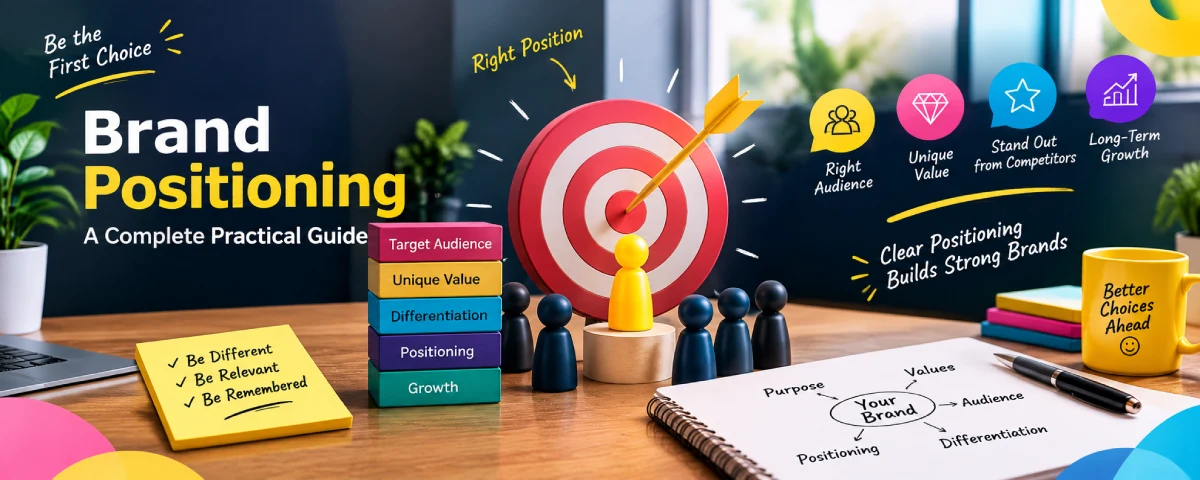
Brands generally attempt to appeal to everyone. This normally leads to them having no distinctive position whatsoever.
Brand positioning refers to the process of making the choice of the exact position you wish to occupy in the minds of your customers. The question is simple, why should one pick you over the alternatives available?
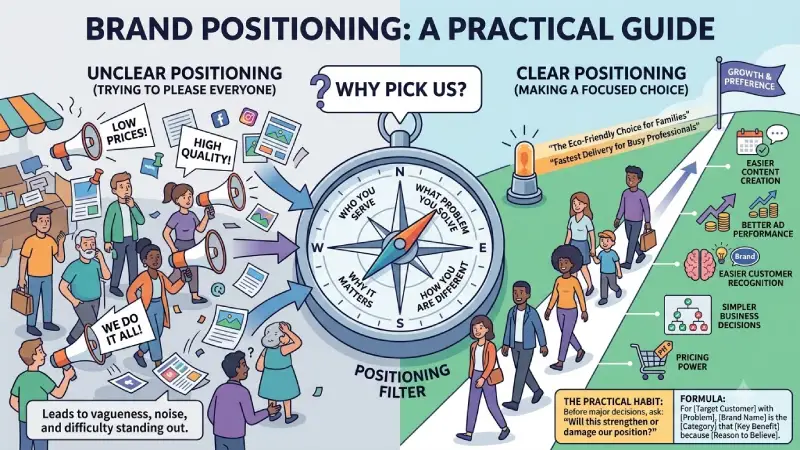
Clear positioning makes marketing easy while vagueness makes everything feel like a general statement.
In this manual, the concept of positioning has been explained, including its importance, types, development, usage, and factors that may reduce it.
Brand Positioning: Meaning and Key Concepts
Brand Positioning is the process of positioning a brand based on its perception relative to other competing brands.
It is not a catch phrase. It is not a logo. It is where you position your brand in the mind of customers.
Brand positioning is generally based upon several key decisions:
- Who you serve
- What problem you solve
- How you are different
- Why that difference matters
A simple way of putting it is that:
Positioning is the answer to the question, “Why us?”
Why Brand Positioning Matters
Clear positioning helps in several practical ways:
- It makes your marketing more focused and consistent
- It helps customers understand you faster
- It reduces direct competition because you are not fighting on the same ground as everyone else
- It supports better pricing power over time
- It makes decision-making easier inside the business
With proper positioning, expectations about that brand are clearly defined. This helps customers to identify and trust the brand more easily. Without positioning, a lot more effort will be required to generate interest from the potential customer base and turn it into actual sales.
Studies carried out in recent times have revealed that the brands that have consistency in their positioning grow faster and are preferred by the customers. Consistency in the brand is said to lead to an income advantage of between 10 to 30% in various research studies. This occurs since recognition is achieved due to the specific nature of the brand.
It is in congested market places that brands succeed not because they try to please everyone but rather because they have a clear position.
What Changes When Positioning Is Clear vs Unclear
| Area | Clear Positioning | Unclear Positioning |
| Customer Understanding | People quickly grasp what you stand for | People feel confused or need more explanation |
| Marketing Focus | Messages stay consistent and sharper | Messages change often and feel generic |
| Competition | You compete in a defined space | You compete with almost everyone |
| Pricing Power | Easier to protect or increase price | More pressure to discount |
| Internal Decisions | Easier to say yes or no to new ideas | Endless debates about direction |
| Long-term Growth | Steady brand building | Harder to build lasting preference |
Practical Benefits for Any Brand
Regardless of whether you have a local, online, or services business, effective positioning can be beneficial to you in the following ways:
- Your content becomes easier to create because you know what to say and what to avoid
- Your ads usually perform better because the message is more relevant
- Customers remember you more easily
- You waste less money testing random ideas that do not fit
- New team members or freelancers understand the brand faster
An effective means of understanding: Effective positioning requires less effort to achieve a particular outcome. Ineffective positioning will mean increased effort for every sale and every marketing endeavor.
There will be more competition in the market, making it expensive to catch people’s attention from 2025 to 2026. Brands that remain focused on their value will spend money effectively and foster strong preferences.
Key Types, Methods, and Examples
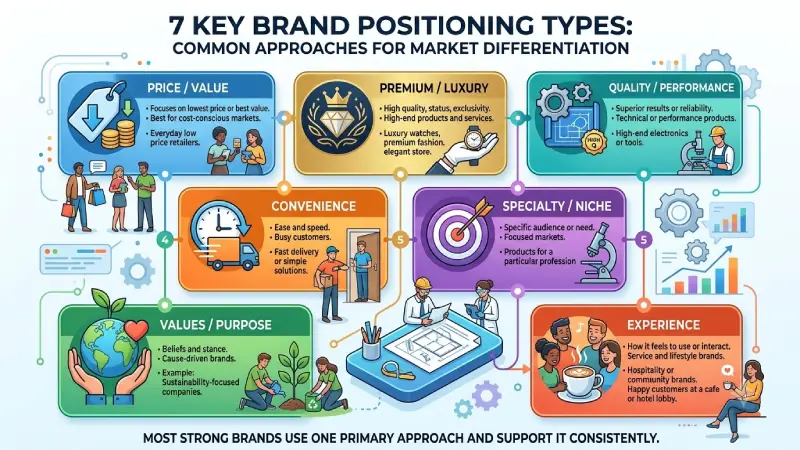
There are several common ways to position a brand. Most strong brands use one primary approach and support it consistently.
| Positioning Type | What It Focuses On | Best For | Real-World Style Example |
| Price / Value | Lowest price or best value | Cost-conscious markets | Everyday low price retailers |
| Premium / Luxury | High quality, status, exclusivity | High-end products and services | Luxury watches, premium fashion |
| Quality / Performance | Superior results or reliability | Technical or performance products | High-end electronics or tools |
| Convenience | Ease and speed | Busy customers | Fast delivery or simple solutions |
| Specialty / Niche | Specific audience or need | Focused markets | Products for a particular profession |
| Values / Purpose | Beliefs and stance | Cause-driven brands | Sustainability-focused companies |
| Experience | How it feels to use or interact | Service and lifestyle brands | Hospitality or community brands |
Common methods to develop positioning:
- Study the target customer and their real alternatives
- Identify the main problem or desire you address
- Map competitor positions
- Find a space that is meaningful to the customer and realistic for you
- Write a clear positioning statement
- Test it with real customers
- Align all marketing and product decisions with it
Simple positioning statement formula:
For customers that [need or problem], [Brand] is the [category] that [key benefit], because [reason to believe].
How to Use or Apply Brand Positioning
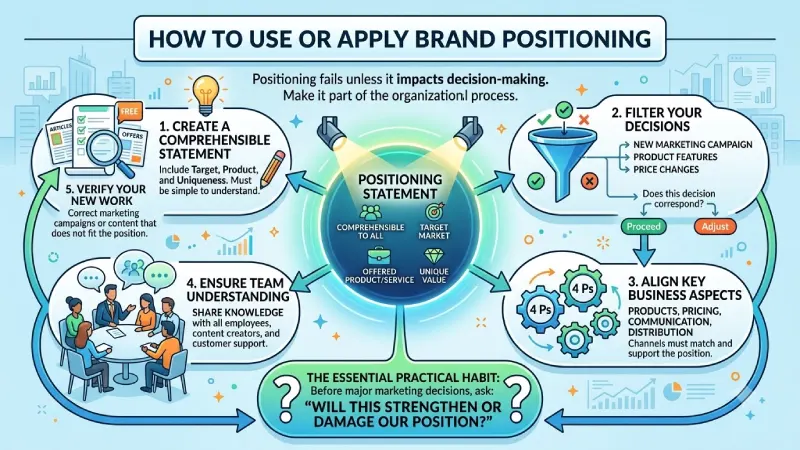
Positioning does not make sense until it impacts decision-making. It is not uncommon for many firms to create a positioning statement that they would never apply while designing their marketing and products. This is the reason why positioning fails to produce any results.
Below is a step-by-step process for using brand positioning.
- Positioning Statement Creation
The statement needs to be comprehensible for anyone from the company. Information regarding the target market, the offered product or service, and what makes the positioning statement special need to be included into the positioning statement. Otherwise, if a positioning statement is hard to understand, it cannot be used.
- Use a positioning statement to filter your decisions
When you decide to introduce a new marketing campaign, product features or changes in the prices, ask whether this decision corresponds with the position.
- Align the most important aspects of the business
The aspects of the business, such as products, pricing, communication and the channels of distribution should match with each other and support the chosen position. Otherwise, the consumers may stop believing in the position of the brand.
- Ensure that the entire team understands the position
The knowledge of the position should be distributed among all employees. Share the information about it with all those people who will create new content or communicate with customers.
- Verify your new work against the positioning
Make sure that the new marketing campaign, published articles or offers match the position of the brand. If something does not fit into it, correct
A simple practical habit that works well:
When considering whether to approve any major marketing decision, there is one question that should be asked every time, “Will this strengthen or damage our position?”
If this question is asked all the time, the brand will remain consistent and marketing decisions will become much simpler.
Positioning is not a one-time activity. Positioning will work if it becomes part of the decision-making process of the organization.
Best Practices and Common Mistakes
Best practices:
- Choose one clear primary position instead of trying to own many
- Make sure the position is meaningful to the customer, not just different
- Support the position with real proof (product, service, experience)
- Keep the position consistent over time
- Align every major touchpoint with the same idea
- Test how customers actually describe you
Common mistakes:
- Trying to position the brand for everyone
- Choosing a position you cannot deliver on
- Changing positioning too frequently
- Creating a clever statement that the business does not actually live
- Ignoring what competitors already own
- Focusing only on features instead of the customer’s real need
One of the costliest blunders is developing a positioning statement that makes for a great conversation at meetings, yet never gets translated into actions. Actionable positioning statements are key to creating value.
Final Thoughts
It’s not necessary to be better in everything. Positioning is all about being clearer with yourself when viewed by your consumers.
With such positioning, your marketing efforts would be simpler, your message would be stronger, and the entire business would make more sense. If your position is unclear, everything will take more effort and result in lesser outcomes.
Pick a position you can own. Stand behind it consistently. Look at it from time to time. This simple practice remains one of the most effective moves a brand can make.
The related guides about Brand Identity, Brand Voice, Brand Storytelling, Brand Guidelines, and Brand Awareness explain how other aspects come into play to build a position.