


Most businesses talk about marketing but never clearly decide the basic combination of things they will use to attract and keep customers. That combination is called the marketing mix.
Marketing mix simply means the set of marketing tools that are utilized to market the product or service. If these marketing tools combine effectively, marketing becomes more understandable and the outcomes become better. Otherwise, you just waste your money and mislead others.
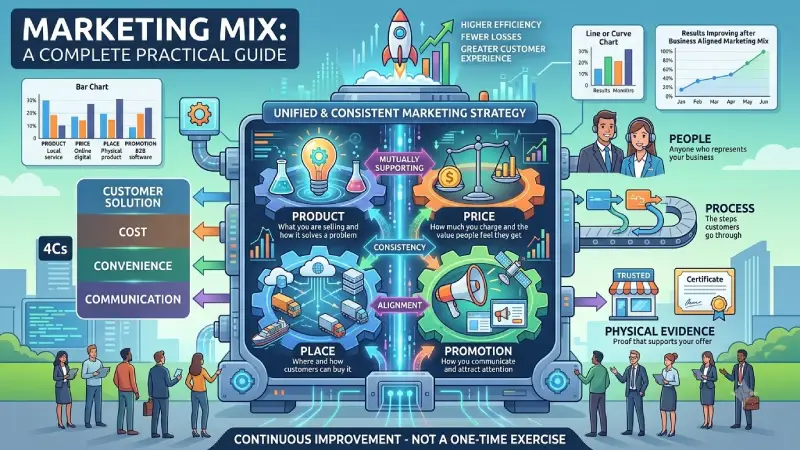
This guide will help you understand the concept of marketing mix, its importance, different types of marketing mix, application of marketing mix in practical environment, and common errors.
Marketing Mix: Meaning and Key Concepts
The Marketing Mix can be termed as the collection of decisions taken by an individual about his/her marketing strategy towards the product. The traditional marketing mix is usually known as 4 Ps:
- Product – What you are selling and how it solves a problem
- Price – How much you charge and the value people feel they get
- Place – Where and how customers can buy it
- Promotion – How you communicate and attract attention
Over time people added more elements, especially for services. The common expanded version is the 7Ps:
| Element | Simple Meaning | Key Question It Answers |
| Product | What you offer | What problem does it solve? |
| Price | How much it costs the customer | Is the value clear for the price? |
| Place | Where and how people buy | Is it easy to get? |
| Promotion | How you talk about it and attract people | How will people discover and trust it? |
| People | Anyone who represents your business | Do customers have a good experience? |
| Process | The steps customers go through | Is buying and using it smooth? |
| Physical Evidence | Proof that supports your offer | What makes the offer feel real and trustworthy? |
But you needn’t include all seven in every enterprise; the key is that the selected ones should be mutually supporting and not conflicting with one another.
Why Marketing Mix Matters
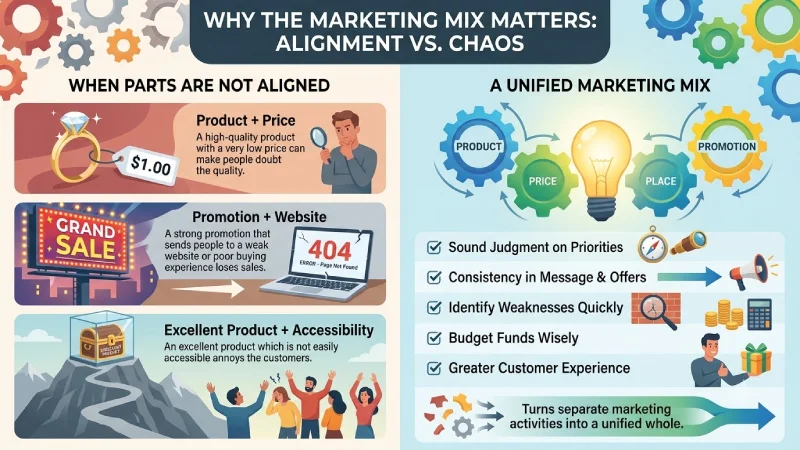
When the parts of the marketing mix are not aligned, problems appear quickly.
Examples:
- A high-quality product with a very low price can make people doubt the quality.
- A strong promotion that sends people to a weak website or poor buying experience loses sales.
- An excellent product which is not easily accessible annoys the customers.
Having a definite marketing mix can help you:
- To make sound judgment on your priorities
- To maintain consistency in your message and offers
- To identify weaknesses quickly
- To budget your funds wisely
- To provide a greater customer experience
Thus, the marketing mix turns separate marketing activities into a unified whole.
Key Types, Methods, and Examples
There are a few common ways people organize the marketing mix.
- The Classic 4Ps
Most appropriate for tangible goods and straightforward organizations. - The 7Ps
Better for service businesses and more complex offers. - The 4Cs (a customer-focused version)
- Customer solution (instead of Product)
- Cost (instead of Price)
- Convenience (instead of Place)
- Communication (instead of Promotion)
While some new companies consider experience, data, and relationships, the 4Ps and 7Ps remain relevant in most practical cases.
Simple examples:
| Business Type | Product Focus | Price Approach | Place / Channel | Promotion Style |
| Local service business | Clear, reliable service | Mid to premium | Website + local presence | Google, referrals, content |
| Online digital product | Easy-to-use tool or course | One-time or subscription | Website / platform | Content + email + paid ads |
| Physical product brand | Quality + specific benefit | Value-based or premium | Online store + selected retail | Social proof + targeted ads |
| B2B software | Solves a clear business pain | Tiered pricing | Website + sales process | Content, LinkedIn, demos |
How Different Businesses Prioritise the 4Ps
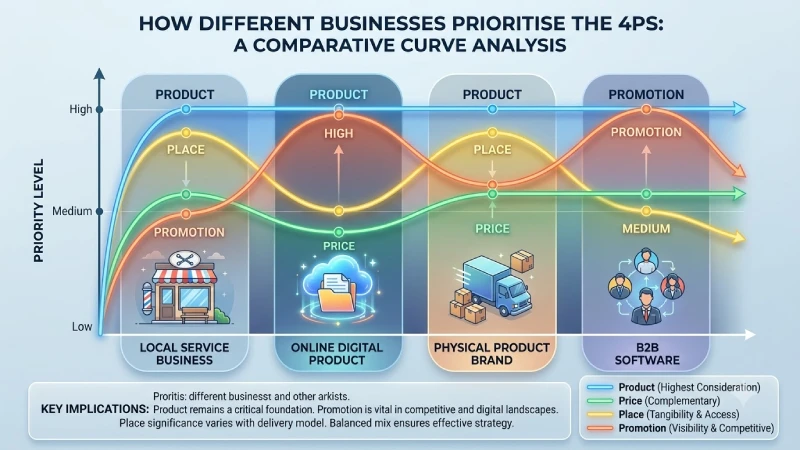
How Various Firms Treat the 4Ps Differently
It is not true that all firms give an equal consideration to Product, Price, Place, and Promotion. The considerations generally depend on the nature of the offering and the decision-making process of the customers.
The table below highlights some basic comparisons regarding the relative significance attached by various types of firms to the four principal components (illustrative perspective):
| Business Type | Product | Price | Place | Promotion |
| Local Service Business | High | Medium | High | Medium |
| Online Digital Product | High | Medium | Medium | High |
| Physical Product Brand | High | Medium | High | High |
| B2B Software | High | Medium | Medium | High |
What this typically implies:
- While most companies give due emphasis to the Product itself as well because otherwise, it won’t work,
- Promotion is emphasized in online markets and competitive markets where visibility is crucial,
- The Place factor becomes essential when we talk about services and tangible products,
- And Price is always an essential aspect that functions efficiently when it complements the value of the product and its market positioning.
The comparison above enables us to understand if the present emphasis is balanced. It’s hard for the marketing mix to function effectively if there is one highly developed element and another poorly developed element at the same time.
How to Use or Apply Marketing Mix
Here’s a practical way to work with the marketing mix:
- Start with the customer and the problem
Be clear who you serve and what problem you solve. - Define the Product clearly
What exactly are you offering and why should someone care? - Set the Price with value in mind
Look at what the customer gains, not only at your costs or competitors. - Choose the right Place
Make it easy for your target customers to find and buy from you. - Plan Promotion that matches the rest
Your message and channels should fit the product, price, and customer. - Check the extra elements if you are a service business
People, Process, and Physical Evidence often decide whether customers stay or leave. - Review the full mix together
Ask: Do these pieces support each other or create friction?
Question: Are these elements compatible or contradictory?
Task: Write a paragraph on each element in your present marketing mix strategy and then check whether any contradiction exists.
Best Practices and Common Mistakes
Best practices:
- Ensure the alignment among elements is maintained
- Make your decision according to your customer and not your competitors
- Evaluate the mix in case you decide to change your product, pricing, or channels
- Be basic first before adding more complex elements
- Experiment with just one element so that it becomes easier to know what is effective
- Concentrate mainly on the customer experience with respect to elements
Common mistakes:
- Copying a competitor’s mix without understanding why it works for them
- Focusing only on Promotion and ignoring Product or Place problems
- Changing price too often without a clear reason
- Making the buying process harder than it needs to be
- Using messages that do not match the actual product experience
- Treating the marketing mix as a one-time exercise instead of something you improve
The first and foremost issue is that firms continue to increase their promotional expenses despite low product or service quality. It seems that improving the balance of marketing activities proves to be more efficient than raising the budget.
What Happens When the Marketing Mix Is Aligned
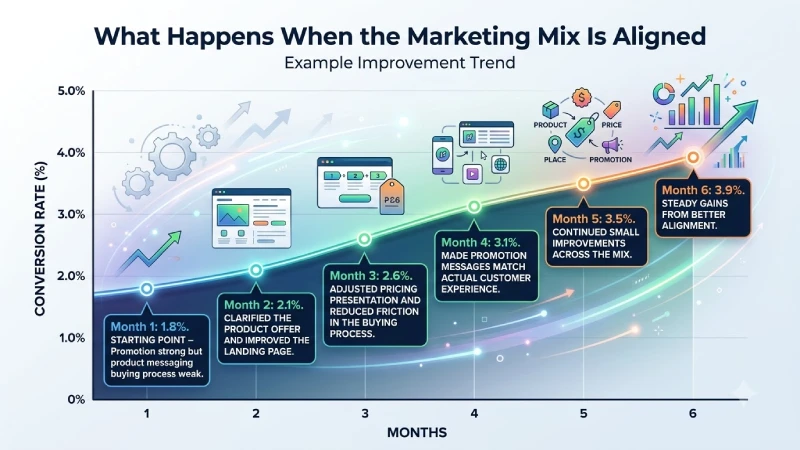
In the case when a company manages to fix its flaws in the marketing mix and align its elements, the outcome will take place step-by-step rather than abruptly.
This graph illustrates how a company’s conversion rate changed after aligning such elements as Product, Price, Place, and Promotion in their marketing mix and not just boosting advertising expenses.
Example Improvement Trend
| Month | Conversion Rate | What Changed |
| Month 1 | 1.8% | Starting point – promotion was strong but product messaging and buying process were weak |
| Month 2 | 2.1% | Clarified the product offer and improved the landing page |
| Month 3 | 2.6% | Adjusted pricing presentation and reduced friction in the buying process |
| Month 4 | 3.1% | Made promotion messages match the actual customer experience |
| Month 5 | 3.5% | Continued small improvements across the mix |
| Month 6 | 3.9% | Steady gains from better alignment |
It is typical in situations where a company begins to concentrate not only on the traffic but also on other elements of optimization. Just plotting out the increase in the conversion rate for six months would be enough for you to get the point.
Frequently Asked Questions
Marketing Strategy vs. Marketing Mix – what is the difference?
Marketing Strategy is the way and the strategy itself, whereas marketing mix consists of the means (Product, Price, Place, Promotion, etc.) applied for the execution of the marketing strategy.
Do I need to consider using all 7 Ps?
No, most companies succeed on the basis of just 4 Ps. Additional elements should be used only if they affect customer perception.
How frequently should I update my marketing mix?
Every 3-4 months or at the time of significant changes in your product or pricing policy, as well as in your main distribution channel.
Can the marketing mix evolve over time?
Absolutely. As the company grows, the right blend of the factors may change.
Is the marketing mix concept still relevant in 2026?
Yes, although channels and tools changed, the necessity for alignment remains unchanged.
Conclusion
The marketing mix is not a complex theoretical construct; it is a tool that helps ensure that all key components of marketing activities complement rather than contradict each other.
Clarify all elements of the marketing mix (product, price, place, and promotion, as well as any additional elements in case of their importance for your business). Maintain consistency of these elements. Check them periodically. Improve the weak elements before allocating additional funds on traffic generation.
Companies that perceive the marketing mix as a live process of decision-making tend to achieve higher efficiency with fewer losses.