Growth hacking is not simply a series of hacks thrown together nor going viral by accident. Growth hacking is a scientific process of discovering the most effective experiments that influence your metrics with minimum resources. Companies that grow quickly in 2026 consider growth as the result of loops, incentives, and constant testing, rather than a set of hacks.
Below is a guide based on the proven methods.
For the overarching strategy, read our complete guide on Startup Marketing.
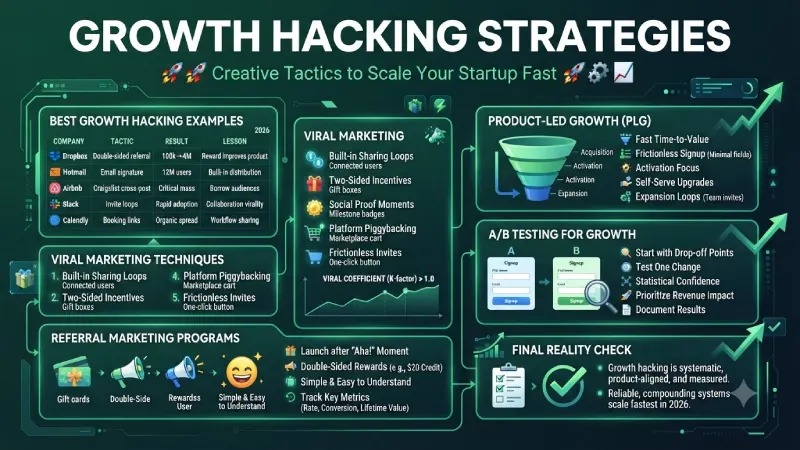
Best Growth Hacking Examples
The common factor between all those examples is that there is always a very strong connection between growth and core value proposition of the product.
| Company | Tactic | Result | Lesson for 2026 |
| Dropbox | Double-sided referral (extra storage) | 100k → 4M users in 15 months | Reward that improves the product itself |
| Hotmail | “Get your free email at Hotmail” signature | 12M users in 18 months | Built-in distribution on every use |
| Airbnb | Cross-posting listings to Craigslist | Early critical mass | Borrow existing audiences |
| Slack | Team invite loops inside the product | Rapid workplace adoption | Collaboration creates natural virality |
| Calendly | Booking links in every email | Organic spread through daily use | Make sharing part of the workflow |
Modern versions of these ideas still work. The difference in 2026 is that users are more skeptical of pure incentives and algorithms change faster. A hack works best when it appears to be an inherent part of the product as opposed to an added marketing effort.
Viral Marketing Techniques for Startups
True virality is rare. Most “viral” growth is engineered through product design and timing.
Techniques that still produce results:
- Integrated sharing loops — Make it easy and valuable for the user to invite someone else (team invitations, collaborative features, publicly shareable output).
- Dual incentives — Give an incentive to both the inviter and the invitee in the form of increased value to the product.
- Social proof moments — Yearly recaps, milestones, or shareable accomplishments (such as Spotify Wrapped) that the user will be proud to post about.
- Platform piggybacking — Put your product in places your users are already spending time on (subcultures, existing products, marketplaces), without spamming.
- Frictionless invitation — Invitation that can be made by just clicking or using one link.
Track your viral coefficient (K-factor). Most products sit well below 1.0. Even a modest, consistent K-factor of 0.2–0.4 combined with strong retention compounds powerfully over time.
Referral Marketing Programs
A great referral program transforms satisfied customers into a cheap customer-acquisition system.
What works for startups:
- Launch only after users reach a clear “aha” moment. Asking too early produces weak referrals.
- Use double-sided rewards when possible (credit, extra features, or storage that benefits both sides).
- Place the ask inside the product at moments of peak satisfaction.
- Keep the reward simple and easy to understand (“Give $20 credit, get $20 credit”).
- Track referral rate, conversion of referred users, and long-term retention of referred customers. Referred users often retain better and have higher lifetime value.
Start simple. Many early-stage teams run a manual version first (personal asks + unique links) before building full automation. Calculate the unit economics well to make sure that the gain does not surpass the customer’s worth.
Product-Led Growth Strategies
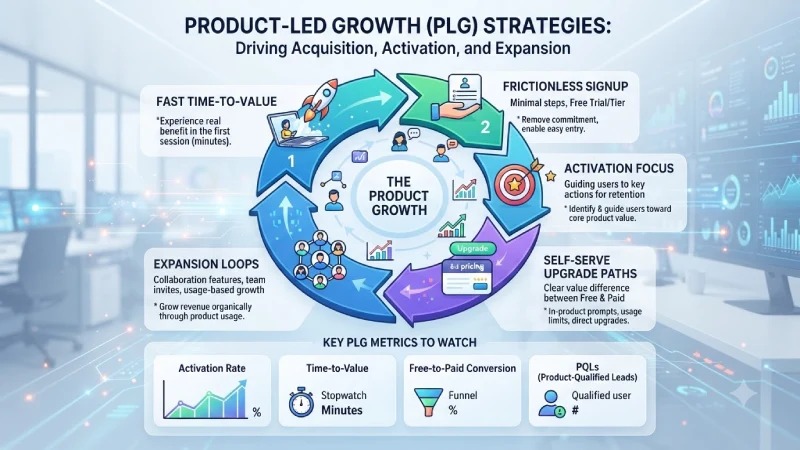
PLG, or product-led growth, has emerged as the default motion for most SaaS and digital products. Growth is driven by the product itself.
Core elements that matter:
- Fast time to value — The user must derive actual value from the first use session, preferably within minutes.
- Frictionless sign-up process — Elimination of extra steps. Trial/free plans that do not entail any significant commitment.
- Activation — Determining the key one/two things that indicate high retention and ensuring that every user activates those.
- Self-service upgrade funnel — On-product cues, usage caps, and making the difference between free and paid services clear.
- Revenue expansion loop — Collaboration capabilities, team invitations, and usage-based upgrades that drive revenue growth without requiring much sales effort.
The PLG model will be most effective if the product demonstrates its value without a sales discussion and has low ACVs. For higher ACVs, the hybrid approach is more efficient (PLA plus sales-assisted closing).
Key metrics to watch: activation rate, time-to-value, free-to-paid conversion, and product-qualified leads (PQLs).
A/B Testing for Growth
Random testing wastes time. Testing targeted at high-leverage sections of the funnel amplifies.
Practical approach for small teams:
- Begin with the biggest gaps, such as the signup conversion rate, activation rate, or important onboarding steps.
- Only test one variable at a time to make sure you can learn from it.
- Keep testing until the results are statistically significant, especially on small traffic sites.
- Focus on the tests that impact your bottom line rather than vanity tests.
- Document everything that is tested (hypothesis, results, decisions).
Common high-impact tests for startups:
- Signup form length and required fields
- Onboarding sequence and first-action prompts
- Pricing page layout and trial length
- Referral incentive amounts and messaging
- Email subject lines and call-to-action placement
F&Q
What is growth hacking?
Growth hacking is a scientific approach to conducting experiments to discover how one can maximize key performance indicators through efficient and resourceful means. Growth hacking is about growth loops, incentives, and experimentation rather than randomness or virality.
Can viral marketing tactics still work for startup firms in 2026?
Viral marketing strategies have become very rare these days, but engineered virality works well for those who integrate it into their products. Some good methods for making the virality work include integrating sharing loops, offering dual incentives, creating social-proof events such as annual reviews, using platforms, and giving frictionless one-click invites. You need to measure the K-Factor.
What is the referral program design for startups?
Start only when the user gets to the “aha” moment. Use two-way incentives, set the incentive during the peak of satisfaction while inside the application, keep the incentive simple, and track the referral ratio, conversion, and retention of referrals. It can be started manually and always verify the unit economics.
Conclusion
Tools range from simple feature flags to dedicated experimentation platforms. The tool matters less than the discipline of forming clear hypotheses and acting on the results.
Final check for reality Growth hacking happens if it is systematic, product-specific and measured. The hacks which seem smart from outside came after lots of experiments and focused on one or two of the most effective loops. Choose one or two of the strategies described above, conduct rigorous experiments and evolve those loops which work.
Those startups that will succeed the most in 2026 will be not those which have the most creative ideas but those which transform their good ideas into systems.
Need case studies for your type of products? Experiment tracking sheet? Need some advice about how to prioritize which loop to develop first? Let me know more about your company.
To take the next step, see our detailed guide on Startup Branding and Positioning.