

Email still has one of the best ROI’s when it comes to startups. It is under your control, it costs you pennies per email, and engaged subscribers have higher conversion rates than other kinds of traffic. Startups that succeed with email marketing treat it as a system — building the proper list, welcoming the right way, automating key moments, and then doing outreach.
Here’s a practical 2026 guide built for early-stage teams.
For the overarching strategy, read our complete guide on Startup Marketing.
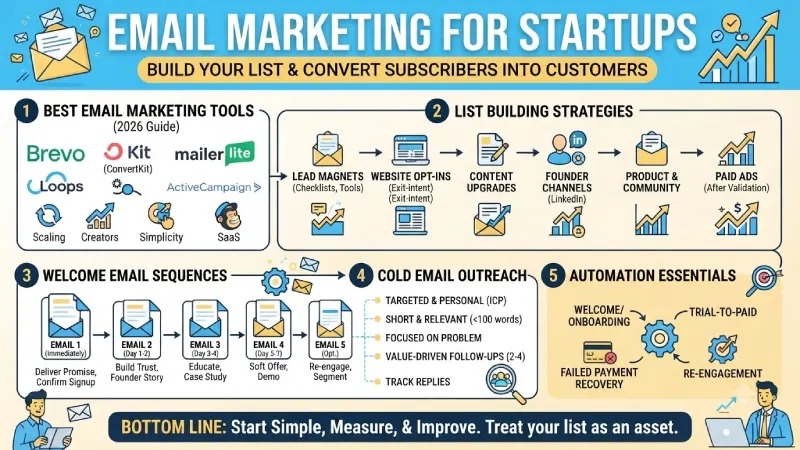
Best Email Marketing Tools for Startups
Base your decision on what stage you are at and your primary application.
| Tool | Best For | Free Tier | Starting Paid Price (approx.) | Why Startups Like It |
| Brevo | Budget + high volume | Yes (300 emails/day) | $9/mo | Send-based pricing, solid automation |
| Kit (ConvertKit) | Creator / audience-first | Yes (up to 10k subscribers) | ~$25–29/mo | Generous free plan, simple automations |
| MailerLite | Simple + good value | Yes (1k contacts) | $10/mo | Clean editor, easy automation |
| Loops | Modern SaaS lifecycle | Limited | $49/mo | Built for product-triggered emails |
| ActiveCampaign | Advanced automation | Trial only | $15/mo | Strong workflows and scoring |
| Sequenzy | SaaS with billing triggers | Yes (limited emails) | ~$19/mo | AI sequences + Stripe-style integrations |
| Mailchimp | Familiar all-rounder | Yes (limited) | $13/mo | Easy start, large template library |
Practical advice
- Pre-seed/Solo founder: Begin with the free version of Kit, Brevo, or MailerLite.
- SaaS with product events: Consider Loops or other services with good event triggers.
- Require advanced automation from day one: ActiveCampaign or equivalent.
Most startups stay on free or low-cost plans longer than expected. Switch only when you hit limits or need features that clearly increase revenue.
Email List Building Strategies
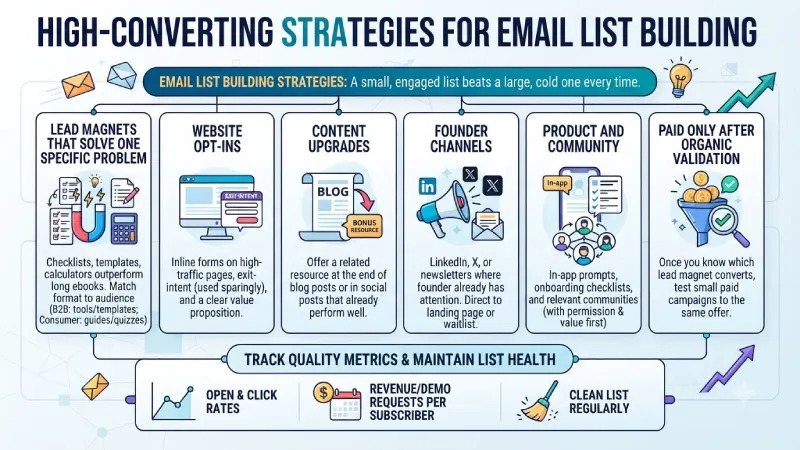
A small, engaged list beats a large, cold one every time.
High-converting approaches for startups:
- n solving a very specific problem Lead magnets Checklists, templates, calculators, brief audit, swipe file Long ebook lead magnets don’t work The format must match the demographics (B2B likes templates/checklists whereas consumers like guides/quiz)
- Website sign-ups Inline forms on highly trafficked pages, exit-intent (sparingly used) and clearly defined value proposition on the form itself. “Get weekly startup marketing strategies” works better than “Subscribe to our newsletter.”
- Content upgrades Provide an additional resource after blog posts/social posts that have proven their worth.Founder-owned channels LinkedIn, X or newsletters from where the founder is known. Redirect traffic to a landing page/waitlist.
- Product and community Product in-app notifications, onboarding checklist, and relevant community (with value first).
- Paid only after organic proof of value Once you’ve figured out what’s working, test some paid campaigns on the same offer.
Start monitoring your metrics right from the first day – open rate, click rate, and conversions (revenue or demo requests) per subscriber. Keep cleaning your list; unsubscribe the hard bounces and inactive subscribers.
Welcome Email Sequences for Startups
New subscribers are most open right after they join. A simple 3–5 email sequence does more than most complex campaigns.
Recommended structure (adjust timing to your product):
| Timing | Goal | What to Include | |
| 1 | Immediately | Deliver the promise + first action | Confirm signup, give the lead magnet or next step, set expectations |
| 2 | Day 1–2 | Build trust / show value | Short founder story or one useful tip |
| 3 | Day 3–4 | Educate or prove | Case example, quick win, or social proof |
| 4 | Day 5–7 | Soft next step | Relevant offer, demo, or deeper resource |
| 5 | Day 8–14 (optional) | Re-engage or segment | Preference center or light check-in |
Let the first email focus on only one actionable step. Human-like language is key. Mobile-first design is crucial. Look at completion rate, but also the actions that follow (not only opens).
When talking about SaaS, the welcome sequence is basically an onboarding process – take the customer to the “aha” moment as soon as you can.
Cold Email Outreach for Startups
Cold emailing will work as long as the email is relevant, personalized, and respectful.
Core rules that still hold in 2026:
- Use different sending domain along with correct methods of authentication (SPF, DKIM, DMARC).
- Warm up new domains properly.
- Keep bounce rates low (verify emails before sending).
- Write short, relevant first emails (often under 80–100 words).
- Focus on the recipient’s problem or trigger, not your product features.
- Follow up 2–4 times with new value, then stop.
- Track replies and positive responses more than open rates.
Use a good ICP and start by creating your account lists and then your contact list. You can use tools such as Apollo, Instantly, or similar for data and sequencing, but copy and targeting are much more important than the tool used.
Cold emails are supposed to spark conversations rather than broadcast messages. Quantity without quality will damage your domain’s reputation.
Email Marketing Automation for Startups
The objective is to save time and improve relevance rather than creating more complexity which you can’t sustain.
Start with these high-impact automations:
- Welcome / onboarding sequence (covered above)
- Trial-to-paid or activation sequences (if you have a free trial or freemium model)
- Failed payment / dunning recovery
- Re-engagement for inactive subscribers
- Simple behavioral triggers (visited pricing page, used a key feature, etc.)
Start with a small number of active streams. A single effective stream will be better than five semi-effective streams.
Segmentation based on engagement and behavior and not just demographics. Send more emails to people who open and click them and fewer or no emails to the people who do nothing.
Summary The secret behind email marketing is taking care of the list like an asset. Grow the list with value, onboard people correctly, automate the revenue generating steps, and then go ahead and create campaigns.
Do you need help with writing welcome emails or setting up your automation tool for the stage that you are at? Let me know more about your business, and I’ll make something for you.
Frequently Asked Questions
How big does my list need to be before email marketing is worth it?
You don’t need thousands. A few hundred engaged subscribers who open and click can already bring in leads or sales. Focus on quality and relevance first. Size comes later.
Should I buy email lists?
No. Bought lists almost always hurt your sender reputation and deliver almost zero results. Build your own list through lead magnets, content, and your product. It’s slower but it actually works.
How often should I email my list?
There’s no universal number. For most startups, once a week or every 10–14 days is a solid starting point. Watch engagement. If people open and click, you can go a bit more frequent. If opens drop, pull back. Consistency matters more than frequency.
What’s a good open rate in 2026?
That is entirely based on your industry and how good your list is, but some good B2B and SaaS lists will range from 30 to 50% for good open and targeting. Poor lists that have been neglected or not nurtured enough will drop below 20%. Measure yourself against industry standards.
Do I need fancy automation right away?
No. A simple welcome sequence of 3–5 emails is usually enough at the beginning. Add trial-to-paid, failed payment, and re-engagement flows only when those situations actually exist in your business. Complexity without results just creates maintenance work.
Does cold emailing still work for startups?
Certainly, but only if you do it right. Warm your domain, verify your emails, be concise and relevant, and make sure that you deliver real value in your follow-ups. Cold emailing is supposed to act like an ice breaker and not spamming.
Do I start off with the free version or pay right away?
Go with the free version as long as it fits (Kit, Brevo, MailerLite all have usable free versions). Switch to a paid plan once you hit the volume cap or require special features that will generate additional income. Most young startups find themselves staying in cheap versions for longer periods than anticipated.
What actions can I perform to ensure that my email is sent to the inbox?
Make sure you authenticate your domain (SPF, DKIM, DMARC). Use a separate sending domain for email outreach. Low bounce rates, no spam language, and clean mailing list – that’s what you need. Ultimately, engagement plays the main role here; those who open and click on emails get you into the inbox.
Conclusion
Email marketing still works for startups because you own the channel. No algorithm change can take it away overnight. No matter how many people your cold list includes, a small list of interested parties is guaranteed to beat it each and every time.
The system is straightforward:
- Offer something useful to grow the list.
- Greet new subscribers well so that they do not forget their reasons for subscribing.
- Automate the important moments (onboarding, payments failure, reengagement).
- Then conduct campaigns periodically after understanding the reaction of your audience.
Most early teams overcomplicate it. Start simple. Use a free or cheap tool. Watch your open rates, click rates, and actual conversions. Clean the list regularly. Write like a human talking to another human. That mix continues to outperform all other methods of conversion that you might use with a restricted budget.
To take the next step, see our detailed guide on Growth Hacking Strategies