

Creating a successful startup always begins with testing the concept before devoting much time and effort to the development process. This is where an MVP comes into play. MVP gives founders the ability to create the initial version of their product using only those features necessary to address the customers’ problems. This method will allow startups to enhance their products, minimize their risks, and create solutions which would really match the market needs. This article is dedicated to the description of MVP, to the explanation of the difference between MVP, prototype, and complete product, as well as to the list of MVP benefits and its successful creation in 2026.
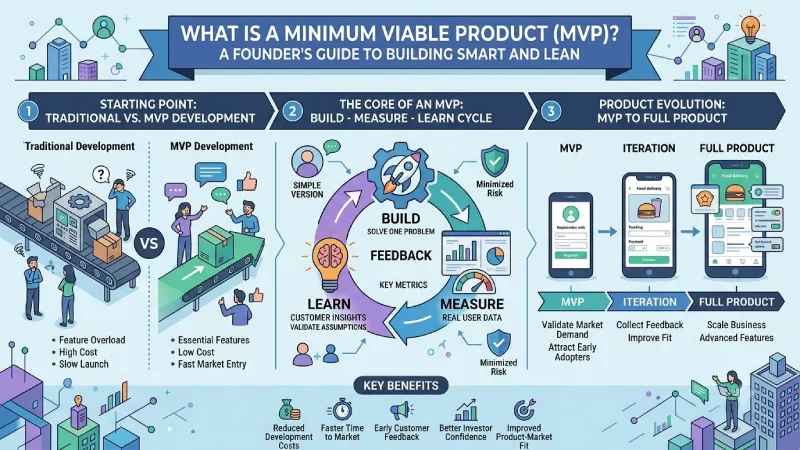
What Is a Minimum Viable Product?
Creating a business is a thrilling experience; however, there are many risks involved in it. The creators can spend months and even years working on their product because they believe that the market will love it, but then realize that the market is not interested at all.
Instead of investing huge amounts of time and money into developing a fully featured product, successful entrepreneurs start with something much simpler: a Minimum Viable Product (MVP).
If you’ve ever wondered what is a minimum viable product, the answer is straightforward:
Minimum Viable Product (MVP) is the simplest version of a product, consisting of the minimum number of necessary features which can address some particular customer’s problem and give founders an opportunity to get feedback from users.
MVPs are not partial products or substandard versions of your concept. Instead, they are merely the tools used to help businesses test their assumptions and reduce development costs and ultimately develop a product that meets the demands of the customer.
Among the best known tech companies of modern times, some were born through an MVP and then grew into platforms, such as Airbnb, Dropbox, Uber, and Spotif. They did not succeed because they had excellent software. They succeeded by learning from real users fast enough.
Entrepreneurs who begin to work on their projects in 2026 will be offered many options, but the concept of creating an MVP will be one of the best decisions for them.
Why Every Startup Should Start with an MVP
Most entrepreneurs think that creating the “perfect” product prior to launch is key to success.
In reality, perfection often delays learning.
The startup world runs at a very fast pace. Customer requirements change, competition throws in additional functionalities, and technology keeps getting better. Creating a product for an entire year without knowing how customers would react to it is only making it possible to solve the wrong problem.
An MVP helps founders answer critical questions early.
- Does anyone actually need this product?
- Which features matter most?
- Will customers pay for it?
- What changes will follow?
- Is the business model sustainable?
As opposed to making assumptions, startup companies seek proof from real-life customers.
HBR explains that MVP experiments can validate or invalidate assumptions about a business model.
This significantly improves decision-making throughout product development.
Traditional Product Development vs MVP Development
| Traditional Development | MVP Development |
| Builds every planned feature first | Builds only essential features |
| High development cost | Lower initial investment |
| Long launch timeline | Faster market entry |
| Limited customer feedback before launch | Early user validation |
| Higher financial risk | Lower business risk |
| Difficult to change direction | Easy to iterate and improve |
| Assumption-driven | Data-driven |
Today, most startups usually create MVPs in the course of their normal activities since speed and learning take precedence over perfection.
What Are the Benefits of Having a Minimum Viable Product?
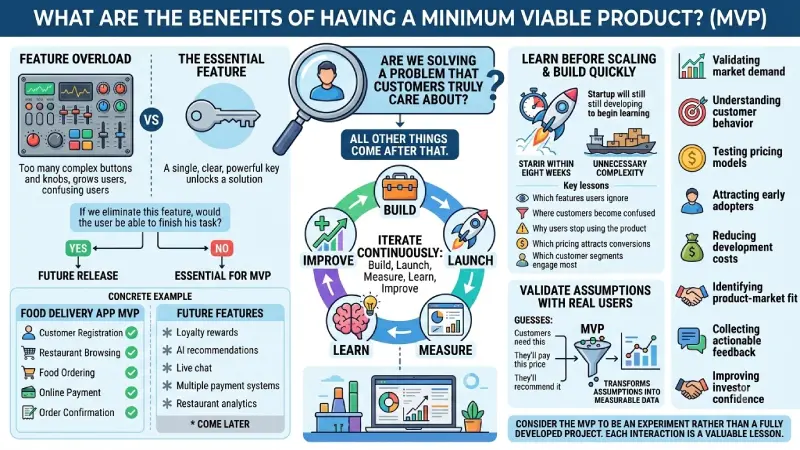
An MVP exists to answer one simple question:
“Are we solving a problem that customers truly care about?”
All other things come after that.
Rather than creating dozens of complex features, entrepreneurs concentrate on offering one very important feature.
The purpose of an MVP includes:
- Validating market demand
- Understanding customer behavior
- Testing pricing models
- Attracting early adopters
- Reducing development costs
- Identifying product-market fit
- Collecting actionable feedback
- Improving investor confidence
Consider the MVP to be an experiment rather than a fully developed project.
Each interaction is a valuable lesson.
MVP Definition and Core Principles
Understanding the MVP definition and core principles is essential before beginning development.
An MVP follows several foundational principles that separate successful startups from unsuccessful ones.
-
Solve One Important Problem
Great MVPs don’t attempt to solve every customer problem.
Instead, they solve one problem exceptionally well.
For example:
Instead of creating a complete project management platform with hundreds of features, an MVP might simply help remote teams organize daily tasks.
That focused solution creates immediate value.
As customer needs become clearer, additional features can be added strategically.
-
Build Only Essential Features
Many founders suffer from “feature overload.”
They assume more functionality creates a better product.
However, in practice, having too many features usually confuses users.
The MVP should consist only of those features that would allow customers to accomplish a single task.
Consider the question:
“If we eliminate this feature, would the user be able to finish his task?”
The answer is “yes,” then this feature is for a future release.
Example
Imagine building a food delivery app.
Instead of including:
- Loyalty rewards
- AI recommendations
- Live chat
- Multiple payment systems
- Social sharing
- Restaurant analytics
An MVP might only include:
- Customer registration
- Restaurant browsing
- Food ordering
- Online payment
- Order confirmation
That’s enough to validate customer demand.
Everything else can come later.
-
Learn Before Scaling
The objective of an MVP isn’t rapid growth.
The objective is rapid learning.
Every customer interaction provides valuable information.
Examples include:
- Which features users ignore
- Where customers become confused
- Why users stop using the product
- Which pricing attracts conversions
- Which customer segments engage most
Learning before scaling prevents expensive mistakes.
-
Build Quickly
Speed creates competitive advantage.
A startup that launches within eight weeks can begin learning while competitors are still developing features.
Launching earlier doesn’t mean sacrificing quality.
It means avoiding unnecessary complexity.
Founders should prioritize:
- Fast development
- Reliable performance
- Simple user experience
- Continuous improvement
As opposed to waiting for perfection, successful startups move, learn, and evolve.
-
Validate Assumptions with Real Users
Every startup begins with assumptions.
Examples include:
- Customers need this product.
- They’ll pay this price.
- They’ll use these features.
- They’ll recommend it to others.
Without validation, assumptions remain guesses.
An MVP transforms assumptions into measurable data.
Insights from actual customers are invaluable; no brainstorming session can compete.
-
Iterate Continuously
Launching an MVP isn’t the end.
It’s the beginning.
Successful products evolve through continuous improvement.
The process looks like this:
Build → Launch → Measure → Learn → Improve
Each cycle strengthens the product.
This approach minimizes wasted effort while maximizing customer satisfaction.
The Three Components of Every Successful MVP
Every effective MVP contains three essential elements.
| Component | Purpose |
| Minimum | Includes only essential features |
| Viable | Delivers real customer value |
| Product | Solves an actual problem people experience |
Should any of the elements be absent, then the product cannot provide useful information about the customers.
Characteristics of a Strong MVP
Not every early product qualifies as an MVP.
A successful MVP shares several important characteristics.
Focused
It addresses one clearly defined customer problem.
Functional
Even with limited features, it works reliably.
Valuable
Customers receive genuine benefits.
Measurable
User actions generate valuable business insights.
Flexible
Future improvements can be implemented easily.
Scalable
The foundation supports future expansion without requiring a complete rebuild.
Common Types of Minimum Viable Products
Different startups validate ideas using different MVP formats.
Some common approaches include:
| MVP Type | Description | Best For |
| Landing Page MVP | Tests demand before development | New business ideas |
| Concierge MVP | Founder manually delivers the service | Service startups |
| Wizard of Oz MVP | Appears automated but operates manually | AI and automation products |
| Single Feature MVP | Launches with one primary feature | SaaS startups |
| No-Code MVP | Built using no-code tools | Budget-conscious founders |
| Clickable Prototype | Demonstrates workflows without full functionality | UX testing |
| Marketplace MVP | Connects buyers and sellers with limited functionality | Platform businesses |
Each approach reduces development costs while validating customer demand.
Why Simplicity Wins
Entrepreneurs often fear that starting with less product will make their company seem weaker.
The opposite is often true.
Simple products are:
- Easier to understand
- Faster to use
- Less expensive to build
- Easier to improve
- Faster to test
- More adaptable to customer feedback
Complexity can always be added later.
Making things simple after their launch is even more difficult.
Great companies understand how to be simple before going sophisticated.
Founders’ Advice Before Developing MVPs
Before you write a line of code or hire developers, consider the following:
- What problem am I trying to solve
- Who has this problem?
- What is the simplest solution?
- Which feature creates the greatest value?
- What assumptions need validation?
- How will I measure success?
- Which feedback will have an effect on the next iteration?
- These questions will provide a more solid base for all of product development process.
MVP vs Prototype vs Full Product
The majority of first-time entrepreneurs tend to be unaware of the differences between MVP, prototype, and the product itself. Though all three have some connection between them, each of these serves its own specific purpose when creating a product.
| Aspect | MVP | Prototype | Full Product |
| Purpose | Validate a business idea with real users | Demonstrate design or functionality | Serve the complete market with advanced features |
| Users | Real customers | Internal teams, investors, or testers | All target customers |
| Functionality | Core features only | Limited or non-functional | Fully functional with multiple features |
| Goal | Collect feedback and validate demand | Test concepts and user experience | Scale the business and generate revenue |
| Development Time | Weeks to a few months | Days to weeks | Several months or longer |
A prototype is essentially a visual or interactive representation of how the product would function. This is mostly done before the development process starts in order to get some feedback on the layout and workflow.
The concept of Minimum Viable Product (MVP) takes this a bit further. It’s a product that is fully functional but solves only one central issue. This product can be used by customers, who will give feedback to allow the founders to know how to improve next.
The fully developed product refers to the matured product that has all its advanced functionalities, efficiency enhancements, and scaling capability to serve increasing numbers of customers.
For startups, the recommended path is simple:
Prototype → MVP → Full Product
Through this systematic process, there is minimal risk involved and the decisions are made based on customer insights.
Benefits of Building an MVP for Startups
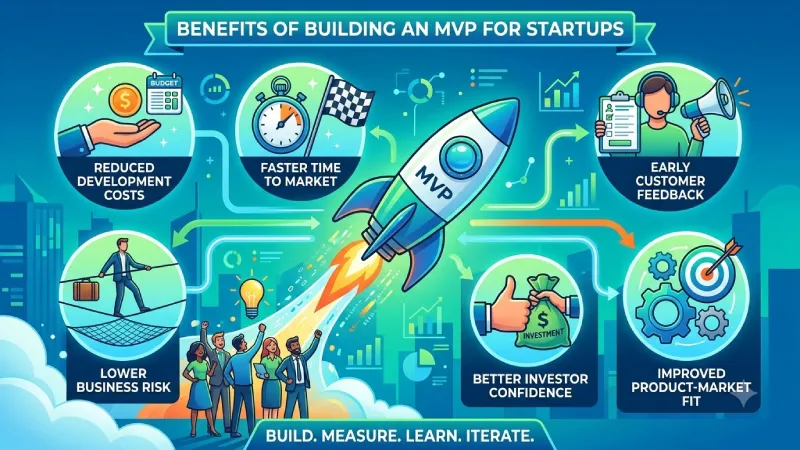
The construction of MVP comes with several benefits, more so in a startup firm at the early stage of development where the resources are limited and there is uncertainty regarding the demand for the product.
Some of the biggest benefits include:
- Reduced development costs by focusing only on essential features.
- Faster time to market, allowing startups to validate ideas before competitors.
- Early customer feedback that guides future product improvements.
- Lower business risk by testing assumptions before large investments.
- Better investor confidence, as a working MVP demonstrates market validation.
- Improved product-market fit through continuous iteration and user-driven enhancements.
Undoubtedly, the biggest advantage is the ability to make intelligent choices. Instead of assuming what their clients might need, they base their products on real user actions and metrics.
The most successful companies never start out perfect. They thrive due to their willingness to listen, change, and improve. MVP allows them to do so faster, cheaper, and more efficiently than by developing a complete product right away.
When to Move from an MVP to a Full Product
But the launching of MVP can only mark the beginning of the product’s development cycle. But then arises another challenge regarding how to determine the right time for moving from MVP to the actual product. Failure to make this determination on time can prove detrimental to the process.
You should consider scaling your MVP when you notice these signs:
- The product sees consistent use from its users.
- Customers’ opinions focus on improvements rather than usability problems.
- There is steady increase in income or in the number of users.
- Market data confirms that all your assumptions were correct.
- You can add new users and new functionality to your infrastructure.
It is here that the founders begin to incorporate more features into their creation to improve its functionality and performance with regards to their clients’ needs.
Common Misconceptions About Minimum Viable Products
Entrepreneurs often misinterpret the use of an MVP. Some of the myths about MVP are:
- Myth: An MVP is a poor-quality product.
- Truth: A good MVP is a basic yet solid solution that delivers real value.
- Myth: All planned features should be included in the MVP.
- Truth: Only the essential ones to solve a single major problem should be included.
- Myth: The launch of an MVP ensures success.
- Truth: An MVP gives you a chance to learn but constant testing is still necessary.
Real-World Example
Before Dropbox developed its product, there was an explanatory video which introduced the concept to users before going all out on development because of the high demand generated by the users’ interest in it.
Best Practices for Founders
- Solve one problem per customer.
- Get user feedback continuously.
- Prioritize changes using data, not intuition.
- Add new features only after validating the current ones.
- Assess results via retention and engagement.
By doing these, startups can develop their products based on the customers’ needs while saving on unneeded development costs and risks.
FAQs
What is a Minimum Viable Product (MVP)?
The MVP is the basic form of a product containing just the necessary features to solve an essential customer need and to obtain customer feedback.
Why do startups need an MVP?
The MVP helps startups test their ideas. It lets them save money on development. They can release the product fast. They also use customer feedback to make the product better.
What is the difference between MVP and Prototype?
Prototype verifies the concept or design of a product whereas MVP is a complete functional product.
When should I move from MVP to a product?
It is necessary to expand an MVP when you have validated the market demand and obtained positive customer feedback.
Conclusion
An MVP, or minimum viable product, is the wisest approach to take when you are looking to turn a mere concept into a proven business. This is because of the fact that by paying attention to important aspects, using live users and learning from feedback, a startup can lower its risks while developing products that people would value. Don’t be perfect from the beginning but use MVP to learn and grow.