


Introduction
Developing a business plan can be a daunting task, especially if you are an entrepreneur developing a new venture for the first time. You may have a great idea in mind but are uncertain on how to develop a coherent and professional business plan. Business plan templates come in handy in such situations.
For the overarching strategy, read our complete guide on Business Planning.
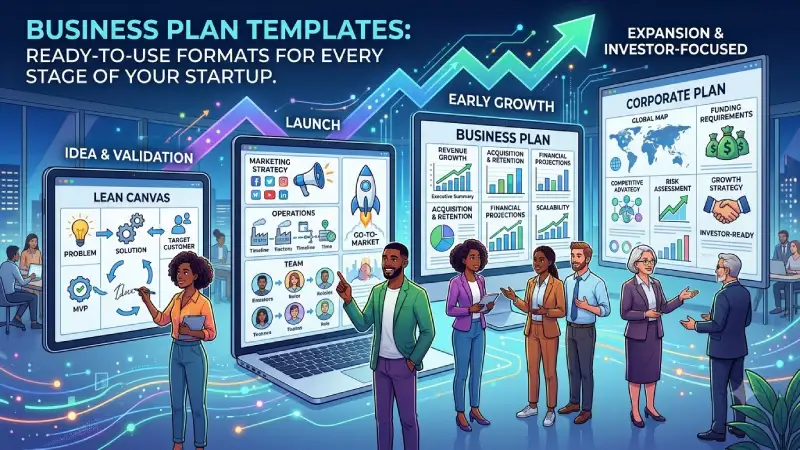
A good business plan template gives you a framework to organize all information concerning your venture and its operations. Instead of developing your business plan from scratch, a template gives you a tried-and-tested framework that you can tailor to meet your venture’s needs.
Not all startups need the same kind of business plans. For instance, a new venture that is still at the validation stage of its idea will require a simplified form such as a lean plan while an emerging startup looking for substantial financial investments may find a traditional business plan useful.
This article takes you through the various types of business plan templates, ranging from free business plan templates, lean business plan templates, traditional and lean plans, one-page business plan templates, among others.
What Is a Business Plan Template?
A business plan template is something that helps people who want to start a business. It gives them an outline to work with.
This business plan template is like a map that shows you what to do. You do not have to think about what to include in your business plan because the business plan template is already set up for you. You can then make changes, to the business plan template to fit your needs.
A typical template may include sections such as:
- Executive summary
- Company description
- Products or services
- Target market
- Market analysis
- Competitive analysis
- Marketing strategy
- Sales strategy
- Operations plan
- Management team
- Financial projections
- Funding requirements
The way something is structured depends on the kind of template being used.
A normal template might have lots of sections while a simple or one-page template will only include the important parts of the business plan.
Why Use a Business Plan Template?
The use of templates can make the entire process faster.
- Saves Time
You already have a starting point as opposed to having to design the outline on your own.
- business plan templates
It allows you to organize information in a logical manner for readers to get to know your business.
- business plan templatesns
A well-designed template will help you recall such elements as finances, marketing, competition, and operations.
- Improves Readability
With consistent headings and format, the plan will be more professional.
- Helps First-Time Founders
First-time founders don’t have any idea of what information should be included for investors, lenders, or partners. A template can help you do that.
- Allows for Easy Updates
When changes happen within your business, it is easy to return to your template and modify the plan according to your needs.
However, it should be noted that templates are merely the foundation of your future business plan.
Types of Business Plan Templates
Different business situations require different planning formats.
The most common options include:
- Traditional business plan templates
- Lean business plan templates
- One-page business plan templates
- Startup business plan templates
- Growth business plan templates
- Small business plan templates
- Industry-specific templates
Which is the best option for your case will depend on your company’s stage, objectives, target audience, and degree of complexity.
Free Business Plan Template for Startups
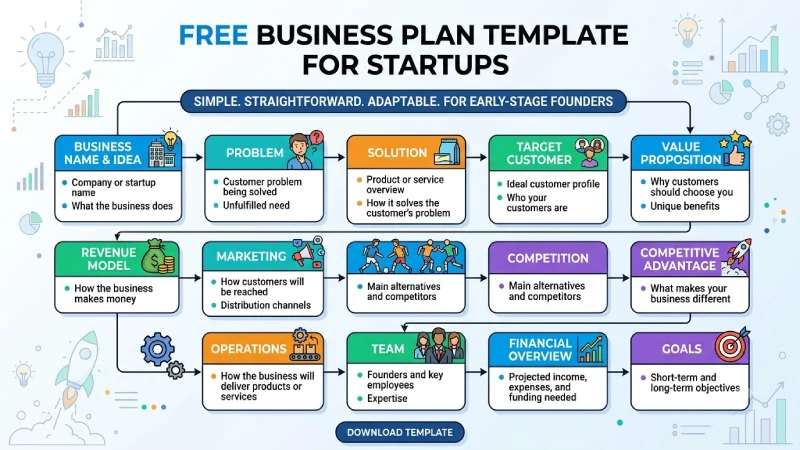
A free business plan template for startups may be a great start for entrepreneurs who wish to arrange their thoughts without spending money on costly software and consultancy.
A basic startup template might include:
- Business Overview
Explain how the business works and what problems the startup addresses.
- Problem
State the problem faced by your customer and the unfulfilled need.
- Solution
Provide a brief introduction to your product/service and describe how it will solve your customer’s problem.
- Target Market
Describe who your customers are
- Business Model
Describe how your startup will make money.
- Competitive Landscape
Describe your competitors and how your startup will differ from them.
- Marketing Strategy
Describe how you plan to reach potential customers.
- Operations
Explain how the business will deliver its products or services.
- Team
Describe the founders and key team members.
- Financial Overvie
Offer some details concerning projected income, expenses, and capital requirements.
A free template becomes very helpful at this early stage of development because the business concept is not yet finalized.
Simple Startup Business Plan Template
Here is a basic structure that early-stage founders can adapt:
| Section | What to Include |
| Business Name | Company or startup name |
| Business Idea | What the business does |
| Problem | Customer problem being solved |
| Solution | Product or service |
| Target Customer | Ideal customer profile |
| Value Proposition | Why customers should choose you |
| Revenue Model | How the business makes money |
| Marketing | How customers will be reached |
| Competition | Main alternatives |
| Competitive Advantage | What makes your business different |
| Operations | How the business will function |
| Team | Founders and key employees |
| Financial Overview | Revenue, costs, and funding |
| Goals | Short-term and long-term objectives |
Although simple and straightforward to start off, this type of format can grow along with the growth of your startup.
Lean Business Plan Template
A lean business plan template focuses on the most important assumptions behind a business.
Unlike a traditional business plan, it does not require lengthy explanations for every section.
A lean plan may include:
- Business problem
- Customer segments
- Value proposition
- Solution
- Marketing channels
- Revenue streams
- Cost structure
- Key metrics
- Competitive advantage
The purpose is to gain fast insights into the workings of the business and find areas of assumptions to test.
Example Lean Business Plan
| Lean Planning Area | Example |
| Problem | Small businesses struggle to manage invoices |
| Customer | Freelancers and small business owners |
| Solution | Simple online invoicing platform |
| Value Proposition | Create and send professional invoices in minutes |
| Channels | SEO, partnerships, and paid advertising |
| Revenue | Monthly subscription |
| Costs | Software development, hosting, and marketing |
| Key Metrics | Subscribers, conversion rate, churn |
| Competitive Advantage | Easy setup and affordable pricing |
This strategy will be helpful especially when your business is at the stage of validation.
Traditional vs Lean Startup Business Plan Formats
Traditional and lean business plans serve different purposes.
| Feature | Traditional Plan | Lean Plan |
| Length | Longer and detailed | Short and focused |
| Level of Detail | High | Moderate |
| Market Analysis | Detailed | Summary |
| Financial Information | Detailed projections | Key financial assumptions |
| Best For | Investors, lenders, formal planning | Early-stage startups |
| Update Frequency | Less frequent | Frequent |
| Flexibility | Lower | Higher |
| Main Purpose | Comprehensive documentation | Rapid testing and iteration |
Neither format is automatically better.
A founder seeking a bank loan may need a detailed traditional plan. A startup testing a new business model may benefit from a lean plan that can be updated quickly.
Some startups use both.
They might start off with a lean plan while validating the ideas and then work on a complete plan when they start raising funds.
One-Page Business Plan Template
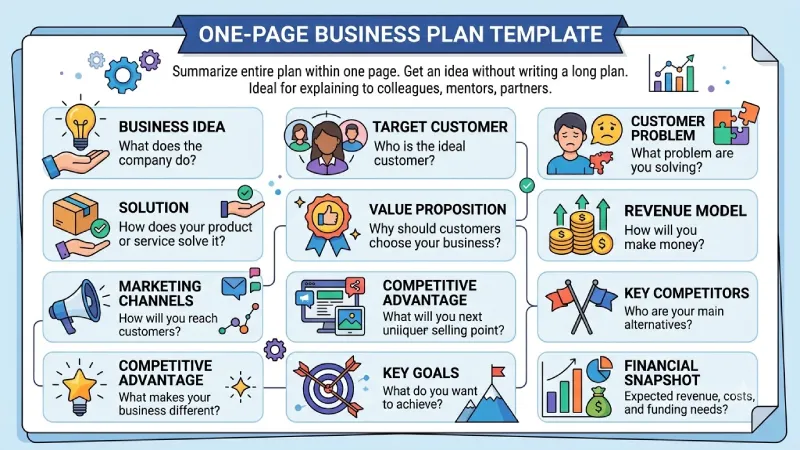
A one page business plan template will allow you to summarize your entire plan within one page.
This will help you get an idea about your business without writing a long plan.
A one-page plan can include:
Business Idea
What does the company do?
Target Customer
Who is the ideal customer?
Customer Problem
What problem are you solving?
Solution
How does your product or service solve it?
Value Proposition
Why should customers choose your business?
Revenue Model
How will you make money?
Marketing Channels
How will you reach customers?
Key Competitors
Who are your main alternatives?
Competitive Advantage
What makes your business different?
Key Goals
What do you want to achieve?
Financial Snapshot
What are your expected revenue, costs, and funding needs?
Example One-Page Business Plan
| Category | Example |
| Business | HealthyBox |
| Problem | Busy professionals struggle to find convenient healthy meals |
| Solution | Weekly meal delivery subscription |
| Target Customer | Health-conscious working professionals |
| Revenue Model | Weekly and monthly subscriptions |
| Marketing | SEO, social media, partnerships |
| Competition | Restaurants and meal delivery platforms |
| Advantage | Customizable healthy meal plans |
| Year 1 Goal | Acquire 1,000 recurring customers |
| Funding Need | Initial working capital and marketing budget |
One-page layout is ideal when it comes to explaining your business concept to your colleagues, mentors, or even potential partners.
Startup Business Plan Template by Business Stage
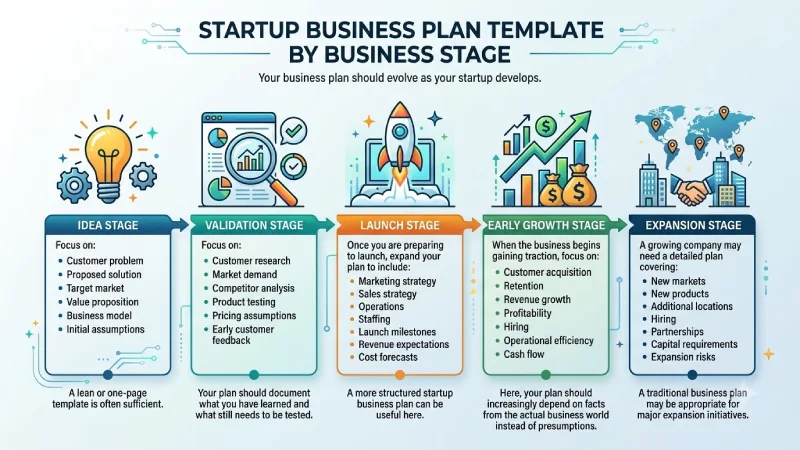
Your business plan should evolve as your startup develops.
Idea Stage
At the idea stage, focus on:
- Customer problem
- Proposed solution
- Target market
- Value proposition
- Business model
- Initial assumptions
A lean or one-page template is often sufficient.
Validation Stage
At this stage, focus on:
- Customer research
- Market demand
- Competitor analysis
- Product testing
- Pricing assumptions
- Early customer feedback
Your plan should document what you have learned and what still needs to be tested.
Launch Stage
Once you are preparing to launch, expand your plan to include:
- Marketing strategy
- Sales strategy
- Operations
- Staffing
- Launch milestones
- Revenue expectations
- Cost forecasts
A more structured startup business plan can be useful here.
Early Growth Stage
When the business begins gaining traction, focus on:
- Customer acquisition
- Retention
- Revenue growth
- Profitability
- Hiring
- Operational efficiency
- Cash flow
Here, your plan should increasingly depend on facts from the actual business world instead of presumptions.
Expansion Stage
A growing company may need a detailed plan covering:
- New markets
- New products
- Additional locations
- Hiring
- Partnerships
- Capital requirements
- Expansion risks
A traditional business plan may be appropriate for major expansion initiatives.
Business Plan Template for Investors
In case you intend to get some money, your business plan needs to make the business opportunity clear to others.
An investor-focused template may include:
- Executive summary
- Problem
- Solution
- Market opportunity
- Target customers
- Business model
- Competitive landscape
- Competitive advantage
- Go-to-market strategy
- Traction
- Team
- Financial projections
- Funding requirements
- Use of funds
- Growth strategy
Investors want to understand not only what your business does but also why it has the potential to grow.
Your template should therefore make the opportunity, market, business model, and financial potential easy to understand.
Business Plan Template for Small Businesses
Venture capitalists typically require a much higher level of complexity than small business entrepreneurs.
A small business template might focus on:
- Business overview
- Products or services
- Local target market
- Competitors
- Pricing
- Marketing
- Operations
- Staffing
- Startup costs
- Revenue projections
- Monthly expenses
- Break-even point
For instance, a local restaurant will place more emphasis on the factors of location, clientele, pricing on the menu, staffing, suppliers, and operational costs.
A freelance consultant will emphasize more on service offerings, clientele, pricing, generation of leads, and client retention.
The template should reflect the actual needs of the business.
Industry-Specific Business Plan Templates
Some industries require specialized planning.
Examples include:
Technology Startup
Focus on:
- Product development
- Technology
- Intellectual property
- User acquisition
- Scalability
E-Commerce Business
Focus on:
- Products
- Suppliers
- Inventory
- Online marketing
- Fulfillment
- Customer acquisition
Restaurant
Focus on:
- Location
- Menu
- Suppliers
- Staffing
- Food costs
- Customer experience
Consulting Business
Focus on:
- Services
- Expertise
- Target clients
- Pricing
- Sales pipeline
- Client retention
SaaS Startup
Focus on:
- Product
- Subscription model
- Customer acquisition
- Monthly recurring revenue
- Churn
- Customer lifetime value
The best template is one that matches your business model and industry rather than forcing your company into an irrelevant structure.
Best Downloadable Business Plan Templates
When looking for a downloadable business plan template, consider the following factors.
- Clear Structure
The template should have logical sections and headings.
- Customization
You should be able to modify sections based on your business.
- Appropriate Level of Detail
Choose a template that matches your business stage.
- Professional Formatting
The final document should be easy to read and present.
- Financial Planning Support
If financial projections are important, choose a template that includes appropriate financial sections.
- Industry Relevance
An industry-specific template may save time if it includes information relevant to your business.
- Easy to Update
Since your business plan may be altered in future, select an easy-to-edit format for your business plan.
Make sure that the template you download is, from a source and you know about the terms of its usage.
How to Choose the Right Business Plan Template
Ask yourself five questions before selecting a template.
- What stage is my business in?
A startup which is at the ideas stage might require a basic template, while an existing company may require a comprehensive plan.
- Who will read the plan?
A plan created for internal use can be shorter than one prepared for investors or lenders.
- What is the complexity of my business?
A simpler service business could have fewer sections compared to a complicated technology company.
- Do I need detailed financial projections?
If you need funding for your business, financial information will definitely need more details.
- How often will I update the plan?
If you think there are going to be many changes, it is advisable to keep it leaner.
Frequently Asked Questions
Which business plan template is most appropriate for a startup?
For a startup, either a one-page or a lean business template will do, but a standard template is ideal for comprehensive planning and raising funds.
Where do I find a free business plan template for my startup?
There are free templates that can be accessed from various trusted business associations, educational institutes, and other business planning sources.
What is a lean business plan template?
A lean business plan is a simple format including important sections such as customers, problems, solution, money, costs, and metrics.
What is the difference between a traditional and lean business plan?
A traditional plan is detailed and comprehensive, while a lean plan is shorter and easier to update. Traditional plans suit formal funding, while lean plans are useful for testing ideas.
Conclusion
There are different business plans templates that make it easier for people to organize their ideas and prepare the roadmap for running a business. It is important to choose a certain format depending on the business development stage, aims, audience, and level of complexity.
Lean or one-page templates are great for start-ups, while the traditional format is best for thorough preparation and financing.
To take the next step, see our detailed guide on Business Plan Templates.