


Low-Cost Start-Up Ideas Let’s be honest for a moment. There are many who don’t even begin their journey because they believe they need a huge sum of money. Expensive office, large inventory, costly software and advertising costing thousands..
I’m talking under a thousand dollars. Sometimes under a hundred. Sometimes basically zero beyond the laptop or phone you already own.
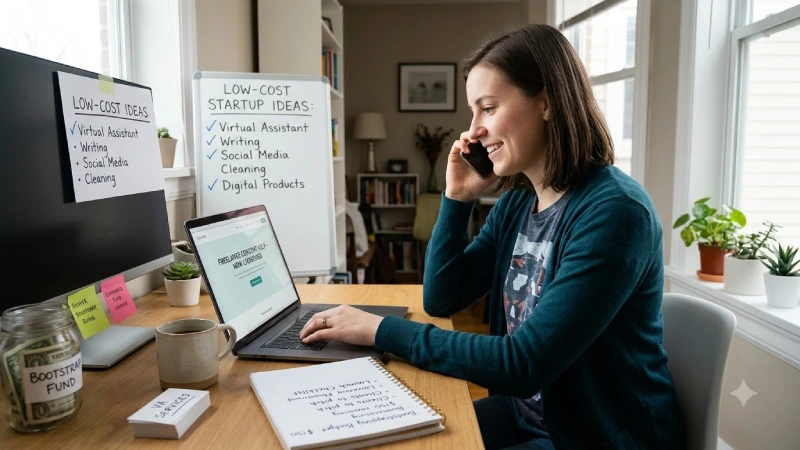
This isn’t about being an overnight success story or making the next unicorn. This is about getting a legitimate business going without digging yourself into a hole in the process. Service work, technology, something simple that’s local. Those types of ventures, where your primary investment is time and some common sense.
Even if you don’t have any experience, and even very little, to begin with, you are ahead of the game. But if you have some skills, then you can capitalize on this fact. The point is to be realistic enough so that a bad month doesn’t crush you.
For the overarching strategy, read our complete guide on Startups
Startup Ideas You Can Launch with Under $1000
This is a concrete list of stuff that people are actually getting for under a grand in 2026. I’ve listed these items according to the context in which they apply.
Under $100 or close to zero
- Freelance writing, editing, or content help. Use free tools. Offer blog posts, emails, product descriptions. Platforms like Upwork or direct outreach to small businesses.
- Virtual assistant work. Emails, scheduling, research, light admin. Many people start with just a professional-looking email and a simple profile.
- Social media management for local businesses or solopreneurs. You do not need fancy software at the beginning.
- Online tutoring or coaching in something you know. Math, languages, test prep, basic software skills, fitness form checks. Zoom is free for shorter sessions.
- Digital downloads on Etsy or Gumroad. Planners, printables, simple templates, checklists. Create once, sell many times.
- Print-on-demand designs. Upload designs, the platform prints and ships when someone buys. Your cost is basically design time and maybe a small sample order.
$100 to $500
- Basic cleaning or organizing services. Supplies are not expensive. Start with residential or small offices.
- Pet sitting, dog walking, or basic pet care. Often needs almost nothing beyond reliability and local promotion.
- Simple pressure washing or mobile detailing if you can get used equipment or start very basic.
- AI setup help for small businesses. Show them how to use a few tools for their actual work. Charge for the setup and a bit of ongoing support.
- Local lead generation. Give dentists, contractors, or lawyers inquiries and bill per inquiry or charge on a monthly basis.
Up to around $1000
- A small Shopify or similar store with dropshipping or print-on-demand so you avoid big inventory.
- Specialized handyman or home service work if you already have some tools.
- A basic course or membership if you have clear knowledge people will pay for.
These are not theoretical. Plenty of people are running these exact models right now with very little cash tied up. The ones that work fastest are usually the service ones where you can get paid in the first couple of weeks.
A quick comparison to keep things clear:
| Idea Type | Realistic Startup Cost | Time to First Money | Main Thing You Need | Biggest Early Challenge |
| Freelance / VA services | $0–200 | Days to 2 weeks | Skill + reliability | Finding first clients |
| Digital products / POD | $0–300 | Weeks to months | Design or content ability | Getting traffic |
| Local services (cleaning, pets, etc.) | $100–600 | 1–3 weeks | Trust + basic supplies | Getting reviews and repeats |
| AI or specialized consulting | $100–500 | 2–6 weeks | Practical knowledge | Proving value quickly |
| Simple online store | $300–1000 | 1–3 months | Product research + marketing | Ad costs and testing |
Numbers are approximate from what operators report in 2026. Your mileage will vary based on location, effort, and how good you are at talking to people.
Bootstrapped Business Ideas for Solo Founders
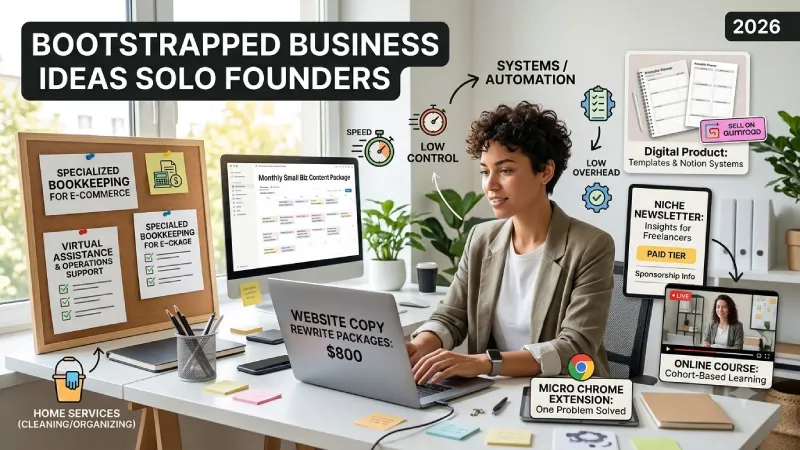
Bootstrapping just means you fund it yourself from revenue or personal savings. No investors. No big loans. For solo founders this is usually the smarter path anyway because you keep control and stay flexible.
Ideas that work especially well when it is just you:
- Productized services. Instead of selling hours, sell a clear package. “Website copy rewrite for $800” or “Monthly content package for small businesses.” Easier to deliver repeatedly and easier to price.
- Niche newsletters or simple content sites that later add paid tiers or sponsorships. Slow at first, but very solo-friendly.
- Micro tools or simple Chrome extensions if you can build or no-code them. Solve one annoying problem for one group of people.
- Specialized bookkeeping or admin support for a tight niche (e-commerce sellers, coaches, therapists).
- Faceless or low-face content combined with digital products.
The advantage of solo is speed and low overhead. The disadvantage is that everything depends on you. So pick things where you can create systems early — templates, checklists, simple automation — so you do not become the bottleneck.
A lot of profitable one-person businesses in 2026 run on a mix of service income (for cash flow) and digital products or retainers (for better leverage). You start with the service to pay the bills, then build the more scalable pieces on the side.
Service-Based Startups with Low Startup Costs
Services are still the easiest startup low-cost entry for most people. You are selling your time, skill, or reliability. No inventory to buy. No warehouse. No big equipment in many cases.
Strong options right now:
Virtual assistance and operations support
Help busy people or small teams with the stuff that eats their day. Email triage, calendar, light research, customer follow-up, basic bookkeeping. Start general, then specialize if you want higher rates.
Cleaning and home services
Cleaning for houses, cleaning when moving out, office cleaning, organizing. The supplies cost almost nothing. A good review system is very effective through word of mouth and Google Business Profile.
Creative and marketing services
Writing, basic graphic designing, social media, video editing, and user-generated content. AI can assist you in creating more content, but human perspective and client interaction is still important.
Specialized help
AI workflow setup, basic website fixes, tutoring, fitness or skill coaching, pet services. The more specific the problem you solve, the easier it is to charge decently and get referrals.
How Services Win with Low Cost Advantage: The basic expenses are often just a telephone, an Internet connection, some software, insurance, if necessary, and travel for local jobs. Many start out working their full-time job and switch over to being a service provider once the numbers work out.
The problem is that you exchange time for money. This is fine in the beginning. Just make sure you are making plans to increase your rates and offer packages to avoid being a cheap laborer indefinitely.
Low-Cost Digital Business Ideas
Digital ideas have almost no marginal cost once created. That is powerful, but they often take longer to make money than services.
Good low-cost digital paths:
- Digital products: templates, planners, Notion systems, spreadsheets, printables, simple guides, prompt collections. Sell on Etsy, Gumroad, your own simple site.
- Print-on-demand stores focused on a clear niche instead of trying to sell everything.
- Simple affiliate or review content in a niche you understand. Takes time to rank or build an audience, but costs almost nothing.
- Online courses or cohorts if you have genuine expertise people will pay to learn. Start with a small live version before building a big polished course.
- Newsletters with a paid tier or sponsorships once you have some readers.
The trap with digital is spending months building in silence. Best way forward: Validate using a simple landing page or pre-sales, or else offer the service version of the same knowledge so that you get paid while building out your digital product.
While the technology has speeded up the creation process, which is great, it’s also flooded the market with mediocrity. Quality, specificity, and distribution make the difference.
How to Fund a Low-Budget Startup Strategically
Most cheap ventures do not require external money. This is the whole idea. However, if you require some leeway or you just want to quicken things, this is a logical sequence:
- Personal savings or current income
The cleanest way. Keep your job while you test. Put a small amount aside each month specifically for the business. - Revenue from the business itself
Start with the lowest-cost version that can generate some cash. Use that money to buy better tools, run small tests, or free up more of your time. This is true bootstrapping. - Friends and family in tiny amounts
Only if the relationship can handle it and you treat it professionally. Small checks, clear terms. - Credit cards or small personal loans
Risky. Only for things that clearly move the needle and only if you have a plan to pay it back quickly from revenue. Easy to dig a hole. - Grants, competitions, or startup programs
It’s something worth exploring in your locality or field depending on your classification. It is not dependable as a stand-alone strategy. - Crowdfunding
Possible for product ideas with a clear story, but it takes work and is not free (fees, fulfillment promises).
What does not typically make sense for these cheap options is to pursue angel investors or venture capitalists. The sums involved are too little, the models are unlikely to be the growth-focused model desired by investors, and you will lose control over something you likely do not need.
The approach to strategic funding: do not invest in anything that does not solve a specific bottleneck problem. Early customers, professional presence, single time-saving tool – everything else can come later.
Create a simple spreadsheet listing each income and expense since the very beginning of your business. Low-budget ventures fail due to tiny leaks more often than dramatic failures.
Practical Advice for Actually Getting Started
- Pick one idea that matches skills or interests you already have. The closer it is to something you can deliver competently, the faster you get paid.
- Talk to potential customers before you build much. A few conversations will tell you more than weeks of planning.
- Make the offer clear and easy to buy. People should understand what they get and how to pay you in under a minute.
- Deliver well for the first clients even if the pay is modest. Reviews and referrals are worth more than the first invoice in many cases.
- Raise your rates the moment you get evidence of your ability to provide the services. One of the easiest traps for inexpensive companies to fall into is undercharging.
- Guard your time and effort. It is natural to agree to all things when you are craving customers. This is what causes burnout.
Common Questions
Can I really start with under $100?
Yes for many service and digital ideas. The limiting factor is usually skills, confidence, and willingness to talk to people, not the cash.
How long until I replace a full-time income?
It varies wildly. Some people get there in a few months with services. Others take a year or more. Most successful ones keep a job or other income until the business is clearly covering their needs with room to spare.
If I don’t have any specialized skills?
Use something that can be learned and has demand for it, or do some basic things while you learn the skill. Reliability and communication will go a long way in the beginning.
Is dropshipping still viable on a low budget?
Possible, but harder than the pure service options for most beginners. Ad costs can eat the small budget quickly. Treat it as a test, not the main plan, unless you are good at product research and creative.
Should I form an LLC right away?
Not always necessary on day one, especially for very small testing. Check your local rules. Many people start simply and formalize once there is consistent revenue. Just keep personal and business money separate from the start.
What about taxes?
Set aside money from every payment. Talk to a basic accountant or use simple software once you have regular income. Ignoring this creates bigger problems later.
Final Thoughts
Affordable does not mean that it’s worthless. Some of the most successful small businesses I know have begun from scratch without any money and thrived because the entrepreneur was obsessed with meeting the needs of the client by cutting costs.
The advantage of running a business on a budget is that you can do nothing else as you cannot afford any distractions. That is why you are forced to concentrate on what really counts – talk to people, give them something valuable and get paid for it.
Choose something you can start this month. Make the smallest version that lets you charge money. Go find a few people who might want it. That is the whole game at the beginning.
The other articles in this series cover profitable angles, beginner-friendly ideas, online-specific plays, and industry options. Each one looks at the same big topic from a different direction so you can find the fit that makes sense for your situation.
It’s not about getting approval or having lots of money in your bank account. It’s about making a clear offer and being willing to put it in front of real people.
To take the next step, see our detailed guide on online startup ideas