

Introduction
Marketing Automation Tools are really important for marketing. It is not about sending emails or putting posts on social media. Businesses have to deal with customer journeys on different places like websites email campaigns, search engines, social media platforms, mobile apps and ecommerce stores all at the same time.
It can be very hard to handle all these marketing things by hand. This is especially true when businesses get bigger and customers expect more from them.
That is why Marketing Automation Tools are a part of digital marketing plans in 2026. Marketing Automation Tools help make things easier, for businesses.
Marketing automation software allows for automating marketing tasks through software programs, which include sending emails, nurturing leads, segmenting customers, scheduling posts on social media, and monitoring campaigns.
Marketing automation from our automation tools guide
It does not matter whether you have a small or big organization, nor does it matter whether you run an online business or any other type of business because today, marketing automation has emerged as the one solution for saving your time, making leads, and connecting with your customers.
This guide highlights marketing automation. Here, you will learn more about marketing automation and its benefits. This guide will also introduce you to the tools required for marketing automation.
What are marketing Automation Tools?
Marketing automation tools are programs that help people do marketing tasks and talk to customers automatically on platforms. Marketing automation tools make it easy to do these things on channels at the same time.
These tools help businesses:
- manage campaigns
- track customer behavior
- send automated emails
- nurture leads
- personalize marketing
- analyze campaign performance
Marketers get to spend time on planning and being creative due to marketing automation since repetitive activities are minimized.
How Marketing Automation Works
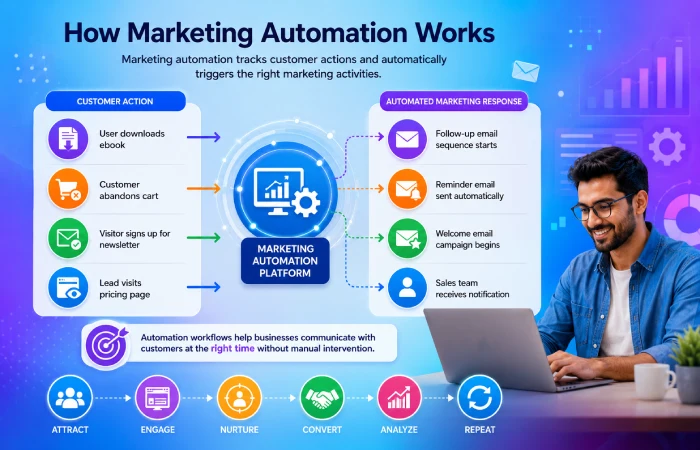
Marketing automation is a process. The first thing that happens here is that it tracks the activities of the customers. It also automatically starts marketing processes. It does this once it has detected the interests and activities of the customer. Marketing automation then evaluates customer activity and takes an action. In reality, it is just the observation of customer activities and triggering of marketing automation processes through them.
For example:
| Customer Action | Automated Marketing Response |
| User downloads ebook | Follow-up email sequence starts |
| Customer abandons cart | Reminder email sent automatically |
| Visitor signs up for newsletter | Welcome email campaign begins |
| Lead visits pricing page | Sales team receives notification |
Automation processes help companies reach out to their customers at the right time without having to handle each and every task manually.
Why Businesses Use Marketing Automation Tools
Marketing automation assists companies in increasing the efficiency of their campaigns while handling huge customer databases.
Saves Time for Marketing Teams
Businesses can automate:
- email campaigns
- customer follow-ups
- social media scheduling
- lead nurturing
- reporting
This reduces repetitive manual work.
Improves Lead Generation
Automated systems monitor customer behavior and aid businesses in discovering their leads in an efficient manner.
Marketers can develop leads automatically with the help of tailored campaigns.
Better Customer Personalization
Modern customers expect personalized experiences.
Marketing automation platforms help businesses send:
- targeted emails
- personalized recommendations
- customer-specific offers
- behavior-based campaigns
Increases Marketing Efficiency
Multiple campaigns can be managed by organizations concurrently without any need for increased manual efforts.
Improves Campaign Analytics
Marketing automation tools provide:
- customer engagement data
- conversion tracking
- campaign performance insights
- ROI reporting
This helps marketers improve future campaigns.
Best Marketing Automation Platforms in 2026
If you search for marketing automation solutions, you will find many. They depend on the requirements of your business. The marketing automation solutions are very important to your business. You should use them in your business.
| Platform | Best For | Main Features |
| HubSpot | All-in-one marketing automation | CRM, email marketing, analytics |
| ActiveCampaign | Customer experience automation | Email workflows and segmentation |
| Mailchimp | Small business marketing | Email campaigns and automation |
| Marketo | Enterprise marketing automation | Advanced lead management |
| Brevo | Affordable automation | Email and SMS campaigns |
| Klaviyo | Ecommerce marketing | Personalized ecommerce automation |
| Pardot | B2B marketing automation | Salesforce integration |
| Omnisend | Ecommerce businesses | Multichannel automation |
Companies need to look at platforms and see how they work with other systems. They must contemplate on whether the platform would be scalable for them, the costs involved, and the type of data they can gather through it. Ease of usage is another factor that firms should take into consideration. The platform has to be able to do a lot of things like integrate with systems be scalable and have good analytics capabilities. Companies have to evaluate these things when they are looking at platforms.
Marketing Automation Strategy
Effective marketing automation goes beyond buying software.
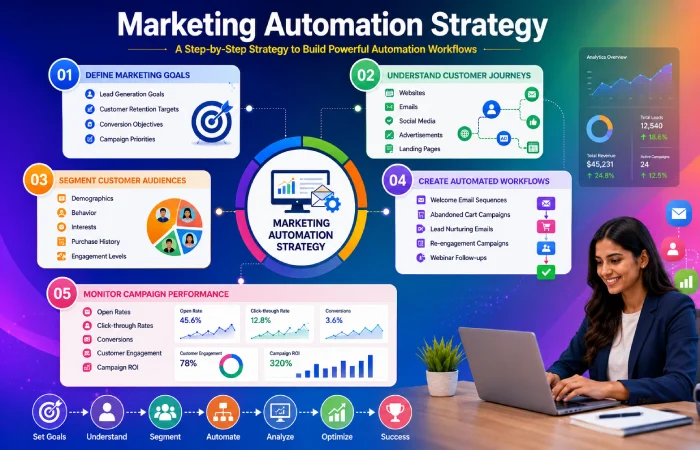
Companies need to have a strategy prior to developing any workflow processes.
Define Marketing Goals
Companies should identify:
- lead generation goals
- customer retention targets
- conversion objectives
- campaign priorities
Clear goals help businesses build better automation systems.
Understand Customer Journeys
Businesses should map how customers interact with:
- websites
- emails
- social media
- advertisements
- landing pages
Understanding customer behavior improves personalization.
Segment Customer Audiences
Marketing automation works best when audiences are segmented properly.
Businesses can segment customers by:
- demographics
- behavior
- interests
- purchase history
- engagement levels
This improves campaign relevance.
Create Automated Workflows
Common marketing workflows include:
- welcome email sequences
- abandoned cart campaigns
- lead nurturing emails
- re-engagement campaigns
- webinar follow-ups
Build on workflow automation software first.
Monitor Campaign Performance
Businesses should regularly analyze:
- open rates
- click-through rates
- conversions
- customer engagement
- campaign ROI
Automation systems should continuously improve based on data.
Marketing Automation for Small Business
Businesses usually do not have a lot of people to do marketing and they do not have a lot of money to spend on it. Marketing automation is really helpful for Small Business because it helps them do better against companies without needing more people to do the work. Marketing automation is good, for Small Business.
Benefits for Small Businesses
Small businesses use automation to:
- save time
- improve customer communication
- automate email marketing
- increase online sales
- manage leads more efficiently
As per Atlassia, workflow automation is one way that an organization can increase productivity and eliminate repetitive processes.
Affordable Marketing Automation Platforms
| Platform | Best For |
| Mailchimp | Email automation |
| Brevo | Budget-friendly campaigns |
| ActiveCampaign | Growing businesses |
| HubSpot Starter | CRM and marketing automation |
| ConvertKit | Content creators |
No-Code Marketing Automation
- No-code platforms help small organizations create automation workflows easily. They do not need expertise.
- This makes automation easy for startups and small teams to use. They can now automate their marketing tasks.
- No-code marketing automation is a game-changer, for them.
B2B Marketing Automation Tools
B2B companies usually have to deal with sales that take a time to complete and they also have to handle customer relationships that are pretty complicated.
Marketing automation helps B2B businesses:
- nurture leads
- score prospects
- automate follow-ups
- align sales and marketing teams
- improve conversion tracking
Common B2B Automation Workflows
| Workflow Type | Purpose |
| Lead nurturing | Educate potential customers |
| Webinar follow-ups | Continue customer engagement |
| CRM automation | Manage sales pipeline |
| Account-based marketing | Personalize B2B outreach |
| Lead scoring | Prioritize high-quality leads |
Popular B2B Marketing Platforms
- HubSpot
- Pardot
- Marketo
- ActiveCampaign
These B2B Marketing Platforms are really helpful. They allow us to automate the customer journey without needing to write code. We can also connect B2B Marketing Platforms to the customer relationship management system. This makes it easier to manage everything. The B2B Marketing Platforms are very useful, for this.
Marketing Automation vs CRM
Many companies get confused, about how marketing automation tools and Customer Relationship Management systems work.
While they may complement each other, they play different roles.
| Marketing Automation | CRM Software |
| Automates campaigns | Manages customer relationships |
| Focuses on marketing activities | Focuses on sales management |
| Handles lead nurturing | Tracks customer interactions |
| Sends automated emails | Stores customer records |
| Supports audience segmentation | Supports sales pipelines |
A lot of companies use marketing automation platforms with their CRM systems. This helps them manage their customers in a way. They do this because it makes it easier to keep track of their customers and what they need. Marketing automation platforms are really useful when they are used with CRM systems.
Real Marketing Automation Examples
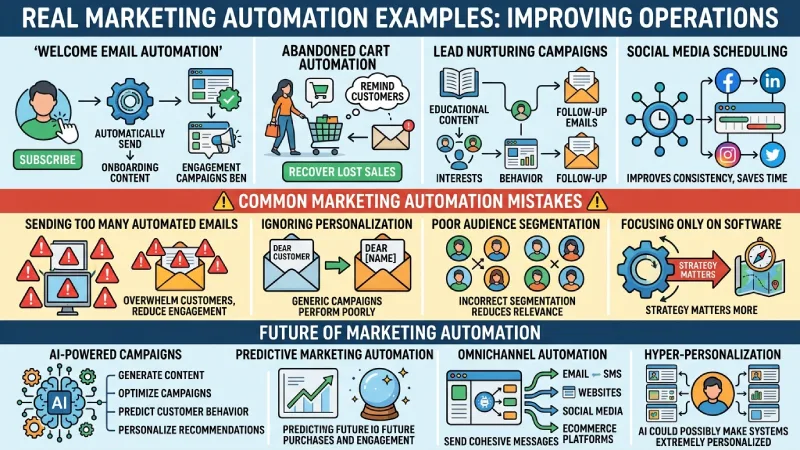
Practical examples help businesses understand how automation improves marketing operations.
Welcome Email Automation
When users subscribe:
- welcome emails are sent automatically
- onboarding content is shared
- engagement campaigns begin
Abandoned Cart Automation
Ecommerce businesses automatically remind customers about unfinished purchases.
This helps recover lost sales.
Lead Nurturing Campaigns
Businesses send educational content and follow-up emails based on customer interests and behavior.
Social Media Scheduling
Automation platforms schedule content across multiple social media channels.
This improves consistency and saves time.
Common Marketing Automation Mistakes
Businesses often face problems when automation strategies are poorly planned.
Sending Too Many Automated Emails
Excessive automation can overwhelm customers and reduce engagement.
Ignoring Personalization
Generic campaigns often perform poorly compared to personalized communication.
Poor Audience Segmentation
Incorrect segmentation reduces campaign relevance.
Focusing Only on Software
Good marketing strategy matters more than automation tools alone.
Future of Marketing Automation
Marketing automation continues evolving with AI, predictive analytics, and customer personalization technologies.
AI-Powered Campaigns
AI tools now help marketers:
- generate content
- optimize campaigns
- predict customer behavior
- personalize recommendations
Predictive Marketing Automation
Platforms increasingly analyze customer data to predict future engagement and purchasing behavior.
Omnichannel Automation
Businesses now automate customer experiences across:
- SMS
- websites
- social media
- ecommerce platforms
Hyper-Personalization
AI could possibly make future marketing systems extremely personalized to the consumer experience.
Frequently Asked Questions
What is marketing automation?
Marketing automation is a system that automates marketing campaigns, customer communication, lead generation, and audience segmentation.
Who uses marketing automation?
Marketing automation can be experienced through e-commerce firms, startups, agencies, B2B firms, SaaS firms, and enterprises.
Difference between CRM and marketing automation.
CRM deals with customer relations and sales information while marketing automation deals with the campaigns and customer engagement.
Are marketing automation tools costly?
There are a lot of platforms providing affordable plans for small businesses and startups.
Conclusion
There are tools of marketing automation that help companies handle their digital marketing in 2026.
The use of automation enables marketers to enhance customer engagement without performing a number of routine operations, such as creating emails, lead nurturing and other operations.
Combining a good marketing strategy with effective tools of automation can help businesses to optimize their campaigns and create better relationships with customers.
With further development of AI and automation technologies, marketing automation is becoming increasingly crucial for competing in the market.
Pass leads to sales automation tools.