

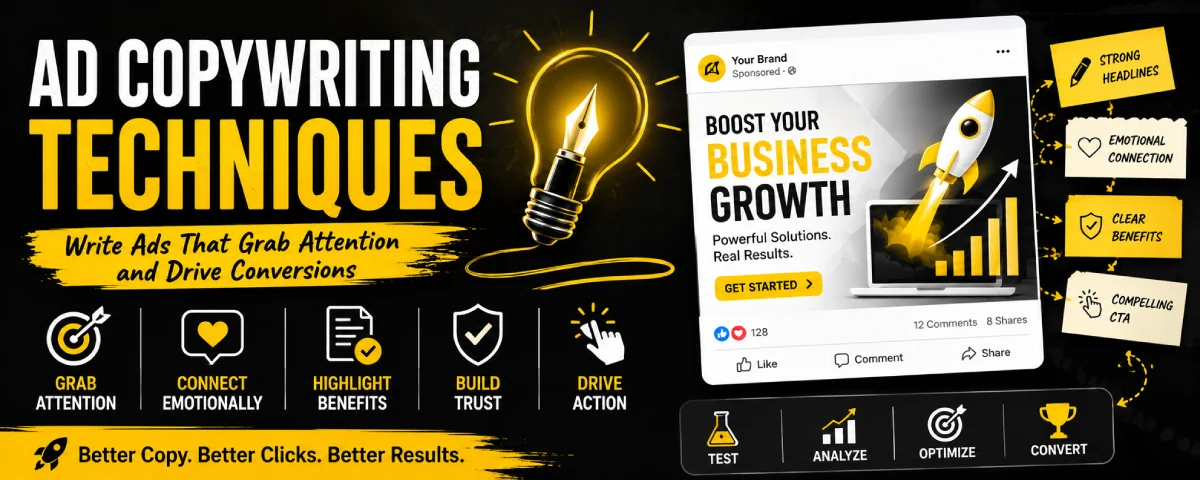
No matter how great the targeting and budgets are, there is nothing without the ad copy that can arrest the scrolling and generate clicks. Copy is what connects the audience and the actions the advertiser expects from him or her.
While many marketers pay a lot of attention to their audiences and bidding, the words in the ad often come last. Yet it is quite obvious that those who perform well are doing it all right: they are targeting correctly and have excellent ad copy.
In this article, I will share some tips on writing good ad copies, which you will find applicable for Google Ads, Meta, LinkedIn, and other ad formats.
Headlines That Grab Attention
The headline is the first (or only) element that catches everyone’s attention. The headline has more significance than any other element when it comes to choosing to read further.
What makes a headline effective
- It is clear
- It feels relevant to the reader
- It creates curiosity or promises a benefit
- It is specific rather than vague
Headline approaches that work well
| Type of Headline | Example | Why It Works |
| Benefit-led | “Get More Leads Without Spending More Time” | Focuses on the outcome |
| Question | “Still Wasting Money on Ads That Don’t Convert?” | Pulls the reader in |
| How-to | “How to Cut Your Cost Per Lead in Half” | Promises practical value |
| Number-based | “7 Proven Ways to Improve Ad Performance” | Feels specific and scannable |
| Direct offer | “Free Guide: Improve Your Google Ads Results” | Clear and low-friction |
| Curiosity | “The Simple Change That Improved Our ROAS” | Makes people want the rest of the story |
Practical tips for headlines
- Put the most important words at the beginning.
- Match the headline to the intent of the audience.
- Keep it easy to read quickly.
- Test different styles instead of relying on one formula.
- Make sure the headline aligns with the landing page.
A good headline is always worth reading, while a bad one ensures that no other portion of the ad is ever going to get read.
Using Emotional Triggers
People decide on the basis of their emotions and provide an explanation for those emotions on the basis of reason. The good ad copy appeals to emotions.
Useful emotional triggers in advertising
- Fear of missing out or falling behind
- Desire for better results or status
- Frustration with current problems
- Hope for an easier or better future
- Trust and safety
- Belonging or social proof
- Curiosity
How to use emotion without overdoing it
- Start with a real problem your audience faces.
- Show that you understand the frustration or desire.
- Present your offer as the bridge to a better situation.
- Support emotional messages with some proof or logic.
Example of emotional progression
- Call out the problem (frustration)
- Agitate it slightly (cost of inaction)
- Offer a way forward (hope + solution)
- Support it with proof or a clear next step (trust)
Emotion is most effective when it appears genuine. Exaggeration or false sense of urgency may cause mistrust, particularly from cold prospects.
Ad Copy Formulas (AIDA, PAS)
Formulas provide a certain structure that prevents you from starting your writing from scratch each time. There are two really good formulas that are always relevant: AIDA and PAS.
AIDA Formula
- Attention – Grab attention with a strong headline or opening line
- Interest – Build interest by relating to the reader’s situation
- Desire – Increase desire by showing benefits and outcomes
- Action – Tell the reader exactly what to do next
PAS Formula
- Problem – Identify the problem
- Agitate – Make the problem feel more real or urgent
- Solution – Present your offer as the solution
When to use each
| Formula | Best For | Tone |
| AIDA | Most general advertising situations | Balanced and persuasive |
| PAS | Problem-aware audiences | Direct and problem-focused |
You can also blend the two. Many great ads begin with a PAS approach and follow up with benefits and a call to action.
Formula is simply a guide, which is not a strict rule. It can be used as a frame of reference and altered to suit your environment.
Call-to-Action Best Practices
The call to action (CTA) is what prompts your audience on how to act next. Even the best of ads will fail without an effective CTA.
Characteristics of effective CTAs
- Clear and specific
- Action-oriented
- Low friction when possible
- Aligned with the stage of the buyer
Strong CTA examples
- “Get the Free Guide”
- “Book Your Demo”
- “Shop the Collection”
- “Start Your Free Trial”
- “Download the Checklist”
- “See Pricing”
- “Get a Free Quote”
CTA tips that improve results
- Use first-person language sometimes (“Start My Free Trial” can outperform “Start Your Free Trial”).
- Match the CTA to the offer. Do not say “Learn More” if you want a purchase.
- Place the CTA where it is easy to see (especially on mobile).
- Test different CTA phrases. Small changes can matter.
- Make the landing page continue the same promise as the CTA.
The CTA should feel like the natural next step, not a sudden hard sell.
Ad Copy Testing Frameworks
Good copywriting only does half the job; testing will reveal what really works with your audience.
Simple testing framework
- Select an element to test (Headline, Core Benefit, CTA, Emotional Appeal, Offer Format).
- Develop multiple versions, but vary the selected element.
- Test the elements for a sufficient amount of time.
- Monitor the correct metric (Clickthrough Rate, Conversion Rate, Cost Per Result, ROAS).
- Save the winning version and test something else.
What to test first
- Headlines (usually highest impact)
- Main value proposition
- Call-to-action
- Emotional angle vs rational angle
- Short copy vs longer copy
Practical testing tips
- Test one variable at a time wherever possible.
- Spend enough time and money on testing.
- Pay attention to conversion rates rather than click-through rates.
- Record your findings so you can have a collection of best practices.
- Update the creativity frequently despite success because audiences get tired.
Testing transforms copywriting into a scientific approach to improving things.
Putting Strong Ad Copy Together
Effective ad copy usually contains these elements:
- A headline that earns attention
- A clear connection to the reader’s problem or desire
- Benefits that matter to the audience
- Some form of proof or credibility
- A clear and compelling call-to-action
Being very clever is not essential. Being clear and relevant is usually more important than being clever. Make sure the message is easily understood by someone who has to scroll rapidly.
Look to your best-performing ads and your customers’ own language. The words that your actual customers use in customer reviews and in sales conversations can often make the most effective copy.
Test, Improve, Think – Always – As Seen Through The Eyes Of The Reader In Any Advertisement. That approach produces copy that consistently converts better over time.
Frequently Asked Questions
- How long should ad copy be?
As short as possible while still being clear and persuasive. On many platforms, shorter copy performs better, but the right length depends on the audience and offer. - Should I always use emotional triggers?
Emotion helps, but it should feel natural. Some audiences respond better to straightforward, rational messages. Test both approaches. - Which copy formula is best?
AIDA and PAS are both strong starting points. Use the one that fits the audience’s awareness level and then adjust as needed. - How often should I test new ad copy?
Regularly. Even winning ads eventually fatigue. Build testing into your normal advertising process. - What matters more — headline or body copy?
The headline usually matters more because it determines whether people read the rest. However, strong body copy and a clear CTA are still needed to convert the click.
Conclusion
An ad copy that sells is one which comprises a great attention grabbing headline, relevance to the reader’s issue or need, real benefits, proof and a clear action step. The relevance and clarity outweighs the use of wit and puns; use consumer language and the formulas like the AIDA and PAS for guidance in systematic testing and writing for the reader’s view point.