


The reason marketing efforts do not succeed is quite obvious; everyone stays busy without realizing what success means. People write content, place ads, test new technologies; however, nobody realizes what it means to be successful at each stage.
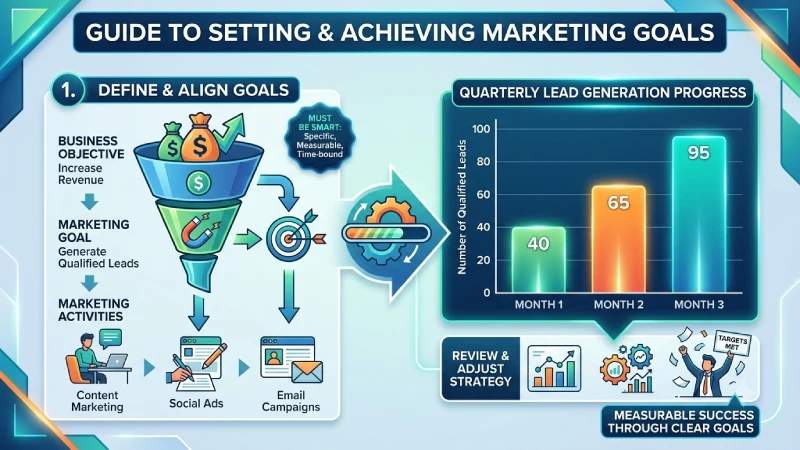
The marketing goals help solve this problem; they convert the abstract desire of becoming famous or earning money into something tangible and measurable.
In this guide, you will find out what marketing goals mean, their importance, types, implementation, and the biggest wastes of your time related to marketing goals.
Marketing Goals: Meaning and Key Concepts
A marketing goal is the particular goal that one’s marketing is meant to accomplish in a certain period of time. It guides all your marketing campaigns, posts, ads, and emails.
A good marketing goal should be specific and measurable. In place of saying “I need more traffic,” it would be better to state “I need 3,000 website visitors monthly from search engines by June.”
Key concepts you should understand:
- Objective: The expected outcome at the end (example: increase sales).
- Marketing Objectives: A more specific break-down of the objective (example: generating 50 qualified leads per month).
- Key Performance Indicators: KPIs that will be utilized to measure the achievement of the marketing objectives (example: Cost Per Lead, Conversion Rate).
- Timetable: Time to achieve the objective.
- Alignment: Making sure that marketing goals are aligned with business goals.
A lot of individuals confuse goals with activities. “Posting 5 times per week on social media” is an activity. “Get 20 bookings for demos from social media in 90 days” is a goal.
Why Marketing Goals Matters
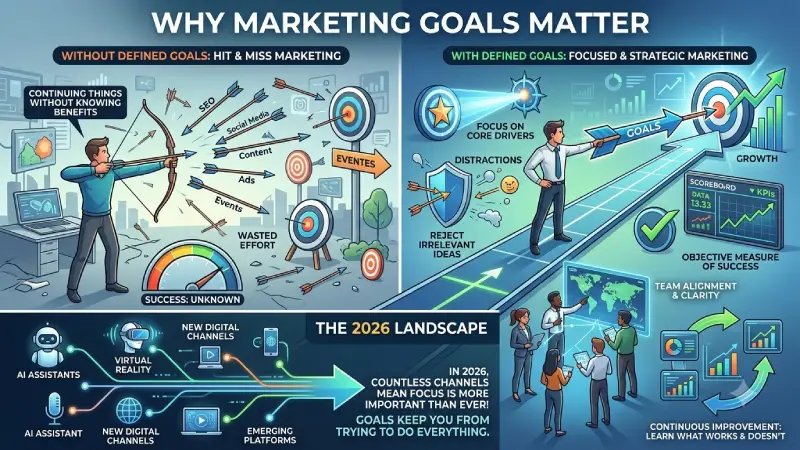
When goals are not defined, marketing is hit and miss. You continue to do things without knowing whether they are benefiting the organization.
Here’s why setting marketing goals matters:
- • They allow you to focus on what really drives your business.
- • They help you determine which things you need to reject.
- • They allow you to have an objective measure of success.
- • They can help you when working with other people because they know where the goal is.
- They also make it easier to get better over time, since you can learn what worked and what didn’t work.
- In 2026, there are going to be a lot more ways for marketers to connect with customers. This means that it is important to focus. Goals will keep you from trying to do everything.
Key Types, Methods, and Examples
Marketing goals may vary because not all stages of the evolution of a company are alike. Here are the main types:
| Type of Goal | What It Focuses On | Example | Typical Timeframe |
| Awareness Goals | Getting known by more people | Reach 50,000 people on social media | 1–3 months |
| Traffic Goals | Bringing people to your website | Get 5,000 monthly website visitors | 3–6 months |
| Lead Generation Goals | Collecting contact information | Generate 100 qualified leads per month | 1–3 months |
| Conversion / Sales Goals | Turning people into customers | Achieve 40 new paying customers in 90 days | 1–3 months |
| Retention Goals | Keeping existing customers | Reduce churn to under 5% per month | 3–6 months |
| Engagement Goals | Building relationship with audience | Increase email open rate to 35% | 1–3 months |
Common methods used to set marketing goals:
- SMART method (Specific, Measurable, Achievable, Relevant, Time-bound)
- OKRs (Objectives and Key Results)
- Looking at past performance and adding a realistic growth target
- Working backwards from a revenue target
Real examples:
- A local service business: “Get 25 booked consultation calls from Google and referrals in the next 60 days.”
- An online course platform: “Get 300 email subscriptions and 40 course enrollments within 90 days.”
- A SaaS business: “Achieve 500 new trials per month and reach 12 percent trial to paid conversion by the end of the quarter.”
Where to add a bar chart:
For this part, after listing the types of goals, it is possible to include a basic bar graph which will illustrate the different types of goals in relation to the difficulty level and time required.
How to Use or Apply Marketing Goals
Setting goals is only useful if you actually use them to guide your work.
Following is a practical approach to setting marketing goals for your business:
- Identify your business goal first
What does your business need? Extra money, extra leads or extra customers?
- Then translate your business goal into marketing goals
For example, if you need extra $20,000 worth of revenue, your marketing goal can be something like: “Get 80 qualified leads and close 20 new customers in the coming 90 days.”
- Subdivide large goals into small ones
Yearly goals → Quarterly goals → Monthly goals.
- Learn how you can achieve your goals through specific actions
When your monthly goal is 100 leads, what are the actions that you can take to get these leads?
- Constantly track your results
Do it on a weekly or bi-weekly basis. Do not wait till the end of the month.
- If something is not working well, change the strategy
Sometimes you need to make some adjustments even if your plan was initially good.A simple monthly habit that works well:
At the start of each month, write your top 1–3 marketing goals for that month and the main activities that will support them. Review the results at the end of the month.
Best Practices and Common Mistakes
Best practices:
- Make goals specific and measurable
- Keep the number of main goals small (1–3 at a time is usually best)
- Make sure goals support the overall business
- Review progress regularly
- Celebrate small wins when you hit targets
- Use past data when possible instead of pure guessing
- Write goals down and keep them visible
Monthly Lead Growth Over 3 Months
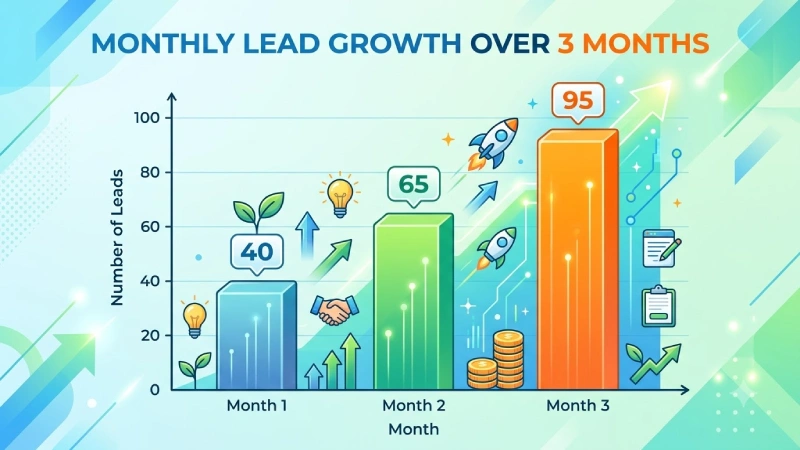
| Month | Number of Leads |
| Month 1 | 40 |
| Month 2 | 65 |
| Month 3 | 95 |
Common mistakes:
- Setting too many goals at once
- Making goals too vague (“get more brand awareness”)
- Setting unrealistic targets with no clear plan
- Focusing only on vanity metrics (likes, followers, impressions)
- Never reviewing the goals after setting them
- Changing goals too often before giving them time to work
- Setting goals without considering budget or resources
One of the biggest problems is setting ambitious goals and then not changing any of the daily actions. Goals are effective only if they affect your actions on a weekly basis.
Frequently Asked Questions
What is the difference between a marketing goal and a marketing strategy?
Goal is what you are going to achieve as a result. Strategy is an overall approach which you are going to use in order to achieve your goal.
How many marketing goals should I define?
One to three marketing goals for most small business owners are enough at any moment. More than 3 goals confuse people.
How often should I check my marketing goals?
Once per week or two weeks in general. Once per month – do the detailed revision of your goals.
Are marketing goals static?
No. Marketing goals have to be stable enough to serve as guidelines for your actions, but also flexible enough in case if something changes in your target market or in your business situation.
What can be my first marketing goal for my business?
Some goal related to gaining experience and some traction, like “Get 20 serious talks with potential customers within 30 days” or “Get 50 signups via content within 60 days”.
Conclusion
Clear marketing goals transform a process of chaos into an effective process. They will help you choose between various actions and also help you measure your success.
No need for any complex models. Choose a couple of clear and relevant goals, split them into monthly targets, make them actionable, and analyze your figures regularly.
Businesses that develop smoothly are those who have their goals set very clearly and adjust themselves to meet these goals. That simple approach is still more effective than most of the marketing approaches used by other companies.