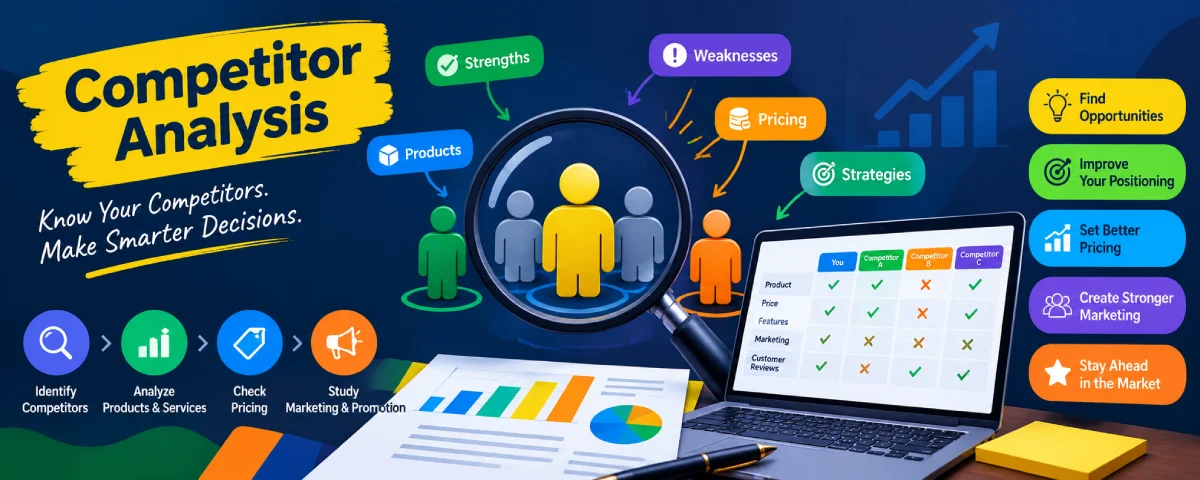
Competitor analysis is a method used to analyze the competitors that are targeting your market share. Competitor analysis allows you to analyze their products, prices, promotional methods, as well as their strengths and weaknesses.
Most companies either do not consider the impact of the competition on them or imitate the competition closely. The right strategy would be to conduct competitor analysis and help you make decisions regarding your own product, pricing, positioning, and marketing.
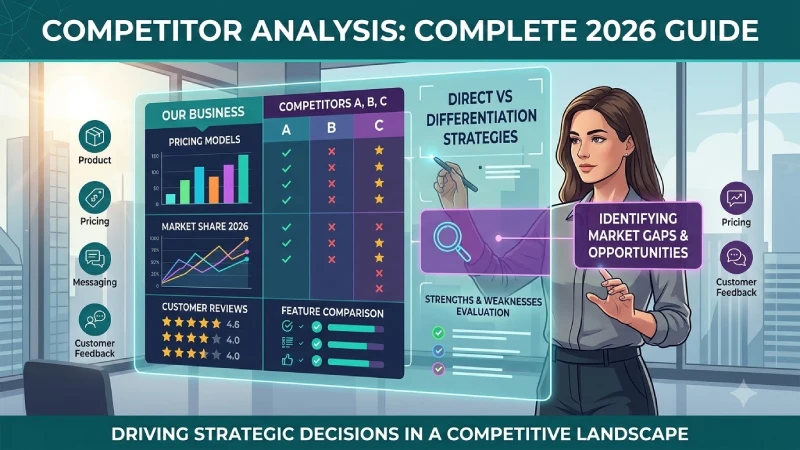
In this essay, we will give a concise definition of competitor analysis, its significance, the different approaches to carrying out competitor analysis, how it should be done, and some errors that should be avoided.
Competitor Analysis: Meaning and Key Concepts
Competitor analysis consists of the gathering and analyzing of information concerning those companies that provide similar services to the same clientele or solve the same problems. The crucial point here is that one does not try to copy them, but rather learn from them.
Key ideas to understand
- Can be either direct (same offer) or indirect (different offer, similar customer need)
- Should concentrate on generating useful information, not gathering random data
- Is most effective if done consistently, not just once
- The most useful findings always have implications for your own business
Direct vs Indirect Competitors
| Type | Description | Example |
| Direct competitors | Offer a similar product or service to the same audience | Two project management tools |
| Indirect competitors | Solve the same problem in a different way | A project management tool vs a simple spreadsheet system |
| Potential competitors | Not competing strongly now, but could in future | A large platform that might enter your category |
Understanding all three groups gives a more complete picture.
Why Competitor Analysis Matters

Markets don’t stand still. There are new offers on the market; there are new price levels; there are improvements to the message; there are changing customer expectations. Competitor analysis keeps you informed about what is going on rather than being unaware.
By the year 2026, customers do their comparisons faster than before. They check review and pricing sites and compare two or three competitors before purchasing. Those companies that understand the competitive landscape will be able to make better decisions regarding positioning, pricing, and messaging, while those who don’t understand it tend to do things repetitively.
Main reasons competitor analysis matters
| Reason | Why It Matters in Practice | Business Impact |
| Customers compare options quickly | People often evaluate multiple choices before buying | Better positioning and clearer differentiation |
| Pricing decisions become safer | You see the real market range, not just your own costs | More confident and realistic pricing |
| Messaging improves | You learn what others emphasise and what they ignore | Stronger, more distinct communication |
| Gaps become visible | Unmet needs or weak competitor areas are easier to spot | New opportunities for differentiation |
| Strategic planning becomes more realistic | You can anticipate reactions and market shifts | Fewer surprises and reactive decisions |
When competitor analysis is especially useful
| Situation | What You Can Learn | Typical Outcome |
| Launching a new product | How similar offers are positioned and priced | Clearer launch messaging and pricing |
| Entering a new market | Who the main players are and what customers already expect | Better market entry decisions |
| Reviewing pricing | Market price ranges and packaging approaches | More competitive and sustainable pricing |
| Improving website or sales pages | Common claims, trust elements, and friction points | Stronger conversion-focused messaging |
| Planning content or campaigns | Topics competitors cover and gaps they leave | More focused content strategy |
| Looking for differentiation | Weaknesses in competitor offers or customer complaints | Clearer unique value direction |
What often happens when businesses skip competitor analysis
- They use the same generic claims as everyone else
- Pricing feels uncertain or disconnected from the market
- Product decisions ignore what customers already compare
- Marketing messages sound interchangeable
- Opportunities to stand out remain unnoticed
The analysis of competition does not imply imitating the rivals or responding to all the actions they take. Instead, it helps to comprehend the decisions your customer base is currently considering and thus make better judgments about your offering.
Those companies which conduct thorough competitor analysis are likely to discover better ways to distinguish themselves. Companies which never look beyond their fences are often unable to articulate reasons why a potential client should pick them over the competition. This becomes particularly important in today’s competitive environment.
Key Types, Methods, and Examples
Competitor analysis can be done at different levels of depth. You do not always need a complex report. Sometimes a simple structured review is enough.
Common areas to analyse
| Area | What to Look At | Why It Matters |
| Product / Offer | Features, benefits, limitations, target users | Understand what customers are being offered |
| Pricing | Price points, packages, discounts, positioning | See how the market values different offers |
| Messaging | Main claims, tone, key phrases | Learn how competitors speak to customers |
| Website & Experience | Clarity, design, user flow, trust elements | Spot strengths and friction points |
| Content & SEO | Blog topics, keywords, resources | Find content opportunities |
| Customer feedback | Reviews, testimonials, complaints | Learn what customers like and dislike |
| Marketing channels | Ads, social media, email, partnerships | See where competitors focus attention |
Simple methods anyone can use
- Browse through websites and pricing sheets of your competitors.
- Look at customer reviews available from various sources.
- Sign up for newsletters or free trials of your competitors.
- Look into their blog posts and social media postings.
- Find any independent comparison studies.
- Speak with your customers about their other options.
Example
It becomes clear to a small software company that their competitors always try to stress on having advanced features in their products. But what becomes quite common is that people often complain about how complicated these products are.
How to Use or Apply Competitor Analysis

Collecting information is only the first step. The real value comes from using the findings.
Practical steps
- Decide your purpose
Are you assessing prices, developing your message, preparing to launch, or searching for opportunities? - Choose the right competitors
Pick a realistic set (usually 4–8). Include both strong players and emerging ones. - Collect information in a structured way
Use the same categories for each competitor so comparison is easier. - Look for patterns
What do most competitors emphasise? What do they ignore? Where do customers complain? - Identify opportunities
Gaps in features, messaging, pricing, or experience often show where you can differentiate. - Make clear decisions
Turn insights into actions for your product, pricing, website, or marketing. - Review periodically
Markets change. Refresh the analysis when needed instead of treating it as a one-time project.
Simple way to organise findings
Create a comparison table with competitors across key categories such as:
- Target audience
- Main offer
- Pricing
- Key message
- Strengths
- Weaknesses
- Opportunities for you
This makes the analysis easier to share and revisit.
Best Practices and Common Mistakes
Best practices
- Look for meaningful information rather than an excessive amount of data
- Include both direct and indirect competitors
- Consider customer feedback, not only the company’s assertions
- Identify weak points in addition to strong points
- Do not forget to refresh the analysis in case of market changes
- Use the results to enhance your decision-making
- Make sure the process is not too complex to implement
Common mistakes
- Copying competitors too much
- Examining only large companies while ignoring small companies
- Concentrating only on the attributes while ignoring the messaging or experience
- Collecting data and not using them
- Thinking that the strategy of the competitor works for them as well
- Conducting analysis once and forgetting about it thereafter
- Making the competitor activities to be a continuous distraction
Perhaps one of the largest problems is companies who switch directions when their competitors come out with anything new. Competitor analysis needs to provide clarity, not confusion.
Final Thoughts
Competitor analysis is not about becoming obsessed with other companies. Competitor analysis is all about gaining an understanding of the options that your clients have to choose from already.
If done properly, it allows you to better understand how you need to set your prices, what message you should send, and where there are openings that other companies miss.
Do not get lost in the theory. Analyze the right competitors, detect the real trends, and develop your actions based on your findings. This practice is one of the most valuable ones out there.
Frequently Asked Questions
- How many competitors do I need to analyze?
Four to eight competitors are enough for most businesses. Otherwise, it will give you an incomplete picture or make the procedure too bulky.
- How often do I need to conduct competitor analysis?
A complete analysis is needed once or twice a year for most businesses, while fast reviews are possible during significant changes.
- Does it bring any value for small businesses?
Yes. Smaller businesses usually receive more value because clear positioning distinguishes them among bigger competitors.
- What is the most common error in competitor analysis?
Gathering lots of data and not applying it to decision-making processes. It will not be valuable without implementation.
- Do I need to pay attention to weaknesses or strengths of my competitors?
Both are important. Strengths will help you to understand what clients value now while weaknesses are usually places for differentiation.
Conclusion
Through competitor analysis, you get an understanding of the market environment within which you operate so that you can make better decisions concerning your product, pricing, message, and promotion. This does not imply imitation but rather taking advantage of the information at hand to find ways of serving the consumers better.
Simplicity, relevance of the findings, and periodicity of the exercise are key considerations. Those firms with a good understanding of their competitive environments seldom react and end up well positioned.