

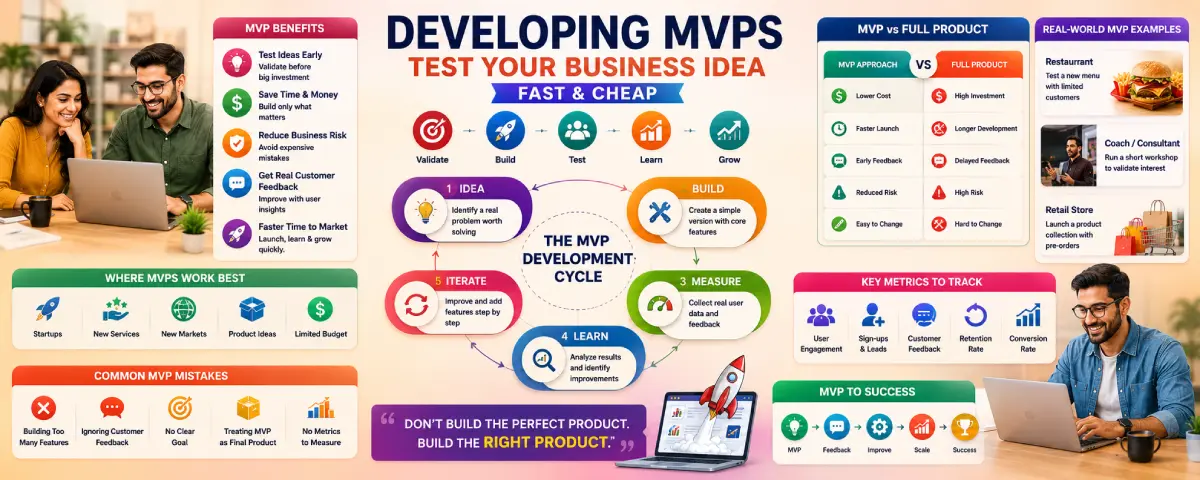
The business world is evolving at a much higher pace compared to what was a few years back. The preferences of consumers keep on changing at a very fast pace, online competition grows daily, and trends related to technology are constantly being updated. As a result of this, it is no longer possible for organizations to invest months and years on trying to create their ideal products without first validating the need of that product among their audience.
This is perhaps the major reason behind the importance of creating MVPs within the field of modern business technology.
A minimum viable product, or MVP, refers to the basic prototype of a business or product which consists of just essential functionalities.This approach helps companies:
save money,
reduce business risk,
collect customer feedback,
and improve products step by step.
For startups and small businesses especially, MVP thinking helps avoid expensive mistakes.
Table of Contents
ToggleWhy Businesses Are Choosing MVP Development
Many companies fail because they build products based on assumptions instead of real customer demand.
A business may spend:
months on development,
large amounts on marketing,
and thousands on technology,
only to discover customers are not interested.
Developing MVPs changes this process completely.
Instead of guessing, businesses release a simplified version early and observe how real users react.
Why This Matters in Business Technology
| Traditional Product Launch | MVP Business Approach |
| Large upfront investment | Lower starting costs |
| Long development cycles | Faster market entry |
| High financial risk | Controlled testing |
| Delayed customer feedback | Early customer insights |
| Difficult to make changes | Easier improvements |
This flexible approach works especially well in modern business technology environments where trends change rapidly.
Businesses today need speed, adaptability, and real-world data.
The Origin of the MVP Concept
The MVP concept became widely popular after entrepreneur Eric Ries introduced it in his book The Lean Startup.
His idea was simple:
Businesses should not waste large amounts of time and money building products before validating demand.
Instead, companies should:
launch quickly,
test carefully,
learn from customers,
and improve continuously.
Over time, this strategy moved beyond startups and became useful for:
small businesses,
service companies,
retail brands,
consultants,
and digital businesses.
Today, developing MVPs is considered one of the smartest ways to reduce risk in business technology projects.
Why MVP Thinking Is More Important Today
Modern markets are unpredictable.
A product idea that looks perfect internally may fail after launch because customer needs shift quickly.
An MVP allows businesses to stay flexible instead of becoming locked into expensive long-term development.
Main Advantages of Developing MVPs
| Benefit | Business Impact |
| Faster testing | Learn what customers actually want |
| Lower costs | Protect business cash flow |
| Better customer feedback | Improve products using real insights |
| Faster launch speed | Enter markets before competitors |
| Easier decision-making | Teams stay focused on core goals |
This is why many modern business technology companies now prefer testing small versions before full expansion.
How MVPs Help Small Businesses
Many people think MVPs are only for tech startups, but that is no longer true.
Small businesses now use MVP strategies in many practical ways.
Real Business Examples
Restaurant Example
Instead of launching a complete catering service immediately, a restaurant may first offer:
a weekend meal package,
limited delivery menu,
or special event combo.
Customer demand helps decide whether expanding the service makes sense.
Consultant or Coach Example
Before building a long online program, coaches may test demand with:
a one-day workshop,
small webinar,
or short paid session.
This allows them to measure real customer interest before larger investments.
Retail Store Example
A retail business may test a new product category by:
creating a simple landing page,
posting sample images,
or collecting preorder interest.
This avoids buying inventory that may not sell.
MVP vs Full Product Development
One of the biggest differences between MVPs and traditional launches is business flexibility.
Business Technology Comparison
| Aspect | MVP Development | Full Product Launch |
| Investment | Lower upfront spending | High development cost |
| Speed | Quick market testing | Slower release process |
| Risk Level | Lower and controlled | Higher financial risk |
| Customer Input | Early feedback | Delayed reactions |
| Product Changes | Easier updates | More difficult revisions |
For many businesses, this makes developing MVPs a safer long-term strategy.
The Role of Customer Feedback
One major advantage of MVPs is direct customer learning.
Instead of relying only on internal meetings and assumptions, businesses gather information from actual users.
This helps companies understand:
what customers like,
what problems exist,
what features matter most,
and what people are willing to pay for.
In business technology, customer feedback often becomes more valuable than predictions.
MVPs Help Businesses Save Money
Financial protection is one of the strongest reasons companies use MVP strategies.
Launching a full product immediately can become extremely expensive because of:
software development,
marketing campaigns,
inventory,
staffing,
and operational costs.
Developing MVPs allows businesses to test ideas gradually before making major investments.
Cost Comparison
| Area | MVP Strategy | Traditional Launch |
| Development Cost | Lower | Higher |
| Marketing Risk | Reduced | Larger campaigns needed |
| Inventory Risk | Minimal | High stock investment |
| Operational Pressure | Smaller scale | Larger commitment |
For startups and small businesses, protecting cash flow is critical.
Why MVPs Improve Team Focus
Large projects often become confusing because teams try to add too many features.
This creates:
delays,
miscommunication,
budget increases,
and unnecessary complexity.
MVP development forces businesses to focus only on solving one main problem first.
This creates:
clear priorities,
faster decisions,
and better workflow organization.
In business technology projects, clarity often improves execution quality.
Common Situations Where MVPs Work Best
When Businesses Should Consider MVP Development
| Business Situation | Why MVP Helps |
| Launching a new service | Tests customer demand |
| Entering new markets | Reduces uncertainty |
| Limited startup budget | Protects cash flow |
| Unsure customer needs | Provides real feedback |
| Competitive industries | Helps businesses move faster |
Not every idea requires full development immediately.
Sometimes smaller testing creates better long-term success.
The Connection Between MVPs and Business Technology
Modern business technology focuses heavily on:
automation,
customer experience,
data analysis,
and rapid innovation.
Developing MVPs fits naturally into this environment because businesses can quickly:
collect analytics,
monitor behavior,
track engagement,
and improve systems.
Technology tools now allow businesses to test ideas much faster than before.
This is one reason MVP development has become popular across industries worldwide.
You can also learn more about practical business technology strategies through this guide on Developing MVPs.
Common Mistakes Businesses Make With MVPs
Even though MVPs reduce risk, some businesses still approach them incorrectly.
Mistake 1: Adding Too Many Features
Some companies create products that are too complex from the beginning.
An MVP should stay focused on solving one core problem.
Mistake 2: Ignoring Customer Feedback
Collecting feedback is useless if businesses refuse to make improvements.
Real learning requires flexibility.
Mistake 3: Launching Without Clear Goals
Businesses need measurable goals such as:
customer signups,
sales,
engagement,
or retention.
Without metrics, testing becomes unclear.
Mistake 4: Treating MVPs Like Cheap Products
An MVP should be simple, but still useful and professional.
Customers still expect quality experiences.
Why Startups Depend on MVP Strategies
Startups face higher uncertainty than established companies.
Most startups operate with:
limited budgets,
small teams,
and intense competition.
Because of this, developing MVPs helps founders validate ideas before scaling aggressively.
Instead of risking everything on one large launch, startups can improve gradually based on customer behavior.
This reduces the chance of expensive failure.
How MVPs Help Competitive Businesses
Competition moves quickly in digital industries.
Businesses that wait too long often lose opportunities to faster competitors.
MVP strategies help companies:
launch earlier,
build customer relationships,
collect market insights,
and improve products continuously.
Speed has become a major advantage in business technology.
Future of MVP Development in Business Technology
MVP development will likely become even more important in the future.
Growing Business Technology Trends
| Trend | Impact on MVP Development |
| AI-powered tools | Faster testing and automation |
| Cloud platforms | Easier product deployment |
| Remote collaboration | Faster global teamwork |
| Customer analytics | Better product decisions |
| Automation systems | Faster business scaling |
As technology improves, businesses can validate ideas faster and more efficiently than ever before.
Frequently Asked Questions
What does MVP mean in business?
MVP stands for Minimum Viable Product. It is a simplified version of a product designed to test customer interest before full development.
Why do businesses use MVPs?
Businesses use MVPs to reduce risk, save money, collect feedback, and test ideas faster.
Are MVPs only for startups?
No. Small businesses, consultants, restaurants, retailers, and service companies also use MVP strategies.
What is the difference between an MVP and a prototype?
A prototype is mainly for demonstration or testing internally. An MVP is designed for real customers and real market feedback.
Can MVPs help small businesses?
Yes. MVPs help small businesses test new ideas without making large financial commitments.
Why is customer feedback important in MVP development?
Customer feedback helps businesses improve products based on real user needs instead of assumptions.
Conclusion
Modern businesses operate in a fast-moving environment where customer expectations and market conditions change constantly. Because of this, developing MVPs has become one of the smartest strategies for reducing risk and improving decision-making.
Instead of spending large amounts of money building perfect products immediately, companies now prefer testing simple versions first.
This approach helps businesses:
learn faster,
protect budgets,
adapt quickly,
and improve products using real customer feedback.
Whether you run a startup, local business, online service, or technology company, MVP thinking can help create smarter and more sustainable business growth in today’s competitive digital world.