


Rewards-Based Crowdfunding: Tiers, Pricing, and Costs
The rewards-based crowdfunding system is the kind in which donors pledge funds in return for receiving either the product itself, early access to it, or some tangible reward rather than an equity share in the enterprise. Following the comprehensive guide to Crowdfunding for Business, the comparison of platforms, and the checklists for launching a campaign, the present article concentrates on the factors that will make a rewards-based campaign profitable and feasible in terms of what the model entails, what kinds of rewards people would like to receive, how manufacturing and shipping prices influence pricing policy, and how to set up an early bird offer and stretch goals. In 2026, this is the most popular way to launch a product on Kickstarter and Indiegogo.
Where This Fits
You already know the overall process and how to prepare a campaign. Now design the rewards and pricing correctly. The natural next steps are usually:
- Understand equity crowdfunding if you later want to sell ownership → Equity Crowdfunding for Business
- Activate your audience and drive pledges → Crowdfunding Marketing Strategy
- Plan production, shipping, and backer communication → Crowdfunding Fulfillment
This keeps the information continuous.
How Does Rewards-Based Crowdfunding Work?
In a reward campaign, you have a funding goal, offer different reward levels and invite users to make a pledge. When you reach your funding goal (if we’re talking about all-or-nothing funding model), the platform gathers the funds, deducts their cut and sends you the remaining balance. You are obliged to send the promised rewards in turn.
Important mechanics still working in 2026:
- Backers are customers, not investors. They are interested in receiving the product in good time and with the quality shown.
- You retain 100% of ownership in the company.
- The fees for using the platform and payment system sum up to 8% on the leading reward platforms.
- Successful campaigns work for about 30 days.
- A majority of initial pledges come from the creator’s pre-launch audience.
This model can work well if the product or prototype is already developed and there is a team interested in buying it. The approach will not fit cases where there is a need for substantial growth capital and the product is yet to be conceptualized.
How Do You Choose Rewards That Match Backer Interests?
Good reward design starts with the backer, not with what is easiest for you to produce.
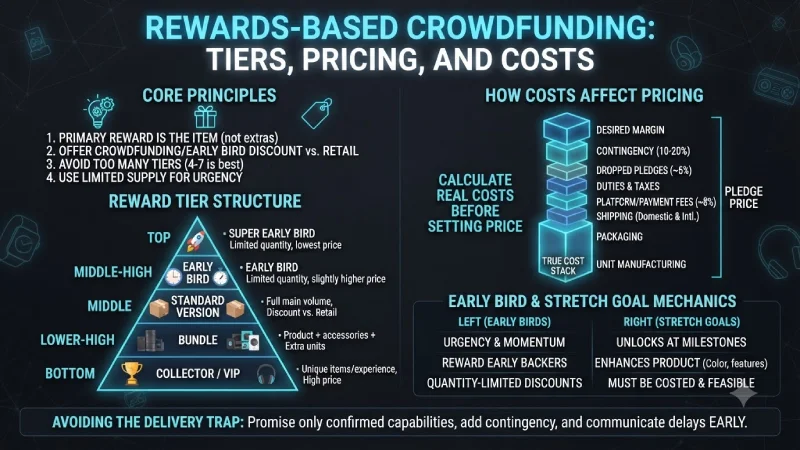
Core principles
- First and foremost, the key reward should be the item itself (or access to it). Backers usually come to back the item, not the t-shirts.
- Price the basic reward such that it looks like an early bird or crowdfunding discount in comparison with the expected retail price.
- Provide a few carefully selected tiers instead of a lengthy and unclear list.
- Supply at least one entry-level tier and one or two high-tier ones.
- Limit the supply in the best early-tier rewards in order to generate some urgency.
Common effective tier structure
- Early-bird or Super Early-Bird version of the main product (limited quantity, best price).
- Standard version of the main product.
- Bundles (product + accessories, extra units, or related items).
- Higher-priced “collector” or “VIP” tiers with extras that are still deliverable.
- Optional add-ons that backers can include at checkout (if the platform supports them).
What tends to under-perform
- Too many tiny variations that confuse people.
- Rewards that cost almost as much to produce and ship as the pledge amount.
- Vague “experience” rewards that are hard to scale.
- Overly complex packages that increase fulfillment errors.
Test reward ideas with your pre-launch audience when possible. Ask which tier they would choose and why. Real feedback is more useful than internal brainstorming.
How Do Production and Shipping Costs Affect Pricing?
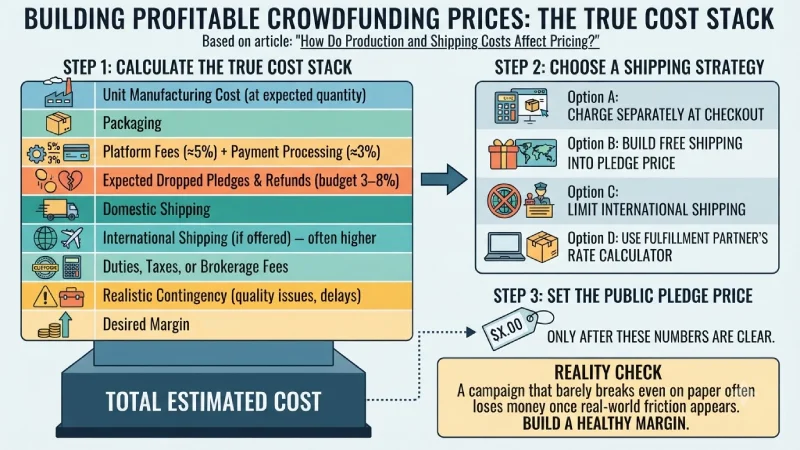
Pricing that ignores real costs is one of the fastest ways to turn a funded campaign into a loss.
Build every price from the true cost stack
For each reward tier, calculate:
- Unit manufacturing cost at the expected quantity
- Packaging
- Platform fee (≈5%) + payment processing (≈3%)
- Expected dropped pledges and refunds (budget 3–8%)
- Domestic shipping
- International shipping (if offered) — this is often higher than creators expect
- Duties, taxes, or brokerage fees that may apply
- A realistic contingency for quality issues, rework, or delays
- Your desired margin
Only after these numbers are clear should you set the public pledge price. Many first-time creators under-estimate shipping and international costs and then face painful choices later.
Shipping strategy options
- Charge shipping separately at checkout (clearer for backers, more accurate for you).
- Offer free shipping on higher tiers or in certain regions (build the cost into the pledge price).
- Limit international shipping to countries where costs and customs are manageable.
- Use a fulfillment partner’s rate calculator early so the numbers are real.
Margin reality check
After all costs, you want enough left to cover unexpected problems and still have a viable business. A campaign that just barely breaks even on paper often loses money once real-world friction appears.
How Do Early-Bird Offers and Stretch Goals Work?
Early-bird offers
These are limited-quantity, lower-priced versions of the main reward that are available at the start of the campaign. They serve two purposes:
- Reward the people who backed you earliest.
- Create urgency and help the campaign reach a strong percentage of the goal in the first 48 hours.
Best practices that still work:
- Make the discount meaningful but sustainable.
- Limit the quantity so the offer feels special without blocking later backers who are willing to pay the standard price.
- Clearly show what the retail or standard campaign price will be so the savings are obvious.
Stretch goals
These are extra benefits, colors, or extras that become unlocked once the project reaches specific milestones beyond the initial goal. It makes the project more exciting and raises more money, but adds to the complications and expense of the project.
Guidelines:
- Do not introduce stretch goals that you have not costed and proven feasible.
- Look for stretch goals that enhance the main product rather than adding too many SKU numbers.
- Convey them incrementally so that they build on the momentum of the existing offer but do not overwhelm it.
- Avoid stretch goals that disrupt the manufacturing schedule or involve new tooling you have not factored into the budget.
Carefully used, early birds and stretch goals will contribute to momentum; carelessly used, they will be detrimental.
How Do You Avoid Promising More Than You Can Deliver?
Most horror stories after a campaign stem from over-promising. This practice is not complicated, but it takes discipline: promise nothing you haven’t yet confirmed with regard to cost, timeline, and capability.
Prevention tactics
- Get your manufacturing quote and lead times locked down prior to the start of your campaign.
- Add in contingency to your budget and delivery schedule.
- Disclose the potential pitfalls and your plan for overcoming them in the Risks and Challenges section.
- Eliminate “we’ll figure it out later” language on features not yet tested and proved out.
- Promise early shipment dates and deliver ahead of them.
- Ensure your rewards don’t have too much complexity for your team (or fulfillment partner) to deliver on.
Communication standard
If something does slip after the campaign, tell backers early, explain what happened, and give a revised plan. Silence damages trust far more than an honest delay.
Scope control during the campaign
It is tempting to keep adding features or new tiers while the campaign is live. Resist unless the addition is fully costed and does not endanger the original promises. Every new commitment increases the chance of disappointing the people who already backed you.
Example reward tier logic
| Tier | Purpose | Pricing Approach | Quantity Limit |
| Super Early Bird | Drive Day-1 momentum | Lowest sustainable price | Yes (small) |
| Early Bird | Continue early momentum | Slightly higher than Super | Yes |
| Standard Product | Main volume | Full early-backer discount vs retail | No |
| Bundle / Deluxe | Higher average order value | Product + extras with clear value | Optional |
| Add-ons | Increase order value flexibly | Cost + margin | No |
Cost stack checklist for each tier
| Cost Element | Include? | Notes |
| Unit production | Yes | At realistic volume |
| Packaging | Yes | Protective + branded if promised |
| Platform + processing fees | Yes | ~8% total typical |
| Dropped pledges / refunds | Yes | 3–8% buffer |
| Domestic shipping | Yes | Real carrier rates |
| International shipping | If offered | Often higher than expected |
| Duties / taxes | If applicable | Research target countries |
| Contingency | Yes | 10–20% common for first runs |
| Desired margin | Yes | Do not set to zero |
Frequently Asked Questions
How many reward levels should there be?
The majority of successful product campaigns have between 4-7 tiers that make sense.
Should shipping be built into the pledge price or be a separate charge?
Building it into the pledge price may be easier for the backer but not as accurate. Having it as a separate charge is typically better.
How large of an early-bird discount is appropriate?
Large enough for the backer to care (20-40% off of projected retail), but small enough to cover all expenses and generate profit. Test pricing on your pre-launch crowd if you can.
What makes for a good stretch goal?
Anything that enhances the offering for all backers, or adds a highly desirable feature without requiring any additional development effort.
Can I change rewards after the campaign launches?
Minor clarifications are usually fine. Major changes to what is being delivered can damage trust and should be avoided unless absolutely necessary and clearly communicated.
Troubleshooting Common Rewards Problems
Tiers are not converting
Look at the price-to-value relationship and the clarity of the description. Sometimes simply reducing the number of options or improving the photos and copy lifts conversion.
Shipping costs are eating the margin
Recalculate with real quotes. Consider limiting international destinations, raising the shipping charge, or adjusting the product price. Do this before launch if possible.
Backers complain that early-bird quantities ran out too fast
This is often a sign the discount was attractive. You can release a second limited early tier or simply let the standard tier become the main offer. Avoid constantly adding more discounted units if it undermines the original scarcity.
You realized a promised feature is harder than expected
Communicate early on. Provide an alternative approach that will be realistic or a refund offer to the backers that are not interested in proceeding further. This will create more trust than hiding behind silence or overly optimistic messages.
Conclution
Rewards-based campaigns have been successful because they are offering attractive rewards, the pricing allows for covering expenses with profit, the practice of early-bird and stretch goals is applied wisely, and all promises can be delivered. Utilize the tools described in the sections above to structure your tier strategy in order to attract backers and at the same time secure the business. After this you should proceed to the marketing guide and fulfillment guide sections in order to activate the audience and deliver the promised rewards.